$8.8 Billion in One Quarter, Zero Dishwashers Loaded: The Robotics Reality Gap
Robotics startups raised $8.8 billion in Q2 2025 alone. Unitree shipped 5,500 humanoids. But the best manipulation systems still fail 30% of the time in unfamiliar kitchens. Here's why the physical world refuses to cooperate.
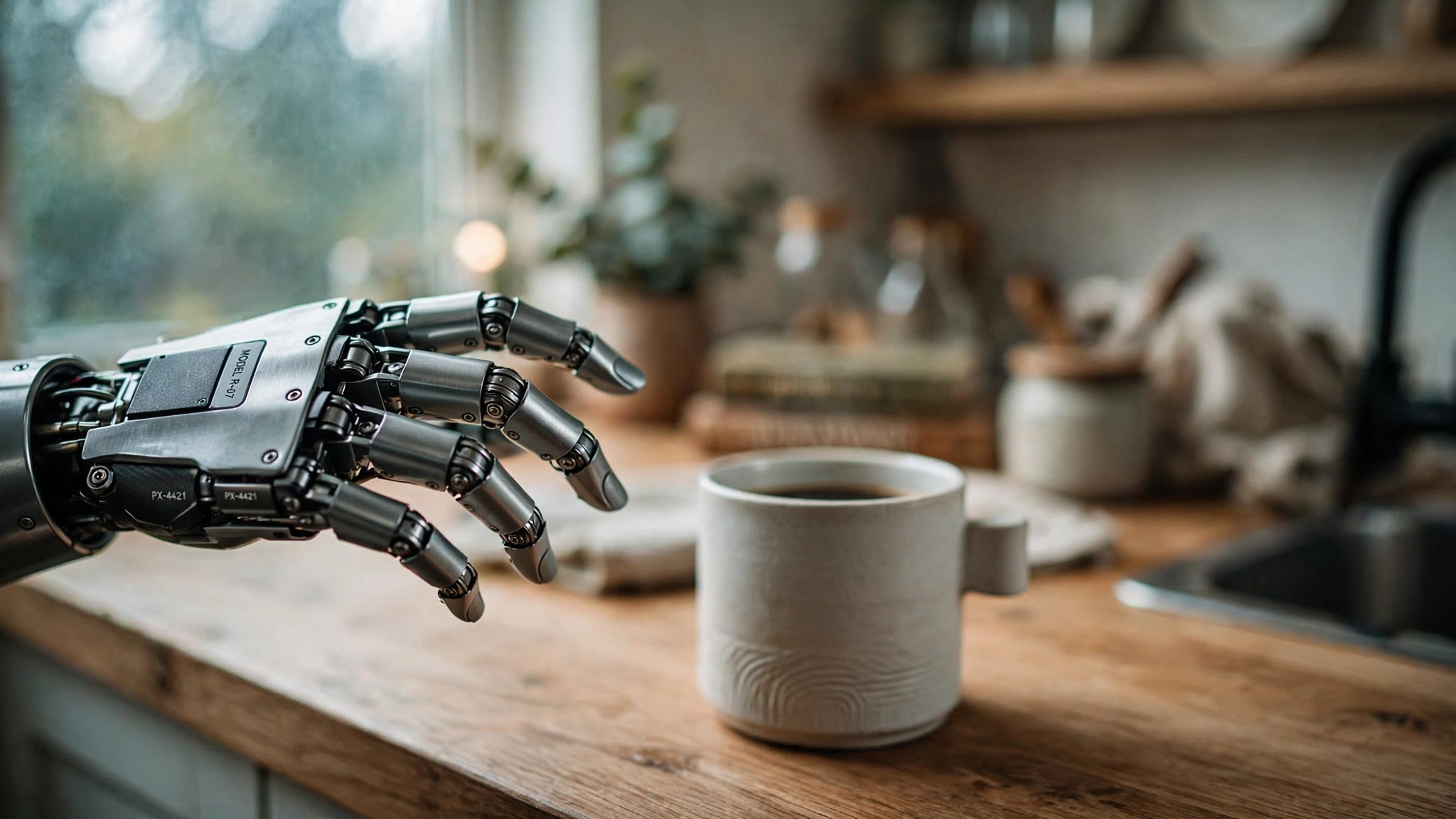
$8.8 billion. That's how much venture capital flowed into robotics startups in a single quarter — Q2 2025 — according to Counterpoint Research data cited by Inc., a figure fifteen times the level recorded in 2017. Figure AI alone raised over $1 billion at a $39 billion valuation, while Unitree shipped more than 5,500 humanoid robots in 2025 and is targeting 20,000 this year. Barclays values the global humanoid market at $2–3 billion today and sketches a base case near $40 billion by 2035.
And yet the best research system for humanoid manipulation in unfamiliar environments achieves a 70% success rate, not in kitchens and not loading dishwashers, but in controlled lab tasks like kneeling, squatting, and tossing objects, according to a February 2026 paper from Tsinghua University representing the current state of the art. The dishwasher remains unloaded.
The Funding-Deployment Mismatch
Counterpoint Research counted roughly 16,000 humanoid robot installations worldwide in 2025, with more than 80% coming from Chinese firms led by Unitree and UBTech, a total that represents a rounding error compared to the capital deployed to produce them.
Consider Figure AI's most publicized success: its Figure 02 robots completed an 11-month deployment at BMW's Spartanburg plant, loading sheet metal parts into car body assemblies with greater than 99% placement accuracy across 1,250 operational hours. But sheet metal loading is one of manufacturing's most structured tasks, with parts arriving in consistent orientations and target positions fixed within millimeters. This is a far cry from the "general-purpose humanoid" vision that justified a $39 billion valuation. The tasks being automated remain narrow: pick, place, repeat.
Why Manipulation Is Harder Than Language
Hans Moravec identified the paradox in 1988: it is easy to give computers the skills of a chess grandmaster but difficult or impossible to give them the motor skills of a one-year-old when it comes to perception and mobility. Nearly four decades later, language models can pass bar exams and medical licensing tests while no robot on Earth can reliably load a residential dishwasher, a disconnect that three specific bottlenecks explain.
Contact physics are computationally savage. When a robot grasps a wet ceramic mug, it must model friction coefficients that shift based on moisture, surface texture, and grip force, all variables that interact nonlinearly in ways that even the best physics simulators cannot fully capture. A Wuhan University framework called RGMP achieves 87% manipulation success using geometric reasoning, but only when object categories were represented in training data.
Environments are adversarial. A kitchen counter is never the same twice — a crumb shifts a plate's center of gravity, a spill changes floor friction, and shifting daylight confuses depth sensors. A Carnegie Mellon and Bosch team achieved 90.9% higher success rates on contact-rich tasks by incorporating tactile sensing, but tested only in a lab. As Oxford professor Ingmar Posner told New Scientist: "Humans are adversarial. They like messing with a robot, if nothing else, just because it's fun."
Training data doesn't exist at scale. Language models train on trillions of tokens scraped from civilization's written output, but no equivalent corpus exists for physical manipulation. Alibaba's Qwen-RobotManip, trained on 38,000+ hours of open-source data (the largest disclosed dataset of its kind), scored just 45% on the RoboChallenge real-world benchmark. Physical Intelligence's π0.7 model, which can cook sweet potatoes in an unfamiliar air fryer following verbal instructions, represents the state of the art, and even its creators express surprise at their progress.
Original Contribution: The Cost Per Successful Manipulation
Combining public data on robot costs and success rates reveals an uncomfortable metric: cost per successful manipulation.
Figure 02 at BMW: The robot loaded 90,000 parts across 1,250 operational hours, and at an estimated robot lease cost of $15–25/hour, derived from Goldman Sachs projections that manufacturing costs dropped 40% between 2023 and 2024, combined with Bank of America's forecast of unit costs falling below $17,000 by 2030 — that works out to roughly $0.21–$0.35 per successful manipulation, a rate that is competitive with human labor at BMW's wage scales but only for this single highly repetitive task in a purpose-built environment.
Research-grade humanoid in unstructured tasks: A $150,000 humanoid operating at a 70% success rate costs roughly $1.50 per successful manipulation. A human worker at $20/hour with 99% reliability costs $0.17. That gap is roughly 9x, and it defines exactly how far the technology must travel.
In structured factory settings robots approach parity, but the commercially interesting territory is the messy middle: warehouses, hospitals, and restaurants where the 9x cost gap means every percentage point of reliability improvement translates directly into deployment viability.
The World Model Problem
The term "world model" has become what "blockchain" was in 2018: invoked in every pitch deck, defined by nobody. A useful world model would let a robot predict the physical consequences of its actions before executing them, and serious efforts are underway at Google DeepMind (Gemini Robotics), Nvidia (Cosmos, Isaac, GR00T), Meta (JEPA), and Physical Intelligence, whose generalist policy trained across many robot form factors has produced the most impressive demonstrations to date.
None of them work reliably outside the lab, because a sentence contains a finite number of tokens drawn from roughly 100,000 vocabulary entries, while a kitchen contains effectively infinite physical states from the combinatorial explosion of every object, surface, and spatial relationship.
Limitations
The cost-per-manipulation metric above relies on estimated lease rates, operational hours, and maintenance costs that manufacturers rarely disclose publicly, and the Figure 02 deployment data comes from BMW and Figure AI's own reporting, which naturally emphasizes success over failures.
Strongest Counterargument
The trajectory matters more than the current state. Language AI went from GPT-2 generating plausible paragraphs to GPT-5.5 passing licensing exams in six years, and if robotics follows even a loosely similar curve, today's 70% lab success rate could become 95% in factories by 2028 and 90% in homes by 2032. Manufacturing costs have dropped 40% in two years, Bank of America projects unit costs below $17,000 by 2030, and Physical Intelligence co-founder Sergey Levine told New Scientist something the skeptics should take seriously: "It's actually gone quite a bit quicker than we thought."
The Bottom Line
Three things to watch:
1. Track deployments, not funding rounds. The industry has raised over $15 billion in two years but installed only 16,000 humanoids worldwide. Until deployments grow faster than funding, this remains speculation with expensive hardware.
2. Manipulation success rates in unstructured environments are the metric that matters. Forget locomotion demos and choreographed dances on conference stages. The gap between 87% success in structured labs and 45% on real-world benchmarks like RoboChallenge is what defines the commercial timeline, and when those real-world numbers consistently cross 90%, mass deployment outside factories becomes economically viable for the first time.
3. The dishwasher test is the right test. Loading a residential dishwasher requires grasping objects of varying size, weight, material, and fragility, arranging them in a tightly constrained three-dimensional space, handling slippery wet surfaces, and adapting to a completely different dishwasher model in every home, and any robot that can do all of this reliably has implicitly solved most household manipulation tasks along the way. We aren't close, but the $8.8 billion says we're betting heavily that we will be.
Related
⚖️ Prior Art: Sim-to-Real Household Manipulation Transfer · 🚀 Startup Idea: Vertical Manipulation-as-a-Service