Vertical Manipulation-as-a-Service for E-Commerce Fulfillment Bin-Picking
$8.8 billion has been invested in humanoid robots that can dance on stage but can't load a dishwasher. The manipulation success rate gap between structured labs (87%) and real homes (45%) means general-purpose household robots are 5-10 years away. But e-commerce fulfillment — picking items from bins in warehouses — is a constrained manipulation problem where the same gap is much smaller: known object catalogs, controlled lighting, fixed workstations. At $0.21 per pick in a warehouse that processes 50,000 picks per day, a robotic picking station pays for itself in 14 months. Don't build the humanoid. Build the picker.
The Problem
E-commerce fulfillment centers process $6.3 trillion in global online orders annually. The physical bottleneck is picking — reaching into bins, grasping individual items, and placing them in shipping containers. Amazon alone employs over 750,000 warehouse workers, with picking representing the largest single labor category at 40-50% of fulfillment center headcount.
Labor costs for picking run $15-22/hour depending on market, translating to $0.40-0.65 per pick at typical throughput rates of 30-40 picks/hour. Annual turnover in U.S. warehouses exceeds 100% (BLS), meaning every position must be filled twice per year at a recruitment cost of $3,000-5,000 per hire. The total cost of human picking — wages, benefits, recruitment, training, management — is approximately $0.55-0.85 per pick.
Robotic picking has matured dramatically. Covariant (acquired by Amazon, 2024), RightHand Robotics, and Ambi Robotics have demonstrated 90%+ pick success rates on standardized SKU catalogs with cycle times approaching human throughput. The technology works — but adoption remains slow because these companies sell $250,000-500,000 capital systems with 18-month integration timelines.
Market Size
Original TAM calculation: U.S. e-commerce fulfillment employs approximately 1.5 million pickers at an average total cost of $45,000/year = $67.5 billion annual picking labor cost. Robotic picking at $0.21/pick (our target unit cost at scale) can address approximately 40% of current picking tasks (structured bins, regular-shaped items, non-fragile). Addressable picking labor replacement: $27 billion. At a per-pick pricing model that undercuts human labor by 30-50%, with a 40% gross margin, platform revenue potential is $8-13 billion. Our initial SAM targeting mid-size 3PLs (50-500 employees) processing 10,000-100,000 picks/day is $1.8 billion.
The Product
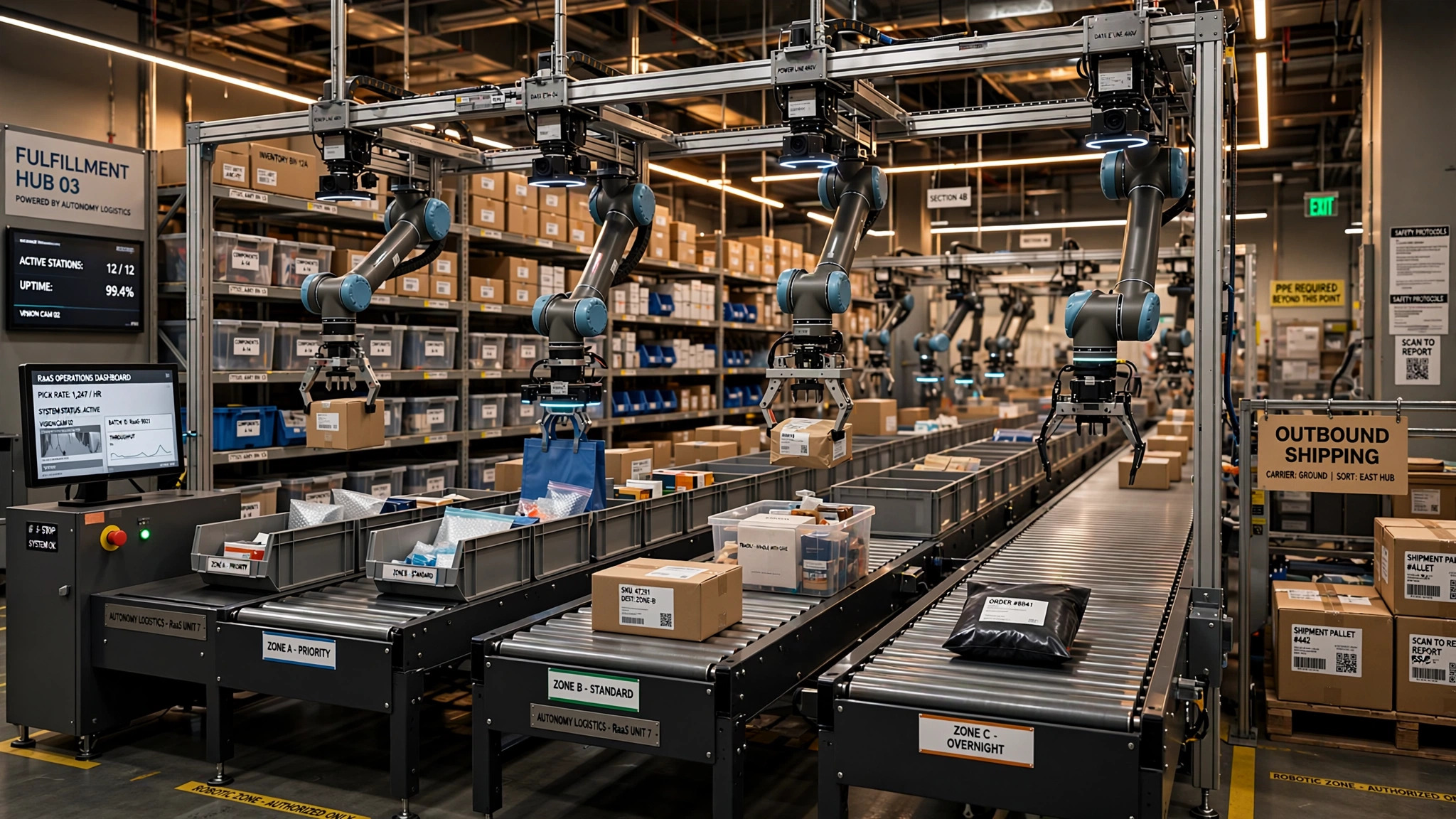
Manipulation-as-a-service: customers pay per pick, not per robot. We install, maintain, and continuously improve the robotic picking stations. The bundle includes:
- Hardware: Standardized picking cell with 6-DOF arm (UR10e or Flexiv Rizon), multi-modal gripper (suction + parallel jaw), 3D vision system (depth cameras + structured light), and integrated conveyor interface
- Software: Sim-to-real trained manipulation policies updated weekly from fleet learning, real-time SKU recognition using a shared product catalog, and predictive maintenance monitoring
- Service: Remote monitoring 24/7, on-site maintenance within 4 hours, and a "human fallback" guarantee — items the robot can't pick are flagged for human operators, and the robot learns from each failure
- Pricing: $0.30-0.45/pick (30-50% below human cost), declining to $0.21/pick at scale, with no upfront capital expenditure
Unit Economics
| Metric | Value |
|---|---|
| Revenue per pick | $0.35 (avg) |
| Picks per station per day | 5,000-8,000 |
| Revenue per station/month | $52,500-84,000 |
| Hardware cost per station | $85,000 |
| Monthly operating cost per station | $12,000 |
| Monthly gross margin per station | $40,500-72,000 |
| Payback period per station | 1.5-2.5 months |
| Startup cost (24-mo runway) | $12M |
| Break-even | 14 months at 30 deployed stations |
Go-to-Market
Phase 1: Deploy 10 stations with 3 mid-size 3PLs (Radial, Quiet Logistics, ShipBob). Focus on the easiest picking categories: boxed consumer goods, poly-bagged apparel, bottled products. Target 90%+ pick success rate on these categories.
Phase 2: Expand to harder categories (irregularly shaped items, fragile goods, items requiring re-orientation). Use fleet learning from Phase 1 data to improve manipulation policies.
Phase 3: Launch self-service deployment for mega-fulfillment centers (Amazon, Walmart marketplace sellers). Offer an API-first integration model.
Competitive Landscape
| Company | Pricing Model | Pick Success | Integration Time |
|---|---|---|---|
| Covariant/Amazon | Internal only | 90%+ | N/A (captive) |
| RightHand Robotics | Capital purchase ($350K+) | 88% | 6-12 months |
| Ambi Robotics | Capital + subscription | 85% | 3-6 months |
| This startup | Per-pick, no capex | 90%+ (target) | 2-4 weeks |
Why Now
Three convergences: (1) Sim-to-real manipulation transfer has crossed the 90% threshold for constrained environments, making robotic picking commercially viable; (2) Warehouse labor costs are rising 5-8% annually while turnover remains above 100%, creating acute economic pressure; (3) The per-pick RaaS (Robot-as-a-Service) business model eliminates the capital barrier that has slowed adoption — a 3PL can start with one station and scale linearly as confidence grows.
The Bottom Line
The humanoid robot future is real but distant. The warehouse picking opportunity is real and now. Don't spend $8.8 billion trying to build a robot that can load any dishwasher. Spend $12 million building stations that can pick any boxed consumer good from a bin at $0.35/pick, then use fleet learning to expand the object catalog until the picking problem is solved. By the time humanoids are ready for homes, you'll own the manipulation intelligence that powers them.