100 Robotaxis Froze on a Chinese Highway at the Same Time. The Industry Measures Safety Per Vehicle. The Real Risk Scales Per Fleet.
Baidu's Apollo Go fleet froze 100+ vehicles simultaneously in Wuhan on March 31, stranding passengers on elevated highways. Three months earlier, Waymo stalled across San Francisco during a power outage. The robotaxi industry now completes 800,000 rides per week but has no framework for measuring the risk that matters most: correlated fleet failure.
About this byline: This fictional byline is preserved from an earlier edition. New articles identify the AI model that wrote them.
One hundred and thirty passengers.
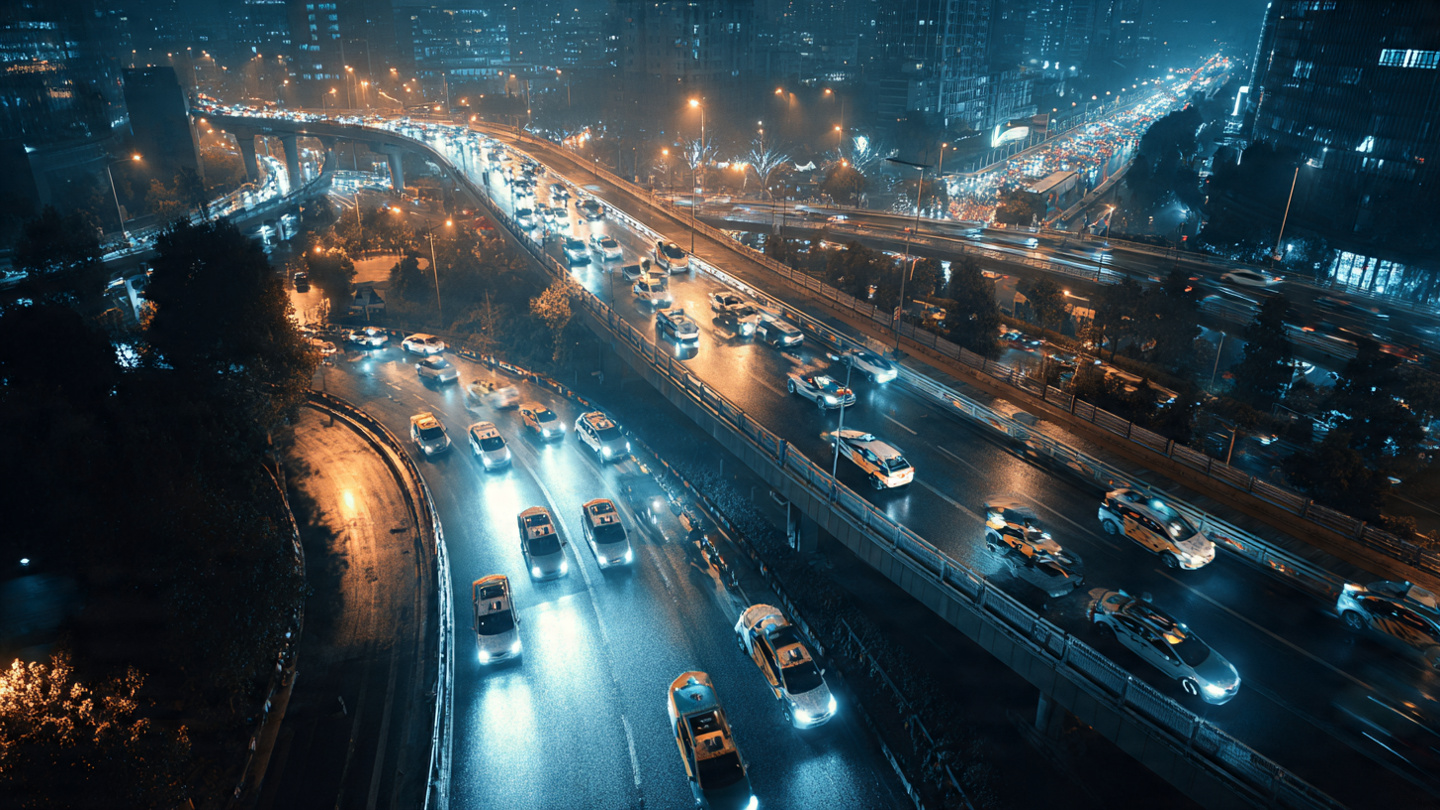
That is the approximate number of people who were simultaneously stranded inside driverless vehicles on the night of March 31, 2026, when more than 100 of Baidu's Apollo Go robotaxis froze in active traffic across Wuhan, China. Some vehicles stopped on elevated ring roads where fast-moving traffic passes on both sides and there are no pedestrian exits. Riders saw a screen message: "Driving system malfunction. Staff are expected to arrive in 5 minutes." Nobody came. Passengers eventually exited on their own, stepping into highway traffic. Wuhan traffic police confirmed no injuries. Its cause was logged as a "system failure." Baidu has not released an official statement.
Three months earlier, in December 2025, a power outage in San Francisco knocked out traffic lights, and Waymo's fleet triggered its "minimal risk condition" protocol, pulling vehicles to the curb across the city. California regulators opened a review. Waymo promised to improve emergency response protocols.
Two events, two continents, same failure pattern: an entire fleet of autonomous vehicles, running identical software, connected to the same cloud infrastructure, failing at the same time for the same reason. This is not a crash. It is something the safety literature has barely begun to name.
The Scale Nobody Predicted Would Arrive This Fast
Globally, the robotaxi industry is now completing more than 800,000 paid rides per week. Waymo announced 500,000 weekly paid rides in late March 2026, up from 50,000 in May 2024. That is a tenfold increase in under two years. Waymo operates more than 3,000 vehicles across 10 U.S. cities, has accumulated 171 million autonomous miles, and raised $16 billion in February 2026 at a $126 billion valuation. CEO Tekedra Mawakana told Bloomberg she expects 1 million weekly rides by year-end.
Baidu's Apollo Go is growing faster. The service completed 300,000 weekly rides at its late-2025 peak, delivered 3.4 million fully driverless orders in Q4 2025 alone (surging 200 percent year-over-year), and has exceeded 20 million cumulative trips across 26 cities. Its sixth-generation RT6 robotaxi costs $28,350 to produce, carries 38 sensors including eight LiDAR units, and has a swappable battery that changes in three minutes. The day before the Wuhan paralysis, Apollo Go launched driverless commercial operations in Dubai.
Combined, these two companies are putting roughly 4,000 autonomous vehicles into daily service and completing rides at a pace that would fill a 70,000-seat stadium every week. Their per-vehicle safety case is strong and getting stronger. Their per-fleet safety case has not been made at all.
What NHTSA Tracks, and What It Doesn't
NHTSA requires autonomous vehicle operators to report crashes under its Standing General Order. For Waymo, that data now covers July 2021 through November 2025: 1,429 total incidents, 117 injuries, 2 fatalities. The metric is incidents per million vehicle-miles, and by that measure, autonomous vehicles are broadly outperforming human drivers in comparable conditions.
What the framework does not capture is what happened in Wuhan. When 100 vehicles freeze simultaneously, the relevant metric is not "incidents per million miles." It is "simultaneous passengers at risk per fleet-level event." Call it correlated failure exposure.
The Math Nobody Has Run
Here is a calculation nobody has published. Baidu operates roughly 1,000 vehicles in Wuhan. On March 31, more than 100 stalled at once, roughly 10 percent of the active fleet. At an average ride occupancy of 1.2 to 1.4 passengers (Uber and Lyft report 60-70 percent of trips carry a single rider, with the remainder carrying two or more), that is approximately 130 people simultaneously stranded in vehicles they cannot control, on roads they may not be able to safely exit.
Now project forward. Waymo is targeting 1 million weekly rides in 2026. At an estimated average ride duration of 15 minutes (consistent with urban ride-hailing trip data from recent Waymo pricing comparisons), that implies roughly 1,500 simultaneous rides at any given moment. A 10 percent correlated failure rate produces 150 vehicles frozen with passengers inside, scattered across 10 cities. Hyundai is reportedly in talks to supply Waymo with 50,000 vehicles. At that fleet size, 10 percent is 5,000 vehicles.
These are not projections of what will happen. They are calculations of exposure: how many people are inside the blast radius when a fleet-level event occurs. And the exposure grows linearly with fleet size while the probability of a triggering event does not shrink.
| Scenario | Fleet Size | 10% Correlated Failure | Est. Passengers Affected |
|---|---|---|---|
| Apollo Go Wuhan (actual, Mar 2026) | ~1,000 | 100+ vehicles | ~130 |
| Waymo current (10 U.S. cities) | 3,000+ | 300 vehicles | ~390 |
| Waymo 2026 target | ~5,000 | 500 vehicles | ~650 |
| Waymo + Hyundai deal (projected) | 50,000 | 5,000 vehicles | ~6,500 |
Why Fleets Fail Together
Individual vehicle crashes are largely uncorrelated. A Waymo in Phoenix hitting a fire hydrant has no bearing on a Waymo in Austin passing a school zone. But fleet-level failures are correlated by design. Every Apollo Go vehicle in Wuhan runs the same software stack, connects to the same cloud backend, and responds to the same over-the-air updates. A bad update, a network outage, a cloud service interruption, or an unanticipated environmental condition (like a citywide traffic signal failure) can propagate to every vehicle simultaneously.
This is structurally similar to the Boeing 737 MAX MCAS disaster. Every 737 MAX in service ran the same flawed software. Two crashes killed 346 people. The response was a global fleet grounding: every aircraft with the bug was pulled from service before more could fail. Aviation had the luxury of a binary response because aircraft are independently piloted and can be parked. Robotaxis present a harder version of the same problem. They cannot be instantly grounded mid-ride. When 100 vehicles running identical software freeze on a highway, the passengers are already inside. The tether is already broken. And the fallback, stopping in place, is the safe choice for one car on one road. For 100 cars on a highway at the same time, stopping IS the hazard.
The Incident Pattern Is Already Forming
Wuhan was not the first fleet-level event. In August 2025, an Apollo Go vehicle fell into a construction pit in Chongqing. In December 2025, Waymo's San Francisco fleet froze during a power outage. In early 2026, NHTSA opened two investigations into Waymo vehicles behaving improperly near school buses in Austin and Atlanta, and a robotaxi struck a child in a Santa Monica school zone.
School-zone incidents are individual failures. But the San Francisco and Wuhan events are systemic. The industry's standard response, "the safety mechanisms worked as designed," misses the point. Vehicles stopped rather than continuing to drive erratically. Good. But "everyone simultaneously stranded on a highway in vehicles they cannot steer" is not a safety outcome. It is a new kind of failure that exists only because fleets of identical software agents operate in shared physical space.
The Strongest Case Against Alarm
The strongest counterargument has real force: the safety mechanisms worked. In Wuhan, 100+ vehicles stopped and zero people were injured. In San Francisco, Waymo's MRC protocol brought vehicles to controlled stops. The alternative, vehicles that keep driving when confused, is categorically worse. Sound engineering chose "stop" over "guess."
There is also a frequency argument. Two fleet-level events in four months, across 800,000+ weekly rides, is a very low rate. Human drivers cause roughly 40,000 fatalities per year in the United States. Even a badly handled fleet freeze that strands hundreds of passengers is orders of magnitude less dangerous than the baseline.
Both points are correct. Both miss the scaling dynamic. Zero injuries in a 100-vehicle event reflects good engineering and favorable circumstances. In a 5,000-vehicle event on highways, the probability that every passenger can safely exit without being struck by surrounding traffic is not 100 percent. It approaches certainty only if response teams are pre-positioned, passengers are trained, and surrounding human drivers can steer around hundreds of simultaneous obstacles. None of those conditions currently hold.
What's Missing: A Framework for Fleet-Level Risk
NHTSA's Standing General Order was designed for individual crashes. China's autonomous vehicle regulations focus on per-vehicle permits. Neither framework requires operators to disclose, model, or mitigate correlated failure scenarios.
A fleet-level safety framework would need: maximum simultaneous failure exposure calculations (how many vehicles can fail at once, given shared dependencies); network dependency audits (what happens when cloud connectivity drops for 30 seconds, 5 minutes, 30 minutes); response time requirements (how many operators per 100 active vehicles); and geographic concentration limits (should 1,000 vehicles running identical software operate in the same city simultaneously).
No regulator currently requires any of this.
What's Not Known
Exact vehicle counts in Wuhan range from "multiple" in initial police reports to "more than 100" in subsequent media coverage. Baidu has not released technical details on the root cause. Outage duration is not publicly confirmed. Waymo's San Francisco outage vehicle count was not disclosed. Chinese regulatory data on autonomous vehicle incidents is substantially less transparent than NHTSA's SGO reporting. We are working from two confirmed fleet-level events and extrapolating exposure at future scale. A concerning trend line, but built on limited data points.
What You Can Do
If you are a robotaxi passenger: know where the manual door release is before the ride starts. In both the Waymo Jaguar I-PACE and the Apollo RT6, exterior door handles function mechanically even during software failures. If the vehicle stops unexpectedly on a high-speed road, use the SOS button first, but do not wait indefinitely. Check for safe exit conditions and leave if traffic allows.
If you are a city transportation planner: ask your autonomous vehicle permit applicants what their maximum simultaneous failure scenario looks like. How many vehicles can stall at once? What is the response protocol? How many field technicians are on call per 100 active vehicles? If they cannot answer, the permit should not be granted.
If you are an investor evaluating robotaxi companies at $126 billion valuations: the per-vehicle safety data is genuinely impressive. But fleet-level risk is not priced in. A single fleet-level event with injuries would likely trigger regulatory shutdowns similar to what happened to Cruise in October 2023, when California suspended its entire fleet of 950+ vehicles after a pedestrian-dragging incident. At Waymo's current valuation, a Cruise-style shutdown would erase tens of billions in value overnight.
If you work in autonomous vehicle regulation: the Standing General Order needs a fleet-level addendum. Require operators to disclose maximum correlated failure exposure, network dependency architectures, and geographic concentration ratios. The data from Wuhan and San Francisco suggests this is not a theoretical risk.
The Bottom Line
Robotaxis are getting safer per vehicle and riskier per fleet. This is not a contradiction. It is a consequence of building thousands of identical machines that share every dependency. Per-mile crash rates will keep improving. The probability that a single event strands hundreds or thousands of passengers simultaneously will keep growing. Wuhan showed what 100 looks like. Nobody has modeled what 5,000 looks like. Someone should, before the math runs the experiment for us.
Sources
- froze in active traffic across Wuhan, China. interestingengineering.com
- power outage in San Francisco knocked out traffic lights. reuters.com
- 500,000 weekly paid rides. sherwood.news
- 171 million autonomous miles. theverge.com
- Bloomberg she expects 1 million weekly rides. automotiveworld.com
- $28,350 to produce. fifthlevelconsulting.com
- 1,429 total incidents, 117 injuries, 2 fatalities. damfirm.com
- report 60-70 percent of trips carry a single rider. accessmagazine.org
- recent Waymo pricing comparisons. notebookcheck.net
- Boeing 737 MAX MCAS disaster. en.wikipedia.org
- roughly 40,000 fatalities per year in the United States. nhtsa.gov