Quantinuum Raised $1.68 Billion at a 410× Revenue Multiple. Two Days Later, It Fell Below Its IPO Price.
Quantinuum sold 28 million shares at $60 each, then watched its stock crater to $56.26 by Friday. Its closest architecture rival generates 12× more quarterly revenue, and a single Japanese research institute accounts for 60% of its sales.
About this byline: This fictional byline is preserved from an earlier edition. New articles identify the AI model that wrote them.
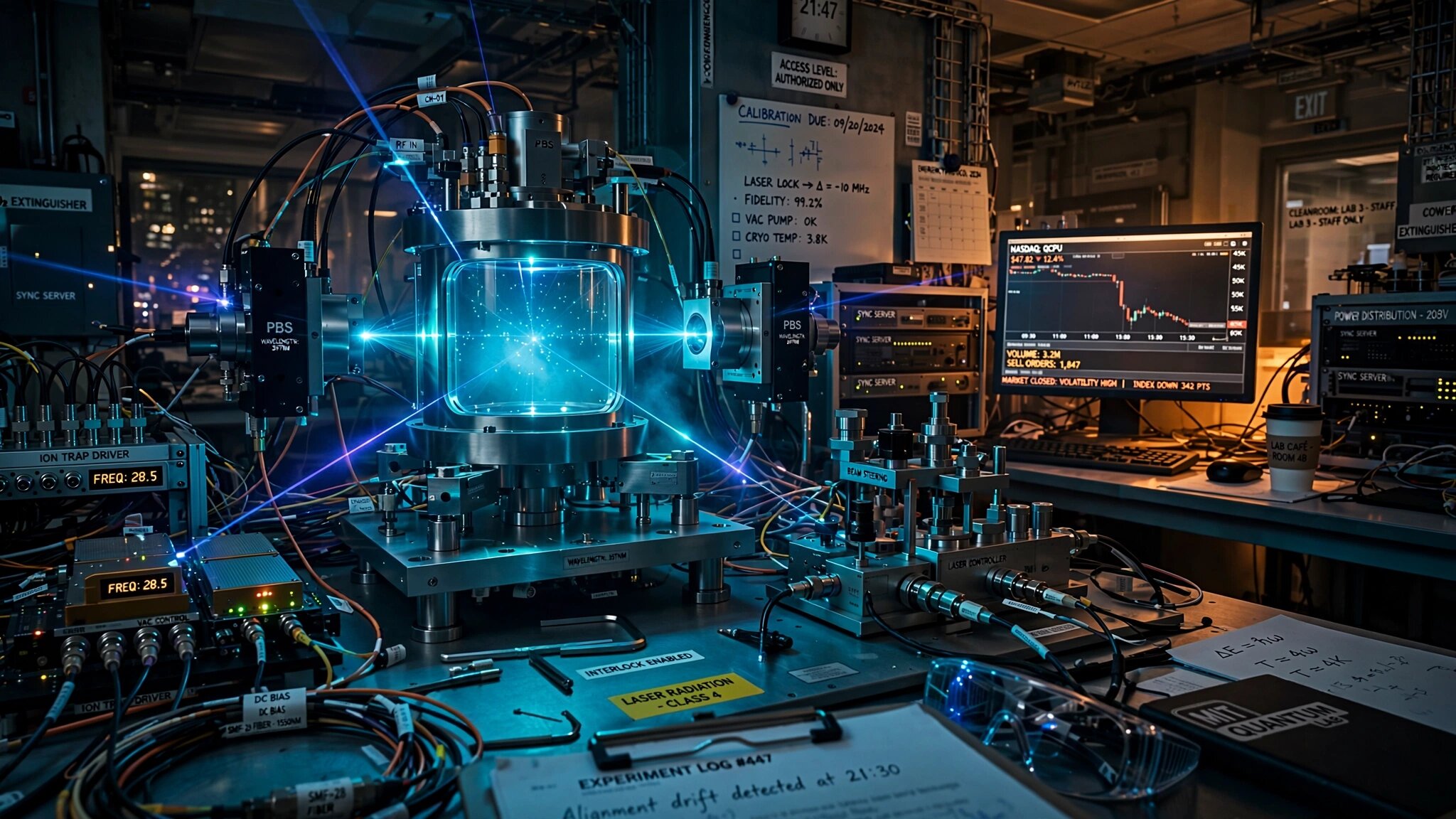
Sixty percent. That is the share of Quantinuum’s 2025 revenue attributable to a single customer: RIKEN, Japan’s largest government-affiliated research institute. Strip RIKEN out and the company that just raised $1.68 billion in the largest quantum computing IPO in history generated roughly $12.4 million from every other customer on Earth combined.
Quantinuum’s first two days as a public company told the story its prospectus couldn’t. Shares priced at $60 on Wednesday, June 3. They opened at $68 Thursday morning on the Nasdaq under ticker QNT, peaked at $71.35 intraday, then bled out to close at $60.38, surrendering nearly all of the day’s gains in a six-hour selloff that accelerated through the afternoon, erasing every cent of upside in a single session. By Friday’s close, QNT sat at $56.26: down 6.2% from the offering price.
What $30.9 Million in Revenue Gets You
Quantinuum reported $30.9 million in full-year 2025 revenue, up from $23 million the year before. At its IPO-close market capitalization of $15.7 billion, that works out to a price-to-sales ratio of approximately 410. Nvidia at the apex of the AI boom never crossed 40× revenue, and nothing else in tech history has come close to what Quantinuum is asking the market to accept.
But the annual number flatters a deteriorating trajectory. Q1 2026 revenue came in at $5.2 million according to the S-1 filing, down 73% from $19.1 million in Q1 2025, which means the company that just raised $1.68 billion in public capital is generating less revenue per quarter than a regional accounting firm. Revenue cratering and losses quadrupling in the same quarter paints a picture that no amount of long-term technology conviction can entirely paper over. Net losses for that quarter ballooned to $136.6 million, up from $30.5 million a year earlier, and R&D spending exceeded five times revenue in 2025, a ratio that is widening, not narrowing.
Reverse-Engineering a $15.7 Billion Valuation
Nobody else ran this math, so here it is. Working backward from Quantinuum’s market cap: at a 30× forward price-to-sales ratio, generous for an unprofitable hardware company that has never posted a profitable quarter and whose most recent quarterly revenue was $5.2 million, the stock needs $523 million in annual revenue to justify today’s price. At 20×, the target climbs to $785 million.
Start from the $30.9 million base. Compound at 50% annually for five years and you reach $234 million, still underwater at 30× but approaching plausibility, except that sustaining 50% compound annual growth for five consecutive years requires commercial traction that does not yet exist in Quantinuum’s financial statements. Push to 80%, maintained for five straight years without a single stumble, and you hit $582 million, just barely crossing the 30× threshold. Only at that rate does the current price begin to make mathematical sense, and Quantinuum has never come close to demonstrating it.
IonQ, which builds the same trapped-ion architecture, grew revenue 202% year-over-year in 2025 and guided for $260–$270 million in 2026. It generates 12.4 times more quarterly revenue than Quantinuum, a gap so large it demands explanation rather than a shrug. IonQ booked $64.7 million in Q1 2026; Quantinuum booked $5.2 million in the same quarter, on the same physics, using the same atoms, manipulated by the same lasers. IonQ trades at a $21.2 billion market cap, roughly 163× trailing revenue, which is rich by any traditional valuation framework, but it has demonstrated the commercial trajectory Quantinuum is asking investors to take on faith.
A Side-by-Side the Sector Needed
Every major public quantum computing company, compared as of Friday’s close:
| Company | Architecture | Market Cap | 2025 Revenue | Q1 2026 Rev. | P/S (TTM) | YoY Rev. Growth |
|---|---|---|---|---|---|---|
| IonQ | Trapped ion | $21.2B | $130M | $64.7M | ~163× | +202% |
| Quantinuum | Trapped ion | $14.6B* | $30.9M | $5.2M | ~410× | +34% (FY) |
| D-Wave | Quantum annealing | $8.8B | $24.6M | N/A | ~359× | N/A |
| Rigetti | Superconducting | $6.9B | $10M | N/A | ~686× | N/A |
*At Friday’s $56.26 close. IPO-day close implied $15.7B. Sources: S-1 filing, Finnhub, company investor relations, MarketBeat.
Something striking hides in this table. Quantinuum and IonQ use the same fundamental technology, the same trapped-ion approach where charged atoms are suspended in electromagnetic fields and manipulated by lasers, yet IonQ generates four times the annual revenue, twelve times the quarterly revenue, has a more diversified customer base, and trades at less than half the price-to-sales multiple. Same physics, same atoms, yet dramatically different commercial execution. If you believe trapped-ion is the right architecture for quantum computing’s future, the market is offering you two bets on the same thesis at dramatically different prices, and one of them costs 2.5× less per dollar of revenue.
One Customer, 60% of Revenue
A single customer accounting for 60% of annual revenue would trigger concentration warnings in any normal IPO analysis, which this is not.
If RIKEN’s estimated $18.5 million in 2025 payments were front-loaded into Q1, consistent with Japanese fiscal year timing and the $19.1 million Q1 2025 figure, then Q1 2026’s collapse to $5.2 million may signal that a large contract phase completed without a replacement lined up, or alternatively, that RIKEN shifted its quantum computing budget to a competitor offering more qubits at a lower price point, though without quarterly customer breakdowns in the S-1 we have no way to know which explanation is correct.
What we can calculate: absent RIKEN, Quantinuum’s 2025 revenue from all other customers worldwide was approximately $12.4 million. Apply the $15.7 billion IPO-close market cap to that figure. Price-to-sales on non-concentrated revenue: 1,266×. That number should make even aggressive growth investors flinch.
Federal Money Is Not a Business Model
Two weeks before the IPO priced, the Commerce Department announced a letter of intent to fund Quantinuum’s development of large-scale fault-tolerant trapped-ion systems, worth up to $100 million. Separately, the Trump administration has committed $2 billion in equity stakes across nine quantum computing companies as part of a national quantum strategy.
Government money backstops R&D runway, and for a pre-revenue technology with a decade-long commercialization timeline that backstop matters, because without federal support the entire American quantum computing industry would be competing for a pool of private capital that has historically been reluctant to fund hardware companies losing $136 million per quarter. But federal grants are non-recurring, they don’t compound, and they don’t prove product-market fit. When 60% of your commercial revenue comes from one government-adjacent research contract and your biggest incoming capital injection is a federal grant, the distinction between “strategic national investment” and “technology that can’t yet sustain itself commercially” becomes vanishingly thin.
Why Smart Money Might Still Be Right
Dismiss the short-term price action entirely, because IPO-day volatility is noise and two trading sessions prove nothing about a decade-long technology thesis, and anyone who sold Nvidia after a flat first week in 2014 is not bragging about it now.
What matters is whether Quantinuum’s architecture can capture a share of what McKinsey and BCG project as a $450 billion quantum computing total addressable market by 2035, and on the hardware side, Quantinuum has a legitimate claim to technological leadership that its competitors have not matched. Its Helios system claims the highest two-qubit gate fidelity of any commercial quantum computer at 99.921%, and its 2:1 physical-to-logical qubit ratio is the best documented result in the industry, directly determining how efficiently a quantum computer can perform error correction, the single hardest unsolved engineering challenge separating today’s noisy prototypes from commercially useful machines. Crack fault-tolerant quantum computing first, and $15.7 billion will look cheap.
Honeywell retains 48.1% voting control. That brings manufacturing precision, supply chain infrastructure, and institutional credibility that pure-play quantum startups cannot match, plus a parent with a $135 billion market cap and no incentive to let its quantum division fail. CEO Rajeeb Hazra chose a traditional IPO over a SPAC specifically to signal substance: “demonstrate that there’s no air gap between what we’re saying and what we’re doing,” he told MarketWatch.
That case is real, and it is also entirely prospective.
What This Analysis Cannot Prove
Revenue recognition timing could explain the Q1 collapse. If RIKEN payments are lumpy and concentrated in specific quarters, the $5.2 million figure might represent a trough rather than a trend, and Q2 and Q3 2026 earnings could show a sharp rebound that retroactively reframes Q1 as seasonal noise rather than structural deterioration, especially given that Q1 2025’s $19.1 million was itself anomalously high compared to the $3.9 million quarterly average for the rest of the year. We also lack visibility into commercial proof-of-concept agreements that Quantinuum has reportedly signed but has not disclosed values for. None of that changes the fact that the only revenue data available at the time of IPO pricing showed a 73% year-over-year decline.
The Bottom Line
Quantinuum’s IPO tested whether Wall Street would pay 410× revenue for the promise of quantum computing’s eventual commercial viability. In two trading sessions the market delivered its verdict: no.
Nothing here invalidates the long-term thesis for trapped-ion quantum computing, which remains one of the most physically compelling approaches to building a fault-tolerant quantum computer, with coherence time and gate fidelity advantages that superconducting systems have not matched. But investing is about price and evidence, not just technology. A $15.7 billion market cap on $5.2 million in quarterly revenue with 60% customer concentration requires conviction in future execution that the company’s own S-1 does not yet support.
What You Can Do. Compare the sector’s price-to-sales ratios against actual revenue trajectories before allocating a dollar to any quantum computing stock, because the multiples in this sector are unlike the multiples in any sector you have seen before, and the downside on a 410× revenue stock that misses a single earnings quarter is not 10% or 15% but potentially 40% or more. IonQ at 163× with demonstrated 202% growth and a diversified customer base carries measurably less execution risk than Quantinuum at 410× with declining quarterly revenue and one dominant customer. Neither is cheap, and both remain pre-profit. Size any position as venture-style capital you can afford to lose entirely, held for five to ten years, never exceeding 2–3% of a diversified portfolio. Watch Quantinuum’s Q2 and Q3 earnings for evidence that the Q1 revenue collapse was seasonal phasing rather than structural demand deterioration. If RIKEN renews, two or more new enterprise contracts materialize, and quarterly revenue climbs back toward double digits, revisit the thesis with fresh eyes. Until then, the burden of proof sits with the company, not with you.