The U.S. Just Bought Equity in 9 Quantum Companies. The Encryption It Accelerates Breaking Protects Everything.
The Commerce Department awarded $2 billion in CHIPS Act grants to nine quantum computing firms on May 21, taking minority equity stakes in every recipient. IBM receives $1 billion to build America's first purpose-built quantum chip foundry. D-Wave confirmed its entire $100 million comes as an equity investment. The government is betting taxpayer money that these companies will generate returns. The technology those companies are building will eventually break the public-key encryption protecting every bank, every hospital, and every government agency on Earth. Half of enterprises have not started migrating to quantum-safe cryptography.
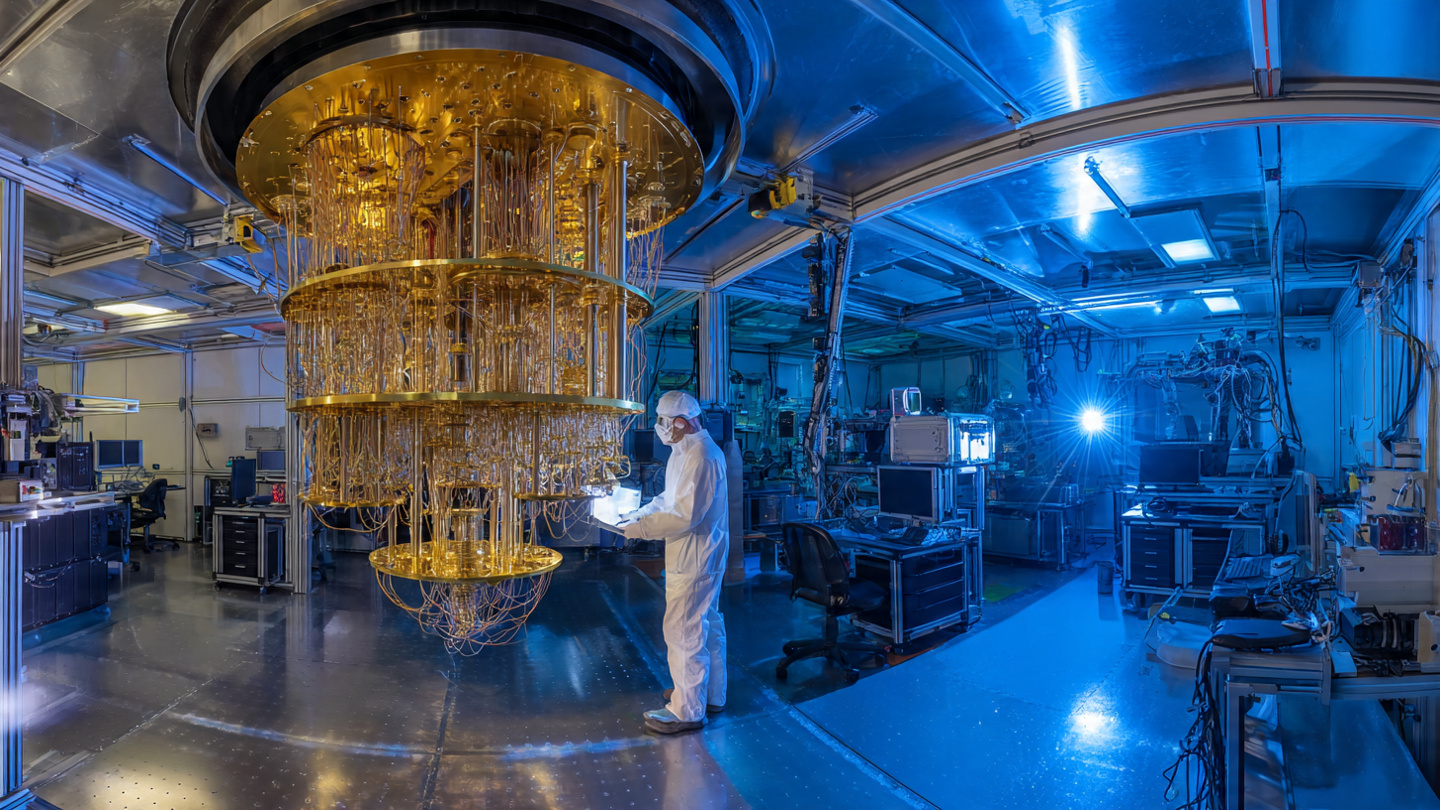
Two billion dollars distributed across nine companies, with equity stakes in all of them.
On Thursday, the National Institute of Standards and Technology announced letters of intent to award $2 billion in CHIPS and Science Act grants to nine quantum computing companies, with the U.S. government taking minority, non-controlling equity stakes in each recipient. This is the largest single federal investment in quantum technology in American history, and it follows a governing template the Trump administration has already applied to semiconductors and rare earth minerals: Washington is no longer merely subsidizing strategic industries but buying ownership in them, structuring deals so taxpayers share the upside if the technology delivers on its commercial promise.
IBM dominates the allocation, receiving $1 billion and committing to match it dollar-for-dollar to create Anderon, a standalone quantum chip foundry operating as an IBM subsidiary in Albany, New York. It will be America's first purpose-built 300-millimeter quantum wafer fabrication facility, producing superconducting qubit chips and specialized control electronics for IBM and, eventually, third-party quantum hardware vendors. GlobalFoundries receives $375 million for the specialized semiconductors that quantum systems require for cryogenic control and readout. D-Wave Quantum, Rigetti Computing, and Infleqtion each receive approximately $100 million, while Australian startup Diraq gets $38 million and the remaining allocations go to Atom Computing, PsiQuantum, and Quantinuum.
Markets celebrated instantly: IBM climbed 12.4%, D-Wave and Rigetti each surged roughly 25%, and Infleqtion popped 30%. Even quantum companies not receiving awards caught the wave, with Arqit rising 30% and IonQ gaining 12%.
The Equity Playbook
The equity-stake structure is what separates this announcement from a standard research grant, and D-Wave confirmed that its entire $100 million award will come as an equity investment. D-Wave's market capitalization was roughly $7 billion before the announcement, which means a $100 million equity investment at the pre-announcement market cap implies a government stake of approximately 1.4%, and if the post-announcement 25% rally holds, the government's initial paper gain is already $25 million. Rigetti and Infleqtion confirmed similar equity structures for their respective $100 million awards.
This is not unprecedented territory for the current administration, which already took a nearly 10% stake in Intel through CHIPS Act funding and invested in rare earth firms MP Materials and Vulcan Elements. Commerce Secretary Howard Lutnick said the deals are structured so taxpayers will ultimately benefit, and a senior Commerce Department official acknowledged the investments could take years to pay off but said the government spread money across multiple companies to reduce risk.
Nine bets instead of one, which is portfolio construction rather than subsidy, and the portfolio deliberately spans every major quantum hardware architecture in existence.
Where Every Dollar Went
| Company | Award | Approach | Market Cap (pre) | Stock Move |
|---|---|---|---|---|
| IBM (Anderon) | $1,000M | Superconducting qubits, foundry | ~$260B | +12.4% |
| GlobalFoundries | $375M | Specialized quantum semiconductors | ~$26B | +7% |
| D-Wave Quantum | $100M | Quantum annealing | ~$7B | +25% |
| Rigetti Computing | $100M | Superconducting, gate-model | ~$4B | +25% |
| Infleqtion | $100M | Neutral atoms | — | +30% |
| Diraq | $38M | Silicon spin qubits | — | — |
| Atom Computing | TBD | Neutral atoms | — | — |
| PsiQuantum | TBD | Photonic qubits | — | — |
| Quantinuum | TBD | Trapped ions | — | — |
The Sword and the Shield Problem
Here is the calculation nobody is running. The $2 billion investment is designed to accelerate quantum computing capability. IBM CEO Arvind Krishna has compared today's quantum computing to where AI chips were a decade ago, telling investors in March that "we think now the time frames have actually collapsed." IBM cites estimates that the quantum industry could generate up to $850 billion in economic value by 2040. The government wants a piece of that value through its equity stakes.
But the technology delivering that $850 billion in value has a specific, well-understood capability at the end of its development arc: Shor's algorithm, running on a sufficiently large fault-tolerant quantum computer, can solve the integer factorization and discrete logarithm problems that underpin RSA and elliptic curve cryptography. Those two algorithmic foundations protect essentially all public-key infrastructure currently in deployment. Every SSL certificate securing a bank website and every encrypted email channel at every government agency. Every VPN tunnel carrying classified material and every digital signature scheme authenticating software updates.
Recent studies published in January 2026 revised the qubit threshold downward sharply: quantum computers capable of breaking widely used encryption may require only 10,000 qubits instead of the millions previously estimated, compressing the estimated arrival of "Q-Day" from 2035 to approximately 2030. Forrester and Google Quantum AI have published similar compressed timelines. An investment of this magnitude, directed at precisely the technical progress those forecasts depend on, should be understood as a policy choice to compress that timeline further.
The government is investing in the sword, but who is investing in the shield?
The Migration That Isn't Happening
NIST finalized its first post-quantum cryptography standards in 2024: CRYSTALS-Kyber for key encapsulation, CRYSTALS-Dilithium for digital signatures. Both are designed to resist attacks from quantum and classical computers alike. The standards exist and the migration pathway is technically defined.
Almost nobody has started walking it. Nearly half of enterprises in North America and Europe have not integrated quantum computing into their cybersecurity strategies as of 2026. Mid-sized organizations are particularly exposed, with 56% admitting they are not prepared. The federal government's own deadlines are staggered out to 2035 for full quantum-vulnerable algorithm retirement under CNSA 2.0. No binding framework at the national level mandates post-quantum cryptography migration timelines for critical infrastructure operators. No multilateral framework at the G7 or G20 level establishes equivalent obligations across jurisdictions.
The investment accelerating quantum capability and the migration defending against quantum capability are moving at different speeds, in the same direction, toward the same threshold. The gap between them is where the most consequential cybersecurity risk of the coming decade will materialize.
And then there is the problem that does not wait for Q-Day at all. The harvest-now-decrypt-later attack paradigm means nation-state actors are rationally incentivized to collect encrypted communications today for decryption once quantum capability arrives. The data being collected is being collected now. The policy window for protecting it closed at the moment of collection, not at the moment of decryption. Every day the migration lags is a day of future vulnerability being recorded and stored.
The Geopolitical Math
The competitive logic is straightforward. China's public quantum investment is estimated at $15 billion or more, with its 15th Five-Year Plan designating quantum technology as a national strategic priority. Beijing's state-directed quantum program has operated at significant scale for years; recent Chinese startups SpinQ and QBoson raised approximately $145 million in recent rounds, signaling a return of private capital after Alibaba and Baidu exited the space. The U.S. government assessed China's program as a direct strategic threat to American technological leadership in a domain with decisive military and intelligence applications.
The $2 billion responds to that assessment by anchoring quantum chip manufacturing on American soil through Anderon and establishing a domestic supply chain for quantum-grade semiconductors through GlobalFoundries, while distributing capital across the ecosystem of competing hardware approaches: superconducting qubits at IBM and Rigetti, quantum annealing at D-Wave, neutral atoms at Infleqtion and Atom Computing, silicon spin qubits at Diraq, photonic qubits at PsiQuantum, and trapped ions at Quantinuum. Six distinct quantum architectures, each with different error rates, coherence times, and scaling properties.
The diversity is the strategy because nobody knows which architecture wins.
Strongest Counterargument
The strongest case against treating this as a security crisis is that the investment's success and the encryption threat are not the same thing on the same timeline. IBM's roadmap targets 100,000 logical qubits by 2033 and a million by the mid-2030s. Breaking RSA-2048 with Shor's algorithm requires a fault-tolerant quantum computer with thousands of error-corrected logical qubits, and no machine today comes close. The current state of the art is measured in hundreds of physical qubits, not thousands of logical ones, and the ratio of physical to logical qubits remains punishing: Microsoft's recent topological qubit breakthrough in 2025 improved the error correction overhead but did not eliminate it. Investing in quantum manufacturing infrastructure is not the same as delivering a cryptographically relevant machine, and there is no guaranteed timeline for when the second follows from the first.
The counterargument is correct on the physics and wrong on the policy. The risk is not that Q-Day arrives on schedule but that the migration required to survive it takes 5 to 15 years for large enterprises and the starting gun has not fired for half of them. If the government's own investment helps compress the timeline by even three years, the migration deficit doubles in severity retroactively.
Limitations
These are letters of intent, not signed contracts, and the final deal terms may differ from the announced figures. The specific equity percentages have not been disclosed for most recipients; our 1.4% estimate for D-Wave assumes the full $100 million was invested at the pre-announcement market capitalization, which may not reflect the actual negotiated valuation. China's $15 billion quantum investment figure is disputed and difficult to verify due to opacity in Chinese public spending disclosures; the RAND Corporation has noted conflicting data on Chinese R&D spending. The Q-Day timeline revision from 2035 to 2030 is based on algorithmic efficiency improvements that reduce qubit requirements, but practical engineering challenges in building fault-tolerant systems at scale remain unresolved, and estimates from different research groups vary significantly. The enterprise PQC readiness figure of "nearly half" unprepared comes from industry surveys that may not reflect the largest, most security-conscious organizations.
What You Can Do
If you run IT infrastructure at any organization handling sensitive data: start your cryptographic inventory now, not next quarter. Identify every system using RSA, ECDSA, or ECDH, and map the dependencies between them. The migration to CRYSTALS-Kyber and CRYSTALS-Dilithium is not a swap of one algorithm for another; it requires changes to certificate chains, key management systems, and network protocols, and the testing surface is enormous. NIST's standards are final, and the tools exist. The only thing missing is urgency, and the government just spent $2 billion manufacturing it.
If you manage a portfolio with exposure to quantum computing stocks: understand that these are letters of intent, not disbursed capital. The deals must survive legal review and final negotiation, and the gap between announcement and execution has historically produced downgrades. D-Wave's market cap tripled in 2024 on hype alone before pulling back. The equity structure aligns government and shareholder interests in a way that traditional grants do not, but it also means the government becomes a co-owner with interests in valuation appreciation, which is a different relationship than regulator or funder.
If you are a policymaker: the sword is getting $2 billion. The shield is getting voluntary adoption guidelines and a 2035 deadline. That asymmetry is the gap this analysis identifies, and it will not close itself.