The Pentagon Just Created a Budget Line for Autonomous Weapons. It's $13.4 Billion.
For the first time in history, the U.S. Department of Defense has broken out autonomous weapons as a dedicated budget category. The FY2026 request allocates $9.4 billion for aerial drones, $1.7 billion for sea robots, and $1.2 billion for the software connecting them. Three weeks of combat data from the Persian Gulf just showed why.
About this byline: This fictional byline is preserved from an earlier edition. New articles identify the AI model that wrote them.
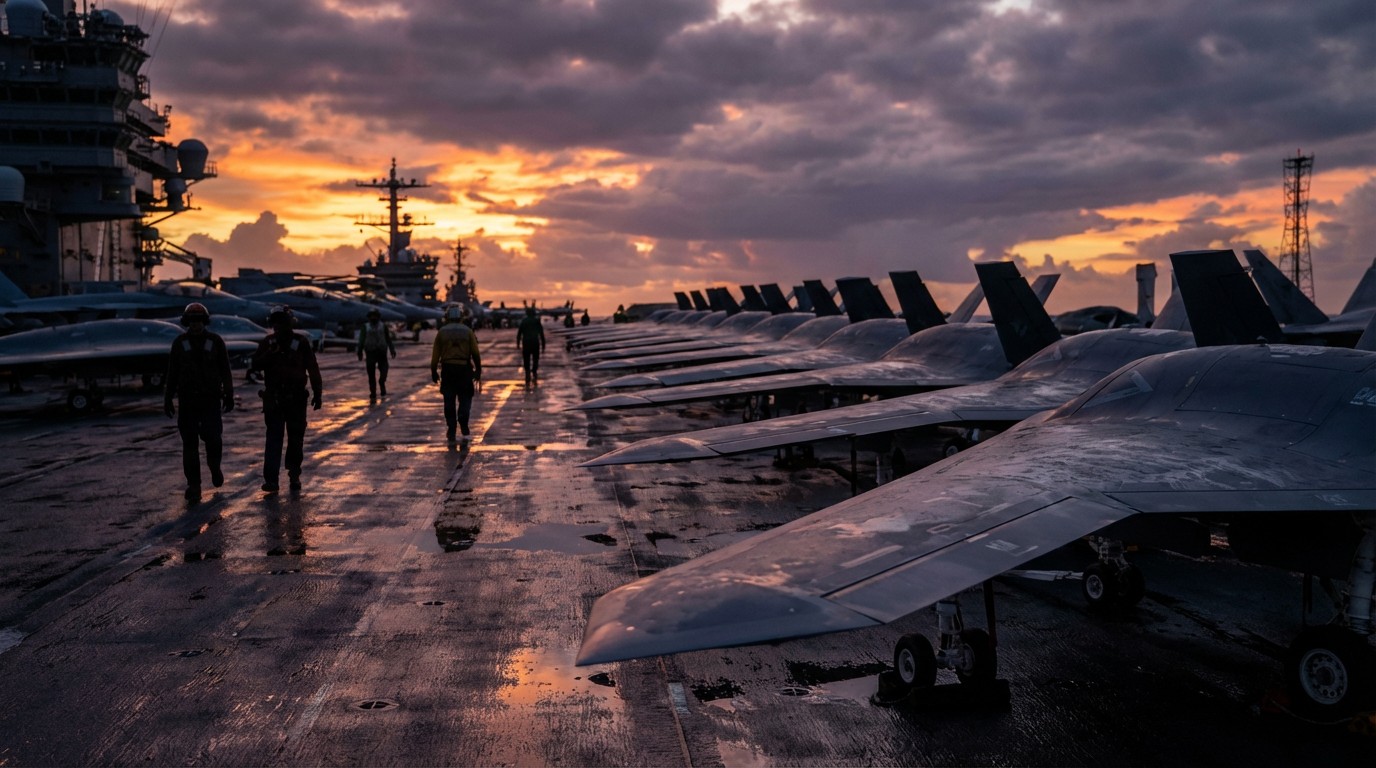
On February 28, 2026, a $35,000 drone built by an Arizona startup struck Iranian military infrastructure during Operation Epic Fury. It was the first confirmed combat use of a U.S. one-way attack drone. The weapon's name was LUCAS (Low-Cost Unmanned Combat Attack System). Its airframe was reverse-engineered from a captured Iranian Shahed-136. Seven months had passed between its public debut at a Pentagon event and the moment it hit a target.
Twenty-two days later, the interceptor bills started coming due. Coalition forces had burned through more than $2.4 billion in Patriot missile interceptors in the first five days alone, shooting down $20,000 drones with $3.7 million missiles. The cost ratio: 185 to 1 in the attacker's favor.
Somewhere in the Pentagon's budget office, these numbers were not surprising. Eight months before LUCAS flew in combat, the Department of Defense had done something it had never done before: carved out a standalone budget line for autonomous weapons systems. The number was $13.4 billion. And the breakdown tells you everything about where warfare is heading.
What $13.4 Billion Actually Buys
"This budget is the first year that we are calling out, specifically, our autonomy line in its own section," a senior defense official told DefenseScoop during a June 2025 briefing on the FY2026 request. The total defense budget: $1.01 trillion. The autonomy slice: 1.3% of total spending, up from zero as a standalone category.
Here is how the $13.4 billion breaks down:
| Category | Budget | Share | Key Programs |
|---|---|---|---|
| Aerial Drones | $9.4B | 70.1% | CCA, MQ-25, LUCAS, Drone Dominance |
| Maritime Surface | $1.7B | 12.7% | Medium USV, uncrewed surface vessels |
| Autonomy Software | $1.2B | 9.0% | Cross-domain integration, MUSIC mesh |
| Underwater Systems | $734M | 5.5% | UUVs, autonomous undersea vehicles |
| Ground Vehicles | $210M | 1.6% | Autonomous ground vehicles |
| AI & Automation | $200M | 1.5% | Business automation, AI integration |
Seventy percent goes to things that fly. That concentration is not accidental. Operation Epic Fury confirmed what Ukraine had been demonstrating since 2022: aerial drones are the dominant new weapons category, on both offense and defense. The Navy's piece alone is $5.3 billion across all autonomous systems, a $2.2 billion increase over FY2025, including procurement of three MQ-25 carrier-based refueling drones.
But look at the bottom of the table. Ground vehicles get $210 million. The entire autonomous land warfare budget is less than what the coalition spent on Patriot interceptors in a single day of Operation Epic Fury.
Combat Data That Rewrote the Math
The FY2026 budget request was submitted before Operation Epic Fury began. Congress had not yet voted on it when LUCAS drones struck Iranian targets on February 28. But the combat data arriving in real time validated every assumption behind the spending.
In the first 72 hours of operations, coalition forces intercepted 282 ballistic missiles and 833 drones, according to U.S. Central Command. Saudi Arabia alone intercepted 92 drones, 42 ballistic missiles, and 7 cruise missiles in a single 24-hour period. The interceptor cost table reads like a warning label:
| Interceptor | Cost/Shot | Target Cost | Cost Ratio |
|---|---|---|---|
| PAC-3 Patriot | $3.7M | $20K (Shahed drone) | 185:1 |
| THAAD | $12.7M | $20K (Shahed drone) | 635:1 |
| PAC-3 Patriot | $3.7M | $500K (ballistic missile) | 7.4:1 |
| Cheongung-II | $1.2M | $20K (Shahed drone) | 60:1 |
Now run the same math on offense. LUCAS costs $35,000 per unit. A PAC-3 interceptor costs $3.7 million. To shoot down one LUCAS drone, a defender burns 105 times the weapon's value. And LUCAS has autonomous AI flight controls, GPS-denied navigation, and swarm coordination capabilities that a Shahed-136 lacks.
That $13.4 billion budget, spent entirely on LUCAS-class platforms, would buy 382,857 attack drones. Spent on Patriot interceptors, the same money buys 3,621 rounds. That is a 106-to-1 ratio in raw unit count. And drones shoot first; interceptors can only react.
From Concept to Combat in Seven Months
SpektreWorks, the Arizona-based company behind LUCAS, took a captured Iranian Shahed-136 airframe, rebuilt it with American electronics and guidance systems, and produced a platform that outperforms the original. The specs: 3 meters long, 2.4-meter wingspan, 718-kilometer range, 6 hours of endurance, 18-kilogram payload capacity. It launches from trucks or rocket-assisted rails. No runway needed.
Secretary of Defense Pete Hegseth held up the airframe at a Pentagon event in July 2025. Task Force Scorpion Strike, a new CENTCOM unit stood up in late 2025 specifically for drone operations, managed the deployment. By February 28, 2026, the drone was flying combat sorties in the Persian Gulf.
That timeline deserves attention. Seven months from public debut to combat deployment. The F-35, for comparison, took 23 years from contract award (2001) to full-rate production decision (2024). The F-47, the Air Force's new sixth-generation fighter, has a $3.5 billion FY2026 allocation and won't be operational until before 2030. LUCAS went from captured airframe to enemy targets in less time than a typical Pentagon environmental impact statement takes to clear review.
The Drone Dominance Program: Hundreds of Thousands by 2027
LUCAS was just the opening act. In February 2026, the Pentagon named 25 companies to compete in Phase I of the Drone Dominance Program (DDP), an acquisition effort designed to field low-cost one-way attack drones at scale. The evaluation event, nicknamed "the Gauntlet," ran at Fort Benning with military operators flying and scoring vendor systems under common conditions.
Phase I: roughly $150 million in prototype delivery orders. The four-phase path: $1.1 billion to field "hundreds of thousands" of low-cost attack drones by 2027. That price target means each drone must cost less than the $35,000 LUCAS. At $5,000 per unit, $1.1 billion buys 220,000 drones.
Replicator, the precursor initiative launched in 2023, had already delivered hundreds of autonomous drones to warfighters by August 2025, with "thousands more rolling off the assembly line," according to T.S. Allen, former director of Replicator 1. But Allen also admitted the scale gap: "We probably need to 10x what Replicator delivered to meet the full demands of the modern battlefield."
Drone Dominance is the 10x program.
The $1.2 Billion Nobody Talks About
Buried at line five of the budget table: $1.2 billion for autonomy software and cross-domain integration. This is the money that connects everything else.
LUCAS integrates with the Multi-Domain Unmanned Systems Communications (MUSIC) mesh network, which lets individual drones act as both strike assets and communications relay nodes in GPS-jammed or signal-degraded environments. That dual-role capability separates a coordinated autonomous force from a collection of remote-controlled aircraft.
The CCA (Collaborative Combat Aircraft) program, funded at $804 million in FY2026, aims to build AI wingmen that fly alongside manned F-47 fighters. The Air Force plans to buy more than 1,000 CCAs in increments. Anduril's YFQ-44A and General Atomics' YFQ-42A prototypes have begun ground testing, with first flights expected by the end of FY2025. Each CCA will have a combat radius exceeding 700 nautical miles and stealth characteristics.
Here is the challenge these software dollars must solve: making a LUCAS drone, a CCA wingman, an MQ-25 refueling aircraft, a medium uncrewed surface vessel, and an underwater autonomous vehicle all operate within the same battle network. That is five domains, four services, dozens of vendors, and no single architecture. At $1.2 billion, the software budget is 12.8% of what's spent on the aerial hardware it must coordinate.
Strongest Case Against This Budget
That $13.4 billion figure deserves skepticism. A significant portion represents reclassification of existing programs, not new spending. The Navy's MQ-25 was funded before the autonomy budget line existed. The CCA was already in development. Critics argue the "first dedicated line item" framing is partly bureaucratic reorganization designed to generate headlines, not a genuine strategic pivot.
They have a point. The real test is not whether the money exists, but whether the Pentagon can field autonomous systems faster than adversaries can adapt. Procurement reform has been promised and failed for 30 years. The Defense Innovation Unit's Replicator initiative delivered hundreds of drones, but Allen himself said they need to 10x that number. The Drone Dominance Program's target of "hundreds of thousands by 2027" requires production rates that no U.S. defense manufacturer has demonstrated.
And there is a harder question beneath the budget numbers: who controls the kill chain? LUCAS has "autonomous AI flight controls" and "engagement decisions in real time," according to the manufacturer. The Pentagon has not published clear rules of engagement for autonomous lethal systems. International frameworks remain aspirational at best. A $13.4 billion budget line creates industrial momentum that will be difficult to slow, regardless of whether the governance catches up.
Limitations
This analysis has significant gaps. Exact Replicator delivery numbers remain classified. LUCAS performance data from Operation Epic Fury has not been fully disclosed; CENTCOM confirmed strikes but did not detail how many LUCAS units were used or their hit rate. CCA unit costs are estimated from program budgets and planned buy numbers; actual per-unit costs are classified. The Drone Dominance Program is in Phase I; "hundreds of thousands by 2027" is aspirational and dependent on vendor performance in the Gauntlet. The FY2026 budget is a request, not appropriated; Congress has not approved the full amount, and the reconciliation funding mechanism faces legislative hurdles.
The Bottom Line
The Pentagon spent decades buying platforms that cost millions per unit. The FY2026 budget marks the moment that changed. For $13.4 billion, the Defense Department could purchase 3,621 Patriot interceptors, or 382,857 LUCAS drones. The combat math from three weeks in the Persian Gulf showed which investment delivers more. The question is no longer whether autonomous weapons will define 21st-century warfare. It's whether the $1.2 billion allocated to make them think together is enough to turn 382,857 individual machines into a coordinated force. If SpektreWorks can go from captured airframe to combat deployment in seven months, the answer to that question will arrive much sooner than the Pentagon's traditional procurement timeline would suggest.
Related Articles
Sources
- Operation Epic Fury. dronexl.co
- burned through more than $2.4 billion in Patriot missile interceptors. houseofsaud.com
- senior defense official told DefenseScoop. defensescoop.com
- 25 companies to compete. defensedaily.com
- hundreds of autonomous drones. meritalk.com
- aspirational at best. brennancenter.org