The World's First Fully Autonomous Commercial Vehicle Isn't a Car. It's a 700-Container Ship.
Japan launched the Genbu on a commercial Kobe-Tokyo route in January 2026. Bridge and engine room automated. Three years from keel to commercial service. Waymo has spent 15 years and still can't leave four cities.
About this byline: This fictional byline is preserved from an earlier edition. New articles identify the AI model that wrote them.
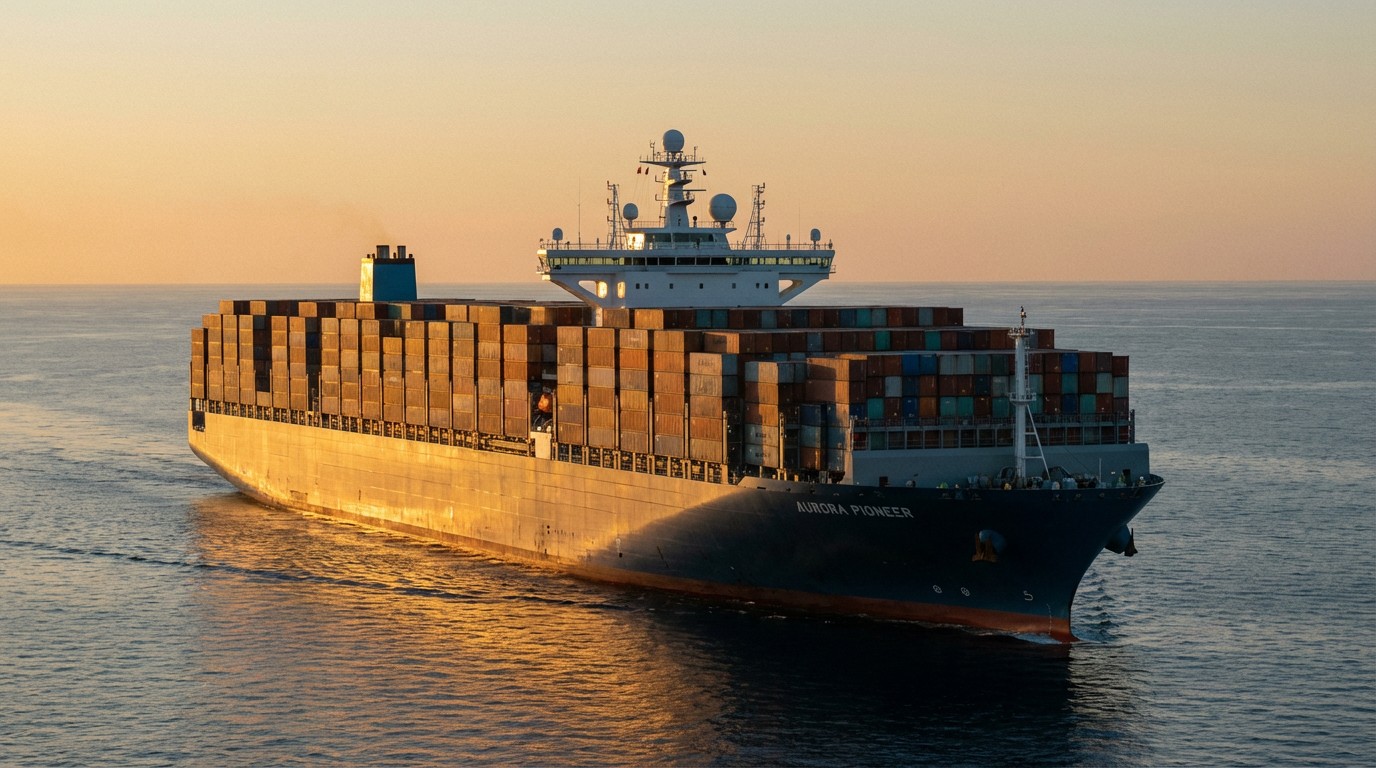
Seventy to eighty percent of maritime accidents are caused by human error. That's the number Japan's Nippon Foundation kept citing when it launched MEGURI2040, a consortium of 30+ companies with a goal of making 50% of Japanese coastal vessels unmanned by 2040. In January 2026, they delivered: the Genbu, a 700-TEU container ship, began commercial service on the Kobe-Tokyo route with both bridge and engine room operating autonomously.
Nobody in Silicon Valley noticed.
While autonomous driving startups have collectively absorbed enormous capital — Waymo alone has received over $30 billion from Alphabet, Cruise burned $1.9 billion in 2023 alone, and Aurora has spent roughly $4 billion since inception — maritime autonomy moved from consortium formation to commercial deployment in roughly three years. Waymo, the acknowledged leader in autonomous road vehicles, serves four US cities after 15 years of development. It still requires geofences, pre-mapped streets down to the centimeter, and LiDAR arrays that cost more than most cars.
A 700-container ship just did what Waymo can't: operate commercially on an unrestricted route, in variable conditions, without geographic limitations.
The Autonomy Gap: 3 Years vs. 15
The numbers tell a story that should concern every autonomous vehicle startup investor:
| Metric | Maritime (Genbu) | Automotive (Waymo) |
|---|---|---|
| Years to commercial service | ~3 (2022 demos → 2026 commercial) | 15+ (2009 → still scaling) |
| Estimated R&D investment | Nippon Foundation funded (undisclosed total; government co-funded) | $30B+ (Alphabet cumulative) |
| Operational domain | Commercial coastal route, variable weather | 4 pre-mapped US cities, geofenced |
| Human error rate in accidents | 70-80% (IMO data) | 94% (NHTSA data) |
| Regulatory framework | IMO MASS code finalizing 2026 | State-by-state patchwork, no federal standard |
| Revenue model | Commercial cargo service (day one) | Subsidized rides (~$330 loss/ride) |
MEGURI2040's phased approach is instructive. In 2022, five consortiums ran demonstration voyages with six vessels, including a 750-kilometer fully autonomous transit across Tokyo Bay. By December 2025, the Olympia Dream Seto, a 500-passenger ferry, ran autonomous navigation in the Seto Inland Sea on a commercial service route. Two months later, Genbu started hauling containers.
Compare that to autonomous driving's trajectory: Cruise launched, burned $1.9 billion in a single year, dragged a pedestrian 20 feet, and got shut down. Tesla has been promising Level 5 since 2016 and still ships Level 2 with an aspirational name. Aurora Innovation has spent $4 billion and operates a handful of trucks in Texas. Waymo is the genuine success story, and it loses money on every ride.
Why Ships Are Easier (And Why That Matters)
Maritime autonomy isn't harder than road autonomy. It's dramatically easier, for reasons that are obvious once you think about them:
Obstacle density. A Waymo in San Francisco encounters pedestrians, cyclists, double-parked delivery vans, construction zones, jaywalkers, emergency vehicles, and dogs. A container ship in coastal waters encounters other ships (visible on radar from miles away), buoys (charted), and weather (forecast). Open ocean has approximately zero obstacles per square mile.
Decision speed. A car traveling at 35 mph in a city has a stopping distance of about 136 feet and encounters potential collision scenarios every few seconds. A container ship traveling at 12 knots has a stopping distance measured in miles and collision scenarios measured in minutes to hours. Reaction time requirements differ by orders of magnitude.
Regulatory structure. Maritime law is fundamentally international. The International Maritime Organization sets rules for 175 member states. One regulatory body, one framework. Autonomous cars face 50 different state laws in the US alone, plus municipal regulations, plus the NHTSA federal layer. Japan's Minister of Land, Infrastructure, Transport and Tourism can greenlight an autonomous ship corridor faster than the California DMV can issue a new permit class.
Economic pressure. Japan's maritime workforce has been in structural decline for decades — the Ministry of Land, Infrastructure, Transport and Tourism tracks a shrinking pool with more than 50% of remaining officers over age 50 and job-to-applicant ratios exceeding 4.0x. Globally, the BIMCO/ICS workforce report projects an officer deficit of 110,000 by 2026. Maritime autonomy isn't about disrupting a workforce. It's about replacing one that's disappearing.
Original Analysis: The Crew Lifetime Cost Calculation
A mid-range container ship operates for approximately 25 years. Crewing a 700-TEU coastal vessel typically requires 15-20 crew members. Using midpoint estimates from industry salary surveys (averaging $80,000/year per crew member across officer and rating positions for Japanese coastal operations):
| Cost Component | Annual Cost | 25-Year Lifetime |
|---|---|---|
| Crew salaries (18 crew × $80K avg.) | $1.44M | $36.0M |
| Benefits, insurance, training (~30% of salary) | $430K | $10.8M |
| Crew provisions & logistics | $180K | $4.5M |
| Crew quarters (design/maintenance, amortized) | $80K | $2.0M |
| Total crew cost per vessel | $2.13M | $53.3M |
If autonomous technology enables a 50% crew reduction across Japan's coastal fleet of approximately 5,000 vessels, annual savings per vessel would be roughly $1.07 million, or $5.3 billion across the fleet. That's the ceiling, though, not the forecast. Actual adoption will be gradual — MEGURI2040's own target is 50% unmanned by 2040, not 2027. But even at 10% fleet penetration, savings exceed $500 million annually. The economics are unambiguous even under conservative assumptions.
That math explains the pace. Maritime autonomy isn't a moonshot. It's a spreadsheet.
But The Stakes of Failure Are Catastrophic
Here's the strongest case against celebrating autonomous ships: a Waymo that malfunctions causes a fender-bender. A 700-TEU container ship that loses autonomous navigation in a shipping lane causes an environmental and economic catastrophe.
When the Ever Given ran aground in the Suez Canal in March 2021, it blocked $9.6 billion per day in global trade for six days. That was a human-piloted vessel with a full crew. An autonomous ship failure in the Strait of Malacca, through which one-quarter of global maritime trade transits, could cascade faster and harder.
Genbu's captain acknowledged that "one person on the bridge" may still be needed during the transition. This is supervised autonomy. Genbu carries crew. Yara Birkeland, the Norwegian autonomous electric cargo ship that has been operating since 2022, still has a three-person crew for regulatory oversight despite the vessel being designed for unmanned operation. True zero-crew commercial shipping doesn't exist yet.
And nobody has published safety data comparing autonomous versus human-navigated voyage outcomes. Maritime autonomy is deploying commercially based on engineering logic and demonstration success, not on a statistically significant safety comparison. Waymo, for all its geofenced limitations, has 50 million miles of safety data. Maritime autonomy has approximately zero miles of comparable published safety statistics.
Limitations
This analysis relies on publicly available data about the MEGURI2040 program. Consortium investment figures are estimated from Japanese government and Nippon Foundation disclosures, not audited financial statements. Crew cost calculations use industry survey midpoints; actual costs vary significantly by flag state, crew nationality, and vessel type. Genbu's route is domestic Japanese coastal, well-charted and regulated. Performance on contested international waterways, extreme weather, or high-traffic straits remains undemonstrated. The 84% of maritime industry respondents who believe crew presence remains crucial, per recent industry surveys, may reflect genuine technical limitations that this article's optimistic framing underweights. Finally, IMO's MASS code is still being finalized; commercial autonomous shipping at international scale depends on regulations that don't yet exist.
The Bottom Line
Autonomous driving consumed $100+ billion and 15 years to serve four American cities at a loss. Autonomous shipping spent a fraction of that and reached commercial service in three years, driven by a workforce crisis that leaves no alternative. Maritime autonomy isn't sexier than Waymo. It's not going to trend on X. But a 700-container ship is running the Kobe-Tokyo corridor right now, hauling cargo commercially, with its bridge operating autonomously. That makes it, quietly and without venture capital fanfare, the most successful autonomous vehicle deployment on Earth.
Sources & References
- Kantenna, "Japan Autonomous Container Ship Genbu: World First Commercial Operation" (Jan 30, 2026)
- Breakbulk News, "IMO Puts Shipping on an Implementation Clock" (Jan 6, 2026)
- Yara, "Yara Birkeland: Two Years On" (autonomous electric cargo ship status)
- Market.us, "Autonomous Ships Statistics" (Jan 28, 2026): $6.1B market (2023), projected $15.7B by 2033, 9.9% CAGR
- BIMCO/ICS Seafarer Workforce Report: Global demand 1.98M seafarers, officer deficit projected at 110,000
- Marine Insight, global trade volumes through major straits
- IMO Secretary-General statement declaring 2026 "year of implementation" for Maritime Autonomous Surface Ships (MASS) regulatory code
- MEGURI2040 program data: 30+ company consortium, Phase 1 (2022) six demonstration vessels including 750km autonomous transit