The Pentagon Ordered 200,000 Drones. Ukraine Builds That Many Every 10 Days.
On July 27, the Pentagon’s own drone chief admitted the U.S. is “still years” from matching Ukraine’s wartime output. Ukraine produces 19,178 attack drones per day. A $1.1 billion Pentagon program has ordered 200,000 total. Run the math three ways on that budget and the gap stops being about money—it’s about industrial architecture.
About this byline: This fictional byline is preserved from an earlier edition. New articles identify the AI model that wrote them.
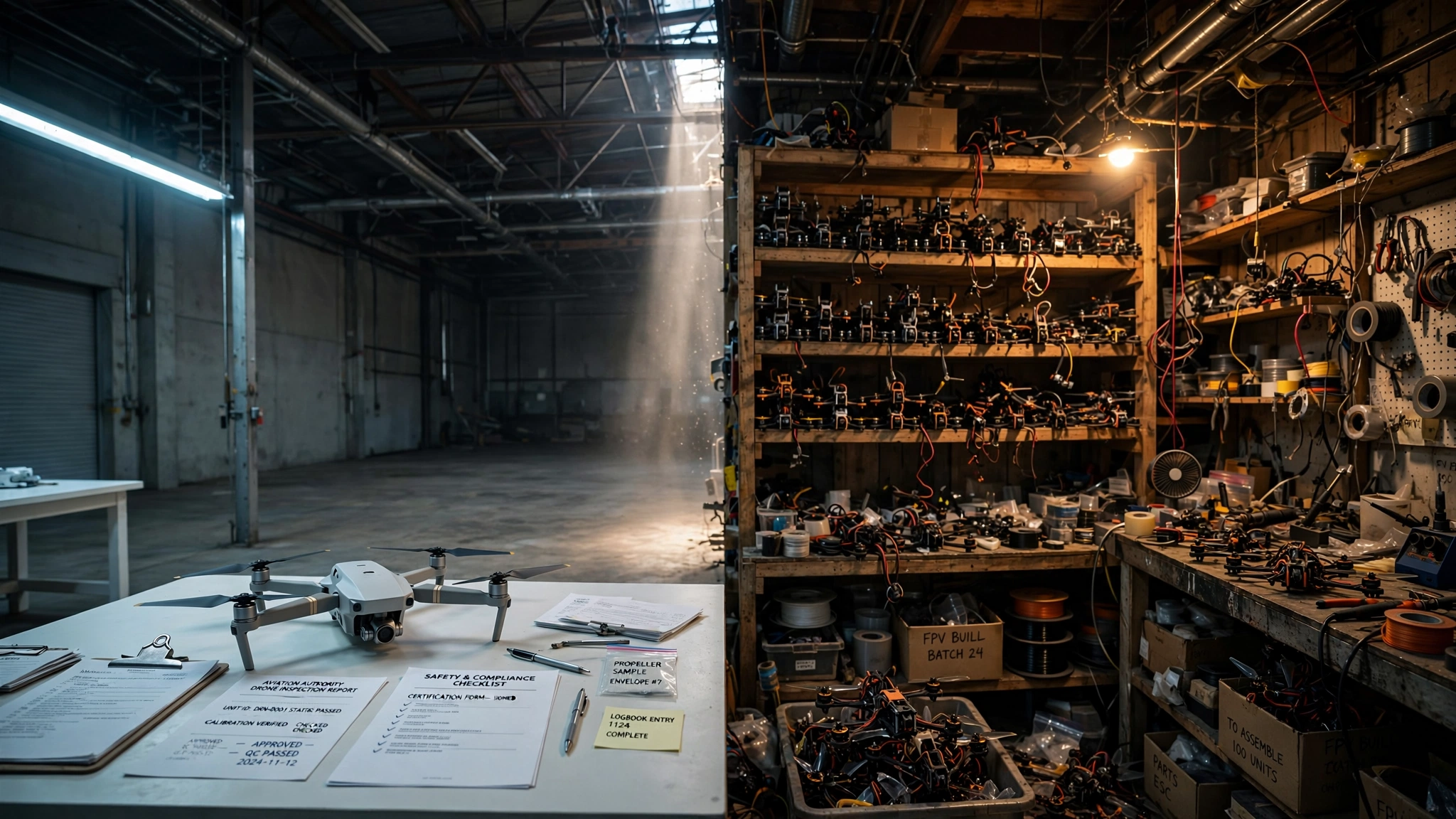
Seven million drones a year. That is what Ukraine will produce in 2026, according to Travis Metz, the Defense Innovation Unit’s deputy director who runs the Pentagon’s Drone Dominance Program, a $1.1 billion initiative to build a domestic attack drone industry essentially from scratch. He shared the figure in a Reuters interview published July 27, alongside the American counterpart: just under 200,000 drones ordered cumulatively through February.
Divide those numbers out and the picture snaps into focus: seven million divided by 365 yields 19,178 drones per day, which means Ukraine matches the Pentagon’s entire cumulative order in 10.4 days, and the Gauntlet II follow-on order of 60,000 drones, the one Pentagon officials characterize as a dramatic scale-up, represents barely three days of Ukrainian output.
Metz, to his credit, did not pretend the gap was small. “It’s much harder to get from zero to 200,000” than it will be to scale further, he said, predicting the U.S. would “eventually rival” Ukraine’s output. But what he described next should concern anyone tracking the program: on July 23, four days before the interview, his agency released a revised supply chain framework mandating a “wholly domestic” small unmanned aircraft system supply chain, banning Chinese-made brushless motors and battery packs from any drone competing in August’s Gauntlet II test at Fort Carson, Colorado.
Here is where it gets uncomfortable. By Metz’s own admission, the “vast majority” of drones purchased in the program’s first phase used those exact Chinese motors.
Competition at Scale: How the Gauntlet Works
Structurally, the Drone Dominance Program replaces decade-long development contracts with live-fire competitions called Gauntlets, where companies fly real drones through combat scenarios and winners earn production orders rather than study contracts. Forty-nine companies showed up at Camp Grayling, Michigan, in June for a qualifying event that ran day and night missions around two scenarios the Pentagon considers critical: striking targets at long range and conducting tactical assaults inside confined, building-like environments, and nineteen survived to advance.
Each of those nineteen must now deliver 120 drones equipped with lethality payloads within approximately five weeks just to remain eligible, a production benchmark deliberately designed to filter out companies that can build a gorgeous prototype but cannot manufacture at volume. Lethality partners drawn from a roster including Bravo Ordnance, Kela Defense, Kraken Kinetics, Mountain Horse, and Northrop Grumman provide warhead systems, allowing smaller drone startups to focus on airframes while established weapons specialists handle the part of the system that actually has to detonate reliably on a target.
Gauntlet I, held at Fort Benning in February and March, produced roughly $150 million in orders for 30,000 one-way attack drones, putting the implied price at $5,000 per drone. Gauntlet II targets 50,000 to 60,000 additional units from top performers, and the program’s stated price ambition is to drive that $5,000 figure down to $2,000 as competition matures and domestic supply chains solidify.
For context, LUCAS, the first American one-way attack drone actually used in combat, cost $35,000 per unit when Task Force Scorpion fired it during operations tied to the broader Iran conflict earlier this year. And the company that topped the first Gauntlet leaderboard was not American. Skycutter, a London-based firm partnered with Ukrainian manufacturer SkyFall, scored 99.3 out of 100 with its Shrike 10 Fiber, a fiber-optic FPV drone born on the Ukrainian battlefield and evaluated on strike accuracy at 2.5 to 10 kilometers, urban operational performance, multi-target engagement, ease of operator use, and production scalability. Ukrainian Defense Drones finished sixth at 72.9 points, meaning Ukrainian-designed systems claimed multiple spots among top performers in the Pentagon’s own evaluation.
Three Ways to Spend $1.1 Billion
What does the Drone Dominance Program’s two-year budget actually buy? We ran the math three ways, each illuminating a different dimension of the production gap.
Option A: Buy drones through Gauntlet competitions at $5,000 each. Result: 220,000 drones, roughly what the program is doing now, spread across multiple vendors with classified contract details and a deliberately competitive procurement structure that rewards performance under live-fire conditions.
Option B: Buy at Ukrainian field prices. Average Ukrainian FPV attack drone production cost runs between $331 and $443, depending on quality and whether components are domestically sourced or imported, with a midpoint around $400. At that price, $1.1 billion purchases 2.75 million drones, more than twelve times the Pentagon’s cumulative order and enough to equip every active-duty U.S. soldier with two.
Option C: Build factories instead of buying drones. Finnish defense company Sensofusion sells a Tactical Drone Factory, a standard 20-foot shipping container fitted with industrial 3D printers, an electronics assembly station, and enough spares to run around the clock with a crew of three, producing 50 interceptor drones per day at under $580 each, all for $2.4 million per unit.
At $2.4 million apiece, $1.1 billion funds 458 factories. Each produces 50 drones per day, or 18,250 per year. Multiply those numbers out and the result is startling: 458 factories producing 18,250 drones annually yields 8.36 million drones per year, exceeding Ukraine’s entire projected 2026 output of seven million.
| Approach | Unit Cost | Drones from $1.1B | Annual Capacity |
|---|---|---|---|
| Pentagon Gauntlet | $5,000 | 220,000 | ~180,000 (est.) |
| Ukrainian FPV pricing | $400 | 2,750,000 | N/A (purchase) |
| Factory infrastructure | $2.4M/factory | 458 factories | 8.36 million/yr |
One approach buys consumable drones. Another builds permanent capacity to produce them indefinitely, at a rate that would make the United States the largest drone manufacturer on Earth overnight. Same budget, radically different outcomes, and the Pentagon chose the one that produces the fewest drones.
Why Industrial Architecture Matters More Than Money
Ukraine did not reach seven million drones a year by writing large procurement contracts. It distributed production across more than 160 small manufacturers operating from warehouses, converted barns, basements, and living rooms, all coordinated through Telegram channels and Zoom tutorials, with a volunteer army of builders cranking out airframes alongside established defense firms while iterating designs weekly based on operator feedback from the front line.
General David Petraeus, visiting Ukrainian drone manufacturers in person, reported that a single Ukrainian company told him it alone would produce three million drones in 2026. Consider the trajectory that statement implies: from essentially zero domestic drone industry in 2022, to roughly two million units in 2024, to about 3.5 million in 2025, to six or seven million this year, constituting a compound annual growth rate of approximately 90% sustained over four years under constant bombardment of energy grids, factories, and logistics infrastructure.
By contrast, 19 companies are advancing through the Pentagon’s structured Gauntlet competition, supported by the world’s largest defense budget, and American domestic drone production across all sectors runs somewhere between 300,000 and 400,000 units per year. Ukraine launches more than that every single month.
Chinese Components, American Costs, Ukrainian Solutions
Senator Roger Wicker, chairman of the Senate Armed Services Committee, testified earlier this year that China controls more than 90% of the global market for small, non-military drones through “years of state subsidies and aggressive pricing,” and that American-made drones cost five to 25 times more than Chinese equivalents. Banning Chinese components is a sound national security decision, but doing it while simultaneously trying to multiply drone production by orders of magnitude creates a compounding constraint: manufacturers must replace 90% of their supply chain and scale output dramatically, all at once, under competitive pressure from companies that have already solved the problem.
Ukraine solved it under fire. Ukrainian manufacturers now produce their own flight controllers, circuit boards, and radio control systems domestically, and the cost of their locally sourced drones actually went down as they localized, according to a GlobalData analysis of the Ukrainian drone industry. Where most supply chain transitions carry a cost premium, Ukraine’s vertical integration, driven by wartime necessity and a distributed manufacturing base that competes internally on price, pushed per-unit costs lower even as it eliminated foreign dependencies.
American drone manufacturing is trending in exactly the opposite direction. Firestorm Labs, the most-tested U.S. portable drone factory, produces about 50 drones per month from its xCell system, a two-container setup representing the current state of the art in American mobile drone production. Finland’s Sensofusion hits that number every single day from one container with three workers, making the American factory 30 times slower than a Finnish competitor producing drones in the same weight class.
When Does Parity Arrive?
Assume the Pentagon’s Gauntlet program continues to scale with Gauntlet I ordering 30,000 drones and Gauntlet II targeting 60,000, which at a pace of two Gauntlets per year means the program orders roughly 180,000 drones annually. Ukraine, at seven million, produces 39 times that volume. Even if the Pentagon doubled its Gauntlet orders every single year, an aggressive ramp by any defense procurement standard, convergence math looks like this:
| Year | Pentagon Output (Cumulative) | Ukraine Output (Annual) | Gap |
|---|---|---|---|
| 2026 | 200,000 | 7,000,000 | 35× |
| 2027 | 560,000 | ~8,000,000 | 14× |
| 2028 | 1,280,000 | ~9,000,000 | 7× |
| 2029 | 2,720,000 | ~10,000,000 | 3.7× |
| 2030 | 5,600,000 | ~11,000,000 | 2× |
| 2031 | 11,360,000 | ~12,000,000 | ~1× |
Under this optimistic doubling scenario, parity arrives around 2031, but the projection assumes the Pentagon sustains 100% annual growth in order volume for five straight years while holding the $5,000 price point, an assumption that conflicts directly with new supply chain restrictions driving costs upward, and it also assumes Ukraine’s growth decelerates sharply from its three-year CAGR of 90% to roughly 15% per year, a slowdown Ukraine has shown absolutely no sign of experiencing.
Not the Same Drone, and That Is Exactly the Point
Here is the strongest case against this entire analysis, stated at full strength: Pentagon tactical UAS and Ukrainian FPV kamikaze drones are fundamentally different weapons serving fundamentally different operational needs, and collapsing them into a single production comparison is misleading. A $5,000 Gauntlet drone carries encrypted communications, anti-jamming capabilities, thermal optics, and extended range inside a reusable airframe designed for reconnaissance missions that a $400 FPV system with a ten-minute flight time and single-digit-kilometer range simply cannot perform, while Pentagon drone costs also embed weapons qualification, testing, and compliance overhead that Ukrainian volunteer-assembled airframes in a basement workshop do not carry.
All of that is true, and pretending otherwise would be dishonest.
But it bends here. Pentagon evaluators designed Gauntlet I scoring criteria around strike accuracy at operationally relevant distances, urban combat performance, multi-target engagement, ease of use by military operators, and production scalability, and a Ukrainian-designed fiber-optic FPV drone born on the battlefield and carried into the competition by Skycutter scored 99.3 out of 100 against those exact criteria, above every American entrant. If Gauntlet scoring reflects what the military actually needs in expendable attack drones, then the gap is not a product of differing requirements or fundamentally mismatched capabilities but rather a production capacity problem, pure and raw, where the country under bombardment has solved the manufacturing puzzle and the country with the world’s largest defense budget has not.
What We Did Not Prove
Several caveats limit this analysis. Sensofusion’s factory output of 50 drones per day is a manufacturer’s claimed figure, not independently verified sustained production data running for months under operational conditions, and our ramp-rate projections assume consistent doubling that historically no Pentagon program has sustained for five consecutive fiscal years. Ukrainian production figures from General Petraeus and other public accounts may run higher than Kyiv’s official tallies, which are not publicly available in full. Per-drone cost comparisons exclude integration, training, logistics, and lifecycle maintenance costs that inflate the Pentagon’s real expenditure but do not appear in unit pricing, and some portion of Ukraine’s remarkable production volume relies on volunteer labor and wartime urgency that no peacetime industrial base can replicate.
We also do not know the actual per-drone cost of Gauntlet orders with certainty because our $5,000 figure derives from dividing Gauntlet I’s $150 million in reported orders by 30,000 drones, and the Pentagon has not confirmed this arithmetic since the actual contract values remain classified.
What You Can Do
If you work in defense acquisition: Study Ukraine’s distributed manufacturing model before writing the next request for proposals, because the Sensofusion-style factory-in-a-container approach represents a fundamentally different procurement philosophy where you buy capability to produce rather than units produced, letting permanent infrastructure compound your investment instead of consuming it.
If you run a drone company competing in Gauntlet: Recognize that the 120-drones-in-five-weeks production requirement is the Pentagon telling you, in plain English, that manufacturing speed is now a selection criterion alongside flight performance, and the companies solving domestic supply chain for motors and batteries fastest will own this market regardless of how elegantly their airframes fly.
If you invest in defense tech: Track companies building production infrastructure rather than just platforms, because Sensofusion, Firestorm Labs, and the Ukrainian JV partners localizing factories in Ohio and New Hampshire represent the picks and shovels of a drone gold rush where the bottleneck is factory throughput, not design ingenuity.
If you follow national security policy: Watch whether Gauntlet II drone costs rise or fall compared to Gauntlet I, because that single data point will reveal whether the July 23 domestic supply chain mandate is accelerating American drone production or widening the gap with a country that currently builds more drones per month than the entire American industrial base produces in a year.
Where This Leaves Us
A $1.1 billion program designed to close a drone production gap with a country whose GDP is one-twelfth of the U.S. defense budget has, after its first year, ordered fewer drones than Ukraine assembles in eleven days. Ukraine, under active bombardment of its cities, power plants, and factories, scaled from zero to seven million drones in four years using distributed manufacturing, volunteer labor, and an iterative design cycle compressed by the unforgiving feedback loop of operators dying when designs fail. America, with every material advantage on its side, has ordered 200,000 drones total and just banned the components most of them were built with.
At $2.4 million per portable factory, the Pentagon’s existing budget could fund 458 factories producing 8.36 million drones per year, capacity that exceeds Ukraine’s current output and that would, once constructed, continue producing year after year without additional procurement contracts. Instead, the money is buying batches: 30,000 here, 60,000 there, consumed on use and gone forever.
Travis Metz said the United States should become “the world champions” of drone production. At 200,000 against seven million, the U.S. has not entered the arena. Whether anyone in the building notices before it matters is the kind of question that answers itself too late.