The Navy Spent $4.7 Million Per Drone Kill Over the Red Sea. A 30-Pound Microwave Drone Just Did 50 in One Flight.
The U.S. military burned through $500 million in interceptor missiles against Houthi drones that cost less than a used car. In a single week of July 2026, three systems collapsed the cost-per-kill from millions of dollars to pennies. Here is the full cost comparison across every system in the current arsenal.
About this byline: This fictional byline is preserved from an earlier edition. New articles identify the AI model that wrote them.
$4.7 million. That is how much a single SM-6 interceptor missile costs, according to Congressional Research Service budget data. The U.S. Navy fired 80 of them over the Red Sea between late 2023 and early 2025, many against Houthi one-way attack drones that cost somewhere between $500 and $20,000 each.
At its worst, the cost ratio reached 9,400 to 1. At best, if the Houthi drones in question were the more sophisticated variants costing around $20,000, it was still over 200 to 1. Either way, the economics pointed in one direction.
National Security Adviser Jake Sullivan called it "just a terrible equation for us, obviously." Vice Adm. Brendan McLane, commander of Naval Surface Forces, disclosed that the Navy fired 220 missiles across 380 engagements: 120 SM-2s at roughly $2.1 million each, 80 SM-6s at $4.7 million, and 20 Evolved Sea Sparrow and SM-3 missiles ranging from $2 million to $28 million per round. Conservative arithmetic puts the total above $600 million. HMS Diamond alone expended an estimated $25 million in Sea Viper missiles during a single Red Sea deployment.
That equation broke something in the Pentagon's procurement brain. The Red Sea campaign was not an abstraction: Houthi attacks killed commercial sailors, choked global trade routes, and forced the largest sustained naval combat operation since World War II. The cost of defense matters because it determines how long that defense can be sustained and at what scale it can be deployed to protect people.
And in the third week of July 2026, three separate announcements in 72 hours signaled that the fix is arriving faster than most analysts expected.
The 72-Hour Convergence
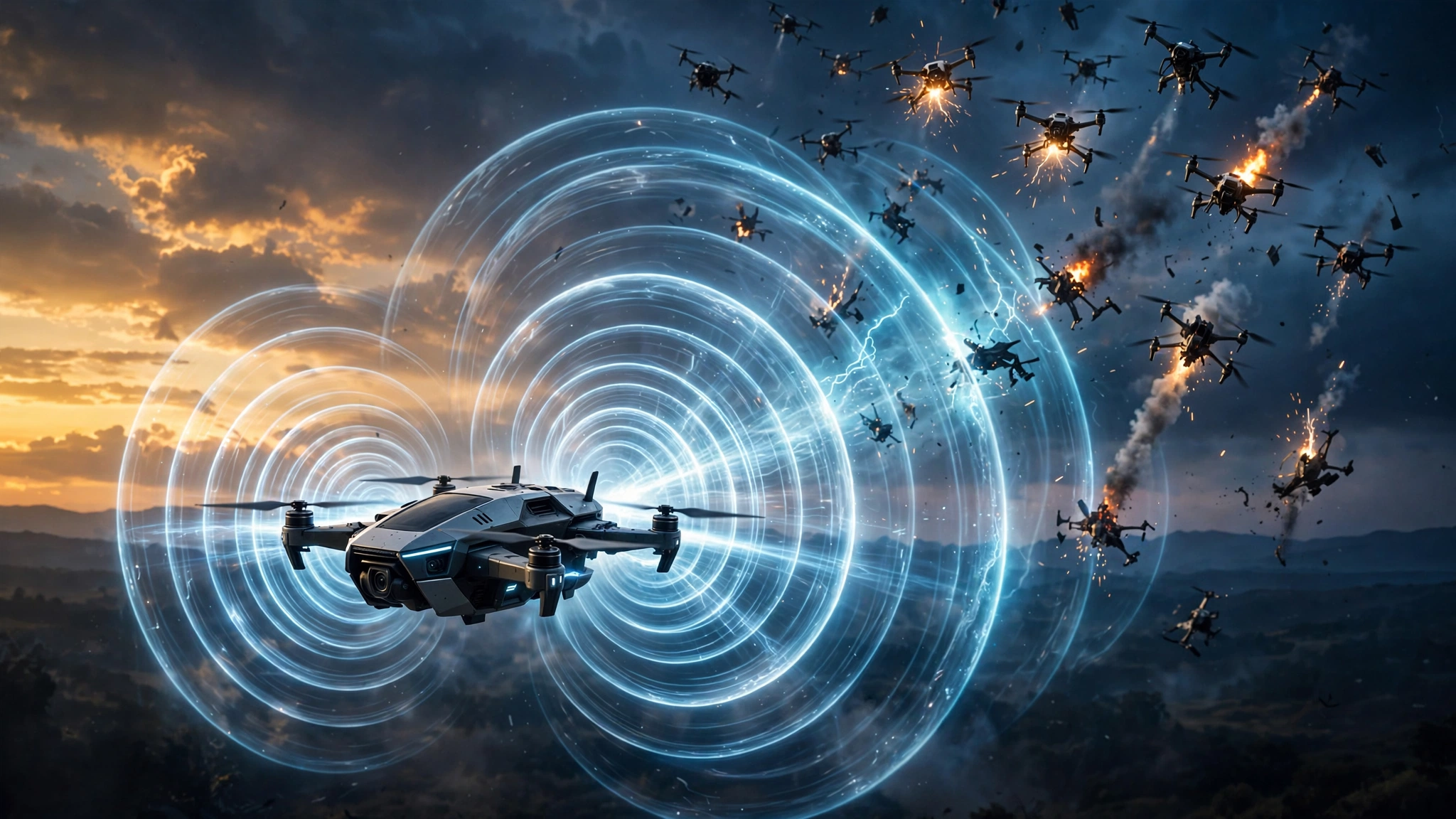
On July 20, Lockheed Martin unveiled MORFIUS X-Rotor, an airborne high-power microwave system that neutralizes more than 50 enemy drones in a single flight. It weighs less than 30 pounds, launches from a six-inch tube, flies into a swarm, and delivers roughly a gigawatt of microwave energy, frying the electronics of every drone within its blast radius. Then it lands, gets recovered, and does it again.
Fifty kills per flight, reusable after recovery.
Also on July 20, Lockheed announced PAC-3 ACE, a new Patriot interceptor costing less than half of the current PAC-3 MSE, which runs about $4 million per missile. ACE targets cruise missiles and aircraft, not drones, but its existence signals that even the kinetic side of the interceptor market is compressing under economic pressure.
On July 22, Reuters reported that Ukraine agreed to export approximately 600 drones to the United States for the Pentagon's $1.1 billion Drone Dominance program. Six Ukrainian companies each received permission to send about 100 units for testing. In its first round, that competition was won by a craft jointly produced by Ukrainian drone firm Skyfall and British company Skycutter.
Washington is buying drones from the country that taught the world how to use them against a superpower's equipment. That is not an arms deal. It is an admission.
The Cost-Per-Kill Table Nobody Has Built
We assembled cost-per-engagement data across every counter-drone system currently deployed, in testing, or recently announced. Sources span Congressional Research Service missile cost estimates, Army budget documents, manufacturer disclosures, and battlefield data from Ukraine. We could not find a comparable public table with sourcing shown, though one may exist in classified defense assessments.
| System | Type | Cost Per Kill | Reusable | Status |
|---|---|---|---|---|
| SM-3 IIA | Ship missile | $28 million | No | Deployed |
| SM-6 | Ship missile | $4.7 million | No | Deployed |
| Patriot PAC-3 MSE | Ground missile | $4 million | No | Deployed |
| SM-2 | Ship missile | $2.1 million | No | Deployed |
| Aster 15 | Ship missile | $1.1 million | No | Deployed |
| PAC-3 ACE | Ground missile | <$2 million | No | 2028 production |
| Stinger (MADIS) | Shoulder/vehicle | $480,000 | No | Deployed |
| APKWS | Guided rocket | ~$30,000 | No | Deployed |
| Coyote Block 3 | Interceptor drone | $10,000–$100,000 | No | Limited deployment |
| Ukraine P1-SUN | Interceptor drone | ~$2,000 | No | Combat-proven |
| MORFIUS X-Rotor | Airborne HPM | ~$4,000 first flight* | Yes | Testing |
| Laser (HELIOS-class) | Directed energy | $1–$10 | Yes | Prototype |
| Epirus Leonidas | Ground HPM | <$0.01 | Yes | Operational testing |
*MORFIUS cost-per-kill estimate: assuming a $200,000 unit cost (based on comparable military drone systems in the 30-pound class), 50 kills per flight yields $4,000 per kill on first flight. After 10 reuse cycles the figure drops to $400 per kill, and after 100 cycles to just $40, though Lockheed has not disclosed unit pricing and actual costs could be significantly higher or lower.
What jumps out is the spread. Between the most expensive system the Navy actually used against drones (SM-3 IIA at $28 million) and the cheapest system now in operational testing (Epirus Leonidas at under one cent), the ratio is 2.8 billion to one. Even comparing the most commonly fired missile during the Red Sea campaign, the SM-2 at $2.1 million, against the Ukrainian P1-SUN interceptor drone at $2,000, yields a ratio of 1,050 to 1.
What If MORFIUS Existed During the Red Sea Campaign?
This calculation is speculative but illustrative, since the Navy disclosed 380 total engagements during the campaign. Not all were against cheap drones; Houthi forces also launched anti-ship ballistic missiles and cruise missiles that genuinely required high-end interceptors. But Sullivan's own language, calling the drone engagements a "terrible equation," suggests a substantial majority involved one-way attack UAVs.
If we assume conservatively that 200 of those engagements targeted one-way attack drones, and if a MORFIUS X-Rotor had been available:
200 drones divided by 50 kills per flight equals four MORFIUS sorties. At a generous $200,000 per unit with zero reuse: $800,000 total.
Over that same period, the Navy spent well over $500 million in missiles. Even if only half went toward drone engagements, MORFIUS represents a cost reduction of roughly 300 to 1. Every number here is crude, the assumptions are rough, and the system has never been tested in a contested maritime environment. But the directional math is hard to ignore.
The Three Generations of Counter-Drone Defense
What the table actually reveals is three distinct technological generations colliding in real time.
Generation One was missiles designed for jets and ballistic threats, repurposed against drones because nothing else was available. This is what the Red Sea campaign looked like. It worked tactically, in the sense that ships were protected and drones were destroyed, but it was economically suicidal. You cannot fight a long war when your interceptors cost 9,400 times what they are intercepting. Magazine depth becomes the binding constraint: an Arleigh Burke destroyer carries 90 to 96 vertical launch cells. Once they are empty, the ship is defenseless.
Generation Two is the Ukrainian model, and it is already combat-proven at scale. Ukraine's P1-SUN interceptor drone has destroyed more than 5,500 Shahed-type drones since its deployment in November 2025. Its manufacturer claims capacity of 50,000 units per month. A second system, the Bullet interceptor from General Cherry, has killed over 1,000. Both cost roughly $2,000 per unit, making them single-use, kinetic, and expendable, but cheaper than the drones they are killing, which inverts the attacker's cost advantage for the first time.
Generation Three is directed energy, and it is where the math gets absurd. Epirus delivered four Leonidas IFPC-HPM prototypes to the U.S. Army in May 2024 under a $66 million contract. Army Chief of Staff Gen. Randy George testified that the systems would deploy to CENTCOM for operational testing. In January 2026, Epirus publicly demonstrated Leonidas defeating a fiber-optic guided FPV drone, the one category specifically engineered to be immune to radio-frequency jamming. In March 2026, Epirus, General Dynamics, and Kodiak AI unveiled Leonidas AGV, a fully autonomous Ford F-600 truck that drives itself to intercept points and fires microwave pulses at incoming swarms without a human in the loop. Whether that autonomy is appropriate for a weapons system is the subject of active international debate; the UN Secretary-General has called for restrictions on lethal autonomous weapons, and the question of human oversight in kill decisions is unresolved in international law.
Epirus claims a cost per engagement of less than one cent, meaning the dominant expense is the electricity consumed by the microwave pulse. Epirus has not published independent third-party validation of this figure.
The Strongest Counterargument
The case against counting on HPM weapons is straightforward: hardening works. A Faraday cage costs almost nothing at the component level, and adversaries who know they face microwave weapons can shield critical electronics with metallic enclosures, ferrite coatings, or redundant wiring. Iran, Russia, and China all have the engineering capacity to produce hardened drones within months of HPM systems reaching operational deployment.
Electronic warfare has always been a cycle of measure and countermeasure. Jammers begat frequency-hopping, frequency-hopping begat fiber-optic control, and fiber-optic control begat HPM systems that attack the electronics directly regardless of guidance method. Adversaries will respond, possibly by increasing power shielding weight, which would increase drone cost and reduce range, partially restoring the economic balance without eliminating the threat.
There is a second problem: range and endurance. MORFIUS is an airborne system that must be launched toward the swarm, fly close enough to deliver its microwave burst, and then return. Lockheed has not disclosed operational range, flight time, or engagement altitude. Leonidas is ground-based and limited to line-of-sight at relatively short range. Neither system can replicate what an SM-6 does: kill an incoming cruise missile at 240 kilometers. HPM fills a specific layer of the defense stack. It does not replace the entire stack.
And there is a third: proliferation. If HPM makes counter-drone defense trivially cheap, it also makes it cheap for authoritarian regimes to suppress civilian, humanitarian, or journalistic drone use. Every drone-defense technology is dual-use, and the actors most eager to acquire it may not be the ones the developers intend to sell to.
What We Did Not Prove
Our MORFIUS cost-per-kill estimate uses an assumed unit price of $200,000. Lockheed has not disclosed pricing. If actual cost is $500,000, first-flight cost-per-kill rises to $10,000, still vastly cheaper than missiles but less dramatic. The Red Sea engagement breakdown by target type (drone vs. ballistic missile vs. cruise missile) is not public, so our "200 drone engagements" assumption is an educated guess based on Sullivan's language and Houthi attack patterns. Epirus's sub-one-cent claim comes from the company itself and has not been independently verified under combat conditions. The Ukrainian P1-SUN's 5,500-kill count comes from its manufacturer, and Reuters noted it could not independently verify the claim.
The Bottom Line
Nobody needed the Red Sea to learn that drones are effective. Everyone already knew that from Ukraine. What the campaign proved was that the U.S. military's existing counter-drone toolkit was economically ruinous at a rate that would empty magazines and drain budgets before any peer conflict entered its second month.
In response, three announcements arrived in the third week of July 2026 from three directions at once: microwave weapons that kill 50 drones per flight and cost pennies to fire, cheaper kinetic interceptors that compress the missile tier, and a billion-dollar program to mass-produce attack drones from Ukrainian designs at industrial scale. Together, they represent the most compressed generational leap in defense economics since precision-guided munitions replaced carpet bombing in the 1990s.
For defense planners, the data argues for accelerating HPM integration. Leonidas is already in CENTCOM operational testing; MORFIUS variants have been flying since 2017. For investors, the shift from expendable interceptors to reusable energy weapons means the companies that own HPM and laser IP will capture disproportionate value. For taxpayers, the arithmetic is stark: a comparable deployment of HPM systems at scale could deliver Red Sea-level protection for a fraction of one percent of what the Navy spent in missiles. Only the timeline to operational deployment remains uncertain.