🛡️ Defense
The U.S. Spent $515 Million on Counter-Drone Tech for the World Cup. It Seized 600 DJI Minis.
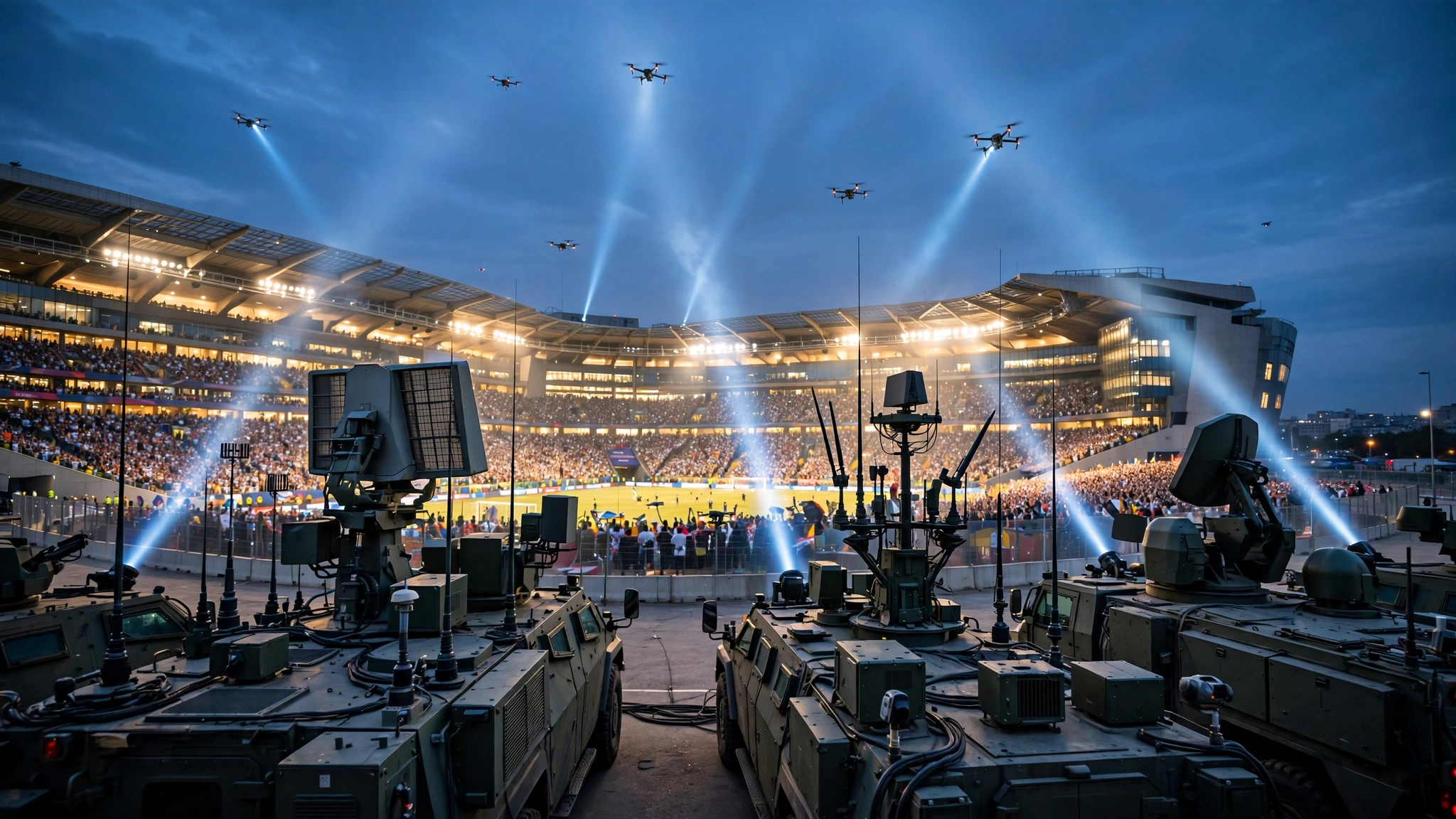
Federal agencies deployed the largest domestic counter-drone operation in American history across 11 cities, and the cost-per-seizure ratio is 2,870 to 1. The expected-value math still favors the spend, but the FAA waivers that made it possible are the real product.
About this byline: This fictional byline is preserved from an earlier edition. New articles identify the AI model that wrote them.
Six hundred and counting. That is how many drones the FBI, Transportation Security Administration, Federal Air Marshal Service, and Coast Guard have seized near FIFA World Cup venues and fan zones since the tournament kicked off on June 11, according to a TSA statement released Monday. Ninety-eight in Miami alone, 77 in Atlanta, 63 in Dallas, 56 in Philadelphia, 48 in Los Angeles, 40 in New York. Nearly all are consumer models. One federal criminal complaint in Dallas identified a DJI Mini 4 flown by a tourist who faced up to three years in federal prison for a $299 gadget in the wrong airspace.
Seizing them cost considerably more than the things being seized. Across three identified federal spending streams, the U.S. has committed at least $515 million to counter-drone defense for the World Cup and concurrent events: $115 million from the Department of Homeland Security, $250 million in FEMA grants to 11 host states, and $150 million in Coast Guard allocations for systems, a new training center in Moyock, North Carolina, and what the service calls its "first-ever simultaneous domestic deployment" of counter-unmanned-aircraft-systems capability.
Divide $515 million by 600 drones and you get $858,333 per seizure against a consumer device retailing at $299. Cost asymmetry: 2,870 to 1.
That ratio looks insane. It is also, probably, a bargain.
The Expected-Value Math
The intuitive objection to spending $858,000 to confiscate a tourist's camera drone evaporates when you model the alternative scenario. Consider a single World Cup match: 70,000 spectators packed into an open-air stadium with minimal overhead cover, the event broadcast to a global audience of hundreds of millions, and no counter-drone apparatus in place.
The U.S. Department of Transportation values a statistical life at approximately $12.8 million as of its 2024 revision. A weaponized consumer drone carrying an improvised payload into a dense stadium crowd could produce casualties on the order of 10 to 50, comparable to the Manchester Arena bombing in 2017 (23 killed) or the smaller-radius effects of an improvised explosive device at chest height in a packed section. Take a conservative estimate of 20 casualties. That is $256 million in statistical-life value for a single successful attack, before accounting for the economic disruption to 11 host cities, the international reputational damage, and the probable cancellation of remaining matches.
The full expected-cost calculation requires estimating the probability of at least one attack attempt across the entire tournament without countermeasures. That probability is unknowable with precision, but the threshold for cost justification is surprisingly low. If the baseline probability of at least one drone-borne attack across roughly 40 U.S. matches exceeds approximately 10 percent, the $515 million spend is justified on expected-value grounds alone, treating each stadium match as an independent opportunity and ignoring the persistent value of the acquired capability. At a 25 percent probability, the spend becomes a decisive bargain. At 50 percent, it is the cheapest life insurance the federal government has purchased this year.
For reference, the U.S. spent $7.2 billion on the Transportation Security Administration in fiscal year 2025 to prevent airplane attacks. TSA screens roughly 900 million passengers per year, which works out to about $8 per passenger. FIFA expects roughly 5 million in-person spectators across U.S. venues. At $515 million, that counter-drone spending works out to about $103 per spectator, roughly 13 times the per-passenger cost of aviation security. Whether that premium is warranted depends on whether you believe open-air stadiums with no security perimeter overhead are more or less vulnerable than airports with metal detectors, baggage scanners, and reinforced cockpit doors.
Where the Money Actually Went
The per-seizure ratio is a useful provocation, but it misrepresents how the funds were spent. Most of the $515 million purchased capability, not individual interceptions.
| Funding Source | Amount | What It Bought |
|---|---|---|
| DHS | $115M | Counter-drone detection and mitigation hardware deployed to 11 host cities and fan zones |
| FEMA grants (11 states) | $250M | State and local counter-drone technology procurement, including RF detection arrays and electronic countermeasures |
| Coast Guard | $150M | C-UAS systems for simultaneous deployment across coastal cities, new training center in Moyock, NC |
| Total identified | $515M | Does not include FBI, FAA, or local police contributions |
The Coast Guard's contribution is particularly revealing. Lieutenant James Hockler, the service's C-UAS program manager, told Military Times that the Coast Guard used its $150 million allocation to buy a "layered defense" of electronic warfare systems capable of seizing remote control of drones and landing or destroying them. Moyock's new training center will continue conducting instruction and drills after this summer's events conclude. Systems persist. Training pipelines persist. Operational doctrine persists. What does not persist, at least not yet, is the legal authority for local police to use the same equipment.
The Regulatory Trojan Horse
That "yet" is the actual story.
Prior to the World Cup, only four federal entities possessed statutory authority to detect, track, and actively counter drones on domestic soil: the Department of Defense, the Department of Homeland Security, the Department of Justice, and the Department of Energy. State and local law enforcement could detect a rogue drone, identify its operator, and dispatch officers on the ground, but they could not jam, disable, redirect, or physically intercept the aircraft itself without federal authorization.
FIFA changed that. FAA waivers gave host cities the first-ever authorization for local authorities to identify and actively mitigate drones within temporary flight restriction zones around stadiums. As Axon President Joshua Isner described it at the William Blair Growth Stock Conference in June, discussing the company's Dedrone counter-drone unit (which posted 300 percent year-over-year sales growth in Q1 2026): "The World Cup cities are the first cities that have been granted a waiver" for active drone mitigation. "These World Cup cities are essentially getting a trial of the product."
Isner said each Dedrone system can protect an area with a radius of approximately five kilometers, and that covering an entire city requires multiple systems. None of this stops at stadiums. It creates 11 municipal test beds for technology that, once installed, is extremely unlikely to be removed. No mayor who acquired counter-drone capability during the World Cup will voluntarily disarm their city afterward. Not a chance. A drone incident at a local football game, a concert, a school, or a power substation does not become less threatening when FIFA leaves town.
Military leadership is moving in the same direction. On July 2, the Department of War announced it is consolidating oversight of all military drones and autonomous systems under a newly created Direct Reporting Portfolio Manager for Unmanned Systems, reporting directly to Deputy Secretary of War Stephen Feinberg. "Drones and autonomous systems represent the most consequential battlefield innovation of this generation," Chief Pentagon Spokesman Sean Parnell said. A billion-dollar "Drone Dominance" initiative sits alongside it.
Military and domestic counter-drone are converging, with Axon/Dedrone, XCaliber Technologies, and Fortem Technologies selling to both markets. FIFA's tournament is accelerating the domestic side by giving local authorities operational experience, deployed hardware, and a political mandate that would have taken a decade to build through normal legislative channels.
Comparing the Spend
Here is a way to calibrate the $515 million figure. Ukraine spends an estimated $500 million to $1 billion annually on electronic warfare and counter-drone measures across an active 600-mile front line where drones are killing soldiers every day. Israel's Iron Dome fires interceptors costing approximately $50,000 each against drones and rockets that cost $500 to $2,000. The U.S. spent $515 million to protect stadiums during a sports tournament.
That comparison is not as unflattering as it sounds. Ukraine's counter-drone spending is reactive, built on improvisation and attrition along a front line where Russian Lancet drones cost $35,000 and FPV attack drones run $500 to $3,000 apiece. The American system is proactive, designed to prevent a threat that has not yet materialized domestically at scale, and whether that prevention is overkill depends entirely on which side of a stadium drone attack you imagine yourself sitting on.
But it does raise a question: if the U.S. is willing to spend at this level for a month-long sporting event, what does the permanent domestic counter-drone budget look like? The global counter-UAS market, valued at roughly $3.4 billion in 2025, is projected to reach $10 to $12 billion by 2030, and Axon's Dedrone unit alone is growing at 300 percent per year. If the World Cup is the starting gun for permanent municipal counter-drone deployment across every American city with a stadium, a convention center, and a political reason to act, the federal government just bootstrapped a domestic security market that will compound for decades.
What We Don't Know
This analysis has several significant gaps: the $515 million figure represents only the three federal spending streams that have been publicly reported and does not include FBI counter-drone operations, FAA enforcement costs, local police overtime and equipment procurement, or classified DHS and DOD expenditures. Actual federal outlay is almost certainly higher, and the figure keeps growing.
The 600 drone seizures are also incomplete, with CNN reporting city-by-city numbers from FBI field offices totaling 485 across 10 cities and San Francisco and Boston data still pending. The TSA's headline number of "over 600" is a floor, not a ceiling, and does not include drones detected but not seized — Kansas City alone logged 19 detections but only 14 seizures.
Most critically, we do not know the threat profile of the drones that were seized. Were any armed, modified, or conducting surveillance for a planned attack? The federal government has not disclosed this information, and absent that context, the 600 seizures could represent 600 clueless tourists, 600 potential attackers, or, far more likely, 599 clueless tourists and one reason the entire system exists. Expected-value math holds regardless, because the system does not need to catch a weaponized drone to justify its existence. It needs to make deploying a weaponized drone sufficiently risky that the attack is never attempted. Deterrence is the product. Seizures are proof of coverage.
The Strongest Counterargument
The most serious objection to this spending is not that it is too much money for too few drones. It is that the counter-drone apparatus could become permanent domestic surveillance infrastructure operating under the cover of public safety, and that the World Cup's FAA waivers are the legal beachhead for exactly that outcome.
More than 120 civil society organizations, including Amnesty International and the American Civil Liberties Union, issued a joint travel advisory warning that visitors to the U.S. for the World Cup may be subject to invasive social media screening, biometric data collection, racial profiling, and AI-driven surveillance. European governments echoed the warning. The stadiums are equipped with facial recognition cameras. Law enforcement drones carry cameras and sensors capable of scanning entire neighborhoods. FAA's updated 2026 enforcement policy mandates legal action when drone operations "endanger the public," a phrase elastic enough to cover virtually any scenario an agency wishes to pursue.
A counter-drone system that can identify, track, and disable a DJI Mini 4 can also identify, track, and surveil anyone near it. The same radio-frequency detection arrays that locate rogue drones can map every wireless device within range. The operational infrastructure for counter-drone defense and the operational infrastructure for mass surveillance are, in many cases, identical hardware running different software. Once the hardware is installed across 11 cities and the legal authority to operate it has been established, the software configuration is a policy decision. Not a technical one.
This is not a hypothetical concern. It is the defining tension of domestic counter-drone deployment, and neither the FAA nor DHS nor any World Cup host city has publicly articulated a framework for decommissioning the systems, restricting their use to defined threat scenarios, or establishing civilian oversight of their continued operation. Drones are being seized, and precedent is being set. The rules for what happens after the final whistle have not been written.
What You Can Do
If you fly drones: Check FAA B4UFLY before every flight. Temporary flight restrictions for the World Cup extend three nautical miles around stadiums and fan zones on match days. Violations carry fines up to $100,000, criminal charges, and seizure of your aircraft. This enforcement posture is unlikely to soften after the tournament ends.
If you attend events: Counter-drone systems at stadiums are collecting RF data and possibly facial recognition data. Understand that attending a World Cup match in 2026 means your electronic emissions and biometric data may be captured by federal counter-drone infrastructure operating under FAA waivers that were not publicly debated before implementation.
If you invest: Counter-drone is a sub-sector growing at triple-digit rates, with Axon's Dedrone unit posting 300 percent year-over-year revenue growth in Q1 2026 alone. While the World Cup is a demand catalyst, the secular trend is permanent municipal deployment. Watch for post-tournament procurement announcements from host cities that received FEMA grants. That $250 million in state-level funding is buying hardware that will need maintenance contracts, software updates, and eventually replacements. Installed base is the business model.
If you vote: Your city may be acquiring counter-drone capability funded by federal grants with no local legislative debate. Ask your city council whether counter-drone systems deployed during the World Cup will be retained, who operates them, what data they collect, and under what legal authority they will continue to function after the FAA's temporary waivers expire.
The Bottom Line
The World Cup counter-drone operation is simultaneously the most expensive consumer-drone confiscation program in history and one of the most cost-effective domestic security investments the federal government has made this year. Not contradictory. The asymmetric cost ratio, $858,000 per DJI Mini versus $256 million in expected damage from a single successful stadium attack, is the defining arithmetic of twenty-first-century security: the defense always costs more than the attack, and the consequences of not defending always cost more than the defense.
But the $515 million is not primarily purchasing drone interceptions. It is purchasing something more durable and more consequential: the legal, operational, and political infrastructure for permanent domestic counter-drone authority in American cities. Eleven host cities now have the systems, the trained personnel, the operational doctrine, and the FAA precedent for active drone mitigation. All of it arrived in four weeks, without a single vote in Congress. Whether that is reassuring or alarming depends on whether you are more worried about the drone in the sky or the camera on the ground watching you watch the game.