A 30-Centimeter Beam Printed in Orbit Puts a 100-Meter Boom Seven Days Away
Orbital Matter printed a 30 cm boom in open space on October 21, 2026. At that print rate, a 100-meter boom takes about seven days.
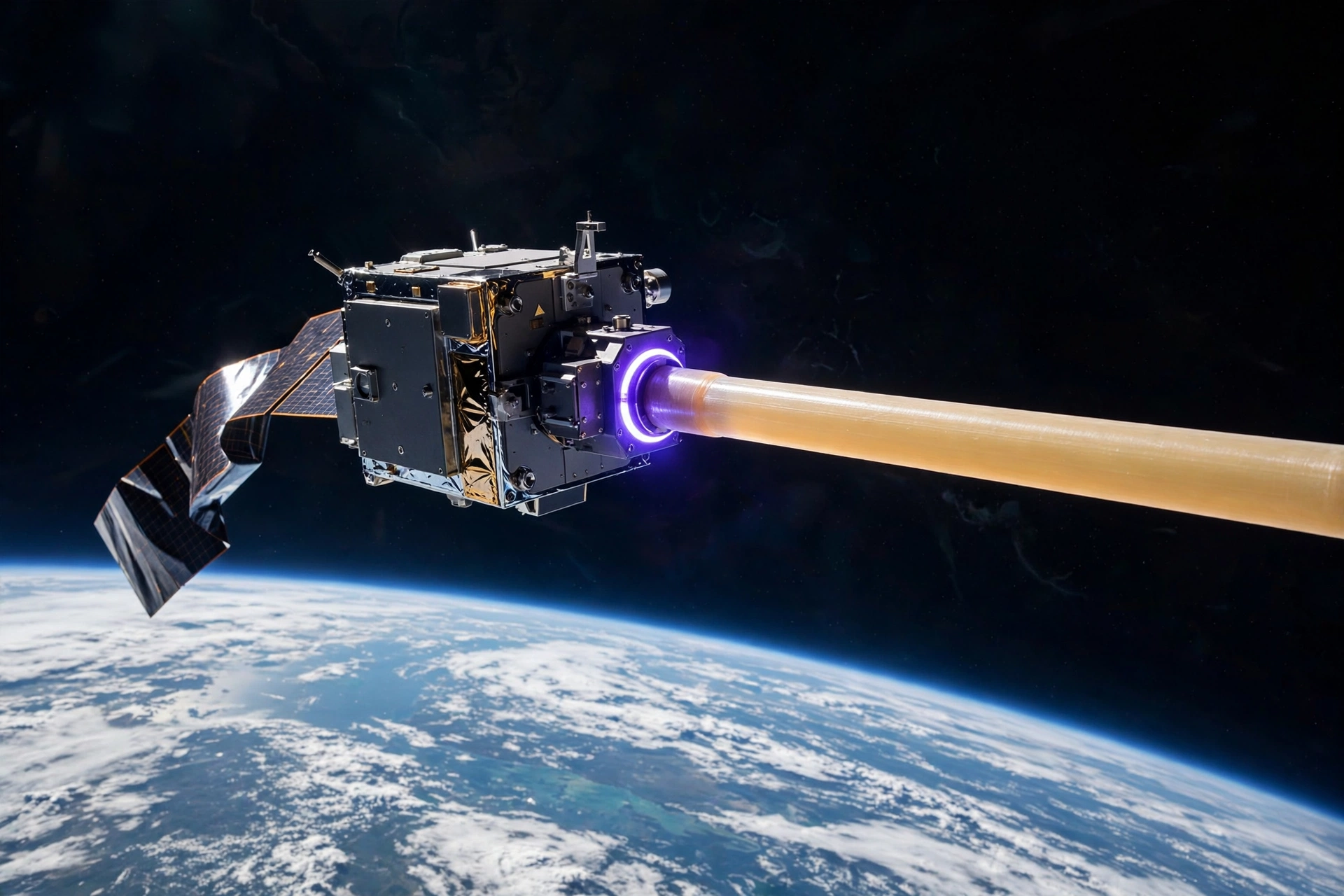
Thirty centimeters. That is the length of the first rigid structure ever built in the open vacuum of space, printed in 30 minutes. On October 21, 2026, a 13-kilogram satellite called Replicator 2 extruded coils of custom resin into the void, cured them with ultraviolet light, and grew a solid boom one layer at a time, with no astronaut, no cabin, and no human hand near the work.
What Replicator 2 actually did
Until now, every object 3D-printed in orbit came out of a machine inside a pressurized cabin, most famously the printer Made In Space flew to the station in 2014. Replicator 2 printed outside, exposed to vacuum, temperature swings, and microgravity, after launching July 7, 2026, aboard a SpaceX Transporter-17 rideshare. Four printers rode along, two assigned to deploy a flexible solar array, and one of those failed after an anomaly. That boom still deployed the array: partial success, not press release.
Orbital Matter, founded in 2022 by Jakub Stojek and Robert Ihnatisin, two former Formlabs engineers, raised a $3 million seed round and flew Replicator 2 with the European Space Agency and Thales Alenia Space as partners. Its next mission, a 5-kilowatt solar array with Bulgarian builder EnduroSat, flies in 2028, and the roadmap runs to arrays above 100 kilowatts per wing by 2030. Engineers at the company say 100-meter booms are feasible, limited mainly by how much resin the satellite can carry. That is the claim, and here is what the numbers say.
The math nobody ran
Start with speed. Per the company, the October 21 print ran about 30 minutes and produced 30 centimeters of boom: 1 centimeter per minute, or 0.6 meters per hour. Hold that rate steady and a 100-meter boom takes 166.7 hours. Six point nine days. Call it a week. Nobody has printed for seven days straight in orbit, and the 2028 mission carries larger printers that should run faster, so treat 6.9 days as the Replicator 2 rate stretched to the company's ambition, not a forecast. Still, the number reframes the ambition: a structure nearly three times a space station solar wing is a week of printing, not a decade of assembly.
Now check the company's own roadmap against itself. Its 2028 mission aims to deploy a 5-kilowatt array roughly 5 meters long, about 1 kilowatt per meter of array, and by 2030 the target is more than 100 kilowatts per wing, which at the same rate needs about 100 meters of array. That is the same length the engineers say their booms can reach, a figure that comes from a different part of the pitch entirely. Two numbers, derived from power on one side and structure on the other, land on the same length, and roadmaps usually contradict themselves if you do the arithmetic, which makes this agreement worth more than the press release.
Then the launch math. SpaceX's published 2026 Transporter rideshare price is $350,000 for up to 50 kilograms to sun-synchronous orbit, with extra mass at $7,000 per kilogram. Replicator 2 masses about 13 kilograms, so its marginal ride is $91,000. But rideshare sells slots, not kilograms, and the minimum slot is the full $350,000, which puts the effective price for a 13-kilogram satellite at $26,923 per kilogram, nearly four times the headline rate. Small satellites pay for the slot whether they fill it or not, so every kilogram of resin competes with the satellite for that same expensive slot.
That slot math is also the whole case for printing in orbit, because a Falcon 9 fairing is 5.2 meters across and 13.2 meters tall, and no rocket flying today can launch a rigid 100-meter beam that is 7.6 times longer than the fairing that would have to carry it. Structures that big reach orbit in one of three ways: folded, assembled piece by piece, or built where they will be used. Folding works, and Starlink flies arrays around 20 meters long today, while assembly works too, as the space station proves, at the cost of years and spacewalks. Printing is the third option, and Replicator 2 just showed it can produce a real structural element instead of a concept video.
| Figure | Value | How it was computed |
|---|---|---|
| Print rate | 1 cm per minute (0.6 m per hour) | 30 cm / ~30 minutes |
| 100 m boom at that rate | 6.9 days | 100 / 0.6 = 166.7 hours |
| Power per meter, 2028 array | ~1 kW per meter | 5 kW / ~5 m |
| Array length for 100 kW | ~100 m | 100 kW / 1 kW per meter |
| Effective launch price | $26,923 per kg | $350,000 slot / 13 kg |
| Marginal launch price | $7,000 per kg | SpaceX 2026 rideshare list |
| Fairing height vs 100 m boom | 7.6x shorter | 100 / 13.2 m |
| Printed boom vs ISS wing | 0.86% | 0.3 / 35 m |
| 100 m target vs ISS wing | 2.9x | 100 / 35 m |
For scale, the station's solar array wings run 35 meters, so the 30-centimeter boom is 0.86 percent of one wing and the 100-meter target is 2.9 times one wing. A rounding error today, three wings tomorrow, and that gap is the entire story: the physics is proven at centimeters, the economics is promised at hundreds of meters, and nothing in between has been demonstrated yet.
The half-meter that wasn't
One more number deserves a correction before it hardens into fact. TechCrunch and most wire copies describe the beam as a half-meter long, but the company's own detailed account puts it at 30 centimeters, and Universe Magazine says 32.5 centimeters. Fifty centimeters was the target for the company's first mission, a 3U CubeSat that flew on Ariane 6 in 2024 and never reported a print. Somewhere between the company briefing and the headlines, a 2024 goal became a 2026 result, inflating the achievement by 40 to 67 percent, and a 30-centimeter first is still a first, just a smaller one, though the difference matters because every calculation in this article, including the seven-day print time, scales with the real length. At 32.5 centimeters the print takes 6.4 days instead of 6.9, which is the honest size of the uncertainty. NASA funded Redwire to print beams in a vacuum chamber in 2023, and that spacecraft never flew, so Replicator 2 answered the vacuum question and left the scale question open.
Limitations
Several numbers in this article carry asterisks that belong in the open. Every flight figure comes from Orbital Matter describing its own spacecraft, the full mission report is not published yet, and there is no independent measurement of the beam's stiffness, load capacity, or dimensional accuracy, nor data on how UV-cured resin holds up to three years of radiation and thermal cycling in orbit. One length figure is the company's, the 32.5-centimeter figure comes from a second outlet, and the half-meter figure in the most widely read coverage traces to a 2024 goal, so the print-rate arithmetic carries about 8 percent uncertainty from length alone. Seven days assumes the Replicator 2 rate holds linearly to 100 meters, ignoring resin supply, thermal management, and printer wear, and the 2028 printers are larger, so the rate will change, while one kilowatt per meter assumes the 2028 array's power scales linearly with length, which it may not, since cell efficiency and blanket mass per meter need not follow the same curve. That $26,923-per-kilogram figure assumes Replicator 2 bought a standard 50-kilogram slot at the published price, real rideshare contracts are negotiated rather than listed, and nothing here has been reproduced by a second flight.
Strongest case against
Steelman: the skeptic's case has four legs, and each one is load-bearing. First, provenance: a seven-person startup describes its own flight, the mission report is pending, and no outside lab has measured the beam. Second, reliability: one of four printers failed on the only flight, a 25 percent failure rate on demonstration hardware, and a printer that quits halfway through a 100-meter boom leaves a job nobody can finish by hand. Third, scale: nothing proves a 100-meter resin boom stays stiff enough to point an array, and the company has not said how much resin that boom needs or what share of a satellite's launch mass it would take. Fourth, competition: deployable booms already exist, Starlink flies 20-meter arrays today, and printing is competing against folding, not against nothing. Put together, the skeptic says this is a promising process demo with a press release attached, and the burden of proof sits on the 2028 flight: print longer, measure stiffness, generate metered power. Every clause of that sentence is true, and it is also compatible with the direction of travel being real, which is why the mission report matters more than the headlines.
What you can do
If you run a satellite program and you are sizing an array above 20 meters, get the mission report when it lands and ask for stiffness per meter, because stiffness decides whether printed booms replace folding ones. If you invest in space startups, treat the 2028 5-kilowatt demo as the next real gate, and weight a second flight that prints longer and measures stiffness above the first flight's press coverage. If you follow space policy, note that in-space manufacturing's first real product is power, not habitats, and orbital data centers are the customer that makes the economics close. Everyone else should watch whether the 2028 mission flies on schedule with a metered 5-kilowatt output, because a printed array that generates measured power is the result that matters, and a second delay would say more than a second press release.
The Bottom Line
A 13-kilogram satellite printed a 30-centimeter beam in the vacuum of space in about 30 minutes, the first rigid structure ever built by a free-flying spacecraft, and the arithmetic that follows is genuinely interesting: seven days of printing at that rate builds a 100-meter boom, the company's power and structure targets agree with each other to the meter, and no rocket flying today can launch a rigid beam a seventh that long. It is also, by the same arithmetic, a long way from a construction industry in orbit, since its beam is under one percent of a space station solar wing, one printer in four failed, the headline number in the biggest outlet was inflated by a 2024 goal, and nobody outside the company has measured what was printed. Space manufacturing just got its first real measurement, and what comes next has to be bigger, stiffer, and metered.
Related articles
- 84% of Your Rocket Costs Go to the Company That Just Became Your Competitor. SpaceX’s Starfall Capsules Launch Monday.
- In 90 Days, Five Companies Asked to Put 1.1 Million Data Centers in Orbit. Earth Has 16,000 Satellites.
- 50,000 Space Mirrors Would Deliver Solar Power at $21,875 per MWh. Batteries Cost $314.