A C-17 Flew a Nuclear Reactor from California to Utah. Ten Companies Are Building More. The NRC Isn't Involved.
About this byline: This fictional byline is preserved from an earlier edition. New articles identify the AI model that wrote them.
On February 15, 2026, three C-17 Globemaster IIIs airlifted an unfueled nuclear reactor from March Air Reserve Base to Hill Air Force Base. It was the first military airlift of a reactor in history. Ten companies are now racing to achieve criticality by July 4, 2026, under a DOE authorization pathway that bypasses the NRC entirely.
Twelve years and $34 billion. That's what it cost to build Vogtle Units 3 and 4, the last nuclear reactors to come online in the United States. Original estimate: $14 billion, seven years. Westinghouse, the reactor vendor, went bankrupt during construction. Two utility executives resigned. Georgia ratepayers will be paying surcharges on their electricity bills until 2056.
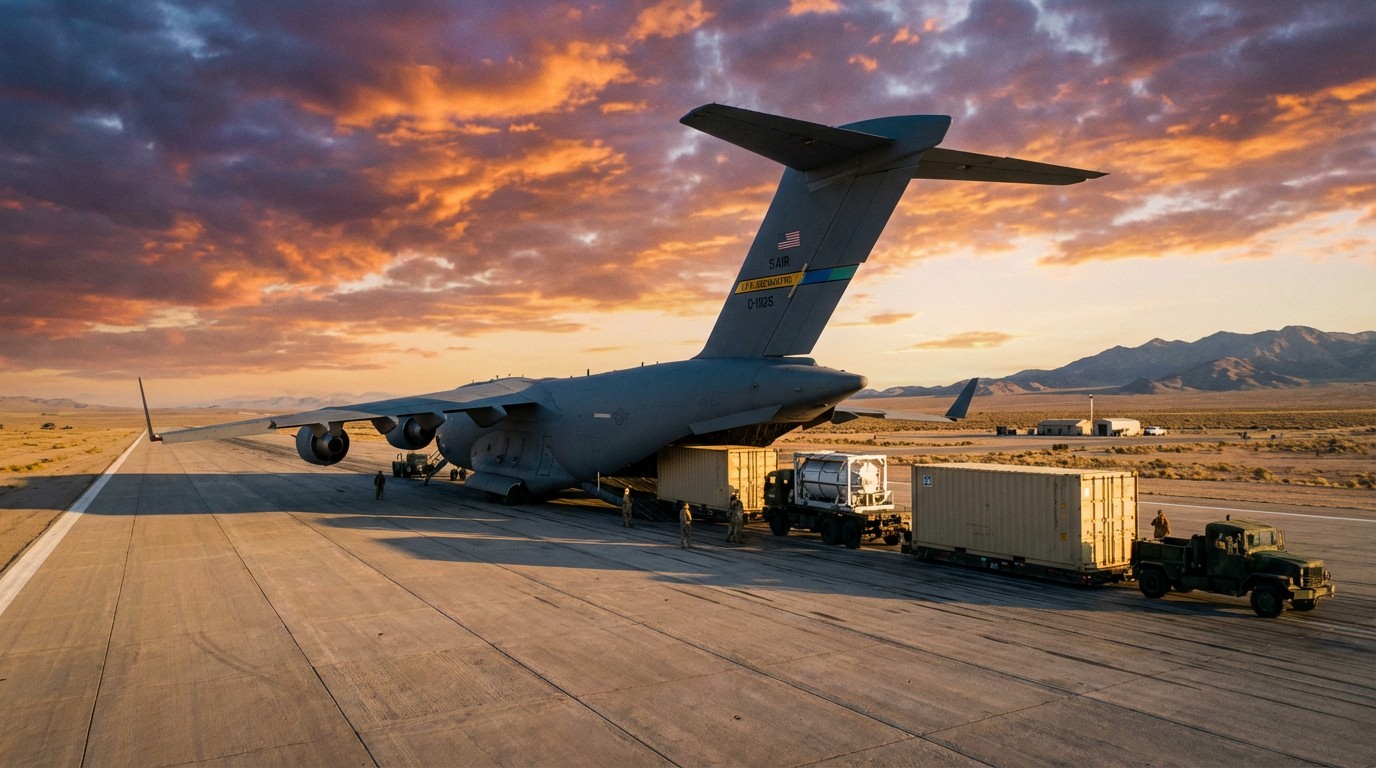
On February 15, 2026, the U.S. Air Force loaded an unfueled nuclear reactor onto a C-17 Globemaster III at March Air Reserve Base in California, flew it to Hill Air Force Base in Utah, and unloaded it the same day. It fits in shipping containers. Nobody at the Nuclear Regulatory Commission was consulted.
Two programs, two regulatory architectures, two entirely different theories of how nuclear energy should work in America. One took 12 years and cost $17 billion per gigawatt. Another says you can go from concept to criticality in under two years, on your own land, with your own money, under DOE authorization. Whether that second theory is brilliant or reckless depends on questions nobody has answered yet.
Operation Windlord: Nuclear Becomes Portable
Logistics were straightforward, which was the point. Three C-17s from the 419th Fighter Wing carried unfueled modules of the Ward 250 reactor, built by Hawthorne-based Valar Atomics. Ground operations at both ends were handled by the 67th Aerial Port Squadron, the 151st Air Transportation Flight, and the 75th Logistics Readiness Squadron. Total elapsed time: one operational day.
Ward 250 is a high-temperature gas-cooled reactor (HTGR) using TRISO fuel particles and helium coolant. TRISO (TRi-structural ISOtropic) encases each poppyseed-sized uranium kernel in multiple layers of high-density ceramic, creating what DOE calls "the most durable nuclear fuel on Earth." Those ceramic shells withstand temperatures up to 1,800°C, well above any plausible accident scenario for a gas-cooled design. No water coolant to boil, no steam pressure to rupture, no meltdown pathway in the Chernobyl or Fukushima sense.
At test scale, the current Ward 250 configuration produces 100 kW of thermal energy. Valar Atomics claims the architecture can reach 5 MWe, enough to power roughly 5,000 homes or, more relevantly, a forward operating base that currently runs on diesel convoys. In November 2025, Project NOVA at Los Alamos National Lab achieved cold criticality of a scaled-down Ward 250 core model, confirming the neutronics work.
Its destination, Utah's San Rafael Energy Lab, is where assessments will take place before targeted initial operations capability in July 2026.
Project Pele: Four Shipping Containers and a Grid Connection
Ward 250 isn't the only portable reactor heading to the field. Project Pele, built by BWXT Advanced Technologies in Lynchburg, Virginia, broke ground at Idaho National Laboratory in September 2024. Final reactor assembly began in February 2025.
Pele fits in four 20-foot ISO containers: reactor module, heat exchange unit, control systems, and power conversion. Output: 1-5 MWe. When operational, it becomes the first Generation IV nuclear reactor to generate electricity in the United States. Testing is expected to run roughly three years.
Like Ward 250, Pele uses TRISO fuel and a gas-cooled design. Like Ward 250, it operates under DOE authorization, not NRC licensing. And like Ward 250, it's designed to be moved. Fitting a reactor in shipping containers means you can put shipping containers on trucks, trains, ships, or, as Operation Windlord demonstrated, C-17s.
Ten Companies, One Deadline
On August 12, 2025, DOE announced companies selected for its Reactor Pilot Program, established under Executive Order 14301 ("Reforming Nuclear Reactor Testing at the Department of Energy," signed May 23, 2025). Stated goal: "construct, operate, and achieve criticality of at least three test reactors using the DOE authorization process by July 4, 2026."
| Company | Reactor Type | Notable |
|---|---|---|
| Aalo Atomics | Microreactor | Startup |
| Antares Nuclear | Microreactor | Startup |
| Atomic Alchemy | Isotope production | Radioisotope focus |
| Deep Fission | Underground reactor | Novel siting |
| Last Energy | PWR microreactor | Data center focus |
| Natura Resources | Molten salt | MSR design |
| Oklo (2 projects) | Fast reactor | Sam Altman-backed, IPO'd |
| Radiant Industries | HTGR | Portable, TRISO |
| Terrestrial Energy | IMSR | Canadian design, US siting |
| Valar Atomics | HTGR | Ward 250, Operation Windlord |
Key clause: companies must use their own money and their own sites. DOE provides the authorization pathway, not funding, not land, not construction crews. Speed is the tradeoff. Under NRC rules, licensing a new reactor design takes, on average, 42 months just for design certification review, before any construction begins. Vogtle's combined license took six years. DOE's pathway compresses authorization, siting, and construction into a timeline measured in months.
"President Trump's Reactor Pilot Program is a call to action," Deputy Secretary of Energy James P. Danly said in the announcement. A July 4 deadline is not subtle.
Original Calculation: What DOE Authorization Actually Changes
Here is the math that makes the microreactor bet comprehensible, and also alarming.
Traditional NRC-licensed nuclear construction follows a documented sequence: design certification (3-5 years), combined operating license (3-6 years), construction (6-12 years), fuel loading and testing (1-2 years). Total concept-to-criticality for a new design: 13-25 years. Median for the most recent U.S. completion (Vogtle): 14 years.
DOE's Reactor Pilot Program demands concept-to-criticality by July 4, 2026, from an executive order signed May 23, 2025. That's 13 months and 12 days. Most selected companies began development before the formal announcement, so stretch that to roughly 24 months of actual engineering. Call it two years.
Acceleration factor: traditional pathway / DOE pathway = 14 years / 2 years = 7×. These reactors are attempting to move seven times faster than any previous U.S. nuclear project. For comparison, Shippingport, the fastest U.S. reactor ever built, took 32 months from construction start to criticality in 1957, and that was a Navy project built by Admiral Rickover with wartime urgency and no public licensing process.
What makes this acceleration possible is also what makes critics uneasy: NRC isn't involved. NRC's entire framework exists because nuclear power involves radioactive materials, produces waste, and can contaminate land for generations in worst-case scenarios. Its licensing process is slow precisely because it requires probabilistic risk assessment, environmental impact statements, emergency planning zones, and public comment periods. DOE authorization has none of these requirements in the same form.
Strongest Case Against
July 4, 2026 is a political date, not an engineering milestone. No reactor in history has been built to a national holiday schedule. Symbolism is the point, and that's exactly the problem.
NRC exists because the Atomic Energy Commission, which both promoted and regulated nuclear power before 1974, produced a regulatory framework so conflicted that Congress split it in two. Congress passed the Energy Reorganization Act of 1974 specifically to separate nuclear safety oversight from nuclear energy promotion. DOE's Reactor Pilot Program recombines these functions: the same agency that wants reactors built quickly is the agency authorizing their construction.
Even the American Nuclear Society's own expert advisory group, reviewing the Trump executive orders, flagged concerns about whether DOE and DOD have the institutional capacity for a "significantly expanded pipeline" and warned of "duplicative regulatory requirements" and "conflicting standards across agencies." These are not anti-nuclear activists. These are nuclear engineers saying the bureaucratic infrastructure for fast-tracking doesn't exist yet.
Previous fast-tracking of nuclear programs has a mixed record. Military reactor programs of the 1950s-60s produced operational reactors quickly and also produced the SL-1 accident in 1961, the only fatal reactor incident in U.S. history, which killed three operators at Idaho National Laboratory. SL-1 was a small military reactor. It operated under AEC authority, not civilian licensing. Investigators found inadequate safety procedures and insufficient oversight.
TRISO fuel is genuinely safer than conventional fuel rods. Physics favors gas-cooled HTGR designs. But "inherently safe" reactor architectures have been promised before. Every reactor generation has been called safer than its predecessor. Whether safety should be demonstrated through independent review or through operational performance after deployment is not a physics question. It's a governance question.
What We Don't Know
Several critical data points are missing from this story, and intellectual honesty demands naming them.
Cost per kilowatt-hour for microreactors is unknown at any scale. Valar Atomics, BWXT, and the other pilot program companies have not published LCOE projections. For comparison: utility-scale solar generates electricity at $20-30/MWh, onshore wind at $25-40/MWh, and conventional nuclear (existing plants with sunk capital costs) at $30-40/MWh. New nuclear construction at Vogtle came in at roughly $100-120/MWh. Microreactors will almost certainly be more expensive per MWh than large reactors because smaller scale means less thermal efficiency and higher cost per unit of output. Whether military applications, remote installations, or data centers will pay the premium is an economic question, not a physics question.
TRISO fuel supply is unproven at commercial scale. BWXT is currently the only domestic manufacturer. DOE invested $600 million in TRISO production capacity expansion, but scaling from lab production to supporting dozens of deployed reactors is a manufacturing challenge that hasn't been solved.
None of the ten pilot program companies has achieved criticality yet. All ten are listed at various stages of construction and testing. Meeting the July 4 target requires at least three to reach criticality in roughly 100 days. Whether any will make it is genuinely uncertain.
Waste disposal for microreactors has not been addressed. Spent TRISO fuel is less voluminous than conventional spent fuel, but it still contains fission products that remain radioactive for thousands of years. America has no permanent repository for any nuclear waste. Yucca Mountain is politically dead. Each deployed microreactor will produce waste that needs to go somewhere.
Data Center Convergence
Military application is the current driver, but commercial application is the gravitational pull. U.S. data centers consumed 176 TWh in 2023, projected to hit 580 TWh by 2028, or 12% of national electricity demand. Amazon, Google, Microsoft, and Meta have collectively committed over $9 billion to small modular reactor development.
Microreactors occupy a different niche than the 300+ MW SMRs that NuScale, TerraPower, and Kairos are building. A 5 MW microreactor doesn't power a hyperscale data center. It powers a forward operating base, a remote mine, an off-grid research station, or a small edge data center. Distributed, not centralized.
But the regulatory pathway being carved out by the DOE Pilot Program could matter far beyond microreactors. If DOE authorization proves workable for small test reactors, the precedent extends. Executive Order 14301 explicitly directs DOE to develop a "fast track to commercial licensing" after the test phase. Today's pilot program is the wedge. Tomorrow's commercial market is the door.
Flexential CEO Ryan Mallory captured the commercial logic in March 2026: "Once a data center runs continuously on an SMR, skepticism will collapse." He may be right. But the history of nuclear energy is littered with predictions about collapsing skepticism that preceded collapsing budgets.
The Bottom Line
Three things happened in 2026 that have never happened before: a nuclear reactor was airlifted on a military transport, the federal government created an authorization pathway for building reactors without NRC licensing, and ten private companies began constructing test reactors simultaneously. Whether this represents the long-overdue modernization of America's nuclear regulatory calculus or a dangerous erosion of safety oversight is not yet knowable. TRISO physics and gas-cooled designs are genuinely favorable. A July 4 deadline and a promoter-regulator housed in the same agency are genuinely concerning. What is certain is that the 14-year, $34 billion pathway that produced Vogtle is dead. What replaces it, and at what cost to safety margins, depends on what happens in Utah and Idaho over the next 100 days.