53 Startups Have Raised $9.8 Billion on Fusion. One Government Project Has Spent $50 Billion and Never Made Plasma.
Helion achieved the first privately funded D-T fusion in February. CFS installed SPARC's first superconducting magnet. Private fusion raised $2.64 billion last year, up 178%. ITER pushed first plasma to 2033 and discovered €5 billion in repair costs. A dollar-per-milestone comparison shows why iteration is beating planning.
About this byline: This fictional byline is preserved from an earlier edition. New articles identify the AI model that wrote them.
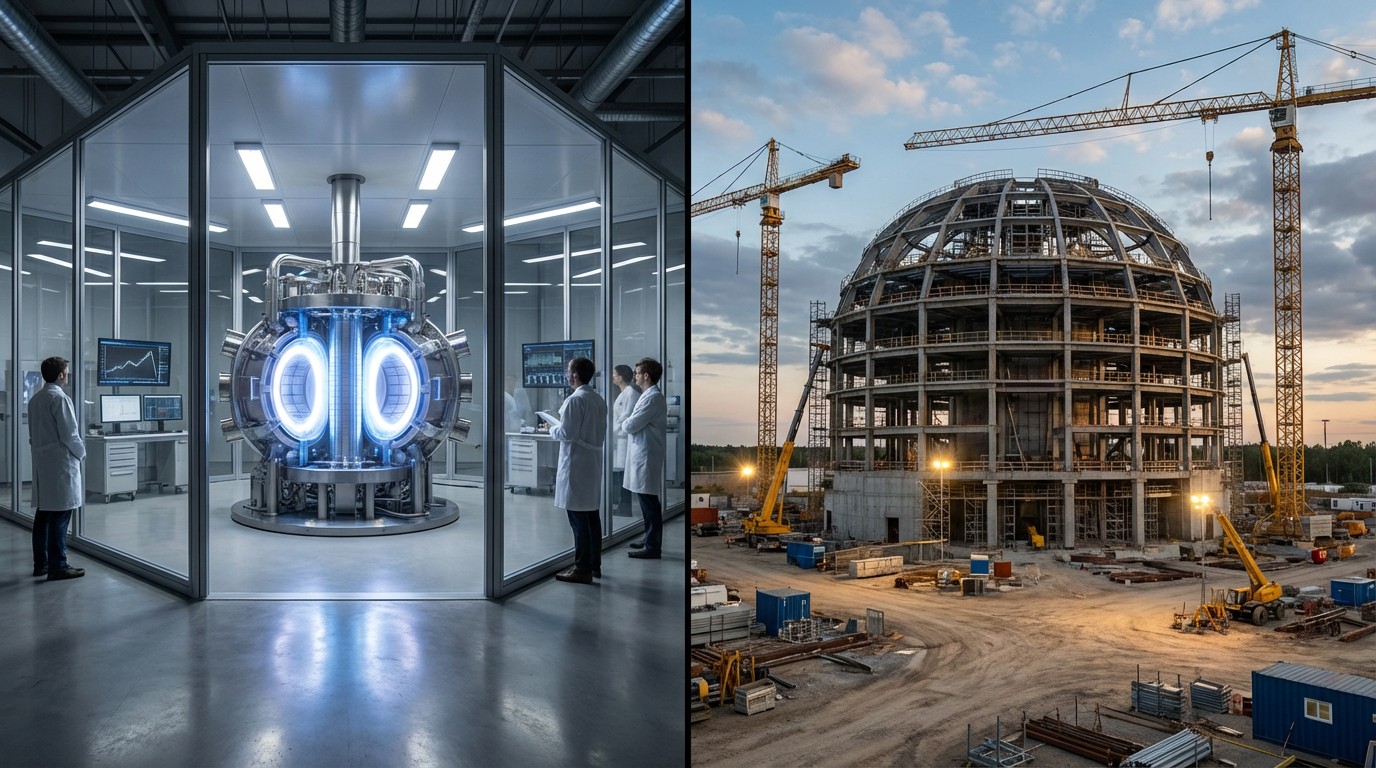
Fifty billion dollars. That is the U.S. Department of Energy's estimate for ITER's total construction costs, including in-kind contributions from 35 member nations. ITER disputes the number. The project's own accounting puts it at €18-22 billion ($20-24 billion). Either way, the machine in Cadarache, France, has been under construction since 2013, has consumed over a decade of engineering effort, and has never produced a single plasma pulse. First plasma, originally scheduled for 2025, now targets 2033 at the earliest. In July 2024, Director-General Pietro Barabaschi announced €5 billion in additional repair costs for malfunctioning components.
Meanwhile, on February 13, 2026, a company in Everett, Washington with roughly $1 billion in total funding did something ITER has never done. Helion Energy's Polaris prototype achieved the first privately funded deuterium-tritium fusion, hitting plasma temperatures of 150 million degrees Celsius. It was confirmed by Ryan McBride, an expert in pulsed power and plasma physics with experience at Sandia National Laboratories and the University of Michigan.
Thirteen years. Same starting gun. Radically different lap times.
The Private Fusion Surge
According to the Fusion Industry Association's 2025 Global Report, 53 private fusion companies have collectively raised $9.766 billion. In the 12 months ending July 2025 alone, the sector pulled in $2.64 billion, a 178% increase over the prior year and the highest annual total since 2022. Public funding to private fusion companies also rose 84%, adding nearly $800 million.
The marquee rounds tell their own story. Pacific Fusion emerged from stealth in November 2024 with a $900 million Series A, the largest debut in fusion history. Helion closed a $425 million Series F in January 2025, backed by Sam Altman. Marvel Fusion raised €113 million ($132 million) in a Series B. Industrial heavyweights like Chevron, Siemens Energy, and Nucor joined deep-tech VCs like DCVC and Breakthrough Energy Ventures on the cap tables.
At the other end of the scale, Commonwealth Fusion Systems (CFS), the MIT spinout with several billion in funding, installed the first of 18 high-temperature superconducting magnets in its SPARC tokamak in early 2026. CFS targets first plasma this year, with net energy gain (Q>10) expected by 2027. Its commercial follow-on, ARC, would be a 400-megawatt plant near Richmond, Virginia, delivering grid power in the early 2030s.
Original Analysis: Dollars Per Milestone
Comparing ITER to private fusion on total spending alone obscures the more revealing metric: capital efficiency per scientific achievement. The following table tracks verifiable milestone firsts and the approximate capital deployed by each entity at the time of achievement.
| Milestone | Entity | Date | Approx. Capital Deployed |
|---|---|---|---|
| First private 100M°C plasma | Helion (Trenta, 6th gen) | 2024 | ~$600M |
| First private D-T fusion | Helion (Polaris, 7th gen) | Feb 2026 | ~$1B |
| First HTS magnet at tokamak scale (20 tesla) | CFS | 2021 | ~$2B |
| First magnet installed in net-energy device | CFS (SPARC) | Jan 2026 | ~$2B+ |
| First commercial fusion PPA signed | Helion + Microsoft | May 2023 | ~$600M |
| First plasma (any kind) | ITER | 2033 (projected) | $20-50B+ (projected) |
| D-T burning plasma (Q>10) | ITER | 2036+ (projected) | $20-65B (projected) |
The methodology here is straightforward but imperfect. Helion's total funding is approximately $1 billion across seven rounds, per public funding disclosures. CFS has raised several billion dollars, per The Fusion Report. ITER's cost range reflects the gap between ITER's own €18-22B estimate and the U.S. DOE's $65 billion figure (which ITER disputes as including indirect costs that other projects also bear but don't report).
Even taking ITER's own lower estimate, the ratio is striking. Helion achieved commercial-temperature plasma and D-T fusion for approximately $1 billion. ITER has spent roughly 20 times more and has not yet produced any plasma. CFS expects to demonstrate net energy gain at perhaps one-tenth of ITER's cost. If CFS hits Q>10 in 2027 as planned, it will have done so with fewer dollars than ITER has spent on repair overruns alone.
Why Iteration Beats Planning
Helion was founded in 2013, the same year ITER broke ground. In that time, Helion has built and tested seven prototype machines. Each generation ran, produced data, revealed problems, and informed the next design. Their 4th prototype (Grande, 2014) achieved 4 tesla compression. Their 5th (Verne, 2015) demonstrated direct magnetic energy recovery at 95% round-trip efficiency over 1 million pulses. Trenta hit 100 million degrees. Polaris hit D-T fusion at 150 million degrees. Seven machines, seven sets of lessons, one decade.
ITER, by contrast, is building one machine. The single most complex machine ever attempted, designed by committee across 35 countries, with components manufactured on four continents and assembled in southern France. A vacuum vessel segment arrives damaged from Korea. A thermal shield piece doesn't fit the specification from India. Each problem cascades through a supply chain spanning the European Union, Japan, China, India, Russia, South Korea, and the United States. There is no second prototype to absorb lessons. There is no iteration cycle. There is ITER, and then there is whatever comes after ITER, probably in the 2040s.
The Fusion Industry Association survey found 84% of private companies target grid electricity by end of the 2030s. More than half target 2035. The median company says it needs another $700 million to reach a pilot plant. That median figure, $700 million, is less than ITER's recent repair overage.
Different Architectures, Different Bets
The private sector is not just faster; it is more architecturally diverse. Helion uses a field-reversed configuration (FRC) with pulsed magnetic acceleration and direct energy recovery, avoiding the steam turbine entirely. CFS uses a compact tokamak with HTS magnets. Type One Energy is building a stellarator for the Tennessee Valley Authority. TAE Technologies pursues hydrogen-boron fusion. Pacific Fusion's approach remains partially undisclosed.
ITER is a conventional tokamak, the most studied but also the most scale-dependent design. Its science case requires a machine the size of a building. The private sector's architectural diversity functions as a portfolio hedge: if tokamaks don't scale economically, an FRC or stellarator might. If pulsed systems can't sustain power output, steady-state machines are in development. No single company has to work for the industry to succeed.
China is also accelerating outside the ITER framework. China National Nuclear Corporation established China Fusion Energy Company in 2025, and the BEST (Burning Plasma Experimental Superconducting Tokamak) is now in final assembly.
Strongest Counterargument
ITER is designed to achieve something no private company has: sustained burning plasma with a fusion gain above 10. Not a brief pulse of D-T reactions, but a self-heating plasma that produces 500 megawatts of fusion power from 50 megawatts of input for 400 seconds or more. That is a fundamentally harder engineering problem than what Helion demonstrated in February.
Helion's Polaris D-T result was a milestone, but the company has not disclosed energy gain ratios (Q values), pulse duration, or total fusion energy produced. Achieving "measurable D-T fusion" at 150 million degrees is not the same as achieving net energy. CFS projects Q>10 for SPARC but has not yet produced any plasma. The gap between "first plasma" and "sustained net energy for commercial electricity" is measured in billions of dollars and years of engineering, even optimistically.
Private fusion's track record on timelines is also mixed. Helion's Microsoft PPA promises 50 MW by 2028. If Helion misses that date, penalty clauses (not publicly detailed) would apply. The history of energy technology is littered with startups that demonstrated physics at small scale and never bridged to commercial generation. Venture capital timelines and fusion physics timelines may not be compatible. ITER's glacial pace may partly reflect the actual difficulty of the engineering, not just bureaucratic dysfunction.
What We Don't Know
This analysis relies on publicly reported funding totals from the FIA survey and company press releases. Actual burn rates at private fusion companies may differ significantly from disclosed raise amounts. Some companies may have spent more than they've raised (through government grants and non-dilutive funding); others may be sitting on unspent capital.
ITER's cost estimates depend heavily on accounting methodology. The €18-22 billion figure counts direct project costs. The DOE's $65 billion figure includes in-kind contributions valued at replacement cost, U.S.-specific overhead allocations, and other indirect items. Neither number is "wrong"; they answer different questions. We use both to bound the range.
Helion's D-T fusion announcement did not include Q values, which would be the most scientifically meaningful metric. Without those numbers, we cannot directly compare Helion's achievement to ITER's design target. CFS's SPARC timeline depends on completing magnet installation and achieving first plasma this year, neither of which is publicly verified beyond the first-magnet announcement.
Finally, the 53 private companies in the FIA survey represent a self-selected sample. An unknown number of fusion startups have already failed and are not counted. Survivorship bias may inflate the apparent efficiency of private capital.
The Bottom Line
Private fusion has moved from PowerPoint to plasma in a decade. $9.8 billion across 53 companies has produced the first private D-T fusion, the first 20-tesla HTS magnet at scale, the first commercial PPA, and credible timelines for grid electricity by 2028-2035. ITER has spent at least $20 billion (and possibly $50 billion) without producing plasma, and won't until 2033 at best. The question is no longer whether private fusion can do real physics. It can. The question is whether it can do real electricity. If even one of these 53 companies delivers grid power before ITER achieves first plasma, the international megaproject model for energy R&D will need a serious audit.
Related
Sources
- estimate for ITER's total construction costs. en.wikipedia.org
- announced €5 billion in additional repair costs. thechemicalengineer.com
- Helion Energy's Polaris prototype achieved the first privately funded deuterium-tritium fusion. helionenergy.com
- Fusion Industry Association's 2025 Global Report. fusionindustryassociation.org
- Pacific Fusion emerged from stealth in November 2024 with a $900 million Series A. emc2fusion.com
- Helion closed a $425 million Series F in January 2025. techfundingnews.com
- China National Nuclear Corporation established China Fusion Energy Company. neimagazine.com