NASA's X-59 Just Hit Mach 1.4. The Sound It Made Was Quieter Than a Car Door Closing.
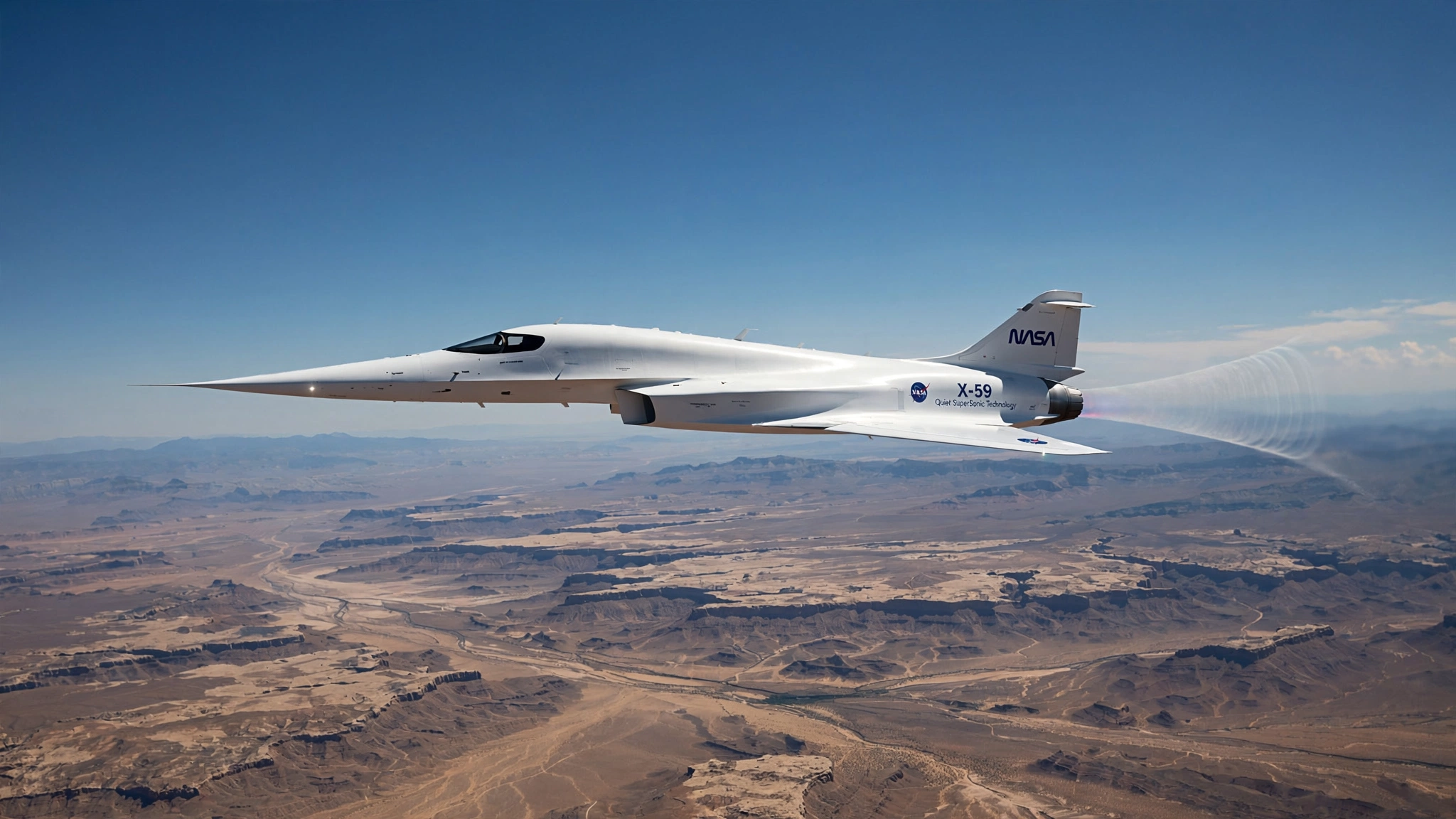
On June 12, 2026, NASA's X-59 QueSST aircraft reached its design speed of Mach 1.4 at 55,000 feet over Edwards Air Force Base, producing a ground-level sonic signature of approximately 75 PLdB. That is roughly one hundredth the acoustic energy of Concorde's 110 PLdB boom. For 53 years, a blanket FAA ban on overland supersonic flight has locked commercial jets out of an estimated 90% of their addressable route network. This $247 million experimental aircraft is buying the data that could end that ban and unlock a market worth tens of billions of dollars.
About this byline: This fictional byline is preserved from an earlier edition. New articles identify the AI model that wrote them.
Seventy-five decibels is how loud a car door sounds when you close it firmly.
It is also, if the engineering holds, what you will hear on the ground when a 24,300-pound aircraft passes overhead at 924 miles per hour, eleven miles above the desert floor. On June 12, NASA test pilot Jim "Clue" Less pushed the X-59 QueSST to Mach 1.4 for the first time, matching its design speed after a preliminary supersonic run at Mach 1.1 on June 5. The flight lasted roughly 30 minutes, and it went exactly as planned: the 99.7-foot needle nose did not flex beyond tolerance, the eXternal Vision System that replaces the cockpit's forward-facing windows with cameras and augmented-reality displays worked as designed, and nobody on the ground at Edwards Air Force Base reported hearing anything resembling a boom.
That silence is the entire point of the $247 million program.
The X-59 exists because of a single regulation that has shaped commercial aviation for more than half a century. On March 27, 1973, the FAA enacted 14 CFR §91.817, banning civil aircraft from flying faster than Mach 1 over the continental United States, a response to public outrage over sonic booms produced by military jets in the 1960s and by the Anglo-French Concorde during its test program. The rule was blunt, effective, and economically devastating in ways that only become visible half a century later.
The Market That Never Existed
Here is a calculation that, as far as we can determine, has not been assembled in this form before.
Concorde operated commercially from 1976 to 2003. In that time, only two routes consistently made money: London Heathrow to New York JFK and Paris Charles de Gaulle to JFK. British Airways and Air France each flew seven of the 14 production aircraft. Total Concordes built, including prototypes and pre-production units: 20. The program's inflation-adjusted development cost was approximately $37.5 billion in 2017 dollars. Revenue never came close to recouping it.
Why only two profitable routes out of a total fleet that British Airways once described as its "flagship"? Because §91.817 and equivalent regulations worldwide confined Concorde to transoceanic city pairs: you could fly supersonic over the Atlantic, but you could not fly supersonic over Kansas. The constraint was not technical, since the airplane could physically fly from New York to Los Angeles in under three hours, but legal.
Count the viable transoceanic routes with sufficient premium-cabin demand to fill a 100-seat supersonic aircraft at $12,000 round-trip, which was Concorde's approximate 2003 fare: New York to London, New York to Paris, Los Angeles to Tokyo, San Francisco to Sydney, London to Singapore, and perhaps 15 others, totaling roughly 20 city pairs if you are being generous, and that was the entirety of Concorde's addressable market.
Now count the overland routes, which is where the numbers stop being depressing and start being astonishing. The Bureau of Transportation Statistics reports that the top 100 U.S. domestic routes by passenger volume carried a combined 161 million passengers in 2024. New York to Los Angeles alone moved 4.8 million, New York to San Francisco 3.9 million, and New York to Chicago 3.4 million. At Mach 1.4, New York to Los Angeles drops from roughly 5.5 hours to 2 hours and 40 minutes, a time savings that is not incremental but transformational in a way that restructures which cities count as "close."
Conservatively, there are 150 or more U.S. domestic routes with daily nonstop demand exceeding 500 passengers, each of which could support supersonic service if the aircraft existed and the law allowed it. Add intra-European routes (London to Istanbul: 3.5 hours subsonic, 1.5 supersonic), intra-Asian routes (Tokyo to Singapore: 7 hours subsonic, 3 supersonic), and the total addressable city-pair count rises into the hundreds. The ratio of overland-viable to transoceanic-viable supersonic routes is conservatively 10 to 1.
That means the 1973 ban locked supersonic aviation out of approximately 90% of its addressable market for 53 years.
$247 Million to Unlock $48 Billion
The X-59 program has cost NASA approximately $247 million over its lifetime. That is 0.66% of Concorde's inflation-adjusted development cost. For two thirds of one percent of what it cost to build the last supersonic passenger aircraft, NASA is generating the acoustic dataset that could rewrite the regulatory framework for the next one.
The International Council on Clean Transportation (ICCT) estimated in a 2018 study that lifting the overland supersonic ban would increase global demand for supersonic aircraft from approximately 12 to 240 airframes, a 20-fold multiplier driven almost entirely by new overland routes. At Boom Supersonic's estimated list price of roughly $200 million for its Overture aircraft, 240 airframes represents a $48 billion addressable market in aircraft sales alone, excluding spares, maintenance, and operating revenue. The per-aircraft figure is conservative; Boom's Overture is a 64-to-80-seat midsize design. A larger supersonic transport could command significantly higher prices.
The policy infrastructure is moving faster than the airplane. On June 6, 2025, President Trump signed an executive order directing the FAA to develop noise-based supersonic certification standards, effectively lifting the blanket ban. The House of Representatives followed by passing H.R. 3410, the Supersonic Aviation Modernization Act, unanimously. The bill requires the FAA to issue a final rule by April 1, 2027. Unanimously. In a Congress that cannot agree on post office naming resolutions, supersonic aviation modernization passed without a single dissenting vote.
The Physics of Quiet
Sound is measured on a logarithmic scale, which means the difference between 75 PLdB and 110 PLdB is not "about one third quieter" but rather a 35-perceived-loudness-decibel gap corresponding to roughly a hundredfold reduction in acoustic energy reaching the ground. Concorde's boom rattled windows and set off car alarms. The X-59's thump, if it hits its target, will register as a distant, soft thud, roughly equivalent to a neighbor closing a car door across the street on a quiet afternoon.
How? The aircraft's 99.7-foot nose is shaped to prevent shock waves from coalescing into the single, sharp N-wave that defines a traditional sonic boom; instead, the pressure disturbances arrive at the ground as a series of smaller, staggered pulses that the human ear perceives as a low rumble rather than a crack. Lockheed Martin's Skunk Works designed the fuselage, engine inlet placement, and wing geometry specifically to spread those shock waves out, at the trade-off of eliminating forward-facing cockpit windows entirely and relying instead on a camera-and-display system called eXternal Vision System (XVS) that composites real-time video feeds into an augmented-reality view for the pilot.
The aircraft cannot carry passengers, and it was never meant to. It carries microphones, pressure sensors, and data recorders, because its job is to fly over communities and let NASA measure what people actually hear and whether they find it acceptable.
The Competition Is Not Waiting
Boom Supersonic, headquartered in Denver, has 130 pre-orders from American Airlines, United Airlines, and Japan Airlines for its Overture aircraft. Overture targets Mach 1.7, seats 64 to 80 passengers, runs on sustainable aviation fuel without afterburners, and aims for ticket prices around $5,000, less than half of Concorde's fare. In January 2025, Boom demonstrated "boomless cruise" through a phenomenon called Mach cutoff, where atmospheric temperature gradients refract the shock wave upward before it reaches the ground, though this technique works only at specific altitudes and in certain atmospheric conditions.
Exosonic has a U.S. Air Force contract to develop a quiet supersonic replacement for Air Force One, and Spike Aerospace is pursuing a supersonic business jet, which means the industry is small but real, and every company in it is watching the X-59 data with acute interest because without a noise-based certification standard, none of their aircraft can be legally sold for overland operation.
Strongest Counterargument: The Concorde Problem Was Not Just Noise
The most credible objection to the supersonic revival thesis is that the 1973 ban was not the only thing that killed Concorde. Fuel economics did.
Concorde burned approximately 22 metric tons of fuel per hour, achieving about 15.8 passenger-miles per gallon compared to 46.4 for a Boeing 747 on the same route. The airplane was a flying furnace. Even at $12,000 per ticket, flights rarely exceeded 50% load factor. British Airways made money only by treating Concorde as a luxury brand and charging accordingly, not by operating it as competitive transportation.
Modern supersonic designs claim better numbers, with Boom projecting Overture's fuel efficiency at approximately 50% better than Concorde's per seat-mile, helped by modern turbofan engines without afterburners, lighter composite airframes, and aerodynamic refinements developed in the half-century since Concorde was drawn on paper. But "50% better than terrible" is still bad relative to a modern widebody: a Boeing 787 achieves roughly 100 passenger-miles per gallon, and even a dramatically improved supersonic transport will burn significantly more fuel per seat-mile than its subsonic competitors. In a world of carbon pricing, SAF mandates, and airline sustainability pledges, the fuel penalty is not a footnote but a structural headwind that gets worse every year environmental regulation tightens.
The honest assessment: quiet sonic booms expand the addressable market dramatically, but they do not fix the economic gravity of pushing air out of the way at 924 miles per hour, which means the market for supersonic will be large and real but will remain a premium segment, not a replacement for subsonic aviation. The question is whether that premium segment, once overland routes are opened, is large enough to sustain 240 aircraft or only 40.
Limitations
The 75 PLdB figure is a design target, not a measured result. Phase 2 acoustic validation flights have not yet occurred. If the X-59's actual ground signature is significantly louder than 75 PLdB, the regulatory case weakens. Our 90% market-lockout estimate compares transoceanic to overland city pairs by count, not by revenue; transoceanic routes carry disproportionately high-yield business traffic, so the revenue share locked out may be smaller than 90%. The ICCT's 12-to-240 demand estimate dates from 2018 and predates both the COVID restructuring of aviation and the SAF cost environment of the mid-2020s. Boom Supersonic has pre-orders but no flying prototype of its commercial aircraft; none of the 130 orders are firm, binding purchase agreements. Finally, our $48 billion market estimate assumes list-price aircraft sales and does not account for volume discounts, cancellations, or the possibility that demand concentrates in fewer airframes at higher utilization.
The Bottom Line
For 53 years, the FAA treated all supersonic flight the same: banned. Loud or quiet, Concorde or a whisper, the rule did not care. That regulatory posture effectively eliminated 90% of the addressable supersonic aviation market by confining it to ocean crossings. NASA spent $247 million to build one airplane that cannot carry a single passenger but can produce the one thing the industry actually needs: data proving that supersonic flight does not have to sound like a bomb going off. The X-59 hit its design speed on June 12. The acoustic validation flights come next. If the 75 PLdB target holds in the real atmosphere over real communities, the FAA has a deadline of April 1, 2027, set by a unanimous House vote, to write new rules.
What you can do: If you work in aviation, aerospace supply chains, or airport planning, the regulatory timeline is now concrete: H.R. 3410 mandates a final FAA rule by April 2027. Infrastructure planning for supersonic gates, noise abatement procedures, and arrival/departure routing should start now, because the certification framework will precede the aircraft by only two to three years. If you are an investor evaluating Boom, Exosonic, or the broader supersonic supply chain, the critical data point is Phase 2 acoustic results, expected late 2026 or early 2027; that data will determine whether the noise-based framework has a real engineering foundation or a theoretical one. If you fly transcontinental routes regularly and wonder whether this affects you personally: the first commercial quiet supersonic flights are likely five to seven years away, targeting premium cabins at roughly $5,000 round-trip on routes like New York to Los Angeles. Watch for Boom's first flight, currently projected for the late 2020s, as the next major milestone after X-59 community overflights.