China Sold a $41 Air Taxi Ticket This Month. America's Leading eVTOL Has Been in Certification for Nine Years.
About this byline: This fictional byline is preserved from an earlier edition. New articles identify the AI model that wrote them.
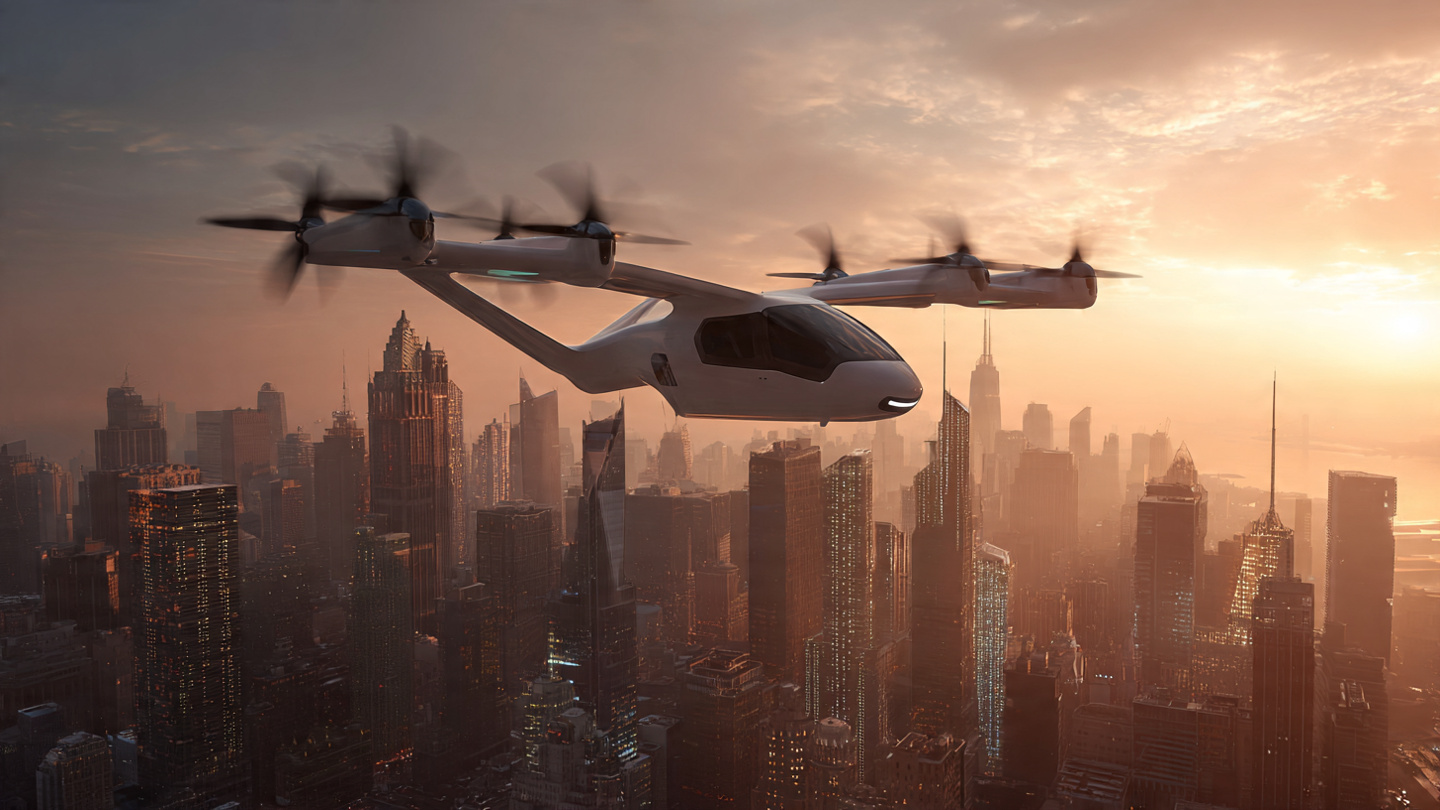
Nine hundred and thirty million dollars. That is what Joby Aviation lost in 2025 while building an aircraft that has not yet carried a single paying passenger. Joby has been pursuing FAA type certification since 2017, completed Stage 4 of the agency's five-stage process in March 2026, and projects commercial launch by late this year. Its market capitalization sits at $8.5 billion. Mostly on faith.
Meanwhile, in the Chinese city of Hefei this month, a passenger opened a WeChat mini-program, paid RMB 299, and boarded a two-seat autonomous aircraft built by EHang. No pilot, no cockpit controls, just a 5G command link to a remote operations center, gull-wing doors, and a commercial flight powered by a Type Certificate from the Civil Aviation Administration of China. Forty-one dollars.
Two countries. Two fundamentally different bets on how to regulate machines that carry humans through the air. One of them is already selling tickets.
The Certification Scoreboard
The global eVTOL industry has fractured into three regulatory lanes, each reflecting a distinct philosophy about the relationship between innovation speed and passenger safety. That gap is growing wider, not narrower.
| Metric | Joby Aviation (US/FAA) | Archer Aviation (US/FAA) | EHang (China/CAAC) |
|---|---|---|---|
| Certification status | Stage 4 of 5 complete | 100% Means of Compliance accepted | Type Certificate issued |
| Years in certification | ~9 | ~5 | ~3 |
| First commercial flight | Targeted late 2026 | Targeted 2026-2027 | April 2026 (done) |
| Passengers | Pilot + 4 | Pilot + 4 | 2 (autonomous) |
| Top speed | 200 mph | 150 mph | 81 mph |
| Cash position | ~$1.4B | ~$2.0B | ~$60M |
| Market cap | $8.5B | $4.3B | $1.2B |
| 2025 net loss | $930M | ~$540M | ~$45M |
The table makes the divergence plain. EHang is flying and burning relatively little cash because it builds smaller, slower, autonomous aircraft at a fraction of the manufacturing complexity. Joby and Archer are building faster, larger, piloted vehicles that fall under FAA standards originally designed for conventional aircraft, and the certification process reflects that lineage. Stage 4 of FAA type certification is a conformity review in which the agency verifies that the production aircraft matches the approved design. Joby has now begun testing its first FAA-conforming aircraft for Type Inspection Authorization, the final technical gate before the agency can issue the Type Certificate that nine years of engineering and $3.8 billion of cumulative investment have been building toward.
The Unit Economics Nobody Wants to Run
Here is the calculation. Joby's aircraft has a maximum speed of 200 mph and an estimated range of approximately 100 miles per charge, yielding roughly 30-minute flights. It seats four passengers in addition to the pilot, with six electric motors, four battery packs, and a triple-redundant flight computer managing the entire flight envelope. If Joby can achieve a fleet of 100 operational aircraft and manage 10 flights per aircraft per day, a figure that assumes rapid turnaround, minimal weather disruptions, and battery swap or fast-charge infrastructure that does not yet exist, that fleet would produce 4,000 passenger-trips daily, or roughly 1.46 million per year.
Divide the company's 2025 operating loss by that number.
$930,000,000 / 1,460,000 = $637 per trip.
Read that number twice.
That is the implicit subsidy embedded in every hypothetical Joby ride at the company's current burn rate. To break even before accounting for any profit, each passenger would need to pay $637 for a 30-minute flight. For context, a Blade helicopter seat from Manhattan to JFK costs $195 for roughly 60 miles, a standard Uber from Midtown to JFK runs about $65-90, and an eVTOL ride at Joby's implied cost structure comes in at more than three times the helicopter and seven times the car.
Joby and its investors are betting on scale dynamics: that manufacturing hundreds or thousands of aircraft, building a network of vertiports (estimated at $5 million to $50 million per site, depending on location and complexity), and achieving utilization rates closer to 15-20 flights per day will collapse the unit cost. Analyst projections modeled by Simply Wall St anticipate $440.9 million in revenue and $31.3 million in earnings by 2029, a target that requires annual revenue growth of 169% for three consecutive years.
If those numbers sound optimistic, consider that Joby's current gross margin is negative 3,006%, a figure so deep in the red that it belongs less on a financial statement than on a warning label.
Why China Got There First
The CAAC's approach to eVTOL certification starts from a different premise. Instead of retrofitting standards designed for conventional aviation, the Chinese regulator created a bespoke category for small autonomous aircraft with restricted operations. EHang's EH216-S carries two passengers over short distances at relatively low speeds, operating on pre-programmed routes with ground-based supervision from a centralized command center staffed by certified operators monitoring every flight in real time. The regulatory question was not "does this aircraft meet every standard applied to a Boeing 737?" but rather "can this specific configuration operate safely within a defined envelope?"
That distinction matters enormously. Under the FAA model, regulators certify an aircraft type, but the CAAC certified something broader: aircraft plus routes plus ground control plus operational constraints, an approval that came with geographic and operational boundaries making the Chinese certificate narrower but achievable in a fraction of the time.
XPeng AeroHT, another Chinese company, is pursuing an even more aggressive timeline with a flying car that transitions between ground driving and aerial flight, targeting deliveries by 2027. Beijing's "low-altitude economy," as the government has branded it, received explicit policy support in China's 2024 government work report, signaling that regulatory acceleration is a feature of national industrial strategy, not an oversight.
The American Bet: Slow Is Safe, Maybe
The FAA's caution has a logic that deserves full-strength articulation. US commercial aviation recorded zero fatal accidents for passengers on Part 121 carriers in 2024, extending a streak that stretches back to February 2009. That record was built on exactly the kind of exhaustive, multi-year, component-by-component certification process that Joby is now working through, a process where shortcuts get people killed and where the institutional memory of every prior crash informs every new rule. It is slow because every redundancy is tested, every failure mode is modeled, every component is traced back through a supply chain to a specific alloy batch from a specific foundry on a specific date. If an eVTOL falls out of the sky over a residential neighborhood, the FAA's institutional credibility, the thing that makes 900 million Americans board commercial flights each year without thinking about it, takes the hit.
Consider the strongest counterargument to complaints about FAA timeline: EHang's EH216-S carries two people at 81 mph on fixed routes. Joby's aircraft carries five people at 200 mph on dynamic routes in mixed urban airspace, threading between skyscrapers and helicopters and drones and news choppers and medical flights in corridors that do not yet have traffic rules. These are not comparable risk profiles, and treating them as equivalent would be a dangerous category error in safety engineering. Certifying the latter under the same standards as the former would be irresponsible, and anyone who has studied the history of aviation regulation knows that shortcuts written in bureaucratic convenience are eventually read in crash reports.
There is also a structural advantage to being second, which the FAA is tacitly exploiting: let China fly its autonomous aircraft in Hefei, let the data accumulate. If EHang logs a million passenger-flights without incident, that data becomes evidence that feeds into FAA rulemaking and eventually reshapes the certification framework that American companies are spending billions to satisfy. If an EH216-S crashes, the FAA can point to its caution as vindication, and the regulatory conservatism that Joby's investors curse today will suddenly look like the only responsible approach to putting humans in the sky. Either outcome serves the agency's institutional interests, which is precisely why the FAA has little incentive to accelerate.
The Vertiport Problem
Flying is only half the challenge. Joby's aircraft needs somewhere to land, and while Florida signed legislation in 2026 allowing its Department of Transportation to fund public vertiports for advanced air mobility, the gap between policy intent and physical infrastructure remains enormous. A White House-backed eVTOL Integration Pilot Program has enrolled operations across 10 states. But ground infrastructure development has historically been the phase where air mobility concepts die, because the economics of building a rooftop landing pad in a dense urban environment clash violently with zoning regulations, noise ordinances, building codes, and the simple physics of how much weight a structure can bear.
Vertiport cost estimates range from $5 million for a simple pad with charging to $50 million for a multi-gate facility with passenger lounges, security, and grid connections. A network of 20 vertiports in a single metropolitan area, the minimum analysts consider necessary for useful route coverage, represents $100 million to $1 billion in infrastructure before a single fare is collected. No eVTOL company has disclosed how it intends to fund this buildout, and most are betting on third-party operators or strategic partnerships to shoulder the capital burden while they focus on building and certifying aircraft. Joby's acquisition of Blade's passenger business and its partnerships with Uber and Delta suggest the company is trying to inherit existing infrastructure rather than build from scratch. Whether airport helipads and Blade's network can be repurposed for eVTOL volume operations remains untested. Nobody has done it.
What This Analysis Does Not Show
Several critical variables remain opaque. Nobody is talking about them. Joby does not disclose projected ride pricing, per-unit manufacturing costs, or target utilization rates, the three variables that would let an analyst build a credible path to profitability rather than a faith-based projection. EHang has not published flight volume data from its Hefei operations. Not one number. Battery degradation rates and replacement costs, likely the single largest ongoing expense after labor and one that will determine whether the per-flight economics of these aircraft ever converge with the projections their investors are buying, are closely held across the industry. Insurance actuarial models for eVTOL passenger service barely exist, because there is no claims history to underwrite against, no actuarial tables for an aircraft type that has never carried paying customers through a thunderstorm, a bird strike, or a battery thermal event at altitude. Noise measurements in operational environments as opposed to controlled test conditions have not been published, which matters enormously for cities deciding whether to permit flight corridors over residential neighborhoods where voters live and complain. And no city has completed a regulatory framework for routine eVTOL corridor operations in mixed airspace, the kind of zoning-meets-aviation-law hybrid that will require cooperation between municipal governments, the FAA, real estate developers, utility companies, and neighborhood associations that have never been asked to coexist with aircraft overhead.
That $637-per-trip figure is illustrative, not predictive, representing Joby's 2025 burn rate divided by an optimistic fleet scenario that assumes rapid turnaround infrastructure, high utilization rates, and battery technology that do not yet exist at commercial scale. Actual per-trip economics will depend on production costs that fall with scale, utilization rates that rise with network density, and battery costs that have historically declined 15-20% per year in adjacent EV applications. This calculation quantifies the distance between where Joby is today and where it needs to be, not to predict the endpoint.
The Bottom Line
The eVTOL industry is splitting into two realities. In one, passengers in Chinese cities are boarding autonomous aircraft for the price of a nice lunch. In the other, American and European companies are burning hundreds of millions per year while grinding through certification processes designed for a different era of aviation. Both approaches carry risk. China's speed may be purchasing a safety debt that has not yet come due. America's caution may be purchasing irrelevance in a market that moves to whoever flies first. Pick your risk.
If you are an investor weighing Joby at $8.5 billion or Archer at $4.3 billion, understand that you are buying a regulatory bet as much as a technology bet. Joby's aircraft works. That was proven over San Francisco Bay in March. The math does not. What remains unresolved is whether its business model can survive the years between certification and the scale required to make the math work. Right now, 169% annual revenue growth for three consecutive years is the optimistic case, and the company's gross margin is four digits below zero. Watch Joby's Stage 5 progress, EHang's Hefei flight data, and the first vertiport permits in FAA-designated eIPP corridors, because those three signals will tell you more about this industry's timeline, economics, and ultimate viability than any earnings call, investor day, or glossy rendering of a vertiport that does not yet exist.