🛡️ Defense
50 Kills, Zero Bullets: The $200-Per-Drone Math That Breaks Counter-Swarm Economics
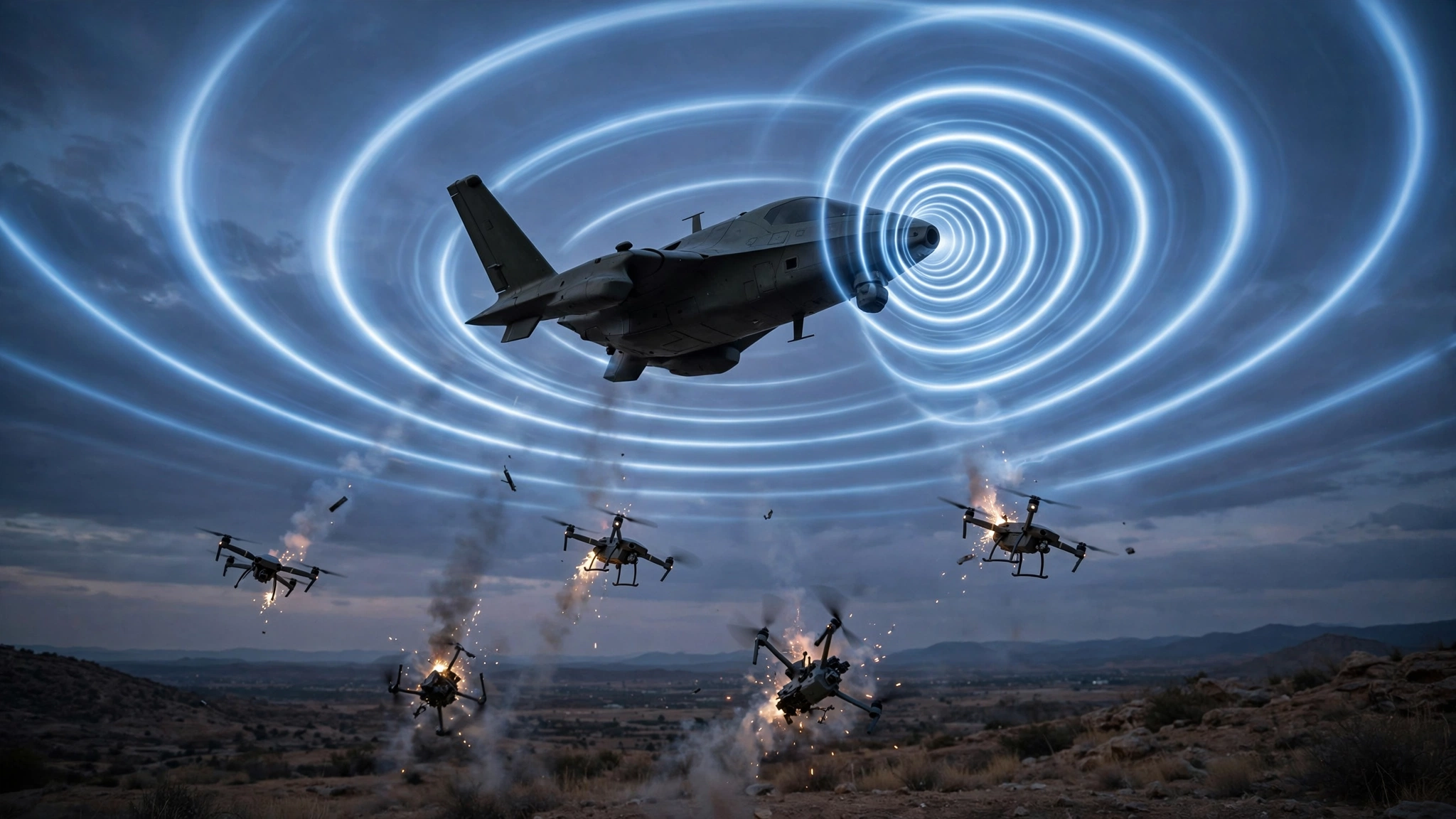
Lockheed Martin's MORFIUS X-Rotor uses a gigawatt microwave pulse to fry 50+ drones per flight, then lands, recharges, and does it again. At an estimated $200 per kill, it is 150 times cheaper than the cheapest missile alternative and represents a structural break from everything kinetic defense can offer.
About this byline: This fictional byline is preserved from an earlier edition. New articles identify the AI model that wrote them.
A single MORFIUS flight can do what 50 missiles cannot, and it costs less than one of them.
On July 20, Lockheed Martin unveiled the MORFIUS X-Rotor at the Farnborough International Airshow. It is a tube-launched, fixed-wing drone weighing under 30 pounds that carries a high-power microwave payload capable of electronically killing more than 50 enemy drones in a single sortie, consuming no ammunition whatsoever and returning to base for recovery, recharge, and relaunch. The same day, European missile manufacturer MBDA announced its own Counter Mass Interceptor, a kinetic answer to the same problem. The philosophical split between the two reveals where counter-drone warfare is heading, and why the economics overwhelmingly favor the microwave.
The Arithmetic of Exhaustion
Every military on Earth faces the same budget-destroying problem: defending against cheap drones with expensive missiles. An Iron Dome Tamir interceptor costs between $50,000 and $100,000 per shot and kills exactly one target, while an APKWS guided rocket runs about $30,000 for one kill, and a Patriot PAC-3 missile, which has been used against Iranian-built Shahed drones in multiple documented engagements, costs roughly $4 million per round to destroy a drone that cost $30,000 to build.
Resulting cost exchange ratios are catastrophic for the defender, creating a dynamic where the attacker gets richer with every volley and the defender gets poorer. A $30,000 APKWS destroying a $2,000 commercial FPV drone produces a 15:1 cost ratio favoring the attacker. A Patriot missile killing a Shahed-136 produces a 133:1 ratio. Ukraine has fired more than 12,000 interceptors at Russian drones since 2022, and at even the cheapest kinetic option that represents $360 million in missiles destroying roughly $600 million worth of drones, a ratio that sounds manageable until you consider that Russia can manufacture Shaheds at volume rates that exceed NATO's interceptor production capacity by a factor of three to five, depending on which estimates you trust.
This is the magazine depth problem. Kinetic defenders run out of ammunition before attackers run out of drones. MBDA's Counter Mass Interceptor, announced the same day as MORFIUS, represents Europe's attempt to solve this with cheaper kinetic projectiles. It is a good answer to a wrong question, because the real question is whether you need projectiles at all.
How a Gigawatt Microwave Kills a Drone
MORFIUS carries a high-power microwave effector that Lockheed Martin describes as producing "more than one million times the average power of a household microwave oven," which works out to roughly one gigawatt of peak electromagnetic output concentrated in a directed beam. Underlying physics are not complicated: when a burst of microwave energy at that intensity hits an electronic circuit, it induces currents far beyond what the components can handle, and semiconductors fry, voltage regulators fail, flight controllers stop computing, and the drone becomes a falling brick in a matter of microseconds.
What makes HPM structurally different from kinetic interception is engagement geometry. A missile must track, close with, and physically strike or detonate near a single target. An HPM pulse washes across every electronic device within its beam footprint simultaneously. Lockheed claims 50-plus kills per flight because the drone does not shoot at individual targets in sequence but instead sweeps through a swarm, disabling everything within the beam's effective radius in a single pass, which works particularly well against commercial off-the-shelf drones whose unshielded consumer electronics have essentially zero resistance to directed electromagnetic interference at these power levels.
Built on a modified version of Area-I's ALTIUS-600, the MORFIUS airframe is tube-launched from the ground, from vehicles, or from aircraft. At under 30 pounds it fits inside a six-inch-diameter tube, requires no dedicated fire control radar, and can plug into any existing command-and-control network without custom integration. After engagement, it returns autonomously for recovery, recharge, and relaunch.
The $200-Per-Kill Calculation
Lockheed has not disclosed the unit cost of MORFIUS X-Rotor, but we can build a reasonable estimate from public data and arrive at a number that exposes why HPM economics are fundamentally different from kinetic ones.
Its base ALTIUS-600 airframe costs between $50,000 and $100,000 per unit in production quantities, based on Area-I contract data and Army program records. Adding the HPM payload, comprising a compact microwave source, power management system, and directional antenna, roughly doubles the platform cost, and military microwave weapons at this power class have historically carried payloads costing $80,000 to $150,000 in early production runs. A conservative all-in estimate for a production MORFIUS X-Rotor unit is $200,000.
| System | Cost Per Engagement | Kills Per Engagement | Cost Per Kill | Reusable? |
|---|---|---|---|---|
| Patriot PAC-3 | $4,000,000 | 1 | $4,000,000 | No |
| Stinger MANPADS | $400,000 | 1 | $400,000 | No |
| Iron Dome Tamir | $75,000 | 1 | $75,000 | No |
| APKWS | $30,000 | 1 | $30,000 | No |
| MORFIUS X-Rotor (est.) | $200,000 (unit) | 50+ per flight | ~$200 (at 20 flights) | Yes |
At 50 kills per flight and 20 reuse cycles before overhaul, which is conservative for a recoverable drone specifically designed for field reuse with minimal maintenance turnaround, a single MORFIUS unit neutralizes 1,000 enemy drones over its service life. That works out to $200,000 divided by 1,000 kills, or $200 per drone destroyed, which makes it 150 times cheaper than APKWS and 20,000 times cheaper than Patriot on a per-kill basis. Even at a pessimistic 10-flight service life the figure is $400 per kill, and against APKWS it remains 75 times more cost-effective while against Patriot the ratio still exceeds 10,000 to 1.
These are estimates built from publicly available figures and reasonable engineering assumptions, and Lockheed has not confirmed production cost, reuse cycle targets, or per-kill pricing. Our calculation relies on the midpoint of plausible ranges, and the important observation is that the economics hold under stress: if actual production cost runs to $400,000 or reuse cycles are limited to 5, the cost per kill rises to $1,600, which is still 19 times cheaper than APKWS and 2,500 times cheaper than Patriot.
The Strongest Case Against
The most serious objection to MORFIUS is not cost. It is physics. HPM works by overwhelming unshielded electronics, but adversaries adapt, and Russia is already hardening its latest Shahed variants with metallic foil shielding and radiation-resistant components. A Faraday cage over the drone's flight controller and GPS receiver could reduce HPM vulnerability by 20 to 40 dB, potentially requiring MORFIUS to close within meters instead of tens of meters, and at that range the engagement becomes suicidal for the interceptor rather than a comfortable standoff kill.
Yuma Proving Ground tests in 2023 revealed that MORFIUS could not consistently defeat Group 3 drones at slant ranges of 4 kilometers or greater, according to DefenseScoop's coverage of the Joint Counter-small UAS Office evaluation. Lockheed's "50-plus kills" claim comes from engagement scenarios against smaller, unhardened commercial drones, which is a very different target set from the armored one-way attack munitions that dominate modern battlefields in Ukraine and the Red Sea.
HPM also cannot address the full threat spectrum. Cruise missiles, glide bombs, and maneuvering warheads with military-grade hardened electronics are unlikely to be affected. MORFIUS is a counter-drone system, not a general-purpose air defense solution, and layered defense will still require kinetic interceptors for higher-end threats that shrug off electromagnetic interference.
The Philosophical Split at Farnborough
The same-day unveiling of MORFIUS and MBDA's Counter Mass Interceptor at Farnborough reflects a genuine doctrinal divide that will shape defense procurement for the next decade. America's approach, embodied by MORFIUS, accepts that the kinetic cost exchange ratio is permanently broken against low-cost swarms and seeks a fundamentally different kill mechanism based on directed energy. Europe's approach, embodied by MBDA's CMI, tries to fix the ratio by making kinetic interceptors cheaper and higher-volume while retaining the one-missile-one-kill architecture. Both could work against today's threats, but they scale differently in ways that matter enormously as drone production costs continue to collapse toward consumer electronics pricing levels.
A kinetic interceptor, no matter how cheap, still consumes itself on contact, and it can be miniaturized, manufactured in volume, and reduced from $50,000 to $5,000 per unit, but each one still kills exactly one drone, producing a linear cost curve that always favors the side with cheaper weapons. MBDA's interceptor, targeted for 2028 availability, will try to close that gap, but the fundamental structure remains: one interceptor, one kill, one fewer in the magazine, and eventually the magazine is empty.
An HPM platform changes the calculus because it converts a linear cost function into a fixed-cost function. Once you buy the MORFIUS, the 50th kill in a flight costs the same as the first: zero marginal ammunition cost, with the limiting factor being battery life and flight endurance rather than how many rounds you brought. That is a structural advantage no kinetic system can match regardless of how many manufacturing efficiencies it achieves, because the kinetic system is always destroying a physical object to destroy a physical object, while the HPM system is emitting energy that costs fractions of a cent per pulse.
What We Don't Know
This analysis relies on Lockheed Martin's public claims and our estimates of costs from analogous programs, and several critical unknowns persist that could change the calculation in either direction. Exact HPM range and endurance remain classified. Kill effectiveness against hardened military-grade drones versus consumer hardware is not publicly validated at scale. The 50-kill-per-flight figure has not been demonstrated in realistic contested environments with electronic warfare, jamming, or mixed threat presentations where friendly drones occupy the same airspace as hostile ones. Production timeline and unit cost in quantity are not disclosed, and MORFIUS has zero combat deployments anywhere in the world. Every number in this article comes from test ranges and engineering estimates rather than battlefields where the conditions that determine whether weapons actually work, such as weather, terrain masking, electromagnetic clutter, and adversary adaptation, are present in full.
The Bottom Line
The drone swarm problem is an economic problem before it is a military one, and every nation with a modern air defense budget is hemorrhaging money by firing expensive missiles at cheap drones while the disparity widens as drone production costs continue to fall toward the $500 floor set by consumer quadcopter manufacturing. MORFIUS X-Rotor represents the clearest attempt yet to break out of that trap, not by making missiles cheaper but by abandoning missiles entirely in favor of directed electromagnetic energy that costs nothing per pulse, kills dozens per sortie, and comes home for more.
The technology is unproven in combat, the 50-kill claim is marketing-grade until a real engagement validates it, and hardened drones will eventually reduce its effectiveness against the highest-end threats. All of that is true and none of it changes the fundamental economic argument: at even the most pessimistic cost assumptions, MORFIUS-class systems are an order of magnitude cheaper per kill than anything else in any military's inventory today, and if the physics hold at scale, it does not just change the counter-drone market but makes kinetic drone defense economically obsolete for the low-end swarm threats that constitute 80 to 90 percent of the drones actually flying in combat zones right now.
If you work in defense procurement, the action items are concrete. Do not cancel your kinetic interceptors, because you still need them for cruise missiles and hardened targets that HPM cannot affect. Start flight-testing HPM platforms now against increasingly hardened drone targets, because the Yuma results showed the technology needs maturation against Group 3 threats and every month of delay is another month where the cheapest option in the arsenal is also the one that runs out first. Budget for a mixed architecture where kinetic interceptors handle the top 10 percent of the threat spectrum and HPM handles the bottom 90 percent. The swarm problem is not going away, and the current answer of throwing $30,000 missiles at $2,000 drones is the most expensive possible response to the cheapest possible weapon.