The Pentagon Spent $62.8 Million on 10 Buildings. They'll Be Done in 6 Months. Here's What the Data Actually Shows.
ICON's $62.8M Army contract works out to $785 per square foot. Civilian 3D-printed homes cost $119. The math looks terrible until you factor in the $116 billion maintenance backlog and 2-5 year traditional MILCON timeline that the Army is trying to escape.
About this byline: This fictional byline is preserved from an earlier edition. New articles identify the AI model that wrote them.
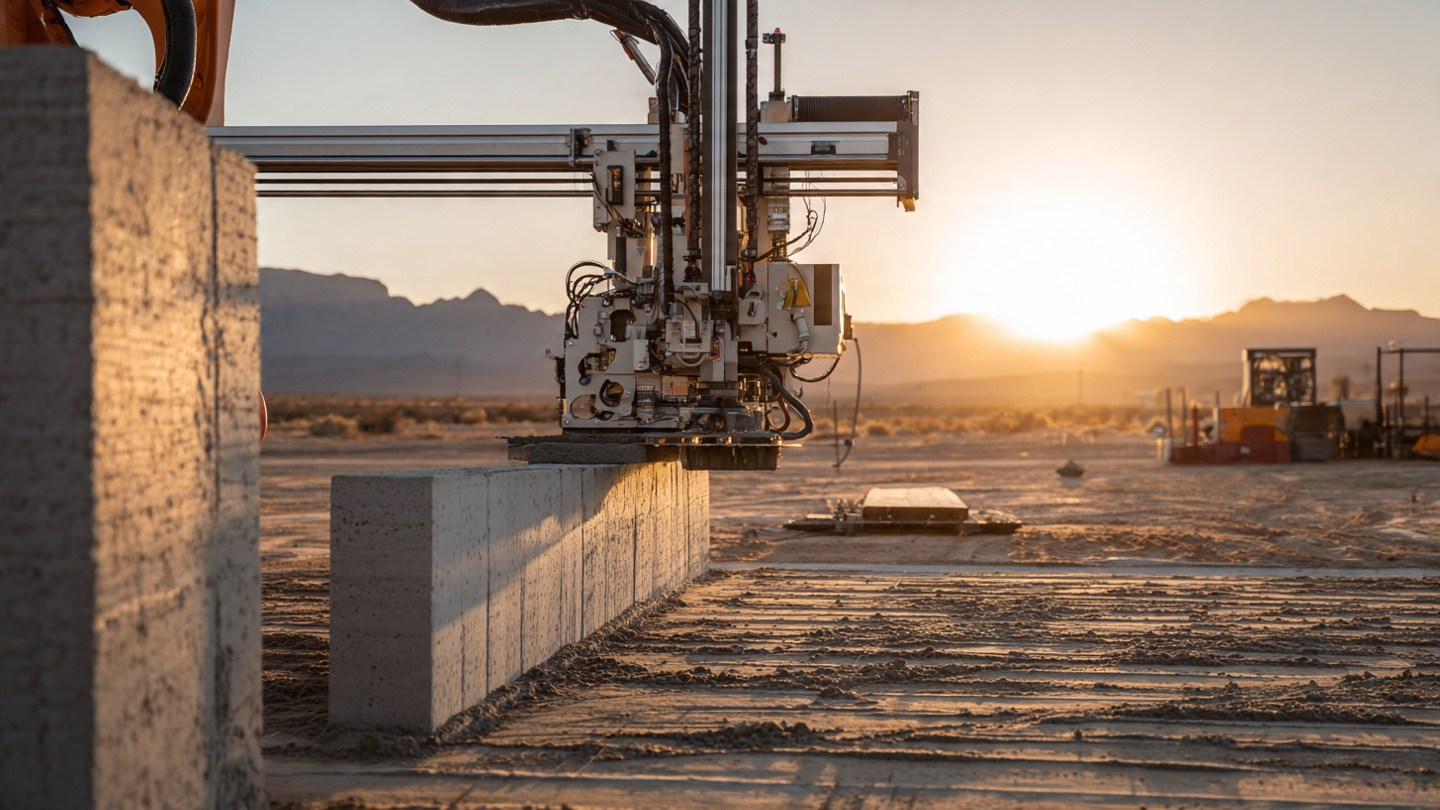
$6.28 million per building.
That is what the U.S. Army is paying ICON, an Austin-based construction technology company, to 3D-print 10 transient training barracks at Fort Bliss in El Paso, Texas. The $62.8 million Other Transaction Authority agreement, announced in January 2026, is the largest deployment of robotic construction technology for the Department of Defense. Delivery timeline: six months. Traditional military construction for a comparable project: two to five years.
ICON has been testing this at smaller scale since 2023. A prototype barracks at Camp Swift, Texas, built in partnership with the Defense Innovation Unit, proved the concept could meet Unified Facilities Criteria, the UFC compliance standards governing blast resistance, force protection, and structural integrity for military buildings. Soldiers have logged more than 50,000 nights in ICON's 3D-printed structures. The Army ran 65 full-scale wall tests and over 100 component tests before signing the production contract.
None of those numbers tell you whether this is a good deal. The cost comparison does.
The Scorecard
I calculated the implied cost per square foot from the contract value and ICON's prototype dimensions, then stacked it against every comparable benchmark I could find.
Contract math: $62.8 million divided by 10 barracks equals $6.28 million per building. ICON's prototype barracks was approximately 8,000 square feet. Using that as the estimate: $6,280,000 divided by 8,000 square feet equals $785 per square foot.
| Construction Method | $/sq ft | Timeline | Notes |
|---|---|---|---|
| ICON 3D-printed barracks (Fort Bliss) | ~$785 | 6 months (10 buildings) | UFC-compliant, desert-hardened, turnkey |
| Traditional MILCON barracks | $300-600 | 2-5 years | Recent projects often exceed $1,000/sq ft |
| Civilian 3D-printed (Apis Cor) | $119 | ~3 months | 2,168 sq ft home in Melbourne, FL; all-in cost |
| Civilian 3D-printed (SQ4D) | ~$250 | ~3 months | Market-rate listing in Long Island, NY |
| Civilian stick-built (national avg) | $150-200 | 6-12 months | Single-family home, no special compliance |
Sources: ICON contract value from ICON press release (Jan 2026). Apis Cor cost from Fixr.com analysis ($260K total for 2,168 sq ft). MILCON range from GAO reports on recent barracks construction projects. National construction averages from Census Bureau Survey of Construction.
On raw cost, the Pentagon is paying 4 to 6 times what civilians pay for a 3D-printed building. That comparison is not quite honest, because the military buildings include blast-resistant walls, force protection setbacks, full mechanical/electrical/plumbing packages, site preparation in the Chihuahuan Desert, and the overhead of a government contract. But it is useful as a benchmark for how far military 3D printing has to go before it competes on price alone.
Why Cost Is the Wrong Metric
The Army has 138,000 barracks rooms. Many were built in the 1950s through 1970s. Congressional investigations have documented mold infestations, pest problems, and structural failures across multiple installations. DoD's facilities maintenance backlog exceeds $116 billion and grows every year.
Traditional military construction, known as MILCON, takes two to five years from congressional authorization to occupancy. That timeline includes environmental review, design competition, contractor selection, and the construction itself. A barracks approved in fiscal year 2024 might house its first soldier in 2028.
ICON is promising 10 buildings in six months. If they deliver, the implied time compression is 4x to 10x faster than traditional MILCON. For an institution sitting on a $116 billion maintenance deficit, speed might matter more than unit cost.
Run the math a different way. If the Army needs to replace 10,000 of its worst barracks rooms over the next decade, the MILCON pipeline could deliver roughly 2,000 to 5,000 per year at current pace. ICON's demonstrated throughput, if it scales linearly, could do the same volume in one to two years. Construction bottlenecks are not about money. Congress appropriates billions annually. It is time.
What 50,000 Soldier Nights Tell Us (and What They Do Not)
ICON reports that soldiers have logged more than 50,000 nights in 3D-printed barracks. That is a meaningful operational test. It covers thermal cycling in Texas summers and winters, occupancy wear, and the daily stress of transient training populations moving through facilities.
What it does not tell us: long-term structural performance. Concrete 3D printing uses a proprietary cementitious mixture extruded in layers. No 3D-printed building in the United States is older than about three years. Nobody knows the 20-year maintenance profile, the thermal cycling degradation rate in desert environments, or how the layered construction responds to foundation settlement over time. That 50,000-night figure is real. It is also insufficient for lifecycle cost analysis, because lifecycle analysis requires decades of data that do not exist yet.
The Civilian Spillover Thesis
The United States has a housing supply gap exceeding 4 million homes, roughly 500,000 unfilled construction jobs, and a median new home price around $400,000. If you believe that military procurement drives costs down the learning curve, the Fort Bliss contract matters for civilian housing too.
History supports this. GPS, the internet, microwave ovens, and containerized shipping all started as military projects and became civilian infrastructure. Military contracts absorb the R&D cost, validate manufacturing processes, and create supplier ecosystems. ICON's $170 million in total government contracts effectively subsidize the development of construction robotics that could eventually print civilian homes at scale.
How steep is the learning curve? ICON's $785/sq ft military price needs to fall to the $150-200/sq ft range to compete with conventional homebuilding. That is a 75-80% cost reduction. Semiconductor manufacturing achieved comparable declines over 20 years. Solar panels did it in 15. Construction, historically, does not experience dramatic learning curves because every building site is different, local codes vary, and labor markets are fragmented.
Apis Cor's $119/sq ft home in Florida suggests the floor price for simple 3D-printed residential structures is already competitive. But Apis Cor's home is a single-story residence with no blast resistance, no UFC compliance, and standard residential electrical and plumbing. Scaling from that to military-grade construction added a 6.6x cost multiplier. Scaling back down to civilian mass production will require stripping that multiplier out, and it is not obvious that ICON can do both simultaneously.
The "It's Just Walls" Problem
The strongest counterargument against 3D-printed construction is structural. A robot prints walls. That is it. Walls and basic structural elements. Expensive components of any building remain traditional: HVAC systems, electrical wiring, plumbing, roofing, interior finishing, windows, doors, and insulation. COBOD, a competing 3D construction printer manufacturer, and independent analyses from multiple construction economics firms estimate that 3D printing saves only 10-30% of total building cost, because the shell represents a minority of the total expense.
If 3D printing saves 20% on total construction cost, the Fort Bliss barracks should cost about $640/sq ft compared to an $800/sq ft traditional equivalent. That is savings of $160 per square foot, or $1.28 million per 8,000-square-foot barracks. Meaningful, but not decisive. The Army is not choosing ICON because of a 20% cost advantage. It is choosing ICON because of a 400-1,000% speed advantage.
This matters for the civilian spillover thesis too. If the robot only handles the shell, and the shell is 20-30% of total home cost, the ceiling for 3D printing's impact on housing affordability is a 6-9% reduction in total home price. On a $400,000 home, that is $24,000 to $36,000. Real savings, but not the revolution that early press coverage suggested.
Limitations
The $785/sq ft figure relies on an estimated 8,000 square feet per barracks, based on ICON's prototype. The Fort Bliss buildings could be larger or smaller. If they are 10,000 square feet each, the per-square-foot cost drops to $628. If they are 6,000 square feet, it rises to $1,047. ICON has not disclosed the exact floor plans.
The $62.8 million contract likely includes first-of-kind costs: mobilization, tooling, R&D amortization, and equipment setup that would not recur on subsequent builds. A follow-on contract for 50 barracks at the same site would almost certainly show lower per-unit costs. We do not have data on what those costs would be.
No peer-reviewed lifecycle cost analysis comparing 3D-printed and traditional military construction exists. The 50,000 soldier-night figure, while operationally significant, covers at most three years of occupancy data. ICON is privately held and does not disclose unit economics, material costs, or machine utilization rates. Our comparison uses publicly available data only.
What You Can Do
If you work in construction or homebuilding: Watch ICON's Fort Bliss timeline. If they deliver 10 buildings in six months as promised, the speed claim moves from marketing to verified data. Track the Defense Innovation Unit's construction portfolio for follow-on contracts, which will reveal whether costs decline on the learning curve.
If you work in military facilities or MILCON procurement: The OTA contract structure ICON used bypasses standard MILCON timelines. If the buildings perform, expect this model to expand to other installations. The Army Audit Agency should be publishing performance data from the Fort Bliss deployment within 12-18 months.
If you are in a housing-short market: Civilian 3D-printed homes are already available in Texas, Florida, and Virginia at prices competitive with stick-built construction. Apis Cor, SQ4D, and Alquist 3D are the three most active civilian builders. Alquist operates with as few as two crew members per print. If you are a developer, request quotes and compare total project costs, not just shell costs.
If you invest in construction technology: ICON has raised over $400 million and holds $170 million in government contracts. ICON is not publicly traded. Public comparables are COBOD (private, Danish), Mighty Buildings (private, Oakland), and the construction divisions of larger firms like Bechtel and Fluor exploring additive manufacturing. At scale, the sector is pre-revenue. Fort Bliss is the closest thing to a production proof point.
The Bottom Line
At $785 per square foot, ICON's 3D-printed barracks cost more than civilian alternatives and sit at the high end of traditional military construction. The value is in speed: six months versus two to five years. For an Army staring down 138,000 aging barracks rooms and a $116 billion maintenance deficit, paying a premium to compress timelines by 4x to 10x is a rational trade. Whether that speed premium translates to civilian housing depends on whether 3D printing can cut total home costs by more than the 6-9% ceiling that the "it's just walls" analysis suggests. Fort Bliss is the test. If 10 barracks stand in six months, the data changes. If they do not, the cost table speaks for itself.