America Is 4.5 Million Homes Short. Technology Built 12,000 of Them.
3D printing, modular factories, AI design tools — Silicon Valley has spent $3 billion promising to solve the housing crisis. The crisis got worse. The math explains why.
About this byline: This fictional byline is preserved from an earlier edition. New articles identify the AI model that wrote them.
Twelve thousand homes.
That is the combined output of every 3D-printed, factory-built, robotically-assembled, AI-designed housing startup in the United States in 2025. Twelve thousand units across every modular factory, every concrete printer, every prefab operation that raised venture capital and promised to "disrupt" housing.
The deficit grew by roughly 300,000 units in the same period.
The Deficit Nobody Agrees On
How many homes is America actually short? Depends who you ask, and every estimate is worse than the last.
| Source | Estimate | Year | Method |
|---|---|---|---|
| Freddie Mac | 3.8 million | 2021 | Household formation vs completions |
| National Association of Home Builders | 4.5 million | 2024 | Population growth + obsolescence |
| Realtor.com | 5.5 million | 2023 | Gap between supply and demand at current prices |
| Zillow | 4.5 million | 2022 | Vacancy rate targeting |
| National Low Income Housing Coalition | 7.2 million (affordable) | 2024 | Units affordable/available to ELI renters |
Use any number you want. They all say the same thing: the United States needs to build between 500,000 and 800,000 more homes per year than it currently does, sustained for a decade, just to get back to something resembling a functioning market.
In 2025, total housing starts were approximately 1.35 million. Down from 1.55 million in 2022. The direction is wrong.
The Technology Scorecard
Every few months another startup raises nine figures to "solve housing." Here is what that money produced.
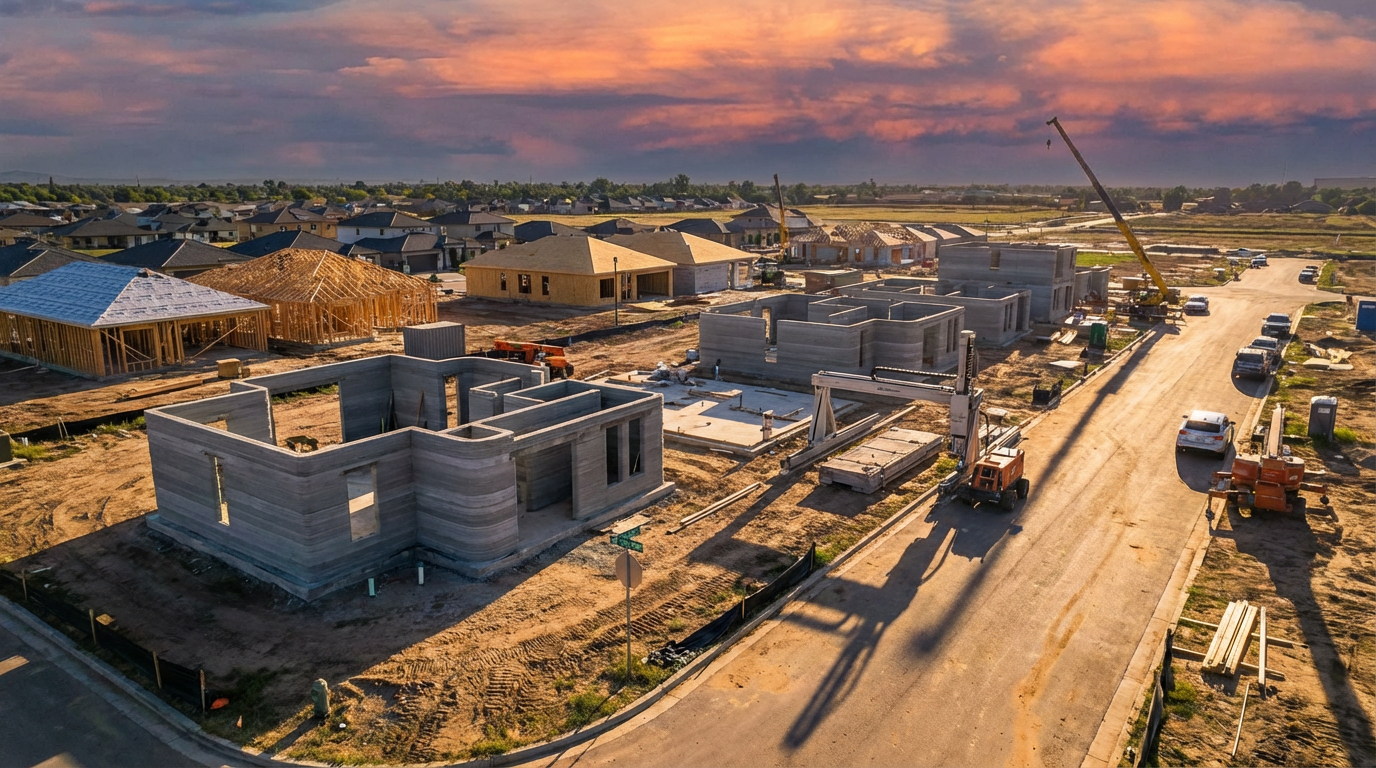
3D Printing: The Poster Child That Can't Scale
ICON, the Austin-based company that became synonymous with 3D-printed housing after printing a proof-of-concept for a developer in 2018, laid off 25% of its workforce in March 2025. It had raised over $450 million. Its Vulcan printer can produce the walls of a house in about 48 hours. The walls are roughly 20% of a home's cost. Electrical, plumbing, HVAC, roofing, foundation, finishing — all still require conventional trades.
The flagship project, a 100-home community in Georgetown, Texas called Wolf Ranch, broke ground in 2022. As of early 2026, ICON's website lists no completed community of that scale. The homes that were completed sell for $450,000–$800,000. Not affordable housing.
Alquist 3D in Virginia has printed homes in Virginia and the Midwest, some priced under $250,000 — but at volumes measured in dozens, not thousands.
Modular: The Eternal "Almost"
Factory-built housing should be the answer. Controlled environment, no weather delays, assembly-line efficiency. The pitch has been identical since the 1970s.
The results:
| Company | Raised | Status (2026) | Units Delivered |
|---|---|---|---|
| Katerra | $2.0B | Bankrupt (2021) | ~1,000 |
| Veev | $647M | Looking for buyer | ~200 |
| Factory OS | $100M+ | Operating, limited | ~2,000 |
| Fading West | $50M | Operating | ~500 |
| Cover Technologies | $100M+ | Operating, LA ADUs | ~300 |
| Mighty Buildings | $150M | Restructuring | ~100 |
Katerra's $2 billion implosion is the defining story. The SoftBank-backed company tried to vertically integrate everything — materials, design, manufacturing, construction — and discovered that a lumber supply chain and a technology company are different businesses. The bankruptcy filing revealed they were losing money on every unit even at scale.
Sweden builds 45% of new homes from factory modules. Japan is at 15%. The United States is under 4%.
The difference isn't technology. Sweden has a national building code. The US has thousands of local jurisdictions, each with their own codes, inspectors, and approval processes. A module built in a Pennsylvania factory might not be accepted by an inspector in New Jersey thirty miles away.
AI Design: Promising but Irrelevant to Supply
AI architectural tools — Higharc, Maket.ai, TestFit — can generate compliant floor plans in hours instead of weeks. Higharc raised $53 million; its software produces permit-ready blueprints for production homebuilders. This genuinely works.
It also addresses approximately zero percent of the housing problem. Design is not the bottleneck. A tract homebuilder reuses the same 8–12 floor plans across hundreds of communities. The plans exist. The land, the permits, the labor, and the interest rates are what's missing.
What Actually Constrains Housing
The unsexy answer is that the housing deficit is a policy problem wearing a technology costume.
Four constraints dominate, and none of them respond to better printers or smarter algorithms:
1. Zoning. According to Up for Growth's 2023 report, exclusionary zoning is the single largest contributor to housing underproduction in 47 of 50 states. Seventy-five percent of residential land in American cities is zoned exclusively for single-family detached housing. You cannot build your way out of a deficit when the land itself is legally forbidden from being used efficiently.
2. Skilled labor. The construction industry has 400,000–500,000 unfilled positions on any given month (BLS JOLTS data). Median age of a construction worker: 42 and climbing. Apprenticeship completions haven't kept pace with retirements since 2008. Every technology that "reduces labor needs" still requires electricians, plumbers, and HVAC technicians that don't exist.
3. Interest rates. The average 30-year mortgage rate has been above 6.5% since 2023 — the highest sustained rates since 2001. Every percentage point above 5% prices out roughly 4 million potential buyers (NAR estimates). Builders respond rationally: they build fewer homes when fewer people can afford them.
4. Local permitting. Average time from land purchase to certificate of occupancy in a major metro: 18–24 months. Government regulation accounts for 23.7% of the final price of a new single-family home, according to the NAHB's 2024 cost survey. That is $93,870 on a median-priced new home — up from $65,224 in 2021.
What's Actually Working
Not nothing. But the things that work are boring.
ADUs. California permitted over 20,000 accessory dwelling units in 2023, up from 6,000 in 2018. This is what policy change looks like: state law overrode local zoning, and permits exploded. No new technology required. Just legal permission to build a second unit on land that already exists.
Minnesota's statewide upzoning. In 2023, Minnesota became the first state to legalize duplexes and triplexes on all residential land statewide. Too early for construction data, but permit applications in the Twin Cities rose 34% in the first year.
Manufactured housing. Not modular startups — the old-fashioned HUD-code manufactured homes built on chassis in factories. 112,000 shipped in 2024. Not glamorous, not venture-fundable, and they provide more housing per dollar than any technology startup in the country.
The Uncomfortable Math
At current rates of construction (~1.35 million starts per year) against a 4.5-million-unit deficit growing by 300,000 units annually, the US is not closing the gap. It is falling further behind.
To close the gap by 2035, the country would need to sustain approximately 1.8–2.0 million starts per year for a decade. That hasn't happened since the mid-2000s bubble — and the bubble was building in the wrong places for the wrong buyers.
Technology can help at the margins. Faster permitting (AI code review, like Cloudpermit). Cheaper ADU design. Better materials scheduling. These are 2–5% efficiency gains on a problem that requires a 40% increase in output.
Every startup that raises $100 million to "build homes faster" is solving a problem that accounts for maybe 15% of the deficit. The other 85% is zoning boards, interest rates, labor shortages, and local politics.
Twelve thousand technology-built homes in a year. A 4.5-million-unit deficit.
That's 0.3%.
Sources
- Freddie Mac — Housing Supply: A Growing Deficit (2021)
- National Low Income Housing Coalition — The Gap: A Shortage of Affordable Homes (2024)
- US Census Bureau — New Residential Construction (monthly)
- Up for Growth — Housing Underproduction in the United States (2023)
- NAHB Eye on Housing — Regulation 23.7% of Home Price (2024)
- Bureau of Labor Statistics — JOLTS: Construction Openings
- Federal Reserve FRED — Housing Starts Historical Data
- US Census — Manufactured Housing Shipments
- California HCD — ADU Permit Data
- MinnPost — Minnesota Statewide Upzoning Law
- Texas Monthly — ICON Layoffs (2025)