💻 Computing
Meta Will Burn More Electricity Than Romania by 2027. An Internal Memo Explains Why It Has No Choice.
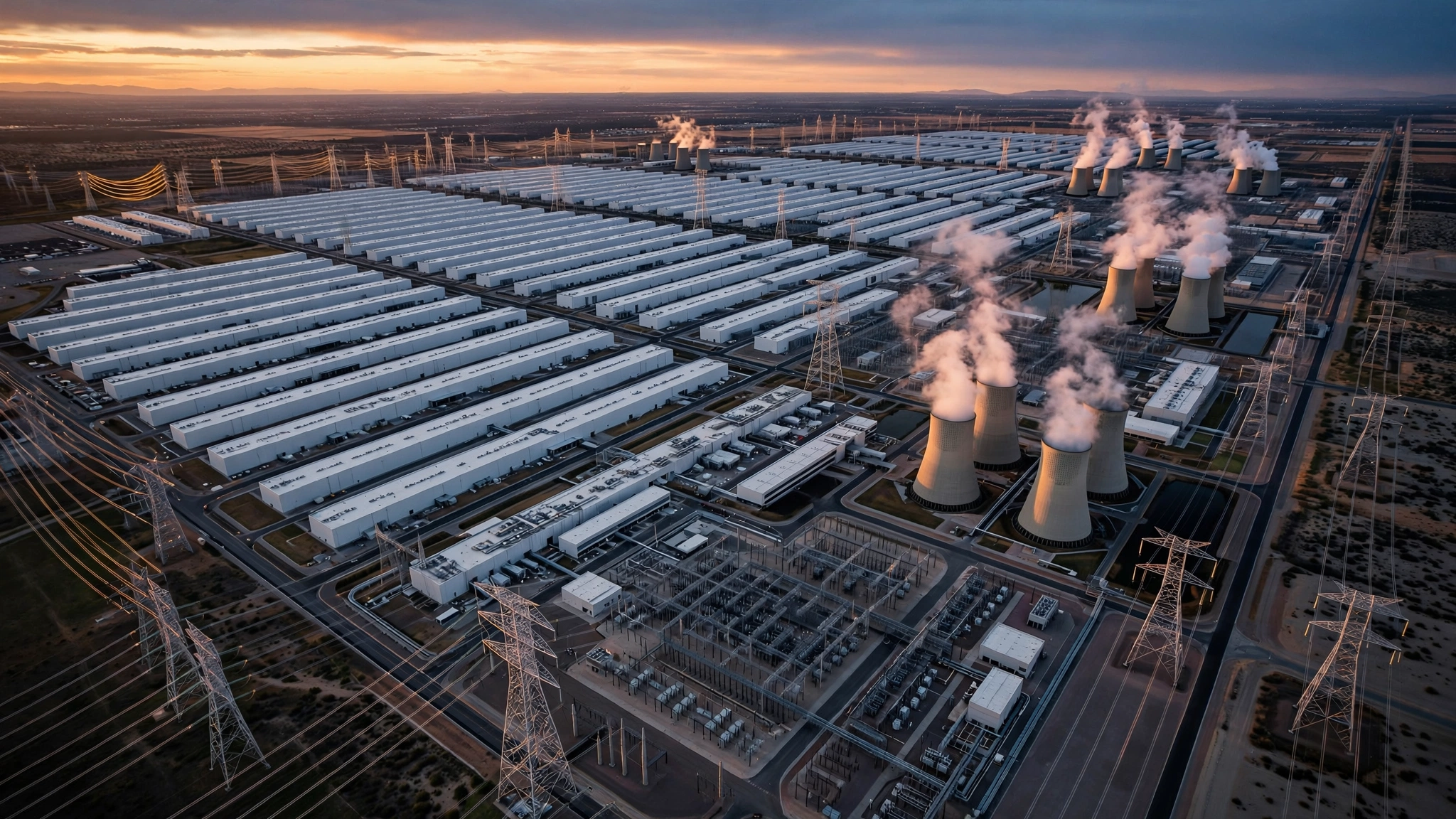
A leaked internal memo reveals Meta plans to deploy 14 gigawatts of computing infrastructure in 2027, consuming an estimated 147 terawatt-hours per year when cooling is included. That is nearly three times Romania's entire national electricity consumption, and the annual power bill alone will exceed $10 billion.
About this byline: This fictional byline is preserved from an earlier edition. New articles identify the AI model that wrote them.
Fourteen gigawatts. That is the computing infrastructure Meta plans to deploy by the end of 2027, according to an internal memo reviewed by Reuters and reported on July 9. The company already has seven gigawatts running in 2026. It intends to double that in twelve months.
Nobody outside Meta has translated that number into what it actually costs to keep the lights on. Here is that calculation, and it explains why the same memo reveals that Meta's in-house AI chip, code-named Iris, will enter production in September after six weeks of bug testing found no major issues.
$10.6 Billion in Electricity
Start with physics. Fourteen gigawatts of IT load, running continuously for a year, consumes 122,640 gigawatt-hours of electricity. Data centers do not operate at 100 percent power utilization efficiency; cooling, networking, power conversion, and lighting add overhead typically measured as a power usage effectiveness ratio of 1.15 to 1.25. At a PUE of 1.2, total facility draw climbs to 16.8 gigawatts, and annual consumption reaches approximately 147 terawatt-hours.
Romania consumed 55 terawatt-hours in 2023, according to International Energy Agency data. Meta's 2027 compute footprint will use roughly 2.7 times that. Portugal consumed 49 TWh. Hungary, 44. A single American corporation will consume more electricity than each of those countries.
At the U.S. Energy Information Administration's average industrial electricity rate of $0.072 per kilowatt-hour, 147 TWh costs $10.6 billion annually. That is the electricity bill alone, before any capital expenditure on servers, chips, buildings, or networking equipment. Meta has budgeted up to $145 billion in total capital expenditure for 2026, part of what the memo describes as Big Tech's collective $700 billion AI infrastructure outlay. The power costs add roughly 7.3 percent on top of that annual capex figure as a perpetual operating expense that never depreciates, never amortizes, and scales linearly with every additional rack brought online.
For context, Goldman Sachs estimated total U.S. data center power demand at approximately 35 gigawatts in 2023, a figure already under upward pressure from the 73 GW of off-grid gas plants being fast-tracked for AI workloads. Meta alone would represent 40 percent of that 2023 baseline by 2027. Even against Goldman's projected 67 GW of U.S. data center capacity by 2030, Meta's 14 GW represents 21 percent of the national total. One company. One-fifth of the country's data center electricity.
Why a Leaked Memo Matters More Than an Earnings Call
Earnings calls are performances. Internal memos are not.
Meta's memo, portions of which Reuters reviewed, contains a sentence that no public-facing executive would voluntarily say to investors: adopting the latest GPUs at a firm as large as Meta "has been a heavy lift, and it has cost us time." That is a confession that Nvidia's supply chain has become a binding constraint on Meta's ability to scale, and it explains everything that follows in the document: the Iris chip, the Broadcom partnership extension through 2029, the long-term supply agreements with Samsung Electronics for memory, SanDisk for flash storage, and Sumitomo Electric for fiber-optic equipment.
These are not procurement optimizations. They are the moves of a company that concluded it cannot buy its way to 14 gigawatts using someone else's silicon on someone else's timeline.
Four Chips in Five Years, and the Fifth Is Coming
Iris is the fourth generation of Meta Training and Inference Accelerators. The genealogy matters because it shows a learning curve that most coverage has missed.
| Chip | Process | Year | Status |
|---|---|---|---|
| MTIA 100 | TSMC 7nm | 2023 | Internal deployment |
| MTIA 200 | TSMC 5nm | 2024 | Internal deployment |
| MTIA 300 | TSMC 3/4nm | 2025-26 | Powering ranking & recommendation |
| Iris | TSMC (node undisclosed) | Sept 2026 | Entering production |
| Next-gen | TSMC 2nm | 1H 2027 (target) | In design with Broadcom |
The release cadence is approximately every six months, which Reuters noted is roughly twice the industry standard. Meta unveiled Iris under its technical name in March alongside three other processors. Broadcom CEO Hock Tan, who is leaving Meta's board for an advisory role on chip strategy, said on Broadcom's March earnings call that "Meta's custom accelerator MTIA roadmap is alive and well. We're shipping now." The next-generation chip after Iris targets TSMC's 2nm process with HBM4 memory, according to TrendForce reporting from April, which would make it one of the first AI accelerators manufactured at that node alongside chips from Apple and Qualcomm.
What the roadmap reveals is velocity. Meta is not designing one chip and waiting to see whether it works before starting the next. It is running overlapping development cycles where Iris enters production while the 2nm successor is already in design, a cadence that only makes economic sense if the company has already committed to deploying custom silicon at multi-gigawatt scale regardless of whether any individual generation delivers a breakthrough. An earlier analysis showed that custom inference chips pay for themselves in under three months at Meta's scale. The chips do not need to beat Nvidia. They need to exist in sufficient volume to fill the gap that Nvidia cannot.
The Supply Chain Is the Strategy
Buried in the memo's details are the supply agreements, and they tell a story the chip announcements do not.
Samsung Electronics for memory chips. SanDisk for flash storage. Sumitomo Electric for fiber-optic cables. These are multi-year, locked-in commitments that, as Morgan Stanley analysts have noted, are critical because "chipflation" has become a macroeconomic concern. Memory prices have climbed 50 to 60 percent this year alone, a phenomenon analysts have started calling "chipflation" because the price increases are large enough to register as a macroeconomic headwind. Apple raised MacBook and iPad prices by 20 percent in June, citing the same memory shortage. Global PC shipments fell 4.9 percent in Q2 2026, the first decline after nine consecutive quarters of growth, according to IDC. The memory market is so tight that Apple has begun testing DRAM from ChangXin Memory Technologies, a Chinese firm on the Pentagon's military blacklist, according to the Financial Times.
Meta's supply agreements are designed to insulate the company from exactly this kind of market dislocation, locking in capacity and pricing while competitors fight over spot-market allocation. Broadcom's extended deal through 2029 includes an initial commitment of one gigawatt of MTIA computing capacity, with plans to ramp to multiple gigawatts. That one-gigawatt floor means Broadcom has guaranteed Meta a minimum volume of custom silicon regardless of what happens to TSMC allocation for other customers, and TSMC allocation is the most contested resource in the semiconductor industry right now.
Strongest Counterargument
The strongest case against Meta's approach is that fourteen gigawatts may never materialize as deployed compute, because announced capacity and operational capacity are fundamentally different things in the data center industry, and the gap between them has historically been enormous.
Data center operators routinely announce capacity targets years before buildout completes. Permitting delays, grid interconnection queues, equipment shortages, and construction bottlenecks regularly push timelines out by 18 to 36 months. Meta itself acknowledged the difficulty in the same memo: adopting hardware "has been a heavy lift." If acquiring GPUs is hard, building the physical infrastructure to house 14 GW of computing is harder. The sites, the power substations, the cooling systems, the fiber runs — all of it must be permitted, constructed, and commissioned at a pace that would represent the fastest sustained data center buildout by a single entity in history.
Meanwhile, Nvidia's Rubin platform, announced at GTC 2026, promises a tenfold improvement in run cost over Blackwell. If Rubin delivers, Meta could achieve the same computational throughput from a fraction of the power envelope, potentially rendering the 14 GW target either achievable with off-the-shelf GPUs or simply unnecessary. Custom silicon makes sense when GPU supply is the bottleneck, but if Nvidia resolves the bottleneck with a next-generation architecture that is radically more efficient, the calculus shifts back toward buying rather than building.
Limitations
The Reuters memo has not been published in full. Our analysis relies on Reuters' characterization and the specific figures and quotes they reported; other details, context, or caveats in the original document are unknown. "Fourteen gigawatts" could refer to total contracted site capacity, total IT load, or something else; the distinction between these definitions can represent a 20 to 40 percent difference in actual power consumption. Our electricity cost calculation uses the EIA's national average industrial rate of $0.072/kWh, but Meta's actual blended rate is likely lower due to large-scale renewable power purchase agreements in regions like Iowa, Texas, and the Nordics; at $0.04/kWh (a plausible PPA rate), the annual power bill drops to roughly $5.9 billion. We do not know what fraction of Meta's compute runs on MTIA versus Nvidia GPUs. Meta has said "hundreds of thousands" of MTIA chips are deployed, but that could represent anywhere from 5 to 30 percent of inference workloads depending on chip performance and utilization rates, and Meta has not disclosed the split.
What You Can Do
If you work in AI infrastructure: watch the 2nm MTIA timeline. If Meta and Broadcom hit their 1H 2027 target for the next-generation chip, it validates the overlapping-development-cycle model and means Meta's custom silicon cadence will outpace Nvidia's traditional release schedule. That has hiring implications: Meta will need thousands of chip verification, packaging, and system integration engineers, and the talent pool overlaps heavily with Nvidia's own workforce.
If you are an energy investor or utility executive: a single company planning to consume 147 TWh annually represents a demand signal larger than some regional transmission organizations currently serve. Track where Meta is acquiring land and power interconnection rights. Those locations will see transmission upgrades, renewable energy development, and municipal revenue windfalls over the next three to five years. The permitting pipeline for those sites is the leading indicator.
If you hold META stock: the number to track is power cost per unit of revenue. Meta generated $164.5 billion in revenue in 2025. If power costs reach $10.6 billion by 2027, that is 6.4 percent of current revenue spent on electricity alone, a line item that barely existed five years ago and now rivals the company's total R&D spending as a percentage of revenue. Revenue must grow faster than power costs to maintain margins, which means AI monetization is not optional. It is existential.
The Bottom Line
Meta is building the largest single-company computing installation in history, and the internal memo explaining why is more revealing than any earnings call. The company cannot buy GPUs fast enough. Adopting them "has been a heavy lift," the memo says, which is corporate-speak for a supply chain that cannot keep pace with a demand curve that doubles every year. So Meta is doing what companies do when they outgrow their suppliers: building its own. The Iris chip entering production in September is not a vanity project or an R&D experiment. It is a logistics necessity for a company that needs fourteen gigawatts of compute, cannot wait for Nvidia to allocate it, and will spend more on electricity in 2027 than most countries generate. The question is not whether Meta can afford to build its own silicon. At this scale, the question is whether it can afford not to.