Rocket Soot Is 540× More Potent Than Tailpipe Exhaust. Megaconstellations Now Own 42% of the Climate Bill.
A peer-reviewed study published May 14 in Earth's Future quantifies what the space industry has avoided measuring: black carbon deposited by kerosene-burning rockets into the stratosphere produces 540 times the instantaneous radiative forcing per gram of soot from surface-level combustion. Megaconstellation missions—primarily Starlink—will account for 42% of all space-sector climate forcing by 2029. The actual launch rate already exceeds the model's projections.
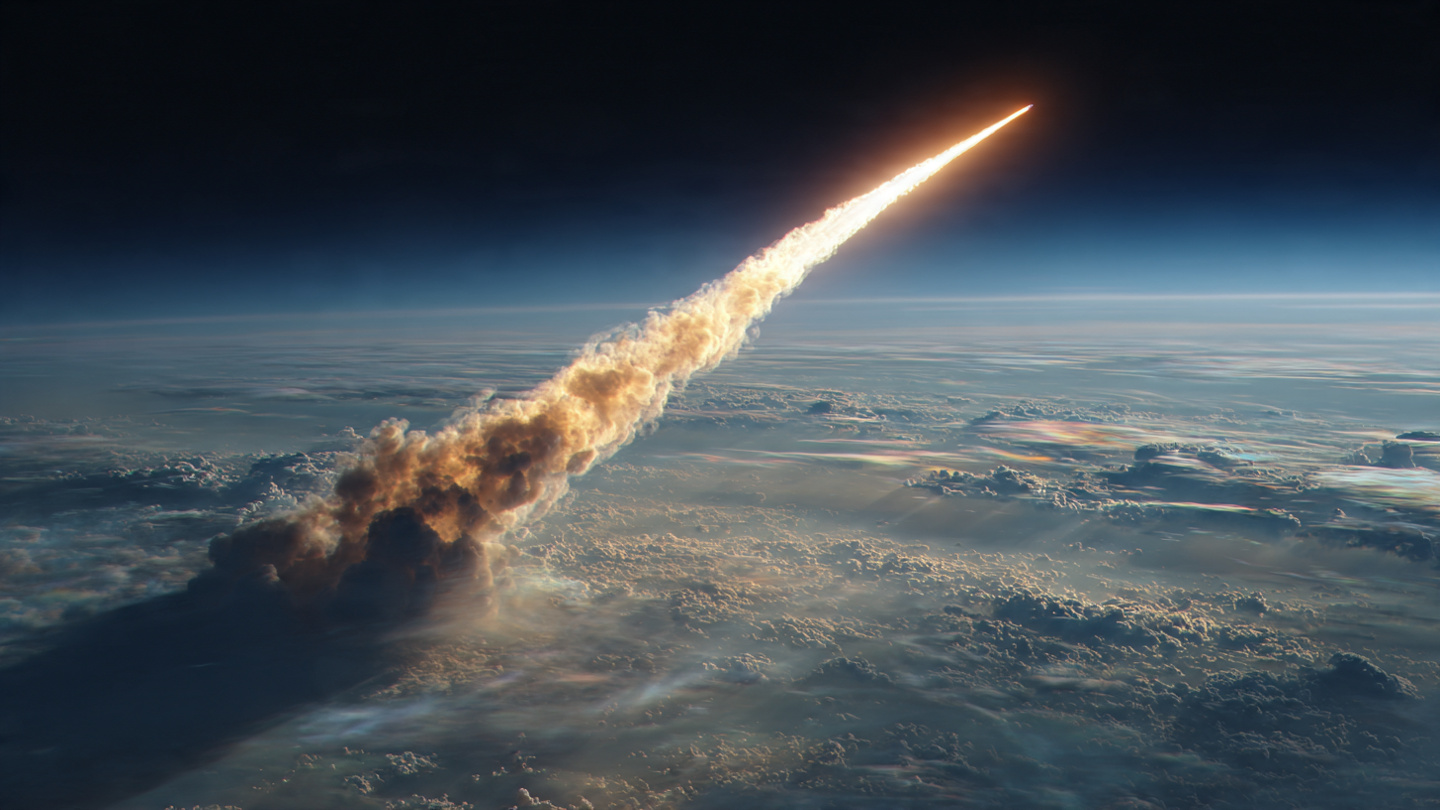
Five hundred and forty. That is the ratio of climate-warming potency between a gram of black carbon injected at rocket altitude and a gram of soot from a diesel truck's exhaust pipe, as calculated by Marais et al. (2026) in the AGU journal Earth's Future. The physics is not exotic: soot at ground level washes out within hours through rain and mixing, while the same particulate matter deposited at 10 to 12 kilometers lingers for two and a half to three years, absorbing incoming solar radiation the entire time. Location creates the multiplier.
Marais and her UCL colleagues coupled the GEOS-Chem chemical transport model with the RRTMG radiative transfer model, tracking emissions from every orbital launch and satellite re-entry between 2020 and 2022, then projected forward to 2029. Total instantaneous radiative forcing from all rocket black carbon reaches +9.7 milliwatts per square meter by 2029, with megaconstellation missions responsible for 56% of that total and 42% of broader sector climate forcing when alumina cooling from solid rocket motors is included. Isolated from the alumina offset, the black carbon component is unambiguously warming at 28% compound annual growth.
A $429 Billion Industry With No Emission Rules
The Satellite Industry Association's 29th annual report, released the same week, counted 296 orbital launches in 2025 deploying 4,434 satellites, a 65% surge over 2024 that pushed the global space economy to $429 billion. Kerosene-fueled Falcon 9 rockets burned 97 to 98% of all propellant consumed for megaconstellation missions in 2023 and 2024. SpaceX filed an FCC application in February 2026 requesting permission to launch up to one million additional satellites as orbital data centers for AI compute, on top of roughly 10,000 Starlink satellites already in orbit, and Amazon's petition to block the filing was dismissed by FCC Chairman Brendan Carr.
We ran a calculation the FCC did not. The Marais study attributes roughly 0.37 gigagrams of stratospheric black carbon to megaconstellation missions by 2029, producing approximately 4.2 mW m−2 of forcing across an estimated 20,000 megaconstellation satellites, which works out to roughly 0.21 microwatts per square meter per satellite. Scale to one million and you reach approximately 210 mW m−2, a figure within the range of deliberate stratospheric geoengineering proposals studied by Kravitz et al. (2012).
How Soon Is Geoengineering Scale?
Eloise Marais, the UCL atmospheric chemist who led the study, described the situation to Gizmodo as "an untested geoengineering experiment with many unintended consequences." The normalized forcing efficiency of rocket black carbon, measured at 2.5 megawatts per kilogram of stratospheric BC burden, falls within the 0.62 to 6.27 MW/kg range from Kravitz et al.'s deliberate injection simulations, meaning the warming mechanism is physically identical whether the soot was placed deliberately or as an unregulated industrial byproduct.
Current stratospheric BC concentrations from rockets sit at roughly 4 × 10⁻⁹ kg m−2, which is 375 to 2,000 times below the 1.5 to 8 × 10⁻⁶ kg m−2 range used in geoengineering models. At the measured 28% compound annual growth rate, that gap closes by midcentury. Even at a conservative 15% annual rate accounting for fleet saturation and propulsion transitions, the trajectory reaches geoengineering-equivalent concentrations between 2071 and 2083, within the expected lifetime of a child born this year.
Conservative projections, by the authors' own admission: actual propellant consumption in 2023 and 2024 exceeded model predictions by 12 to 16%, and the model's 80-kilometer altitude ceiling misses roughly 40% of all launch-phase black carbon.
Arctic Amplification
Peak radiative forcing does not distribute evenly. The study found the strongest BC forcing over the Arctic at 16.0 mW m−2, where soot particles absorb solar radiation that would otherwise bounce off high-albedo ice and snow, compounding warming in a region already heating at four times the global average. Ozone depletion from rocket emissions is measurable but small: 0.018% from primary effects, potentially 0.18% with secondary dynamics included, both far below the roughly 2% from Montreal Protocol-regulated substances.
Strongest Counterargument
All rocket launches combined produce roughly 6.5 mW m−2 of adjusted radiative forcing by 2029, which is a vanishing fraction of the approximately 3,000 mW m−2 from accumulated CO2. Geoengineering proposals typically inject around 1 teragram of material annually while rockets will produce 0.87 gigagrams, leaving a 1,150-fold gap that no credible growth curve closes before the industry transitions to cleaner propellants like the methane already used in SpaceX's Starship. The per-mass potency comparison, while technically accurate, is misleading in absolute terms, analogous to measuring a match's flame temperature and comparing it to a wildfire's heat output. The three-year baseline underpinning the 28% growth rate is too thin to support multi-decade exponential extrapolations, and the study's own ozone figures sit three orders of magnitude below regulatory thresholds.
Correct on current scale, wrong on trajectory. The 28% growth rate is not a model assumption but a measurement the 2023–2024 data exceeded. Stratospheric soot accumulates across a 2.5 to 3 year atmospheric lifetime rather than dissipating seasonally, so each year's emissions compound on the previous year's residual burden. And the regulatory history of atmospheric contaminants offers a lesson: CFCs were "negligible" in 1970, the ozone hole was undeniable by 1985, and the Montreal Protocol required 30 years to begin reversing the damage.
Limitations
The Marais study extrapolates from three years of data (2020–2022) to 2029, a thin baseline even though the authors validated against 2023–2024 actuals. GEOS-Chem does not capture secondary dynamical ozone effects, so actual depletion could reach ten times the primary estimate. No real-world measurements of black carbon from satellite re-entry ablation exist. Our geoengineering threshold timeline assumes sustained exponential growth at rates that cannot persist indefinitely, and the per-satellite forcing calculation should be treated as order-of-magnitude illustration rather than precise prediction.
What You Can Do
If you invest in space companies or satellite broadband providers, press them to disclose per-launch emission inventories, because none currently do and no regulatory body requires it. The Marais team is building an online tracker for launch and re-entry emissions that could provide the data backbone for investor-led disclosure.
If you work in climate or transportation policy, the gap is launch licensing: the FAA's Office of Commercial Space Transportation evaluates safety, debris, and orbital congestion but performs no assessment of stratospheric emissions, and adding a BC impact review falls within current statutory authority under 51 U.S.C. § 50901 with no new legislation required.
If you follow the geoengineering governance debate, notice the asymmetry: deliberate solar radiation management proposals face intense scrutiny and were effectively blocked by the UN Environment Assembly in 2024, while accidental geoengineering from rocket launches operates through the identical physical mechanism at a scale that doubles roughly every three years with zero oversight.
The Bottom Line
A $429 billion industry is depositing stratospheric soot at an unregulated, exponentially growing rate using rockets that burn the same kerosene they burned in the 1960s. Per gram, that soot is 540 times more potent than what comes out of a car's tailpipe. The total quantity is small today, but "small today, growing at 28% per year, with a filed application to scale 100-fold" is not a negligible problem. It is every atmospheric crisis before the crisis became undeniable.