Two thousand, one hundred and sixty. That is the maximum number of passengers per day that Manhattan's commercial heliport infrastructure can physically deliver to Joby Aviation's air taxi network, assuming perfect weather, zero maintenance downtime, and every single flight slot filled from 8 a.m. to 8 p.m. It is also the number that turns an $8.6 billion valuation story into an arithmetic problem.
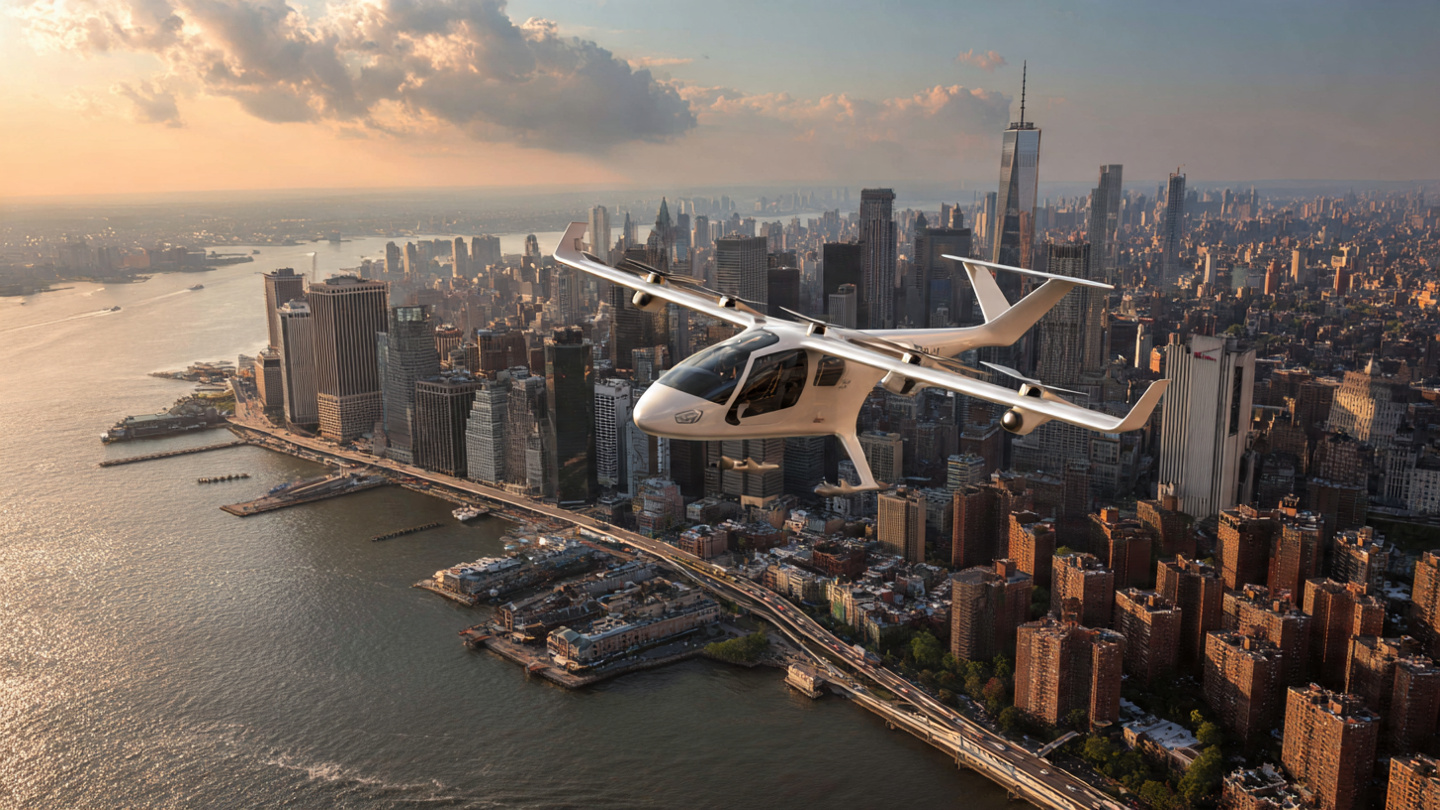
On April 27, 2026, Joby completed its first point-to-point eVTOL demonstration flights in New York City, ferrying passengers from JFK to three Manhattan heliports in under ten minutes. Seven minutes of flight time. Quiet, electric, zero emissions, and covered breathlessly by every outlet from NBC to Reuters. Nobody ran the infrastructure math.
What Joby Actually Proved
Credit where it is earned. Joby flew a certified S4 aircraft, carrying one pilot and four passengers at speeds up to 140 mph, through some of the most complex controlled airspace on Earth, with FAA cooperation under the new eIPP framework (one of eight winning applications across 26 states, announced March 9, 2026). Real routes to Downtown Skyport, West 30th Street Heliport, and East 34th Street Heliport, backed by Delta's $60 million investment. CEO JoeBen Bevirt told reporters he expects FAA type certification within a year.
This was real, not a rendering or a hover test or a controlled demo in some Texas desert, but a five-seat aircraft flying a revenue-representative route through New York City airspace, and that is a genuine engineering milestone that deserves recognition before we reach for the calculator.
Manhattan's Throughput Ceiling
Manhattan has exactly three heliports that serve commercial passenger traffic: Downtown Skyport, West 30th Street, and East 34th Street. Three pads. NYC noise restrictions limit operations to roughly 8 a.m. through 8 p.m., giving each facility a 12-hour daily window during which every minute of capacity is contested between eVTOL demonstrations, existing helicopter charters, medevac operations, and the occasional NYPD sortie. FAA separation requirements and real-world turnaround times (landing, passenger offload, safety check, boarding, takeoff) impose a minimum spacing of approximately three minutes per operation. Even eVTOLs, which are quieter and faster to restart than helicopters, cannot compress this below about three minutes when you account for passenger loading and vertiport procedures.
Here is the calculation:
| Parameter | Value |
|---|---|
| Commercial heliports in Manhattan | 3 |
| Operating hours per day | 12 (8 AM to 8 PM) |
| Max operations per heliport per hour | 15 (at 3-min spacing) |
| Max daily flights (all 3 heliports) | 540 |
| Passengers per Joby S4 flight | 4 |
| Maximum daily passengers | 2,160 |
At 100% utilization, 365 days a year, with zero weather cancellations, that yields 788,400 annual passengers. At $200 per seat, the theoretical annual revenue ceiling for NYC is $157.7 million.
Theoretical. Blade Air Mobility ran this exact business model with helicopters for years, serving 90,000 passengers in 2025 before Joby acquired its passenger operations for up to $125 million. That 90,000-passenger figure represents approximately 247 flights per day, already consuming a significant fraction of available heliport capacity, and Blade had years of brand recognition, established booking infrastructure, and luxury positioning working in its favor. It still reached only 11.4% of the theoretical ceiling.
What $200 Per Seat Actually Buys
Joby's eVTOL pitch rests on a promise: faster than driving, quieter than helicopters, eventually cheaper than both. But at $200 per seat, here is how the JFK-to-Midtown corridor actually compares:
| Mode | Cost | Time | Cost/Mile |
|---|---|---|---|
| eVTOL (Joby, per seat) | $200 | ~30 min door-to-door | $13.33 |
| Helicopter (Blade era, per seat) | $200 | ~30 min door-to-door | $13.33 |
| Rideshare (single occupant) | $150-200 | 45-90 min | $8.33-11.11 |
| Yellow cab (up to 4 riders) | $100 total | 45-90 min | $5.55 |
| Subway + AirTrain | $11.40 | 75-90 min | $0.63 |
Notice what has not changed. Same price. Joby's eVTOL costs exactly what Blade's helicopters cost, same heliports, same route, and the only differences are quieter rotors and zero tailpipe emissions, which are genuine environmental improvements but not economic ones. A family of four still pays $800 round-trip versus $200 in a taxi.
Who pays $200 for a seat to save 30 minutes? Someone whose time is worth at least $400 per hour, which corresponds to an annual income above $400,000. According to NYC median wage data, that puts the addressable market well inside the top 5% of earners. It was a luxury product when Blade operated it with helicopters, and swapping the propulsion system did not change the underlying economics one bit.
Valuation Versus Infrastructure
Joby's stock trades at $8.88 per share, valuing the company at $8.6 billion on essentially zero commercial revenue. Analyst consensus projects $53 million in 2025 revenue, growing to $459 million by 2028, but reaching even the lower target requires Joby to dramatically outperform Blade's historical throughput in multiple cities simultaneously while building charging infrastructure, training pilots, maintaining aircraft, and navigating FAA certification for commercial operations at scale.
On the NYC corridor alone, to reach $200 million in annual revenue at $200 per seat, Joby needs one million passengers per year, which translates to 2,740 per day. That exceeds the 2,160-passenger physical infrastructure ceiling by 27%. You cannot fly more passengers through three heliports than the heliports can physically accommodate, no matter how many aircraft you manufacture or how much capital you raise.
Strongest Counterargument: Build More Vertiports
Joby and its investors are not unaware of this constraint. New vertiports could be constructed: rooftop pads on commercial buildings, offshore floating platforms, converted parking structures, dedicated new facilities at airports beyond JFK, and purpose-built terminals along the waterfront where zoning might prove more permissive than in the residential neighborhoods that ring every existing heliport. Joby has explicitly discussed building its own vertiport infrastructure as part of its long-term strategy.
This counterargument deserves to be taken at full strength, because it is the only path to scale, and the honest reading of Joby's long-term strategy depends entirely on whether new infrastructure can be built fast enough to justify an $8.6 billion pre-revenue valuation before the market loses patience. If Manhattan had ten vertiports instead of three, the daily ceiling rises to 7,200 passengers, and the economics begin to resemble a real transportation network rather than a luxury novelty.
But building new vertiports in Manhattan is an extraordinarily difficult proposition that no eVTOL company has yet accomplished anywhere in the world. NYC zoning requires extensive community review for any aviation facility, a process that routinely consumes three to five years. Noise complaints have driven heliport operating restrictions tighter, not looser, over the past two decades; the East 34th Street Heliport lost its tourist helicopter operations entirely after community pressure in 2016. FAA airspace integration above Manhattan is already among the most congested in North America. And rooftop vertiports face structural load requirements (the Joby S4 weighs approximately 4,400 pounds) that most existing buildings cannot meet without major reinforcement.
New vertiports are possible, but they are also expensive, slow to permit, politically contentious, and years away from becoming operational reality. Pricing Joby's stock today as though that infrastructure already exists is optimism pretending to be analysis.
What This Analysis Does Not Cover
Several critical variables remain unknown, and any one of them could shift the picture substantially. Joby has not disclosed per-flight operating costs, so the $200-per-seat pricing assumption relies on analyst estimates and Blade's historical pricing rather than verified unit economics. Battery degradation rates, pilot labor costs at scale, and maintenance intervals for the S4 airframe are all pre-commercial unknowns that could move the break-even point in either direction. Multi-city network effects (Los Angeles, Dubai, other eIPP cities) could subsidize NYC losses if those markets prove more infrastructure-friendly, and Joby's acquisition of Blade's customer base provides an existing booking pipeline whose conversion rate to eVTOL we cannot yet measure.
Additionally, this throughput calculation assumes current heliport infrastructure, and regulatory changes, emergency FAA authorizations, or successful permitting of new vertiports would raise the ceiling. We are modeling the world as it exists in April 2026, not the world Joby hopes to build.
What You Can Do
Investors: Before buying Joby stock at its current $8.6 billion valuation, demand a specific answer to one question: how many vertiports does Joby plan to operate in each target city by 2028, and what stage of permitting is each one in? Vague references to "infrastructure partnerships" are not a substitute for zoning approvals.
Municipal officials evaluating eIPP applications: Model throughput capacity before approving routes. A single heliport operating 12 hours per day at maximum efficiency yields 180 flights, which translates to 720 passengers. Multiply by your available facilities to find your actual ceiling, then compare that to the economic claims applicants are making.
Frequent JFK travelers: If Joby launches commercially at $200 per seat and your time is genuinely worth $400+ per hour, the service will save you roughly 30 minutes per trip. That math works for a narrow slice of business travelers. For most people, the subway and AirTrain at $11.40 will remain the rational choice for years to come.
Bottom Line
Joby proved something real on April 27, when an electric aircraft flew a useful route through the hardest airspace in America, quietly and cleanly, in a demonstration that represents a genuine engineering achievement deserving of the celebration it received from aviation enthusiasts, transportation journalists, and Delta's PR department alike. But engineering achievements and business models are different animals. Always have been. And the business model has a concrete problem: three heliports, a 2,160-passenger daily ceiling, and a $200 price point that makes eVTOL a helicopter replacement rather than a transportation revolution. Blade served this same market with helicopters for years and never grew beyond 90,000 annual passengers. Joby's stock price assumes it will grow beyond what the physical infrastructure can deliver, and nobody building new Manhattan vertiports has broken ground.
Sources
- Joby Aviation (April 27, 2026). First point-to-point eVTOL flight campaign in NYC. Joby IR
- DroneXL (April 27, 2026). Blade acquisition context, 90,000 passengers in 2025, eIPP framework. DroneXL
- Motley Fool (April 28, 2026). $200/seat pricing, $8.6B market cap, revenue projections. Motley Fool
- Reuters (April 28, 2026). FAA pilot program, Delta $60M investment, international competition. Reuters
- INRIX (2025). NYC drivers lost 102 hours to traffic congestion in 2025. INRIX
- New York State Department of Labor. NYC median wage data and income distribution. NYS DOL