Japan Committed $640 Million to Autonomous Drone Swarms. It Tested the AI Brain in 8 Weeks.
SHIELD, Japan's new layered coastal defense architecture, networks autonomous drones across air, sea, and underwater domains to compensate for a military staffed at just 87% of authorized strength. Mitsubishi Heavy Industries flew the autonomy software from code to airframe in two months. An original cost-exchange analysis reveals the brutal arithmetic driving Tokyo's bet.
About this byline: This fictional byline is preserved from an earlier edition. New articles identify the AI model that wrote them.
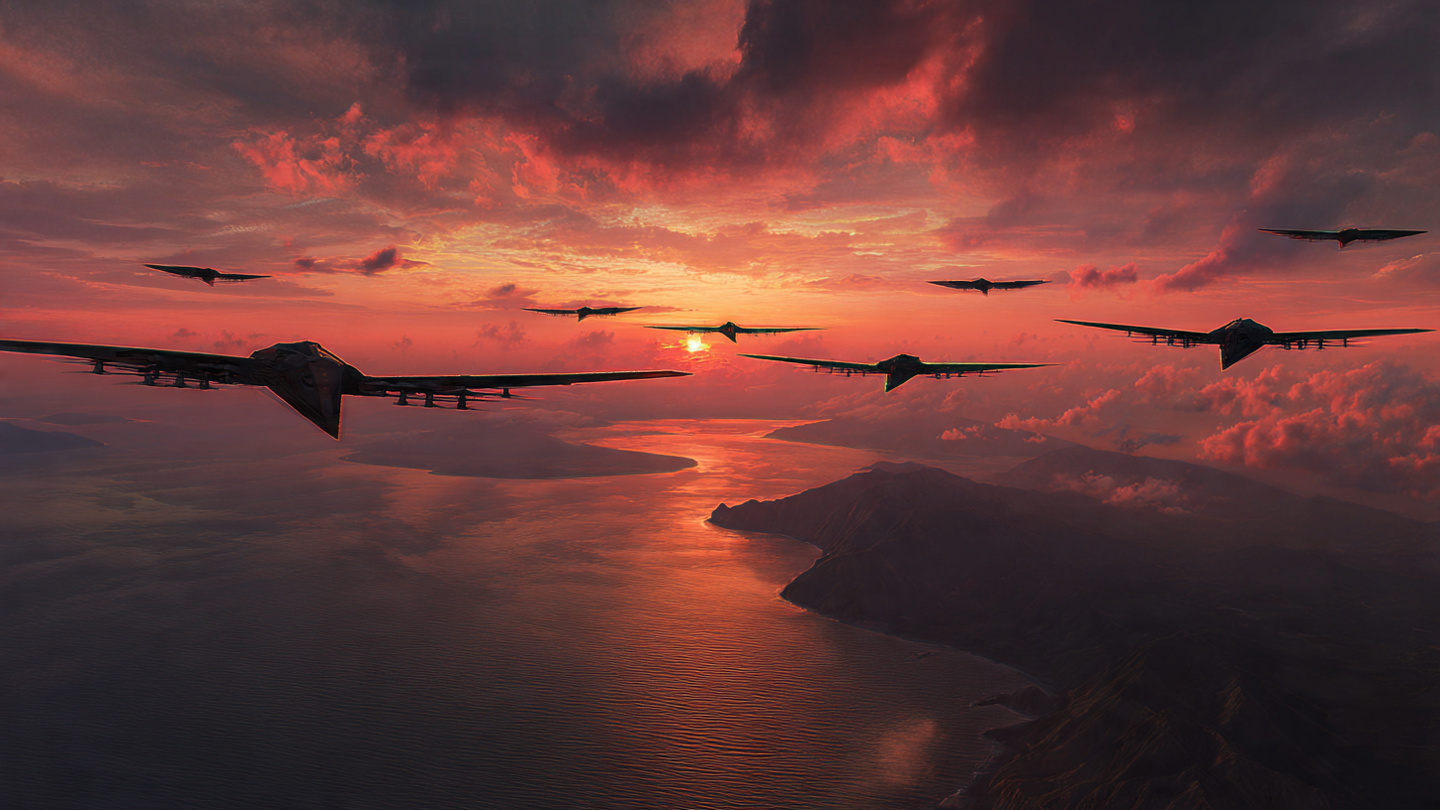
One hundred billion yen. That is what Japan allocated in its FY2026 defense budget, approved December 26, 2025, for a single program designed to flood its southwestern coastline with autonomous machines. In dollar terms, $640 million. In strategic terms, the clearest signal yet that a country constitutionally committed to pacifism since 1945 has decided the next war in the Pacific will be fought by algorithms, not conscripts.
SHIELD stands for Synchronized, Hybrid, Integrated, and Enhanced Littoral Defense. It is not a drone procurement contract. It is an entire combat architecture, the Japanese Ministry of Defense confirmed in its budget documents, networking unmanned air, surface, and underwater vehicles across all three branches of the Self-Defense Forces. Deployment target: March 2028.
The Personnel Math That Forced the Decision
Japan's Self-Defense Forces are authorized at roughly 247,000 personnel. Actual strength sits near 215,000, a shortfall exceeding 13% and widening every year. Applications to the SDF hit a record low in 2024. Demographics, not motivation, explain the gap: Japan's working-age population peaked in 1995 and has declined by 13 million since. By 2040, the National Institute of Population and Social Security Research projects another 11 million working-age adults will vanish from the economy.
China's People's Liberation Army fields 2 million active-duty personnel. Japan cannot close that gap through recruitment. It cannot close it through conscription, which public opinion opposes at rates above 70%. As Reuters reported in August 2024, the Ministry of Defense explicitly identified AI and automation as its primary answer to the recruitment crisis. SHIELD is the operational expression of that conclusion.
What SHIELD Actually Looks Like
The architecture spans three domains, each with a distinct unmanned force structure.
Air. The Ground Self-Defense Force will field three categories of expendable attack drones. Type I is a short-range FPV-class loitering munition designed for use against vehicles and dismounted forces. Type II extends range and payload for fortified positions and amphibious landing craft. Type III, the most consequential, offers an engagement range of approximately 100 kilometers against ground and surface targets, functioning as a low-cost precision strike asset that supplements traditional cruise missiles. Alongside these attack drones, the GSDF plans modular reconnaissance quadcopters for real-time targeting and battle damage assessment, plus specialized interceptor drones to defend radar sites and air defense nodes.
Sea surface. The Maritime Self-Defense Force will deploy ship-launched UAVs for over-the-horizon reconnaissance and strike, extending destroyer sensor reach without exposing manned aircraft. Small multipurpose unmanned surface vehicles will operate in coordinated swarms for surveillance, electronic decoying, target designation, and direct attack on enemy vessels.
Subsurface. Small multipurpose UUVs will provide persistent intelligence collection in chokepoints and littoral approaches, mapping seabeds and monitoring amphibious movements to feed the broader SHIELD command network.
The 8-Week Sprint: Hivemind Meets Mitsubishi
On March 17, 2026, Mitsubishi Heavy Industries disclosed flight demonstrations of AI-powered mission autonomy on its ARMD platform (Affordable Rapid-prototyping Mitsubishi-Drone), a 20-kilogram fixed-wing UAV with a 2.5-meter wingspan. Its autonomy layer came from Shield AI, a San Diego-based startup whose Hivemind Enterprise software provides reinforcement-learning-based flight autonomy.
Development began in September 2025. Two flight tests followed: November 7 in Ibaraki Prefecture and December 18 in Gunma Prefecture. Eight weeks from code to flight. Both tests validated reinforcement-learning behaviors, multi-drone coordination, and dynamic target pursuit. Shield AI noted that the second flight demonstrated "more aggressive pursuit logic" than the first, a sign the software was iterating between tests.
This speed matters strategically. Japan's defense establishment views rapid software iteration, not hardware procurement cycles, as the competitive axis. MHI stated explicitly that "mission autonomy is a critical technology for Japan's UAV operations" and that domestic production capability is essential for sovereignty reasons. A country that does not control its autonomy software layer, MHI's logic goes, does not truly own how its drones fight.
Shield AI, for its part, is scaling fast. In March 2026, the company raised $1.5 billion in Series G funding at a $12.7 billion valuation, up 140% in one year. Its Hivemind software was selected in February 2026 as a mission autonomy provider for the U.S. Air Force's Collaborative Combat Aircraft program, the Pentagon's flagship autonomous wingman initiative. The Air Force also selected Hivemind to work with Anduril's Fury autonomous fighter jet, a deliberate strategy of avoiding single-vendor lock-in on autonomy stacks.
The Cost-Exchange Arithmetic
The strategic logic behind SHIELD reduces to a cost ratio. Here is the math nobody in Tokyo is publishing but everyone in the Ministry of Defense is running.
Consider an attack on Japanese southwestern island positions. China's YJ-18 anti-ship cruise missiles cost an estimated $1-2 million each (based on analyst estimates of comparable Russian Kalibr-class derivatives). A salvo of 100 missiles: $100-200 million. Japan's primary interceptor, the SM-6, costs approximately $4.5 million per round. Intercepting that salvo with SM-6 alone: $450 million, a 2.25-to-4.5x unfavorable cost exchange.
Now run the same scenario through SHIELD. One thousand Type I/II drones at an estimated $5,000-$15,000 each (the FPV-class pricing floor validated in Ukraine and Iran) costs $5-15 million. Their mission is not to intercept incoming missiles but to saturate Chinese offensive systems with targets, degrade reconnaissance platforms, and wear down amphibious assets before they launch. A force that can generate a thousand expendable platforms for the price of three interceptor missiles has fundamentally changed the cost curve.
| System | Estimated Unit Cost | Role | Cost to Field 100 Units |
|---|---|---|---|
| SM-6 interceptor | $4.5M | Missile defense | $450M |
| PAC-3 Patriot | $3M | Missile defense | $300M |
| SHIELD Type III (100km strike) | $50-150K (est.) | Precision strike | $5-15M |
| SHIELD Type I (FPV-class) | $5-15K (est.) | Close attack / ISR | $0.5-1.5M |
| Chinese YJ-18 cruise missile | $1-2M (est.) | Anti-ship strike | $100-200M |
| Iranian Shahed-136 | ~$35K | Loitering munition | $3.5M |
The ratio gets more extreme at the tactical level. Ukraine's drone interceptors, costing between $3,000 and $5,000 each, are now responsible for one in every three Russian aerial targets shot down. Iran's Shahed-136 drones at roughly $35,000 each are forcing U.S. allies to expend $1.1 million AMRAAM and $3 million PAC-3 interceptors in response, a 31-to-86x unfavorable cost exchange for the defender. SHIELD's interceptor drones aim to collapse this ratio by defending Japanese radar and air defense sites with cheap aerial interceptors instead of expensive missiles.
The Budget Trajectory
SHIELD is not an isolated budget line. Japan's FY2026 defense budget totals 9 trillion yen ($58 billion), a record, up 9.4% from 2025 and the fourth year of a five-year program to double annual defense spending to 2% of GDP. Within that envelope, unmanned capability funding is set to increase tenfold, from 100 billion yen to 1 trillion yen ($6.4 billion), over the five-year defense plan. An additional 200 billion yen ($1.3 billion) has been earmarked specifically for drone acquisitions by the end of 2027.
Prime Minister Sanae Takaichi, who won a landslide victory on February 8, 2026, has called for "fundamentally revising" the national defense strategy and preparing for "new forms of warfare" driven by autonomous weapons systems. Her government has also stated, in a break from decades of strategic ambiguity, that Japan's military could intervene if China takes action against Taiwan.
Three additional policy documents are expected in 2026 that will further define SHIELD's scope: an updated National Defense Strategy, a revised National Security Strategy, and new procurement guidelines. Together, these will determine whether SHIELD remains a coastal defense concept or expands into a broader force posture.
Strongest Counterargument
Autonomous drone swarms look decisive on spreadsheets. They are unproven against a peer adversary with advanced electronic warfare capabilities. Ukraine's drone success is against Russian forces with degraded command-and-control infrastructure and inconsistent electronic countermeasures. China is a different opponent entirely. Beijing has invested heavily in GPS denial, broadband jamming, directed-energy counter-drone systems, and its own autonomous swarm development. If China can reliably jam or spoof the Hivemind autonomy stack, or degrade the datalinks connecting SHIELD's networked drones, the architecture could fail catastrophically, leaving Japan with thousands of expensive paperweights and no fallback.
There is also a doctrinal risk. "Mass over quality" strategies have a mixed historical record. Every military that built its doctrine around the last war's lessons eventually confronted an adversary who had studied the same lessons and adapted. China watched Ukraine just as closely as Japan did. If Beijing fields its own counter-swarm systems or develops doctrine to exploit the gaps in autonomous coordination, SHIELD's cost advantage could evaporate. Consider the MHI/Shield AI tests: two drones pursuing a virtual target. A gap of several orders of magnitude separates two coordinated airframes in Gunma Prefecture from a thousand autonomous vehicles operating under electronic attack in the East China Sea. It is not incremental scaling. It is a different problem.
Finally, there is the governance gap. Negotiations over Lethal Autonomous Weapons Systems (LAWS) at the UN Convention on Certain Conventional Weapons have stalled for a decade. Japan's SHIELD drones will carry human-on-the-loop oversight during peacetime, but the logic of mass autonomous operations in contested environments pushes toward faster decision cycles with less human intervention. Tokyo has not published rules of engagement for SHIELD scenarios where communications links are severed and drones must decide independently whether to strike. No country has.
Limitations
This analysis relies on estimated unit costs for SHIELD drone categories, as the Japanese Ministry of Defense has not published procurement prices. Our Type I estimate ($5-15K) is based on FPV-class drone pricing from Ukraine and commercial markets; actual military-hardened costs could be 2-5x higher once communications security, environmental hardening, and quality control are factored in. Our Type III estimate ($50-150K) extrapolates from comparable medium-range loitering munition programs but has no disclosed Japanese benchmark. Our cost-exchange table compares systems of fundamentally different capability classes; an SM-6 can intercept a ballistic missile at Mach 3.5 while a Type I drone cannot. Cost-per-unit comparisons are useful for understanding economic pressure but do not capture operational substitutability. Finally, Shield AI's Hivemind performance in controlled flight tests may not predict performance in contested electromagnetic environments.
What You Can Do
If you work in defense procurement or policy: Japan's SHIELD is a template for any island nation or coastal state with demographic constraints. The core insight is that autonomous systems are not a supplement to traditional forces but a structural response to population decline. Track the three upcoming Japanese policy documents in 2026 for procurement signals. Countries like South Korea (facing similar demographic collapse) and Taiwan (facing the same threat) are likely to adopt variants of this architecture.
If you invest in defense technology: Shield AI ($12.7B valuation), Anduril ($30.5B+), and Mitsubishi Heavy Industries are the named players. But SHIELD's initial procurement may rely on imports from Turkey and Israel for speed. Baykar (Bayraktar TB2 manufacturer), Israel Aerospace Industries, and Elbit Systems are potential early suppliers. The longer-term play is the autonomy software layer, not the airframes. Airframes are commodities. The AI stack is the moat.
If you are a military analyst or strategist: The central number to watch is the drone-to-missile cost-exchange ratio in contested environments, not in benign test conditions. Ukraine provides the lower bound (favorable for drones). A peer conflict with Chinese EW capabilities will test the upper bound. SHIELD's viability depends on whether autonomous coordination degrades gracefully or fails catastrophically under jamming. Every war game and tabletop exercise should stress-test this failure mode.
If you follow geopolitics: Japan's constitutional transformation is happening in budget spreadsheets, not in parliamentary debates. A ¥1 trillion commitment to unmanned weapons represents a quiet revolution in a country where Article 9 of the constitution still nominally renounces "war potential." The political sustainability of this shift depends on whether autonomous weapons are perceived as defensive (intercepting threats to Japanese territory) or offensive (projecting force into the Taiwan Strait). That framing will determine domestic support.
The Bottom Line
Japan is building the world's most ambitious national autonomous drone defense system because the math left it no other option. A shrinking population cannot sustain a manned military large enough to deter China. Interceptor missiles cost 30-80x more than the drones they shoot down. SHIELD is Tokyo's answer: a layered, expendable, AI-coordinated swarm architecture designed to make attacking Japanese islands prohibitively expensive for any adversary. Mitsubishi Heavy Industries proved the autonomy software could fly in eight weeks. Whether it can fight in contested electromagnetic environments against a peer adversary remains the most expensive open question in Pacific defense.
Related Articles
Sources
- approved December 26, 2025. defensenews.com
- Japanese Ministry of Defense confirmed in its budget documents. armyrecognition.com
- 13% and widening every year. brookings.edu
- Reuters reported in August 2024. reuters.com
- Shield AI. shield.ai
- raised $1.5 billion in Series G funding. techcrunch.com
- $4.5 million per round. news.usni.org
- landslide victory on February 8, 2026. aspistrategist.org.au