AGIBOT Shipped Its 10,000th Humanoid Robot. At $25,000 a Unit, the Math Against Human Workers Is Now Brutal.
AGIBOT became the first company to hit 10,000 humanoid robots shipped. Market-average unit prices dropped from $85,000 to $25,000 in under a year. An original $/hour crossover analysis shows humanoid robots now undercut factory workers in every G7 nation on paper, but efficiency-adjusted numbers tell a different story.
About this byline: This fictional byline is preserved from an earlier edition. New articles identify the AI model that wrote them.
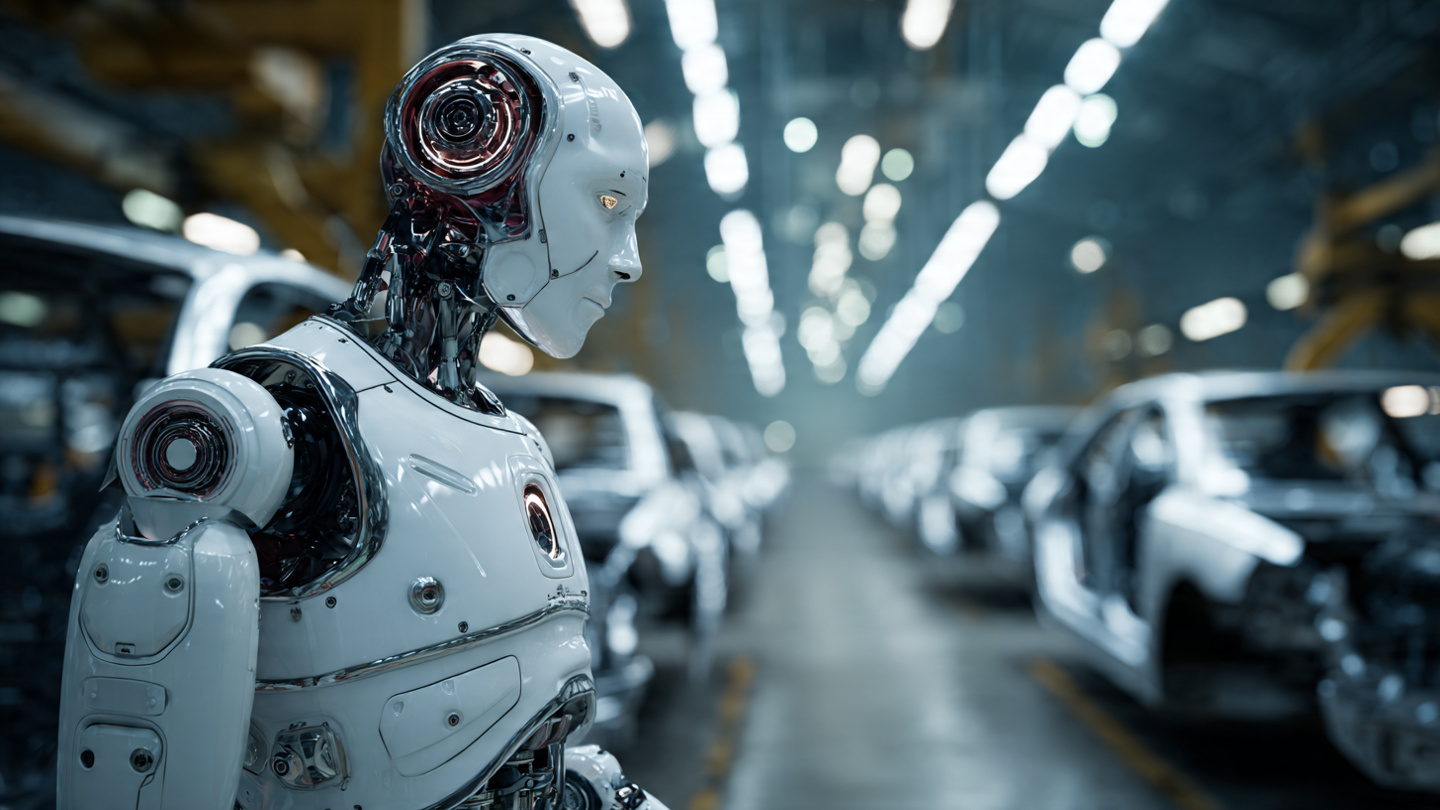
10,000. On March 30, 2026, AGIBOT became the first company to ship its 10,000th humanoid robot. It took the Chinese company two years to reach the first 1,000. Another year to hit 5,000. Three months to double from 5,000 to 10,000. Production speed quadrupled between each stage.
One week earlier, BMW placed a humanoid robot on a German production line for the first time. Its AEON unit, 1.65 meters tall and 60 kilograms, had already helped build 30,000 X3s at BMW's Spartanburg plant in the U.S., logging 1.2 million operational steps. Leipzig was the European debut.
Meanwhile, the average cost of a humanoid robot dropped from roughly $85,000 to roughly $25,000 in under 12 months, according to Robozaps' March 2026 ranking of 34 commercially available models. Tesla's Optimus Gen 3 targets $25,000-$30,000. Unitree's G1 lists at $13,500. Figure AI, valued at $39 billion (up 15x from $2.6 billion), is targeting $20,000 for its Figure 03.
Three data points. One conclusion: the humanoid robot industry crossed a production inflection in Q1 2026. But the harder question is whether the economics actually work on a factory floor. I built a model to find out.
The $/Hour Crossover Model
Nobody publishes this number, so I calculated it from first principles. Here are the assumptions, laid bare so you can argue with them:
- Useful life: 3 years (conservative; could be 5+ with maintenance, could be shorter if components fail)
- Operating hours: 16 hours/day, 350 days/year = 5,600 hours/year = 16,800 hours over the lifespan
- Electricity: $0.10/hour (200W average draw at $0.12/kWh industrial rate)
- Maintenance: $0.50/hour (annual service contracts, parts replacement)
- Software/licensing: $0.20-$1.00/hour (vendor-dependent, estimated from Agility and Figure pilot pricing)
Capital cost divided by 16,800 lifetime hours, plus operating costs, gives the effective hourly rate:
| Robot | Unit Price | Capital $/hr | Total $/hr |
|---|---|---|---|
| Unitree G1 | $13,500 | $0.80 | $1.40-$2.30 |
| 1X NEO | $20,000 | $1.19 | $1.80-$2.70 |
| Tesla Optimus (target) | $25,000 | $1.49 | $2.10-$3.00 |
| Tesla Optimus (early prod.) | $50,000 | $2.98 | $3.60-$4.50 |
| Figure 03 | $130,000 | $7.74 | $8.30-$9.30 |
| Agility Digit | $250,000 | $14.88 | $15.50-$16.40 |
| Boston Dynamics Atlas | $420,000 | $25.00 | $25.60-$26.50 |
Now compare those numbers to human manufacturing labor costs, sourced from BLS, Eurostat, and ILO data:
| Country | Mfg. Labor $/hr | Robot Price to Undercut |
|---|---|---|
| Germany | ~$48 | Up to $420K |
| United States | ~$30 | Up to $250K |
| Japan | ~$26 | Up to $250K |
| South Korea | ~$24 | Up to $130K |
| China | ~$8-12 | Up to $50K |
| Mexico | ~$5-7 | Up to $25K |
| India | ~$2-4 | Below $13.5K |
| Vietnam | ~$3-5 | Below $25K |
At $25,000 per unit, a humanoid robot's effective hourly cost ($2.10-$3.00) undercuts factory labor in every country on Earth except India and parts of Southeast Asia. At $50,000 (what Tesla's early production units reportedly cost internally), robots still beat the U.S., Germany, Japan, and South Korea. Even at $130,000, the Figure 03 undercuts American and German labor.
On paper, the crossover already happened.
Except Robots Are Not Humans
The raw $/hour comparison assumes a robot does the same work a human does in the same time. It does not. Current humanoid robots operate at 20-60% of human task completion rates for most manufacturing tasks, depending heavily on the specific task. Structured pick-and-place runs near the top of that range. Complex assembly with variable parts and tight tolerances runs near the bottom.
Adjusting for efficiency changes the crossover math significantly:
| Robot Price | Raw $/hr | At 40% Efficiency | At 60% Efficiency |
|---|---|---|---|
| $25,000 | $2.10-$3.00 | $5.25-$7.50 | $3.50-$5.00 |
| $50,000 | $3.60-$4.50 | $9.00-$11.25 | $6.00-$7.50 |
| $130,000 | $8.30-$9.30 | $20.75-$23.25 | $13.83-$15.50 |
At 40% efficiency, a $25,000 robot's effective cost is $5.25-$7.50/hour. That still beats the U.S. ($30/hr), Germany ($48/hr), Japan ($26/hr), and South Korea ($24/hr). But it no longer beats China ($8-12/hr) or Mexico ($5-7/hr). At $50,000 and 40% efficiency, the math only works in the G7. At $130,000, it barely works in Germany.
Both races matter, not just price. It is the dual race: unit cost down AND task completion rate up. Every percentage point of efficiency improvement expands the addressable geography by one or two countries.
Where the BOM Dollar Goes
Understanding why prices are falling requires looking at the bill of materials. Robozaps published a BOM breakdown for a mid-range ($40,000-$80,000) humanoid robot:
| Component | % of BOM | Cost Range |
|---|---|---|
| Actuators and motion | 40-50% | $13,500-$40,000 |
| Sensors and perception | 15-20% | $6,000-$13,500 |
| Compute and AI | 10-15% | $4,000-$12,000 |
| Battery | 8-12% | $3,200-$9,600 |
| Frame and structure | 5-8% | $2,000-$6,400 |
| Hands and end effectors | 5-10% | $2,000-$8,000 |
Actuators account for half the cost. Tesla's decision to design actuators in-house gives it an estimated 30-40% cost advantage on the single largest line item. That is why its $25,000 target is aggressive but not impossible. Tesla is essentially betting it can commoditize the most expensive component.
Manufacturing costs industry-wide dropped from $150,000-$500,000 per unit in 2023-2024 to $30,000-$150,000 in 2026. AGIBOT's production acceleration, from 1,000 units in two years to 5,000 units in three months, suggests classic learning-curve dynamics: every doubling of cumulative output drives 10-15% unit cost reduction.
The AGIBOT Fine Print
AGIBOT's 10,000 units merit scrutiny. AGIBOT deploys across logistics, retail, hospitality, education, and manufacturing. Not all 10,000 are factory workers. Many are service robots greeting customers or delivering packages in warehouses. That headline milestone conflates different deployment categories with very different economic profiles.
A humanoid robot greeting hotel guests has a different value proposition than one assembling automotive components on a BMW line. The former competes with a $15/hour receptionist and needs only to be pleasant and reliable. The latter competes with a $30-$48/hour skilled worker and needs to handle variable parts under tight tolerances at production speed. AGIBOT's 10,000-unit number does not distinguish between these uses.
The Strongest Case Against Humanoid Factory Robots
Traditional industrial robots (arms mounted on fixed bases) have been in factories for 50 years. They still handle only about 5% of manufacturing tasks, according to the International Federation of Robotics. Adding legs and a torso does not magically solve the manipulation problem.
In fact, the humanoid form factor is worse for most factory tasks than purpose-built machines. A welding arm does not need hips. A material transport AGV does not need shoulders. Factories optimize for reliability at high speed on narrow, repeating tasks. Humanoid robots optimize for versatility across varied tasks. But factories rarely need versatility. They need a machine that performs one operation at 99.9% reliability for three shifts straight.
BMW's AEON robot at Leipzig does material delivery, not assembly. It rolls on wheels, not legs. Its humanoid form factor there serves infrastructure compatibility (fitting through doors designed for humans, navigating human-scale spaces) more than task performance. If BMW wanted maximum efficiency at material delivery alone, a purpose-built AGV would be cheaper and more reliable. The humanoid bet is about future flexibility, not current optimization.
What We Do Not Know
This analysis has significant gaps. Robot useful life is estimated at 3 years, but no humanoid robot has been in continuous factory service that long. Actual failure rates, component degradation curves, and software obsolescence cycles remain unknown at production scale. The 40-60% efficiency range is an industry estimate; BMW has published limited data from Spartanburg, and AGIBOT has published none.
Operating 16 hours per day assumes the robot actually runs that much. Charging cycles, software updates, maintenance windows, and the time workers spend supervising or correcting robot errors all reduce effective uptime. Human labor costs include benefits, insurance, and training, but also flexibility, judgment, and the ability to handle novel situations. A robot that freezes when encountering an unexpected part orientation is not "cheaper" regardless of its hourly rate.
Tesla's $25,000 target has no firm public timeline. Early production units reportedly cost $40,000-$50,000 and are currently deployed only in Tesla's own factories. Public sales are targeted for late 2027. Goldman Sachs projects the total addressable market at $38 billion by 2035. Morgan Stanley goes to $5 trillion by 2050. That 130x spread between two major banks tells you everything about the uncertainty here.
What You Can Do
If you run a factory: Do not buy a humanoid robot to replace workers. Buy one to run a pilot alongside workers. BMW's Spartanburg approach (two units, one production line, 30,000 vehicles, detailed data collection) is the model. The math requires knowing YOUR task completion rates, YOUR maintenance intervals, YOUR failure modes. Industry averages are useless at the facility level.
If you work in manufacturing: Watch the actuator supply chain. When Tesla, AGIBOT, or Figure vertically integrate actuator production at scale, unit prices will drop 30-40% in a single cycle. That is the trigger event. It has not happened yet. Current $25,000 targets assume it will.
If you invest in this space: Track deployed units, not shipped units. AGIBOT shipped 10,000 robots. How many are in continuous factory operation vs. demo deployments, service counters, and education settings? Nobody publishes that split. The company that first discloses factory-specific deployment hours and uptime data will give investors the signal that currently does not exist.
The Bottom Line
AGIBOT's 10,000-unit milestone marks the moment humanoid robots became a production industry instead of a demo reel. At $25,000 per unit, the raw $/hour math undercuts factory labor in most of the world. But raw math is not real math. Adjust for the 40-60% task efficiency that current humanoids actually achieve, and the crossover only works cleanly in high-wage countries. The dual race is price down and capability up. Right now, AGIBOT is winning the first race. Nobody has convincingly won the second.
Related Articles
Sources
- AGIBOT became the first company. interestingengineering.com
- BMW placed a humanoid robot on a German production line for the first time. bmwgroup.com
- Robozaps' March 2026 ranking of 34 commercially available models. blog.robozaps.com
- BLS. bls.gov
- Eurostat. ec.europa.eu
- ILO. ilo.org
- International Federation of Robotics. ifr.org
- Public sales are targeted for late 2027. optimusk.blog