The Humanoid Robot Industry Shipped 16,000 Units in 2025. The Best One Has a 10% Failure Rate.
The humanoid robot industry shipped 16,000 units globally in 2025 and attracted over $5 billion in investment. Factories are being built to produce 100,000 per year. But the most successful factory trial achieved 90.2% reliability on a single task. Automotive assembly lines need 99%.
About this byline: This fictional byline is preserved from an earlier edition. New articles identify the AI model that wrote them.
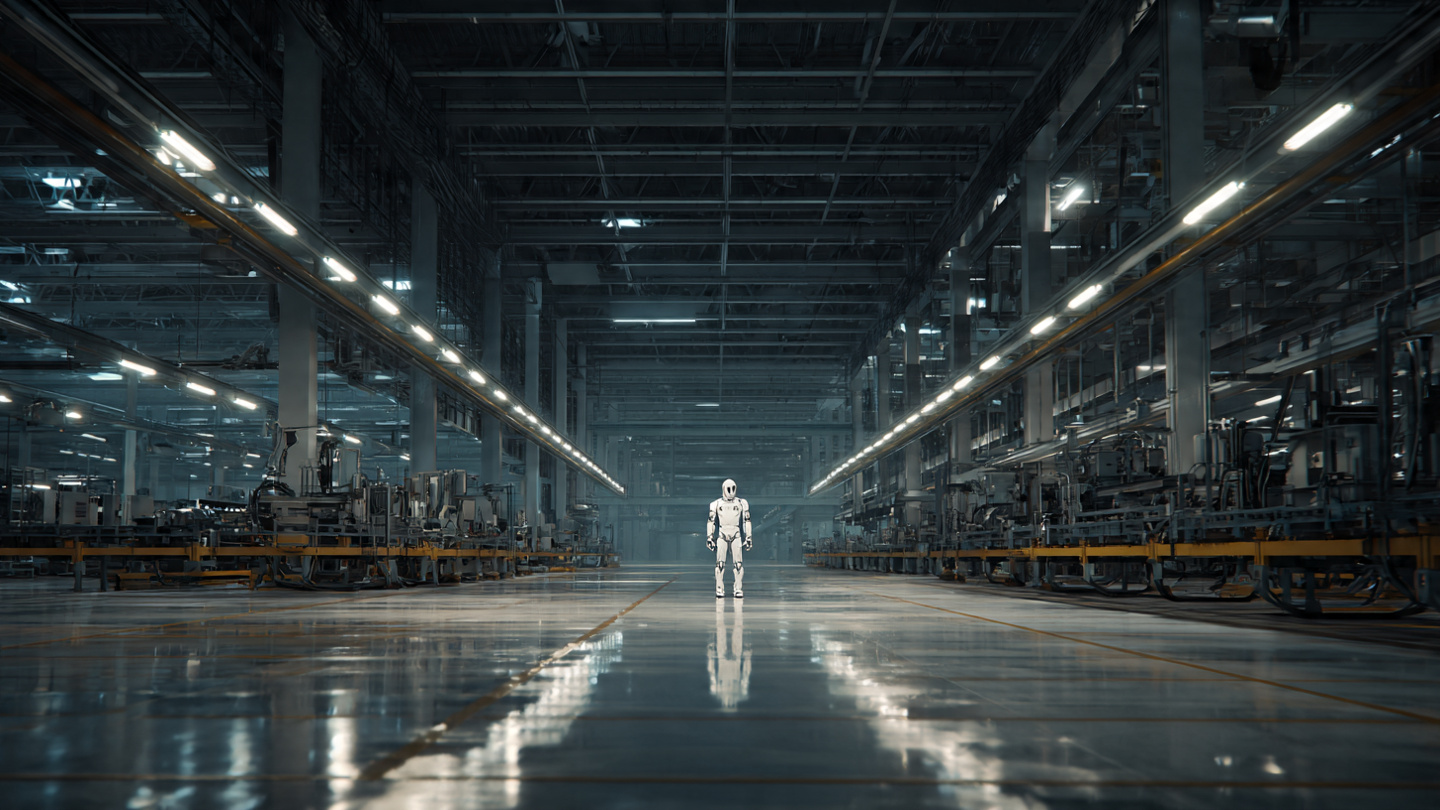
Sixteen thousand.
That is the total number of humanoid robots installed worldwide in 2025, according to Counterpoint Research's January 2026 report. China accounted for more than 80% of them. For context, the world installs roughly 500,000 traditional industrial robot arms per year, a market that took four decades to reach that volume. Humanoid robots are starting from a number you could fit in a single Amazon warehouse.
Investors see things differently. Over $5 billion has flowed into humanoid robot companies since 2020. Goldman Sachs projects a $38 billion market by 2035. Morgan Stanley's bull case reaches $5 trillion by 2050. Manufacturers have announced factory capacity to build more than 100,000 humanoids per year within the next three years.
Between the 16,000 units on the ground and the six-figure production targets, there is a gap wide enough to park every humanoid robot ever built and still have room for the hype.
What $13,500 Actually Buys You
Consumer humanoid robots now cost less than a Honda Civic. Unitree's G1 sells for $13,500. 1X's NEO ships for $20,000 or $499 per month on a subscription model. EngineAI's T800, announced at CES 2026, targets $25,000 with mid-2026 delivery. Tesla aims for $20,000 to $30,000 for Optimus at mass production scale, though internal deployment comes first.
At $13,500, the G1 costs 8.4% of a fully loaded US manufacturing worker's annual compensation. The US Census Bureau puts that loaded cost at roughly $160,000 per year when you include benefits, overhead, and payroll taxes. A robot that replaces one worker pays for itself in 31 days, on paper.
The phrase "on paper" is doing significant work in that sentence.
90.2% Is Not Good Enough
In March 2026, Xiaomi published the most detailed real-world humanoid performance data any manufacturer has released. Its robot completed a three-hour continuous autonomous run at a self-tapping nut installation station on the company's EV assembly line in Beijing. Its task: threading nuts onto magnetic pins, a manipulation challenge requiring controlled force and millimeter-level positional accuracy.
Xiaomi's robot achieved a 90.2% dual-side success rate and met the factory's 76-second takt time, meaning it kept pace with a production line that builds one car every 76 seconds.
Ninety percent sounds impressive for a humanoid robot in 2026. On a production line, it is disqualifying. Trained human workers on automotive assembly lines operate above 99% reliability. A 10% failure rate at one station on a line running at 76-second intervals means roughly 38 defective operations per eight-hour shift. Each one requires human intervention, rework, or downstream quality catches. That robot does not eliminate a worker; it creates a babysitting job.
The Cost-Per-Useful-Hour Problem
Standard pitch compares robot purchase price to annual labor cost. That comparison ignores reliability. Here is a different way to think about it.
Assume a $13,500 robot running 8 hours per day, 260 days per year, for three years. Add an estimated $10,000 per year for maintenance, software, and integration support (no manufacturer publishes these figures, so this is a conservative mid-range assumption). Total three-year cost: $70,500. That works out to $11.30 per operating hour.
A human manufacturing worker at $160,000 per year costs $76.92 per hour. At face value, the robot is 85% cheaper.
Now factor in reliability. At 90.2% success, the robot produces defective output for roughly 204 hours per year. If each failed operation takes a human 2 minutes to catch and correct, and the line runs at one task per minute, you need a dedicated human overseeing every robot-staffed station. That human costs $76.92 per hour. Allocating even half their time to robot oversight adds $80,000 per year to the effective cost of robot labor.
At 99% reliability, the math flips. Oversight becomes intermittent, roughly 21 hours of corrections per year instead of 204. At that threshold, the robot genuinely displaces labor. Between 90% and 99%, the robot is an expensive intern that needs constant supervision.
No manufacturer has publicly demonstrated 99% task reliability for a humanoid robot in an uncontrolled production environment. Xiaomi's 90.2% is the best published number. Most companies publish no reliability data at all.
The Capacity-Deployment Paradox
Figure AI opened BotQ, a dedicated humanoid manufacturing facility designed to produce 12,000 units per year initially, scaling to 100,000 over four years. Agility Robotics built RoboFab in Salem, Oregon, with a target of 10,000 Digit robots per year at full capacity. Hyundai is constructing a facility at its Robotics Metaplant Application Center to produce thousands of Boston Dynamics Atlas units annually.
Combined announced capacity across the top five manufacturers exceeds 100,000 units per year. Total global installations in 2025 were 16,000. Even aggressive forecasts from MarketsandMarkets project cumulative installations reaching 100,000 by 2027. That is two full years of announced capacity sitting idle on day one.
Building production capacity ahead of demand is a standard industrial strategy. Tesla built Gigafactory Nevada before demand for battery packs justified the investment. But Tesla was selling a finished product to consumers who were placing orders. Humanoid robot manufacturers are building factories to produce machines that have not yet demonstrated the reliability their customers require.
| Manufacturer | Facility | Announced Capacity (units/yr) | Status |
|---|---|---|---|
| Figure AI | BotQ | 12,000 | Operational |
| Agility Robotics | RoboFab (Salem, OR) | 10,000 | Ramping |
| Hyundai/Boston Dynamics | RMAC (Georgia) | Thousands | Under construction |
| Tesla | Internal facilities | Not disclosed | Internal deployment |
| Unitree Robotics | Hangzhou, China | Not disclosed | Shipping |
Where Humanoids Are Actually Working
BMW deployed Figure 02 robots at its Spartanburg, South Carolina plant for parts handling and quality inspection. Amazon tested Agility Digit in warehouse tote-moving operations. Hyundai ran an Atlas research prototype at its Georgia factory in October 2025, where the robot independently sorted roof racks for the assembly line. Mercedes-Benz is testing humanoids in its facilities.
Every one of these deployments is described as a "pilot," "test," or "trial." None has been announced as permanent production staffing. That distinction matters: pilot programs are funded by R&D budgets and tolerate high failure rates. Production deployments are funded by operations budgets and require demonstrated ROI. Nobody in the industry has crossed that line publicly.
The Strongest Counterargument
Industrial automation followed this exact trajectory. FANUC shipped its first industrial robot arm in 1974. By 1984, the global installed base was under 70,000 units. By 2023, it exceeded 4 million. That S-curve of industrial automation took 20 years to inflect and another 20 to mature. If humanoid robots are at the equivalent of 1980, quibbling about 16,000 units is like criticizing the iPhone for selling "only" 6.1 million units in 2007. By 2023, Apple was shipping 234 million per year.
This comparison has real force. Bain & Company reports that humanoid unit costs dropped 40% between 2022 and 2024. Learning-curve economics in manufacturing are real and compounding. A $13,500 robot today could be a $5,000 robot by 2030 if Unitree and its competitors follow standard electronics cost curves.
But industrial robot arms solved one problem well: repeatable, high-precision motion in fixed positions. Humanoid robots are trying to solve general-purpose mobility, manipulation, perception, and planning simultaneously, in unstructured environments, while matching human reliability. Self-driving cars promised a similar generalization leap. The industry has spent over $200 billion and 15 years and still operates in geofenced areas. Whether humanoids follow the fast S-curve of robot arms or the slow grind of autonomous vehicles will determine if those Goldman Sachs projections look prescient or laughable.
Limitations
Counterpoint Research's 16,000 figure likely includes research units, demo platforms, and pre-production prototypes alongside commercial deployments. The actual number of humanoids performing productive work in factories or warehouses is probably lower. Xiaomi's 90.2% reliability metric comes from a single station performing one specific task over three hours; other tasks may produce better or worse results. Pricing data from Chinese manufacturers may not include shipping, import duties, integration costs, or ongoing software licensing, all of which affect total cost of ownership. Several manufacturers listed as "available" or "shipping" have limited public evidence of volume deliveries. BMW, Amazon, and Mercedes have not disclosed unit counts, deployment durations, or performance metrics for their pilot programs.
The Bottom Line
Humanoid robots are real. Prices have fallen below $15,000. Factories are being built. Major manufacturers are running pilots. But 16,000 units is a prototype market, not a labor revolution. The gap between a demo reel and a production line is measured in nines of reliability, and no humanoid has publicly demonstrated the 99% task success rate that factory operations demand. When that number appears in a peer-reviewed industrial engineering paper instead of a press release, the $38 billion market projections will start to look like forecasts instead of fairy tales. Until then, the smartest money is watching the reliability data, not the fundraising rounds.
Sources
- Counterpoint Research's January 2026 report. counterpointresearch.com
- $38 billion market by 2035. goldmansachs.com
- US Census Bureau. census.gov
- 90.2% dual-side success rate. mikekalil.com
- 12,000 units per year initially. interestingengineering.com
- 10,000 Digit robots per year. agilityrobotics.com
- MarketsandMarkets. marketsandmarkets.com
- Bain & Company. bain.com