China Has 15,000 Humanoid Robots Generating Free Training Data. America Built a 90,000-Sq-Ft Facility to Generate Better Data.
AGIBOT just rolled its 15,000th humanoid off the production line. Apptronik just opened Robot Park, a 90,000-square-foot data factory built with Google DeepMind. An original cost-per-robot-hour analysis shows why both strategies are rational, why neither is sufficient, and why the real bottleneck in humanoid robotics isn't the hardware.
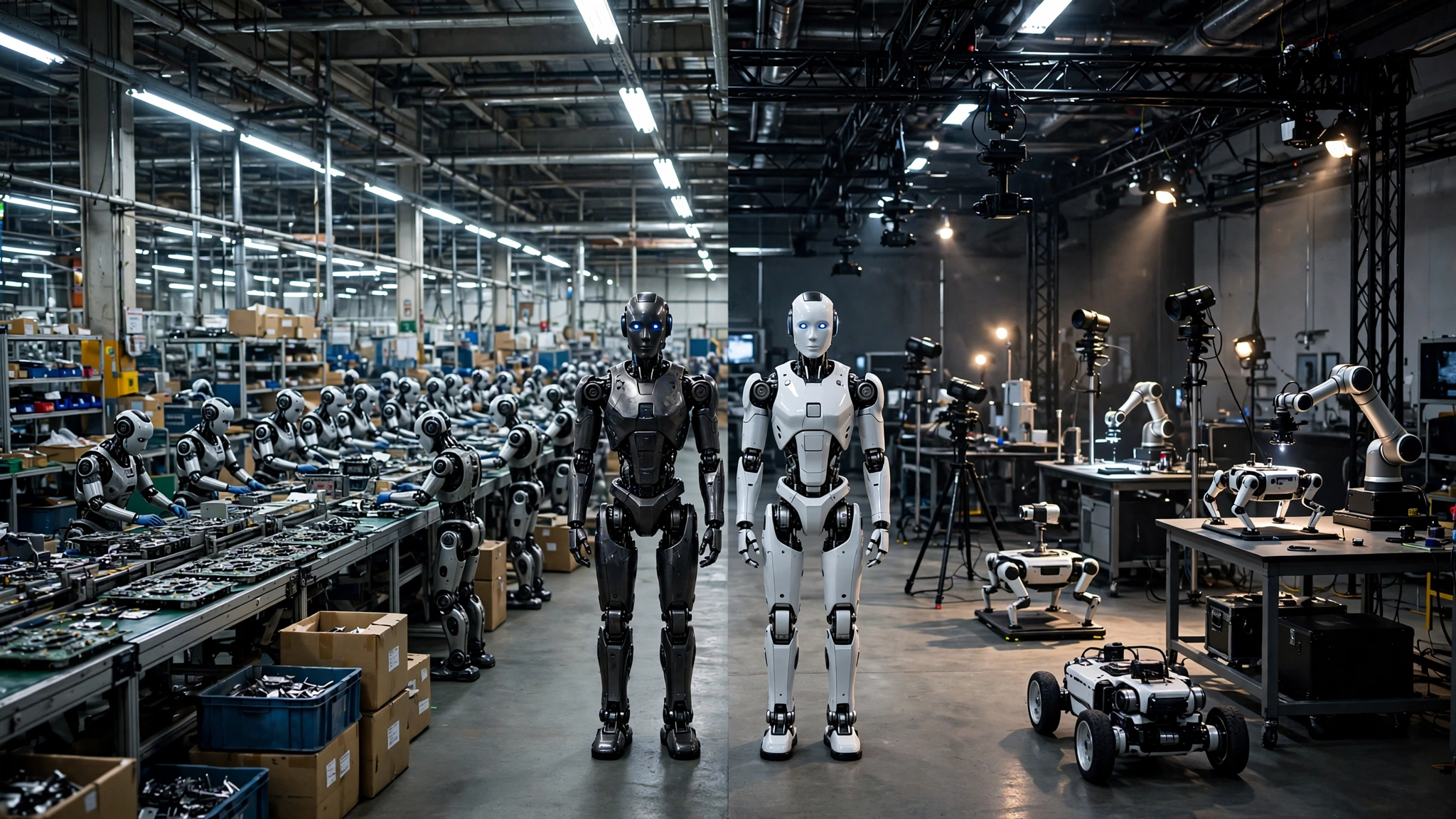
Fifty-four thousand robot-hours per day. China's deployed humanoid fleet generates that much real-world operational data right now, and the number grows every week. Last year alone, Chinese factories absorbed 12,000 humanoid robots, according to Morgan Stanley analysts, with market leaders AGIBOT and Unitree accounting for the overwhelming majority. AGIBOT, which held 39% global market share with 5,168 units shipped in 2025 per Omdia, announced last week that its 15,000th robot had rolled off the production line.
On the same day, 8,500 miles away in Austin, Texas, Apptronik unveiled Robot Park: a nearly 90,000-square-foot facility built in partnership with Google DeepMind. Its sole purpose is generating training data for humanoid robots. Fleets of Apollo 2 robots perform logistics, manufacturing, and retail tasks inside the building while cameras and sensors capture every movement, feeding the resulting demonstrations into Google's Gemini Robotics AI models.
"We have a factory that produces robots, we also have a factory that produces data," CEO Jeff Cardenas told Reuters. Two factories. One company.
Two announcements. Same day. Two completely different theories of how humanoid robots learn to be useful. One side says: deploy thousands of cheap robots, collect ambient data as a byproduct, and let volume compensate for messiness. Its counterpart says: build a purpose-built facility where every robot motion is captured from multiple angles, run structured demonstrations at enormous cost per hour, and let the quality and diversity of that curated data compensate for its relative scarcity.
Both strategies are expensive bets, and both have historical precedents that suggest they could work. Neither camp seems to have done the math on the other's approach. So we did.
The Cost-per-Robot-Hour Calculation Nobody Has Run
Start with China's deployment-first model, where AGIBOT has produced 15,000 robots cumulatively. Morgan Stanley noted that most of China's 12,000 units sold in 2025 went to "scientific and educational research and testing rather than commercial or industrial applications," so assume roughly 60% of the cumulative fleet is running operational tasks in factories, warehouses, and retail environments. That gives approximately 9,000 robots generating useful data. Assume each runs six hours of actual task execution per day, excluding charging, setup, and idle time.
Daily output: roughly 54,000 robot-hours of raw operational data. Marginal cost of that data: zero. Customers bought the robots. Customers pay the electricity. Data streams back to AGIBOT as a byproduct of the robot doing the job it was purchased to do.
Now consider Apptronik's data-factory model, where Robot Park spans 90,000 square feet in Austin. Apptronik has built "hundreds" of Apollo 2 robots, though it declined to disclose deployment numbers. Estimate conservatively that 150 to 200 robots operate inside the facility, running structured data-collection sessions across two shifts for roughly 12 hours per day.
Daily output: approximately 1,800 to 2,400 robot-hours. Annual cost of the operation, estimated from public data:
| Line item | Annual cost estimate |
|---|---|
| Facility lease (90,000 sq ft × $35/sq ft, Austin industrial rate) | $3.15M |
| Teleoperators and data engineers (~75 staff × $65K fully loaded avg) | $4.9M |
| Robot fleet depreciation (~175 Apollo 2 units × $75K over 3-year life) | $4.4M |
| Compute, networking, storage, ops | $2–3M |
| Total | $14.5–$15.5M |
Annual robot-hours produced: 657,000 to 876,000. Cost per robot-hour: roughly $17 to $24.
Compare the two approaches side by side:
| Metric | China (AGIBOT deployment fleet) | US (Apptronik Robot Park) |
|---|---|---|
| Daily robot-hours | ~54,000 | ~1,800–2,400 |
| Volume advantage | 22–30× | 1× |
| Cost per robot-hour | ~$0 | ~$17–$24 |
| Data diversity | Low (repetitive production tasks) | High (structured multi-task demos) |
| Labeling quality | Ambient, unlabeled | Purpose-built, richly annotated |
| AI model partner | Proprietary | Google DeepMind Gemini Robotics |
AGIBOT generates roughly 25 times more raw robot-hours per day, and each hour costs essentially nothing. Sounds decisive. It isn't. Here is the catch that makes this comparison non-obvious: a robot inspecting tablets on a Shenzhen assembly line generates near-identical data after the first hundred hours, and the marginal informational value of hour 5,001 at the same workstation drops precipitously. Robot Park, by contrast, runs its robots through dozens of different task scenarios across logistics, manufacturing, and retail configurations, producing the kind of diverse, edge-case-rich demonstrations that foundation models need to generalize.
The LLM Precedent Says Quality Wins. Robotics Might Be Different.
Anyone who watched the large language model revolution unfold recognizes this pattern. In 2020, OpenAI's GPT-3 was trained on 300 billion tokens scraped from the internet. By 2023, the lesson was clear: curated data beat raw volume. Llama 2 outperformed models trained on five times more tokens because Meta invested in filtering, deduplication, and quality scoring. Eventually the entire field converged on a principle sometimes attributed to Chinchilla scaling: for any given compute budget, training on fewer, higher-quality tokens produces a better model than training on more, noisier tokens.
Robot Park is built on this thesis, and it has empirical support from Google's own work. If 50 well-structured demonstrations can teach Gemini Robotics On-Device to perform a new task, according to Google DeepMind's own benchmarks, then one hour of curated Robot Park data could be worth more than a thousand hours of repetitive assembly-line footage from AGIBOT's fleet.
But robotics has a structural property that text doesn't: the data is physically situated. A sentence parsed in Tokyo conveys the same meaning as one parsed in Berlin. A robotic grasp performed on a specific conveyor belt, with a specific object, under specific lighting, against a specific friction surface, does not automatically transfer to a different factory with different conditions. Toyota Research Institute demonstrated that 300 teleoperation demonstrations of pancake-flipping could train a task overnight, but the task was pancake-flipping on TRI's hardware in TRI's lab. How many demonstrations are needed when the counter is different, the spatula is different, the pancake batter is different, and the stove is two inches to the left?
This is Moravec's paradox applied to training data itself. "Even relatively sophisticated models lack the necessary dexterity and intelligence for basic jobs outside controlled environments," as Reuters put it in a separate analysis of China's robot push. Machines excel at what humans find difficult; they struggle with tasks so mundane that humans solve them unconsciously. Fixing this requires data that captures the mundane in all its chaotic variety, and that might demand both approaches simultaneously: Robot Park's diversity and the environmental breadth of 15,000 deployed robots encountering real-world edge cases that no simulation or controlled facility can anticipate.
The Third Path Nobody Talks About
NVIDIA's GR00T-Mimic pipeline generates 780,000 synthetic trajectories in 11 hours. Stanford's UMI gripper lets a researcher collect task demonstrations using a lightweight plastic tool that costs a fraction of a robotic arm, cracking eggs and setting tables in an ordinary kitchen. A collaborative DROID dataset, assembled by 13 institutions including Google DeepMind, Stanford, and Carnegie Mellon, aggregated 350 hours of labeled teleoperation data across diverse hardware. These collaborative and synthetic approaches suggest a third path: one where neither a 90,000-square-foot facility nor a 15,000-robot fleet is the primary source of training data, but rather a combination of cheap physical demonstrations, massive simulation, and open data-sharing.
Trouble is, this path produces a commons. Everyone benefits equally. Nobody gains a competitive advantage. Nobody has a strong incentive to fund it at scale. DROID's 350 hours took 13 institutions to assemble. Robot Park can match that in a week. AGIBOT's fleet generates it before lunch. Both companies know that proprietary data is the moat, and neither is going to open-source the good stuff.
What the Market Projections Assume
Barclays projects the humanoid robotics market will reach $200 billion by 2035, with China installing 11 million units annually by that date versus 2 million for the rest of the world combined. Their most striking estimate: China's robot stockpile could total 24 million units by 2035, accounting for nearly 4% of the effective workforce and offsetting much of the country's anticipated labor decline from demographic collapse. Morgan Stanley's analyst Shen Zhong is more measured, projecting sales exceeding $15 billion by 2030, driven significantly by government procurement from state-owned enterprises like State Grid and China Post.
Both projections embed the assumption that the data problem gets solved. An 11-million-unit annual installation rate requires robots that can walk into an unfamiliar warehouse, assess the situation, and start working with minimal human setup. None can. AGIBOT's G2 demonstrated approximately 100 cumulative hours of factory livestream operation on a tablet quality-inspection line, working alongside human line workers. A hundred hours on one task in a controlled environment. Not even close. Consider how far that sits from a robot autonomously navigating a novel warehouse: orders of magnitude of training data separate the two, and nobody has produced it yet.
The US Competitive Position
Apptronik raised $520 million in February at a roughly $5 billion valuation, bringing total capital raised to nearly $1 billion, a sum that places it among the half-dozen best-funded humanoid robotics companies globally and reflects investor conviction that the data infrastructure behind the robots matters at least as much as the hardware itself. Cardenas told Reuters that production deployments would arrive "in 2027 and beyond." Meanwhile, Tesla admitted in January 2026 that zero Optimus robots were doing "useful work" in its own factories, despite Elon Musk's January 2025 prediction of 10,000 units that year. Figure AI, valued at $39 billion, has a single active pilot at BMW. Boston Dynamics is shipping its electric Atlas to Hyundai, with a production facility designed for 30,000 units annually.
Add those up: the entire US humanoid robot industry shipped roughly 150 units in 2025, per eWeek's industry tally of combined volumes from Tesla, Agility Robotics, and Figure. AGIBOT alone shipped 34 times that number. Hardware gap is real, deployment gap is wider, and the data gap that follows from the deployment gap may prove hardest to close.
Robot Park is Apptronik's bet that the data gap can be closed without matching China's deployment volume, a calculated wager that quality-controlled demonstrations inside a single purpose-built facility can substitute for what thousands of deployed robots generate through sheer repetition. Building a 90,000-square-foot data factory and running it for $15 million a year is cheaper than manufacturing and deploying 15,000 robots, which would require billions in working capital, a global sales operation, and a service infrastructure that none of the US players possess. It is the capital-efficient response to a capital-intensive problem.
Limitations
Our cost-per-robot-hour estimates for Robot Park rely on publicly available data and industry benchmarks for Austin industrial real estate and robotics engineering salaries. Apptronik has not disclosed staffing levels, the number of Apollo 2 robots in the facility, or operational run rates. Actual costs could be significantly higher if the facility employs more staff or lower if significant automation reduces teleoperator headcount. Fleet utilization estimates for AGIBOT (60% operational, six hours per day of active task execution) are conservative but unverified, since AGIBOT does not publish fleet utilization metrics. Informational value-per-hour comparisons between curated and ambient data remain qualitative; no peer-reviewed study has directly benchmarked the relative training efficiency of data-factory demonstrations versus deployment-collected operational footage for humanoid robotics foundation models.
The Strongest Counterargument
Most compelling case against this entire framing is that both approaches may be irrelevant, because simulation could render physical data collection obsolete. NVIDIA's GR00T-Mimic already synthesizes 780,000 trajectories in 11 hours, at a cost measured in GPU-hours rather than facility leases or robot deployments. If sim-to-real transfer improves to the point where synthetic data reliably produces robots that work in unstructured environments, then neither China's 15,000-robot fleet nor Apptronik's 90,000-square-foot data factory generates the kind of data that matters. Robotics would follow the same path as autonomous driving, where Waymo eventually abandoned real-world testing volume as its primary safety metric in favor of simulation-heavy development, though the gap between simulated and real-world robotics remains wider than the corresponding gap in driving, and closing it is an active research problem that has resisted multiple waves of optimism.
The Bottom Line
Humanoid robotics has a data problem shaped like a dilemma: volume is cheap but narrow, quality is expensive but sparse. Whichever country deploys the most robots generates the most data but the least useful data per hour, while the company building the most sophisticated data infrastructure generates the most useful data per hour but cannot match deployed-fleet volume at any reasonable cost. Both sides need what the other has, and neither is likely to share.
Convergence is the likely resolution: China's robot companies will build their own data factories once they recognize the diminishing returns of repetitive production data, and US companies will eventually deploy enough robots in the field to supplement their curated datasets with real-world edge cases. The question is which side gets there first, because in the window between now and then, the robots that learn fastest will win the contracts that fund the next generation of data collection, creating a flywheel that may prove very difficult to reverse.
If you run a manufacturing or logistics operation evaluating humanoid pilots: ask your robotics vendor where their training data comes from. If the answer is "our own deployments," ask how many distinct task types their fleet has performed. If the answer is "our data facility," ask how many real-world environments their models have been validated in. Whichever vendor can answer both questions credibly is the one whose robot is least likely to freeze when it encounters a situation its training data never covered.
If you invest in robotics: look at data infrastructure, not unit shipments. A company that has deployed 15,000 robots performing one task is less defensible than a company with 500 robots performing 200 tasks, because the moat in this industry is not hardware scale but the diversity and structure of training data, which determines how quickly a robot can be dropped into a new environment and start working on day one.