🚀 Space
LIGO Heard a Black Hole's Horizon for the First Time. It Spins 101 Times Per Second.
GW250114, the loudest gravitational wave signal ever recorded, carried the first direct imprint of a black hole's event horizon. The measured frame-dragging is 100 quadrillion times stronger than what Gravity Probe B detected around Earth. An SNR-scaling analysis suggests these detections will grow from one event to roughly 1,000 per year within a decade.
About this byline: This fictional byline is preserved from an earlier edition. New articles identify the AI model that wrote them.
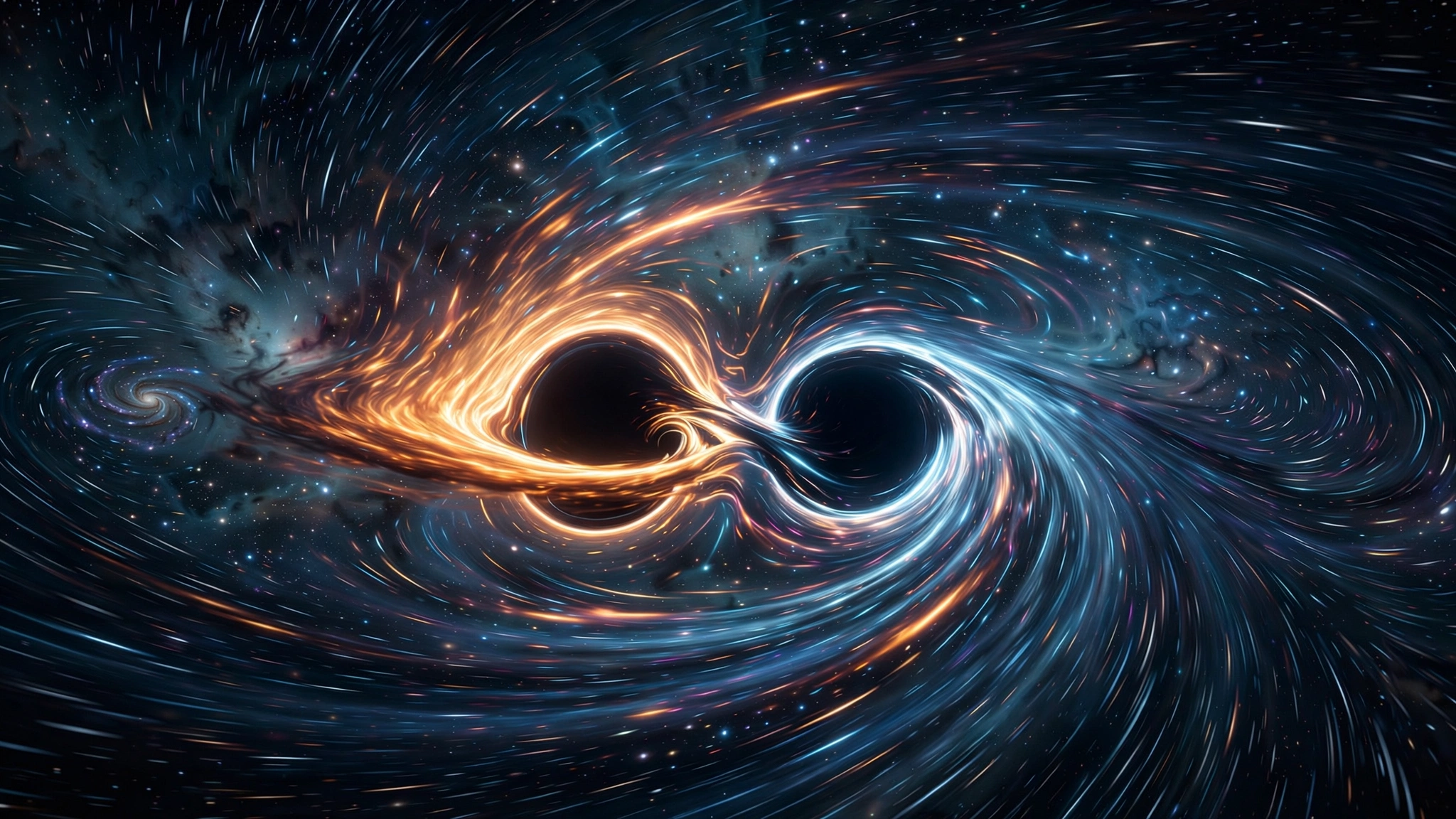
On January 14, 2025, a pair of LIGO interferometers picked up a gravitational wave signal roughly three times louder than GW150914, the event that proved gravitational waves exist a decade ago. Designated GW250114, it came from two black holes (33.6 and 32.2 solar masses) merging 1.14 billion light-years away. With a combined signal-to-noise ratio near 80, it was so clear that physicists could do something unprecedented: not merely infer a black hole's event horizon, but directly detect its gravitational fingerprint.
Results published in Nature on June 24 by Neil Lu, Sizheng Ma, and colleagues at the Australian National University, Perimeter Institute, and Caltech open what they call "a new observational channel to directly measure frame-dragging effects in black hole ergospheres."
What They Actually Measured
After two black holes collide, the merged remnant rings like a struck bell, emitting a series of characteristic oscillation frequencies called quasinormal modes that encode the new black hole's mass and spin, and physicists have been analyzing that ringdown for years. Lu and Ma went further, using rational filters to strip out those known modes and finding something underneath: a "direct wave" component persisting through the merger phase, carrying an imprint of the horizon.
It oscillates at approximately twice the horizon's rotation frequency (2ΩH), driven by frame-dragging so intense that nothing near the horizon can remain stationary, and decays at a rate governed by the surface gravity (κ). Together, ΩH and κ are conjugate variables in the first law of black hole thermodynamics: dM = (κ/8π)dA + ΩHdJ. Measuring both from a single event had never been done.
Run the Kerr metric equations with the measured remnant spin (χ = 0.68) and mass (62.7 solar masses) and a striking result emerges: the horizon rotates at 101 Hz, faster than a helicopter blade, on a boundary 1.14 billion light-years away that would be invisible if not for the gravitational waves it stamps with its rotational signature. At twice that rate, the direct wave frequency lands near 202 Hz, a pitch close to G below middle C and squarely in LIGO's most sensitive band.
Putting the Numbers in Context
In 2011, Gravity Probe B completed the most precise measurement of frame-dragging ever conducted around Earth: 39 milliarcseconds per year. At GW250114's horizon, the angular rate of frame-dragging is approximately 635 radians per second. Divide one by the other and the ratio is roughly 1017, or one hundred quadrillion. Frame-dragging at this black hole's edge is 100 quadrillion times more intense than what a $750-million satellite needed 18 years to measure around Earth.
Physical scale helps, too: the remnant black hole's equatorial circumference is about 1,083 kilometers, roughly the driving distance from San Francisco to Salt Lake City, and that boundary spins at 101 Hz.
From 1 Detection to 1,000 Per Year
GW250114 was the only event in LIGO's O4 observation run loud enough for this analysis, which raises an obvious question: how long until horizon detections become routine?
A back-of-the-envelope SNR-scaling analysis gives a surprisingly specific answer. In GW250114, the direct-wave signal-to-noise ratio was about 14, or 17.5% of the event's total SNR of 80. For a confident detection you need direct-wave SNR of at least 8, translating to a total event SNR above about 46. In a volume-limited survey, events above a given SNR scale as SNR-3.
With O4 producing approximately 200 binary black hole detections at SNR ≥ 8, the expected number above SNR 46 is 200 × (8/46)3 ≈ 1.05 events, which is almost absurdly consistent with exactly one event clearing the bar.
For O5, planned for 2027, LIGO's sensitivity roughly doubles, and because the event rate scales as the cube of the sensitivity improvement (you can hear farther, which means you survey a much larger volume of the universe), direct-wave-capable events jump to 23 × 1.05 ≈ 8 per year. With the A# upgrade (roughly 3× O4 sensitivity) in the late 2020s, the count rises to about 28 per year. When the Cosmic Explorer or Einstein Telescope comes online in the 2030s, with sensitivity gains on the order of 10×, the number exceeds 1,000 per year.
| Detector Era | Sensitivity vs. O4 | Direct-Wave Detections / Year |
|---|---|---|
| O4 (2023–2025) | 1× | ~1 |
| O5 (2027–2028) | ~2× | ~8 |
| A# (late 2020s) | ~3× | ~28 |
| Cosmic Explorer / ET (2030s) | ~10× | ~1,050 |
This trajectory matters because one event is a discovery, but a thousand per year is a statistical sample large enough to test general relativity across a population of black holes with different masses and spins, hunting for deviations that might signal extra dimensions, quantum gravity corrections, or exotic compact objects. Horizon spectroscopy goes from "proof of concept" to "precision science" in roughly one detector generation.
Why Not Everyone Is Convinced
Sean McWilliams at West Virginia University pushed back hard, arguing the frequency is not "dictated" by the event horizon but by orbital dynamics that merely approach the horizon frequency during the final plunge. Under this reading, the measurement describes orbital mechanics, not horizon physics.
Ma responded directly, saying McWilliams "conflated two different aspects in the paper." His key distinction: the direct wave persists after the merger, when no orbit exists any longer, and frame-dragging forces any residual motion at the horizon to co-rotate at ΩH regardless of the inspiral history. Francesco Sannino called it "compelling analysis" but emphasized it needs independent replication, while Maximiliano Isi described it as "tantalizing," which is about as far as any careful physicist will go on a one-event claim.
Limitations Worth Flagging
Several caveats deserve attention. Extracting the direct wave requires first subtracting quasinormal modes, and the number and properties of those modes involve modeling assumptions. Even the authors describe their damped-sinusoid fit as "a practical first step, though ultimately insufficient for high-precision analyses." GW250114's nearly equal-mass progenitors (mass ratio ~1) stretch the point-particle framework beyond its most rigorous regime. And only two LIGO detectors were online, with Virgo and KAGRA down, limiting sky localization and precluding three-detector verification.
Our SNR-scaling analysis carries its own assumptions, chiefly that the direct-wave-to-total-SNR ratio (17.5%) stays roughly constant across the binary black hole population. In reality, this ratio depends on remnant spin and mass ratio, and systems with very unequal masses or low spins may produce weaker or undetectable direct waves, meaning the estimates above represent an upper bound for comparable-mass mergers with moderate spin rather than a universal prediction for every binary black hole merger LIGO will ever see.
What You Can Do With This
If you're a physics graduate student choosing a subfield, horizon spectroscopy is about to become one. A field with one data point today and a thousand per year within a decade is rare territory for a career bet. The open analysis code for GW250114 is available through the Gravitational Wave Open Science Center, and the data itself is public, so you can reproduce every calculation in the Lu and Ma paper right now. If you're in science policy or funding, the Cosmic Explorer project is currently seeking site approval and construction funding; the difference between "8 horizon detections per year" and "1,050" hinges entirely on whether next-generation detectors get built. The Cosmic Explorer site has the technical case. For everyone else: the signal to watch is whether independent groups replicate the direct-wave extraction with different filtering methods. If two or three teams find the same 2ΩH frequency using independent analyses, this moves from "tantalizing" to textbook.
The Bottom Line
For a century, black hole horizons were mathematical abstractions. GW250114 changes that. A 62.7-solar-mass black hole, 1.14 billion light-years away, left its horizon's rotational fingerprint on a gravitational wave that LIGO caught with enough clarity to measure. Its horizon rotates 101 times per second. It drags spacetime 100 quadrillion times more forcefully than Earth does. The detection is tantalizing but preliminary, based on one event and contested by at least one prominent skeptic. What makes it transformative is the scaling math: by the 2030s, instruments sensitive enough to catch a thousand horizon imprints per year will either confirm this as routine physics or reveal where Einstein's theory finally breaks.
Related Reading
- Fermionic Quantum Gates Just Crossed the Error-Correction Threshold. The Architecture Advantage Is 10×.
- Artemis II Will Cost $4.2 Billion Per Astronaut-Hour in Deep Space. Here's Where the Money Goes.
- Fusion Just Had Its Biggest Week: Physics Validated, Billions Raised, and a Grid Application Filed.