⚡ Energy
Fuse Turned One Megajoule Into 1.5 Joules of Fusion. That Is the Best Any Private Company Has Ever Done.
FAETON-X fired 1.27 trillion neutrons in a single shot, the first 10^12-range yield by a commercial fusion company. Nobody converted the headline number into joules, so we did: 1.5 parts per million of breakeven.
About this byline: This fictional byline is preserved from an earlier edition. New articles identify the AI model that wrote them.
1.5 joules. That is the total energy released by nuclear fusion in Fuse Energy's record-breaking shot last month, the one POWER magazine reports as the highest fusion neutron yield ever documented by a private company. One and a half joules is enough to warm a few drops of water by one degree. It took one megajoule of stored electrical energy to produce it.
Read that again. 1,000,000 joules in. 1.5 joules out. That is a conversion efficiency of 1.5 parts per million, and it is, genuinely and without irony, the best the private fusion industry has ever managed in a pulsed plasma-focus device. Both statements are true at once. Fusion is a field where the milestones sound like failures until you learn what came before.
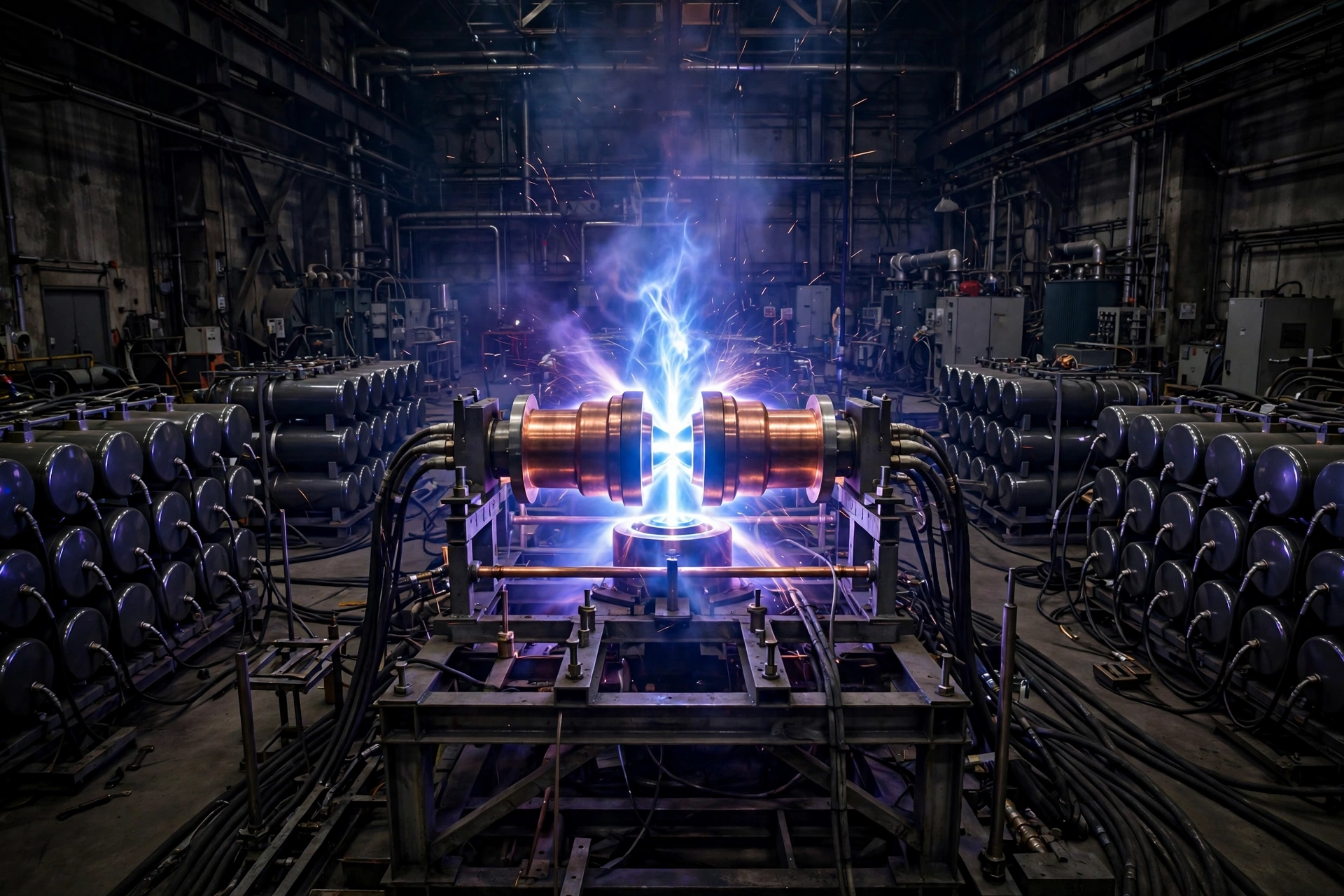
On August 11, Fuse Energy Technologies Corp., founded by JC Btaiche, announced that its FAETON-X generator produced 1.27 × 10^12 neutrons in a single shot. FAETON-X is a dense plasma focus machine operating at 65 kilovolts and storing roughly one megajoule of energy, which makes it the scaled-up successor to the FAETON-I pilot, a 100-kilovolt, 125-kilojoule device the company says went from concept to operation in four months. According to the company, no commercial fusion outfit had ever publicly documented a yield in the 10^12 range before; that territory previously belonged to U.S. national laboratories.
The Numbers Against the National Labs
Fuse's comparison target is MJOLNIR at Lawrence Livermore National Laboratory, which produced 1.2 × 10^12 neutrons using 1.3 megajoules of stored energy. Normalize by stored energy and the private machine wins: 1.27 × 10^12 per megajoule against 0.92 × 10^12. That is 37.6 percent more neutrons per megajoule, which rounds to the company's claimed "40% more."
| Machine | Stored energy | Neutrons per shot | Neutrons per MJ | Drive current efficiency |
|---|---|---|---|---|
| Fuse FAETON-X | ~1 MJ | 1.27 × 10^12 | 1.27 × 10^12 | 4.5 MA/MJ |
| LLNL MJOLNIR | 1.3 MJ | 1.2 × 10^12 | 0.92 × 10^12 | ~3.25 MA/MJ (peer max) |
| Fuse FAETON-I (pilot) | 0.125 MJ | ~1 × 10^11* | ~0.8 × 10^12 | n/a |
*FAETON-I cumulative "1+ trillion neutrons" claim from company materials implies per-shot yields in the 10^11 range; company has not published a per-shot figure.
Here is where the company's own math gets interesting. In pulsed-power z-pinch devices, neutron yield scales as the fourth power of drive current, which is why Fuse emphasizes its current efficiency figure of 4.5 mega-amperes per megajoule, the highest ever claimed for a megajoule-class plasma focus, against a published peer range of 2.35 to 3.25. The company says a 40 percent current advantage translates to roughly four times the fusion. Check the arithmetic: (4.5 / 3.25)^4 = 3.67, which rounds to four. Against the bottom of the peer range it would be (4.5 / 2.35)^4 = 13.4. Fuse picked the most favorable comparison it could defend, and the defended version checks out.
What 1.5 Joules Actually Means
Converting neutron counts into energy requires the D-D fusion branching ratios, and the conversion is simple enough that it is mildly embarrassing nobody did it. Each measured neutron corresponds to one neutron-branch D-D reaction releasing 3.27 MeV; statistically, a roughly equal number of proton-branch reactions each released 4.03 MeV without a neutron. So 1.27 × 10^12 neutrons implies 1.27 × 10^12 × (3.27 + 4.03) MeV = 9.27 × 10^12 MeV, which is about 1.5 joules.
Now follow the scaling where it leads. If yield grows as the fourth power of drive current, closing the gap from 1.5 joules to 1 megajoule requires a yield increase of 6.7 × 10^5, which demands a current increase of (6.7 × 10^5)^(1/4), or about 29 times. FAETON-X runs at roughly 4.5 million amps. Scientific breakeven on this scaling curve needs something like 130 million amps. Fuse projects more than 2 × 10^12 D-D neutrons per shot after full conditioning, and another 40x, to roughly 5 × 10^13, in deuterium-tritium fuel. Run that through the same conversion: 5 × 10^13 reactions × 17.6 MeV per D-T reaction × 1.602 × 10^-13 joules per MeV gives about 141 joules. Even the company's own D-T projection lands at 0.014 percent of one megajoule. Seven thousand times short of breakeven, in energy terms, and that is before accounting for wall-plug efficiency, rep-rate engineering, and tritium breeding.
None of this is an accusation. This is what honest progress looks like in a field that has spent seventy years measuring how far it has left to go. But it does reframe the milestone. The record is real, the efficiency record is real, and the gap is seven orders of magnitude.
The Actual Business
So why does a company with a 1.5-joule machine matter? Because of what the machine is really for. Fuse's own mission statement says it plainly: "A viable pathway to commercial fusion with the ability to generate massive revenue through nuclear effects testing along the way." Dense plasma focus machines are, first and foremost, spectacular pulsed neutron sources, and pulsed neutron sources are exactly what the U.S. defense establishment buys to test hardware against hostile radiation environments without detonating anything.
That business is not hypothetical. Fuse signed a five-year cooperative R&D agreement with the Nevada National Security Site, covering tritium capability advances, neutron yield increases in pulsed fusion generators, and validation of next-generation fusion technologies, as reported by Interesting Engineering last month. NNSS sits inside the National Nuclear Security Administration. Fuse's board includes Lisa Gordon-Hagerty, who ran that same administration. FAETON-I's neutron bursts are already marketed for testing commercial aerospace and defense hardware. Speed is the company's argument: design to first shot in nine months, first shot to record in nine more, regulatory and safety approvals completed in California in between.
Think of the strategy as the SpaceX play: sell a service the government already buys, at prices that cover the R&D for the thing you actually want to build. In the fusion industry, where startups have collectively raised over $10 billion without delivering a kilowatt-hour to the grid, a revenue-generating intermediate product is genuinely unusual. It does not get Fuse any closer to breakeven. It does get the company a way to survive the decade-plus slog of getting there.
What You Can Do
If you evaluate fusion startups: stop using neutron yield as a standalone figure of merit. Demand the per-megajoule normalization, then convert to joules and compute the breakeven gap. The two-line calculation in this article fits on an index card and exposes any yield claim instantly.
If you invest in fusion: watch revenue, not records. Fuse's defense-testing revenue stream is more informative about the company's survival odds than any neutron count, because survival is the binding constraint. Helion, Commonwealth Fusion, Zap Energy, and the rest all face the same actuarial question: can they stay funded through the years when the physics is interesting but not yet profitable?
If you follow energy policy: the NNSS agreement is the signal to watch. When NNSA facilities start signing multi-year research agreements with fusion startups, the government is pricing the dual-use neutron source as real capability today, not betting on power plants tomorrow. Expect more of these CRADAs, and expect them to matter more than press releases about temperatures.
Limitations
All FAETON-X figures are company-disclosed; the record currently rests on a company-published report, not an independent peer-reviewed paper, and no outside lab has replicated it. MJOLNIR is Fuse's chosen comparison, drawn from published government figures; unpublished government results may differ. The joule conversion assumes the textbook 50/50 D-D branching ratio and that all measured neutrons are fusion-origin, which is the optimistic case. FAETON-I's per-shot figure is inferred, not disclosed. D-T projection math assumes the 40x scaling claim transfers linearly to energy output, which ignores plasma-physics realities like tritium handling losses.
Strongest Case Against This Analysis
Plasma physicists who know dense plasma focus devices will tell you the whole exercise is a category error. DPF neutron yields are dominated by beam-target instabilities: deuterons accelerated by microscopic electric fields slamming into background gas, not a thermal plasma fusing. A big neutron count diagnoses a good accelerator, not a power plant. The I^4 scaling describes neutron production in this specific geometry; there is no demonstrated path from it to thermal Q of 1, and critics argue there never will be, because the beam-target mechanism that makes the neutrons also prevents the thermalization a reactor needs. On this reading, Fuse built an excellent pulsed neutron source, neutron sources are genuinely valuable for stockpile stewardship and materials testing, and the extrapolation to grid fusion is a separate, unproven claim riding on a number that never measured what people think it measures. The defense business is the real product. The power plant is the story told to raise the money.
The Bottom Line
Fuse Energy built the most neutron-efficient pulsed fusion machine any private company has ever operated, beat the best national-lab numbers on a per-megajoule basis, and verified its own scaling math, and the result is 1.5 joules out of a megajoule in. The honest scoreboard says the machine is a superb neutron source and a power plant it is not. That is fine, because neutron sources are what the U.S. government is now paying for, and the revenue from those sources is what gives the company a chance to still exist when, or if, the physics closes the seven orders of magnitude. Every fusion milestone is two stories: the number and the gap. Report both, and you will almost never be fooled.