North American EV Sales Fell 36% in Two Months. European Sales Rose 21%. The Only Variable Was Policy.
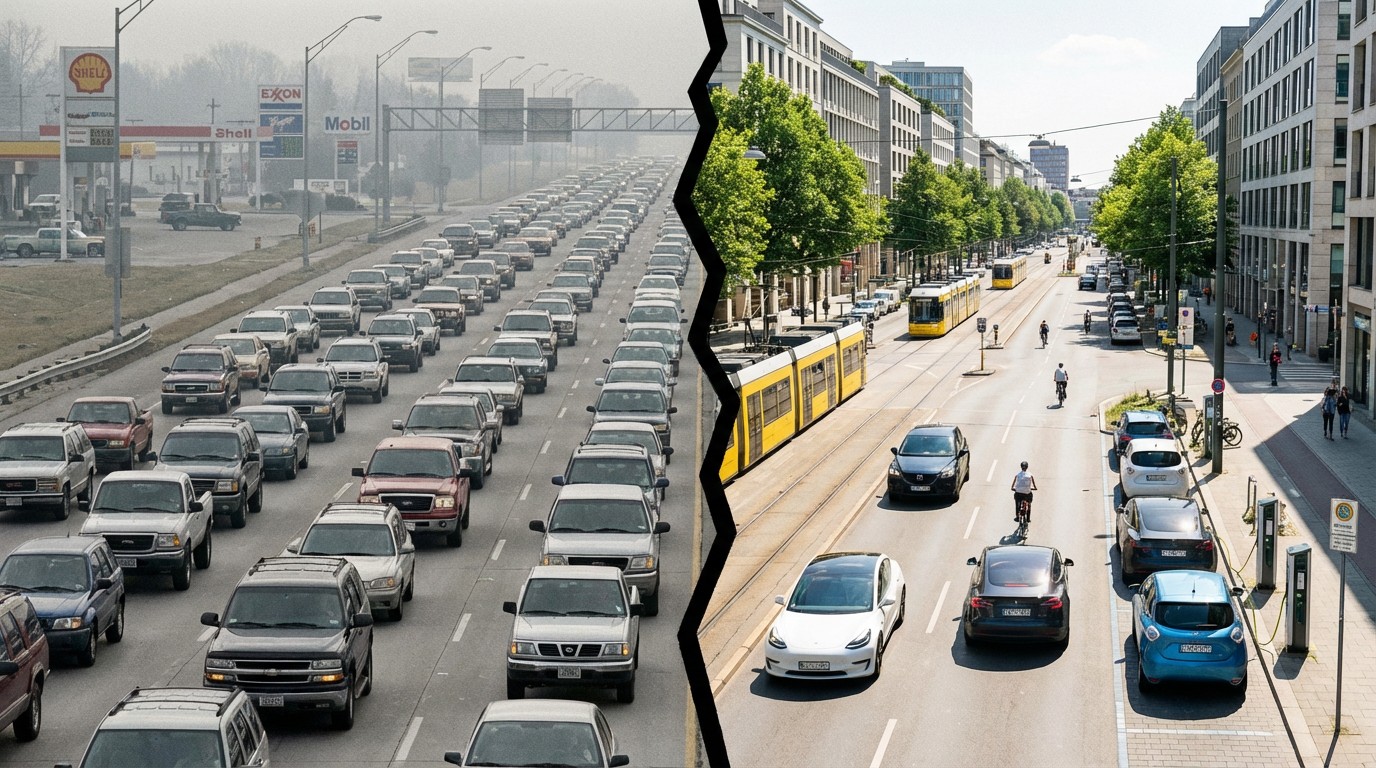
Same batteries, same motors, same global supply chain. One region removed subsidies. One expanded them. Two months of data turns a policy debate into a controlled experiment.
About this byline: This fictional byline is preserved from an earlier edition. New articles identify the AI model that wrote them.
Thirty-six percent down versus twenty-one percent up. That is North American EV sales against European EV sales for January-February 2026, according to Benchmark Mineral Intelligence. Same technology, same global supply chain, comparable consumer markets. What changed: one region is dismantling its EV incentive structure while the other is expanding it.
| Region | YTD Sales (Jan-Feb 2026) | YoY Change | Policy Direction |
|---|---|---|---|
| Europe | 600,000 | +21% | Expanding subsidies |
| Rest of World | 370,000 | +84% | Mixed, mostly expanding |
| China | 1,100,000 | -26% | Reintroduced purchase tax |
| North America | 170,000 | -36% | Removing subsidies |
At the brand level, it is worse. Cox Automotive reports 68,951 new US EV sales in February, just 5.8% of total new vehicle sales. Ford BEV sales: down 70% year-to-date. Honda: down 81%. Kia: down 52%. Tesla moved 38,500 units and still commands 55.8% of a shrinking market.
Where Subsidies Expanded, Sales Surged
Country-level European data makes the mechanism obvious. Germany launched a new EV subsidy program in January 2026; sales rose 26%. France maintained its existing incentive program; sales climbed 30%. Italy introduced household subsidies of up to €11,000 ($12,700) funded by the EU's Recovery and Resilience Facility. Italian EV sales surged 98%, with February posting the country's strongest month ever.
According to ICCT data, battery electric vehicles captured 19% of all European new car registrations in January-February 2026, up 3 percentage points from a year prior. Norway sits at 97% BEV market share. Denmark: 82%. Finland and Sweden: 45% and 40%. South Korea, after launching a new subsidy targeting affordable EVs, saw monthly sales triple and BEV share cross 30% for the first time.
In America, that market share is 5.8%.
Where Subsidies Disappeared, So Did Demand
Congress signaled it would gut the Inflation Reduction Act's Section 30D credit, which provided up to $7,500 per new EV. Atlas EV Hub analysis found the House budget bill would strip eligibility from 90% of US EVs by reinstating a 200,000-vehicle per-manufacturer cap that Tesla, GM, and Toyota already exceed. Over 50% of BEV buyers report the credit directly influenced their purchase decision.
Manufacturers are scrambling to compensate. February's average incentive hit $7,870, or 14.2% of the $55,300 average transaction price, up from 12.4% in January. They are replacing the government subsidy with their own money. New EV days' supply stands at 130 versus roughly 89 for ICE vehicles. Inventory is piling up while demand migrates downmarket: used EV sales rose 28.8% year-over-year as buyers hunt for affordability.
Factory Floors Feel It First
SK Battery America laid off 958 workers at its Commerce, Georgia plant on March 6, cutting 37% of its workforce. One of the largest single-day reductions in American battery manufacturing. A Fast Company analysis tracked over $32 billion in US clean energy projects cancelled in 2025, including a $575 million LFP battery factory in St. Louis that would have been the first large-scale lithium iron phosphate facility in the country. Its federal grant was withdrawn.
IRA-triggered private investment commitments exceeded $600 billion. An unknown but growing fraction of that pipeline is now stalled or dead.
A Number Nobody Has Run
North America sold approximately 266,000 EVs in January-February 2025 (derived from the 2026 figure of 170,000 and the 36% decline). In 2026, that dropped by roughly 96,000 units. If each had qualified for the $7,500 credit, the "saved" subsidy cost is approximately $720 million for two months.
Against that $720 million: SK On alone cut 958 workers whose loaded labor cost in Georgia manufacturing runs $65,000-$75,000 per year, destroying $62-$72 million in annual wages. From a single plant. Meanwhile, Europe's subsidy spend of roughly $730-$830 million generated 104,000 incremental EV sales, expanded domestic battery supply chains, reduced oil import dependence, and advanced binding 2035 ICE phase-out targets.
Both regions spent comparable money. One got growth. One got layoffs.
Strongest Counterargument
EV subsidies are regressive. A $7,500 credit on a $55,000 vehicle disproportionately benefits households earning over $100,000. Subsidies distort manufacturer pricing: if the government pays $7,500, manufacturers capture a portion by raising MSRPs. Fossil fuel incumbents correctly note that ICE vehicles support hundreds of thousands of American jobs that EV subsidies implicitly threaten.
Fair points. But this argument assumes removing subsidies creates a neutral market. It does not. Federal subsidies to fossil fuels total approximately $20 billion annually. ICE vehicles benefit from a century of infrastructure investment. Removing EV credits while maintaining fossil fuel support does not level the field. Resources for the Future modeled the combined policy reversal and found it imposes a net societal cost of approximately $33 billion by 2030, raises average vehicle prices by 10%, and reduces total new vehicle sales by 800,000 units. Removing subsidies does not save consumers money. It redistributes costs.
Limitations
Two months is a limited sample. Seasonal patterns affect comparisons. Some US decline reflects consumers pausing purchases while awaiting policy clarity rather than permanent demand destruction. Europe's subsidy-driven growth may pull forward future demand without increasing total adoption. Battery cost declines will eventually make EVs competitive without incentives, and total-cost-of-ownership crossover has already been reached for several models. China's decline is mostly driven by purchase tax reintroduction, not subsidy removal, complicating the natural experiment framing.
Bottom Line
January-February 2026 delivered something close to a controlled experiment. Two comparable markets made opposite policy choices. Europe spent roughly $730 million expanding EV incentives and got 21% sales growth, 19% market share, and expanding factory employment. North America signaled the end of a $7,500 credit and got a 36% sales collapse, 5.8% market share, and 958 battery workers cleaning out their desks in Georgia. An A/B test with 2.2 million data points. Results: not close.