$7.5 Billion and 3 Years Later, America Has 384 Federal EV Chargers. China Has 16.7 Million.
Congress allocated $7.5 billion for EV charging through the Infrastructure Investment and Jobs Act. As of the latest GAO audit, the NEVI program has delivered 384 ports across 68 stations. The private sector, without waiting for Washington, built the other 271,415.
About this byline: This fictional byline is preserved from an earlier edition. New articles identify the AI model that wrote them.
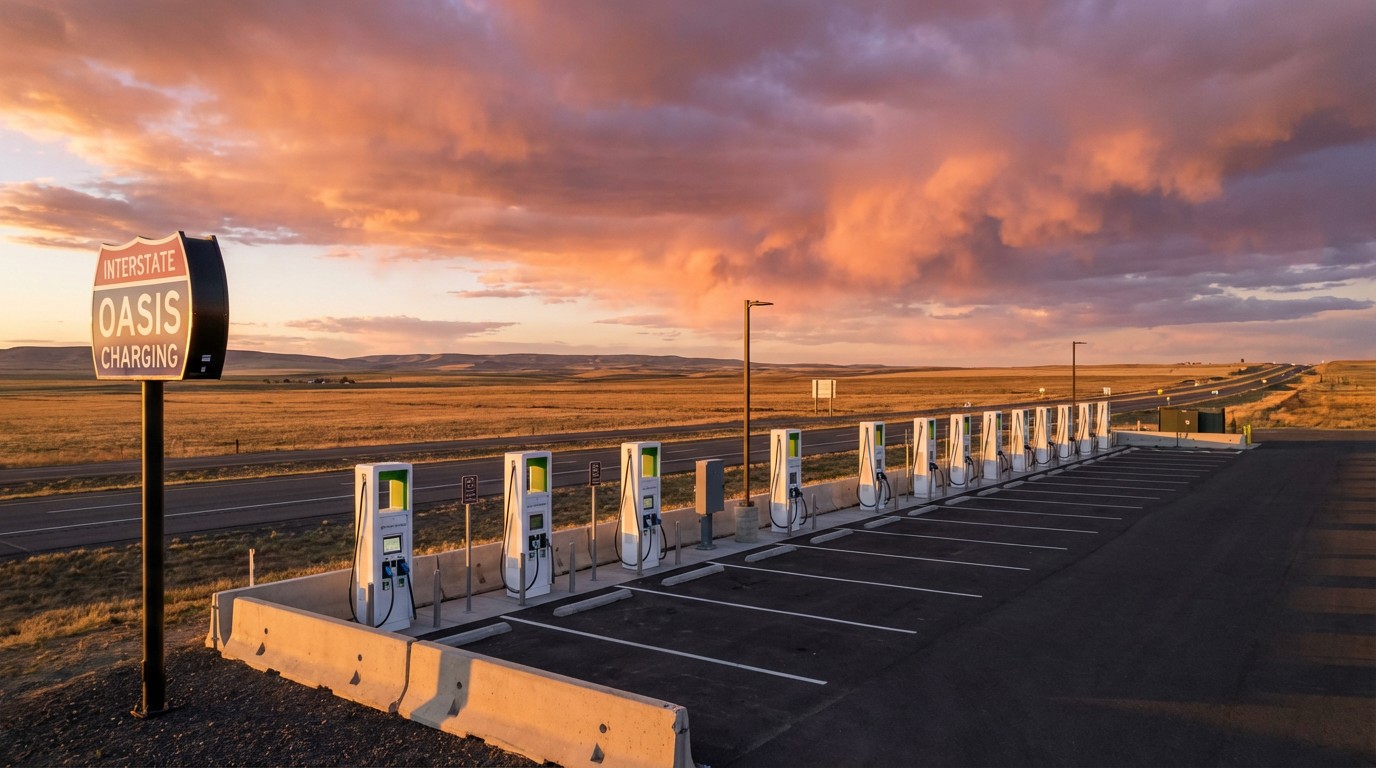
384. That is the number of EV charging ports the federal government's $7.5 billion National Electric Vehicle Infrastructure program has put into service since Congress passed the Infrastructure Investment and Jobs Act in November 2021. Three years, $7.5 billion appropriated, 50 state plans approved, and the result is 68 stations spread across 16 states. For context, ChargePoint alone operates 44,809 stations and didn't need a single dollar of NEVI money to build them.
Pull up the Department of Energy's Alternative Fuels Station Locator in March 2026 and you'll count 84,037 public charging stations housing 271,799 ports across the country. NEVI's 384 ports represent 0.14% of that total. The private sector built the other 99.86%.
Those numbers sound like an indictment. Politicians on both sides have weaponized them. But the math, as usual, is more complicated than the talking point.
Where the $7.5 Billion Actually Sits
First, the accounting. The $7.5 billion breaks into two programs: $5 billion for NEVI (formula grants to states for highway corridor charging) and $2.5 billion for the Charging and Fueling Infrastructure (CFI) discretionary grant program. NEVI distributes money over five fiscal years, FY2022 through FY2026, with $885 million in the final FY2026 tranche.
Most of that money has not been spent. It has not been disbursed. In many cases, it hasn't even been obligated. The path from Congressional appropriation to electrons flowing through a charging cable runs through state plan approval, site selection, environmental review, Buy America Act compliance, utility interconnection, construction, and commissioning. Each step has its own timeline measured in months, not days.
Dividing $7.5 billion by 384 ports gives you $19.5 million per port, a number that went viral on social media and earned its own Congressional hearing. It is also misleading. The actual construction cost of a NEVI-compliant station runs $500,000 to $1 million, with the federal cost share capped at 80%. The per-port math treats money sitting in Treasury accounts as money already spent on chargers. It hasn't been.
The Federal Charger Is Not the Same Animal
NEVI chargers are not the same as a Level 2 box bolted to a hotel parking lot. The program mandates a minimum of four 150-kilowatt DC fast chargers per station, dual connectors (NACS and CCS), OCPP 2.0.1 open standards compliance, ADA accessibility, and a 97% annual uptime requirement. Each station must sit within one mile of an interstate off-ramp. They must accept contactless payment.
For comparison, J.D. Power's 2025 EV Charging Study found the industry-wide charger reliability rate for non-Tesla DC fast chargers hovering around 78%. NEVI's 97% mandate is the strictest uptime requirement in the US charging market. Whether stations can maintain it remains an open question, but the spec itself is real.
Buy America requirements add another layer. BABA mandates that manufactured products used in NEVI-funded stations contain at least 55% domestic content by cost. When the program launched, no DC fast charger on the market met that threshold. Manufacturers had to retool supply chains and, in some cases, open new US assembly lines. ChargePoint, ABB, and Tritium all announced US manufacturing expansions explicitly citing NEVI compliance.
Then the Program Got Paused
In February 2025, the incoming Trump administration paused NEVI disbursements pending a program review. By April, 32 EV charging projects worth $23 million were formally cancelled. The General Services Administration directed federal agencies to disconnect non-essential EV chargers at government facilities. In July, Congress passed legislation terminating the $7,500 new EV tax credit and the $4,000 used EV credit, effective September 30, 2025.
California and 15 other states sued the Department of Transportation in May 2025, alleging the administration was illegally withholding more than $3 billion in congressionally appropriated funds. The case, Washington v. DOT, wound through federal court for eight months. In January 2026, a federal judge ordered all obligated NEVI funds released.
Between the February 2025 pause and the January 2026 court order, the program was functionally frozen for eleven months. During that window, the private sector added roughly 37,000 new charging ports.
The Scorecard: Who Built What
| Network | Stations | Share of US Total | NEVI Funding |
|---|---|---|---|
| ChargePoint | 44,809 | 53.3% | $0 |
| Blink | 5,755 | 6.8% | $0 |
| Tesla Destination | 5,322 | 6.3% | $0 |
| Tesla Supercharger | 3,031 | 3.6% | $0 |
| EVgo | 1,179 | 1.4% | $0 |
| Electrify America | 1,151 | 1.4% | $0 |
| NEVI Program | 68 | 0.08% | $7.5B appropriated |
| All Others | 22,722 | 27.0% | Various |
Pennsylvania leads the NEVI buildout with 28 operational stations, more than any other state, drawing on $16 million in federal investment. Ohio, New York, and Texas have opened stations. The remaining 34 states with approved plans have stations in various stages of permitting, procurement, or construction.
China's 16.7 Million and What It Means
China crossed 16.7 million installed charging units in July 2025, according to the China Electric Vehicle Charging Infrastructure Promotion Alliance. That is a 10x increase since 2020. The ratio works out to roughly two charging piles for every five EVs on the road. Monthly electricity delivered through public chargers hit 7.71 billion kWh.
In the first half of 2025 alone, China installed approximately 2.7 million new charging units. That is 7,000 times what NEVI delivered in three years. It is more chargers in six months than the entire US has installed across all networks since the first public charger went live.
The comparison is instructive but imperfect. China's figures include private home chargers in some counts, making the apples-to-oranges problem worse than the headline number suggests. China's grid infrastructure, land-use planning process, and labor costs are fundamentally different. Beijing subsidizes charger installation through national industrial policy in ways that US federalism structurally cannot replicate.
Still, the ratio is stark. The US has 271,799 public ports. China has 16.7 million total units. Even comparing only public DC fast chargers, China's lead is roughly 30 to 1.
Original Analysis: The Bottleneck Is Process, Not Money
Here is the calculation nobody at DOT has published. Take NEVI's 68 completed stations and divide by the 36 months between the program's launch and the April 2025 GAO audit: 1.9 stations per month nationally. At that rate, building out all 75,000 miles of the National Highway System's Alternative Fuel Corridors would take approximately 440 years.
Even accounting for the 11-month pause and a reasonable ramp-up curve, the deployment cadence needs to increase by roughly 20x to hit the administration's original target of 500,000 chargers by 2030.
The money exists. Congress appropriated it. A federal court ordered its release. The bottleneck is the process itself: Buy America compliance timelines (6-12 months for supply chain retooling), environmental review under NEPA categorical exclusions (still 3-6 months per site), utility interconnection agreements (averaging 8 months in rural corridors according to state plan filings), and the 50-mile maximum spacing rule that forces stations into locations where grid capacity may not exist.
The Strongest Case for NEVI
Calling NEVI a failure by comparing it to ChargePoint's network misses the program's actual purpose. ChargePoint's 44,809 stations cluster in cities, suburbs, and commercial corridors where utilization rates justify the investment. Nobody needs a federal subsidy to install chargers at a Whole Foods in Palo Alto.
NEVI targets the opposite: rural interstate corridors where the round-trip economics don't work. A DC fast charging station on I-80 in central Nevada might serve 15 cars a day. At $0.40/kWh and 50 kWh per session, that is $300 in daily revenue against capital costs exceeding $500,000 and electricity demand charges that don't care how many cars show up. No rational private company builds that station without a subsidy.
Comparing NEVI to total US infrastructure is like comparing the Rural Electrification Administration to Con Edison. They serve different markets. The REA didn't electrify Manhattan; it brought power to places the private sector wouldn't touch. NEVI's thesis is the same: the last 10% of geographic coverage requires public money because the market will never provide it.
Whether 384 ports in three years at that cost is acceptable performance for a federally administered program is a separate question from whether the program should exist.
Limitations
This analysis carries meaningful blind spots. The GAO's 384-port figure is from April 2025; Pennsylvania alone has since expanded to 28+ stations, and multiple states have opened stations in the months following the court-ordered fund release. The true NEVI total in March 2026 is likely higher, but no updated federal audit is available. We don't know the exact amount actually disbursed versus appropriated versus obligated for the 384 ports, making per-port cost calculations approximate at best. China's 16.7 million figure mixes public and private chargers in some counts, and the definition of a "charging unit" differs between DOE and Chinese standards. The 11-month program pause means NEVI's deployment rate reflects political disruption, not necessarily program design capacity.
The Bottom Line
America's EV charging network is growing fast. It grew by 17% in the past year alone. Nearly all of it was built by private companies spending private money chasing private returns. NEVI's contribution to that total is a rounding error: 384 ports out of 271,799. The federal program was designed to fill geographic gaps the market wouldn't serve, and it has done so at a pace that makes a DMV line look brisk. The 11-month political pause didn't help, but even before the freeze, deployment ran at fewer than two stations per month. China's 16.7 million units exist in a different policy universe, but the contrast still stings. The infrastructure money is there. The court order is there. The 97% uptime spec is genuinely ambitious. What's missing is the part where chargers actually get built at the speed the moment requires.
Sources
- 44,809 stations. afdc.energy.gov
- $885 million in the final FY2026 tranche. fhwa.dot.gov
- OCPP 2.0.1 open standards compliance. ecfr.gov
- J.D. Power's 2025 EV Charging Study. jdpower.com
- 32 EV charging projects worth $23 million were formally cancelled. reuters.com
- sued the Department of Transportation. oag.ca.gov
- China Electric Vehicle Charging Infrastructure Promotion Alliance. evcipa.org.cn
- administration's original target. whitehouse.gov