A Single Aluminum Pour Now Replaces 171 Welded Parts. The Engineer Who Designed It Was a Neural Network.
Tesla's Model Y rear underbody: 70 stamped steel parts collapsed into one aluminum casting. Toyota's next-gen platform: 177 parts into three. Meanwhile, GM's generative-AI-designed seatbelt bracket — 40% lighter, 8 parts consolidated to 1, selected from 150 algorithmically generated options — previews a future where the car's engineer and the car's manufacturer are the same piece of software.
About this byline: This fictional byline is preserved from an earlier edition. New articles identify the AI model that wrote them.
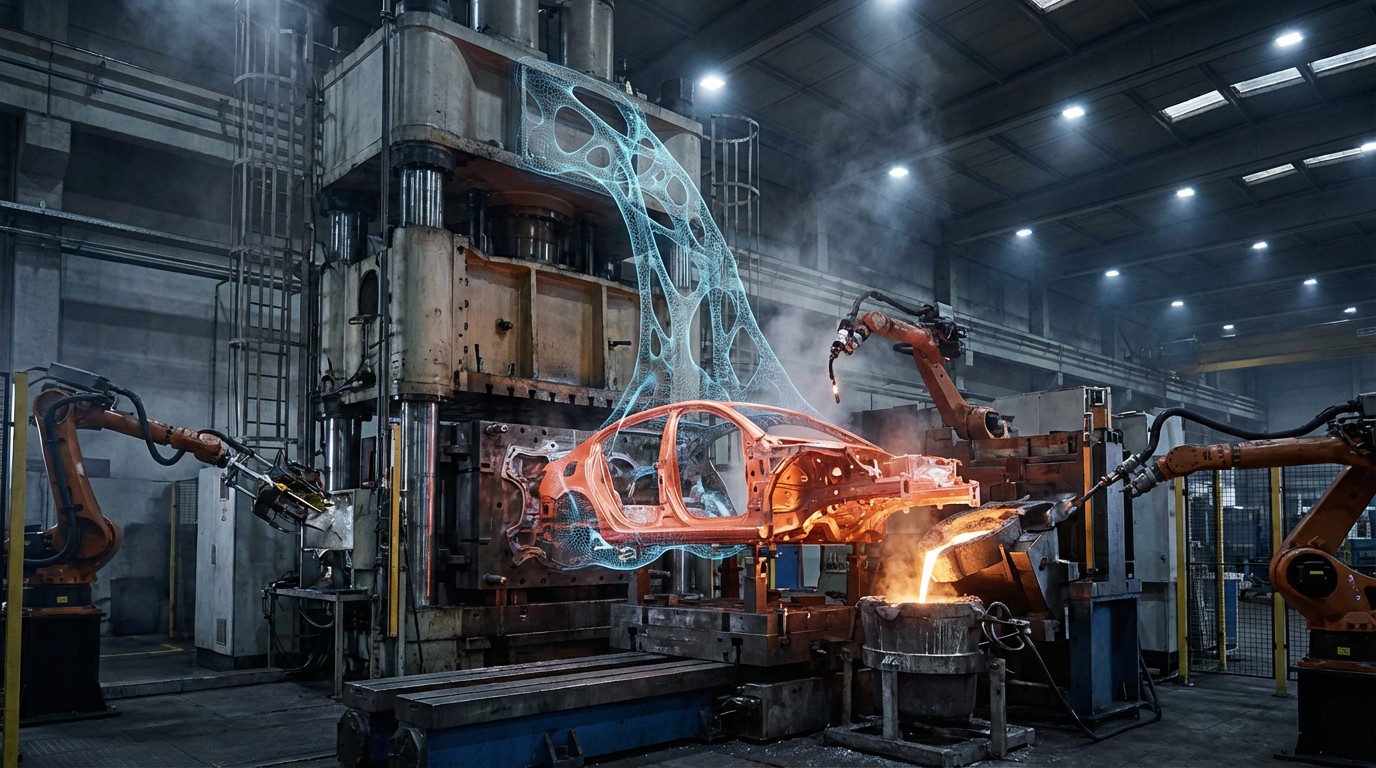
Seventy. That's how many individual stamped steel components made up the rear underbody of a conventional car before Tesla's Shanghai factory started producing the Model Y with a single-piece aluminum mega casting in 2023. One 6,100-ton Giga Press. One pour. One part. According to Thatcham Research's two-year study, published in February 2026, that single casting is not only cheaper to manufacture — it's cheaper to repair. Partial replacement of Tesla's mega cast rear structure costs £2,167 less than the equivalent repair on a traditional multi-piece steel body. The insurance industry's worst fear about gigacasting turned out to be wrong.
But the casting itself is just the visible output. The invisible revolution is what designed it.
The Part That Looks Like a Bone
In 2018, General Motors and Autodesk announced a proof-of-concept that got modest press coverage and deserved more. Using Autodesk's generative design software, GM engineers defined the functional requirements for a seatbelt bracket: load paths, attachment points, material constraints, manufacturing method. The algorithm explored 150 design candidates that met those constraints. The winning design was 40% lighter and 20% stronger than the human-designed original. It consolidated eight separate components into one 3D-printed part.
It also looked nothing like anything a human would draw. The bracket had organic, latticed geometry — more trabecular bone than machined metal. It distributed stress along paths that were mathematically optimal but visually alien. "Generative design is the future of manufacturing, and GM is a pioneer," said Scott Reese, Autodesk's Senior VP of Manufacturing, at the time. The claim was premature in 2018. It isn't in 2026.
The seatbelt bracket was one part. The question now is: what happens when you apply the same approach to the entire car?
The Gigacasting Arms Race
Tesla was first, but the industry has caught up to the point where not gigacasting feels like a strategic risk. Here's the current landscape:
The Gigacasting Adoption Wave
| OEM | Parts Consolidated | Status |
| Tesla (Model Y) | ~70 → 1 (rear) | Production since 2023 |
| Tesla (next-gen) | ~400 → 2-3 (full underbody) | Development |
| Toyota | 177 → 3 (front + rear) | Demonstrated, 2026+ production |
| Volvo (EX90) | ~100 → 1 (floor pan) | Planned |
| Hyundai / Kia | Undisclosed | 9,000-ton press ordered |
| Volkswagen | Undisclosed | Implementation announced |
| Xiaomi / NIO / BYD | Various | Production (China leads in press count) |
Toyota's numbers are the most striking. During a 2023 demonstration, engineers produced a comparable body section in three minutes using gigacasting — the same component that traditionally required 33 assembly steps over several hours. Toyota believes total body assembly time could be halved from 20 hours to 10 per car. The math changes every downstream calculation: labor cost, factory footprint, inventory complexity, quality control inspection points.
But here's what the gigacasting coverage consistently misses: the casting itself is the easy part. The hard part is designing what to cast. A single-piece underbody that replaces 171 welded parts must absorb crash energy across multiple load paths, accommodate battery pack mounting, integrate suspension pickup points, maintain dimensional tolerances across a two-meter span, and be manufacturable in a die that costs $1.5-3 million to produce. Getting the geometry right through physical prototyping would take years. Getting it right through computational optimization takes weeks.
The Simulation Stack
A traditional automotive crash simulation takes 6-36 hours on a high-performance computing cluster. A single frontal offset crash test — one speed, one angle, one barrier — occupies 2-4 million finite elements computed across 100-150 milliseconds of simulated time using solvers like LS-DYNA, Abaqus, or PAM-CRASH. A full NCAP evaluation matrix (frontal, side, rear, pole, pedestrian, rollover) across multiple configurations can represent 200-500 individual simulation runs. At 12 hours average per run, that's 100-250 days of continuous compute for one vehicle platform.
AI surrogate models are compressing this by orders of magnitude. NVIDIA's PhysicsNeMo framework, announced in September 2025, trains neural network surrogates on traditional simulation data. Once trained, these models predict aerodynamic flow fields, structural deformation, and thermal behavior in seconds to minutes rather than hours to days. The workflow is explicit: surrogate models handle initial design exploration across hundreds of candidates, then traditional high-fidelity solvers validate the top picks.
This isn't replacing finite element analysis. It's making it economically feasible to explore design spaces that were previously too expensive to search. When each crash simulation costs $50-200 in compute, you run 500 of them. When the surrogate model costs $0.10 per evaluation, you run 500,000. The design that emerges from 500,000 evaluations is categorically different from one that emerges from 500.
Crash Simulation: Traditional vs. AI Surrogate
| Traditional FEA | AI Surrogate | |
| Time per run | 6-36 hours | Seconds to minutes |
| Cost per run | $50-200 | ~$0.10 |
| Feasible design space | 200-500 runs | 100,000+ runs |
| Fidelity | High (ground truth) | Approximate (~95%) |
| Role | Validation | Exploration |
The Autonomous Fleet as a Sensor Network
The simulation revolution doesn't stop at the factory. Waymo announced in February 2026 that it's using Google DeepMind's Genie 3 model to generate driving scenarios its autonomous fleet has never encountered on real roads — including edge cases like elephant encounters and tornadoes. The generative simulation model creates photorealistic, physically plausible environments for testing perception systems at scale.
NVIDIA's DRIVE Sim, powered by Omniverse, takes a complementary approach: Ansys AVxcelerate Sensors plugs physics-accurate simulations of cameras, lidar, radar, and thermal sensors into NVIDIA's 3D environments. The premise is straightforward: physical road testing would require billions of miles to statistically validate an autonomous system. Simulation compresses those billions of virtual miles into GPU-hours.
But the less obvious revolution is the feedback loop from production vehicles to design. Every Tesla on the road is a sensor platform streaming driving data back to the fleet. That data trains the neural networks that control the next generation of vehicles, but it also informs the structural design of those vehicles. If fleet data reveals that a specific impact configuration is more common than NCAP protocols assumed, the next platform's crumple zone geometry can be optimized for actual collision statistics rather than standardized test protocols. The car designs itself based on how previous cars actually crashed.
The Original Calculation Nobody Ran
Here's a number that quantifies the design revolution. Consider the combinatorial design space for a vehicle underbody:
A traditional underbody platform has roughly 170 individual parts, each with 3-5 designable parameters (thickness, material grade, weld pattern, geometry). That's ~600 design variables. The total design space is astronomical — on the order of 10^200 possible configurations. A human engineering team, over a 4-year development cycle running 500 crash simulations, samples approximately 500 / 10^200 = effectively zero percent of the possible design space.
Gigacasting collapses those 170 parts into 1-3 castings. The design variables drop from ~600 to ~50-80 (wall thicknesses, rib geometries, material flow paths). The design space shrinks from 10^200 to something on the order of 10^30. An AI surrogate running 500,000 evaluations in a week searches 500,000 / 10^30 — still a vanishingly small fraction, but the search is guided by gradient-based optimization, not random sampling. The AI doesn't search randomly through 10^30 options. It follows the energy landscape downhill. In practice, modern topology optimization converges on near-optimal solutions within 1,000-10,000 evaluations for problems of this dimensionality.
The combined effect: gigacasting reduces the problem size by 170 orders of magnitude, and AI-guided search improves sampling efficiency by another 3-4 orders of magnitude. The 2030 car isn't just manufactured differently — it's designed in a fundamentally different region of the possibility space than any car humans could have found alone.
What We Don't Know
The surrogate model accuracy numbers deserve scrutiny. NVIDIA reports "approximate" fidelity at ~95% correlation with traditional FEA — but the safety-critical question is what happens in the 5% of cases where the surrogate diverges. If that 5% error is randomly distributed, it's manageable with validation runs. If it's concentrated in extreme deformation scenarios — precisely the cases that matter most for occupant safety — the surrogate could systematically miss failure modes. Published benchmarks focus on aerodynamics and steady-state thermal loads, where surrogates perform well. Crash dynamics, with their chaotic material failure and contact interactions, are a harder problem, and public validation data on surrogate accuracy for crash simulations is thin.
The repairability question remains open. Thatcham's study showed Tesla's mega casting is cheaper to repair than traditional steel — when the manufacturer invests in repair protocols and affordable replacement parts. Tesla provides cast rear rail assemblies at £31 each. Without that commitment, the repair cost calculus inverts. Not every OEM entering gigacasting has made the same investment in repairability infrastructure. Toyota's gigacasting demonstration explicitly acknowledged that "die-cast parts cannot be repaired" — only replaced. If full-casting replacement costs aren't controlled, the insurance industry's original concerns about gigacasting could prove correct for the fast followers.
And the AI-designed geometries themselves introduce a new kind of engineering risk: interpretability. A human-designed bracket has design intent — an engineer can explain why every feature exists. A generative-design bracket has mathematical optimality but no narrative. When a topology-optimized part fails in a way the algorithm didn't anticipate, the forensic question "why was it designed this way?" has no human answer. The algorithm explored 150 options and picked the one that scored best on the defined objective function. If the objective function was incomplete — if it missed a load case, a corrosion scenario, a fatigue cycle — the design is optimally wrong.
The Strongest Counterargument
The most sophisticated objection to AI-driven automotive design isn't about the technology. It's about the incentive structure. Computational optimization is brilliant at minimizing a defined metric: weight, cost, drag coefficient, peak stress. Cars, however, are multi-objective problems where the objectives conflict. The lightest structure is the weakest. The cheapest casting has the worst repairability. The most aerodynamic shape is the least practical.
Human engineers navigate these tradeoffs through judgment — imprecise, slow, but contextually rich. They know that the weld pattern on the B-pillar needs extra margin because the factory in Fremont runs hotter than the one in Shanghai. They know that the tolerance on the battery mounting point matters more than the optimizer's weight function suggests because field data showed a vibration issue. Generative design captures constraints you specify. It cannot capture constraints you don't know you need.
The counterargument isn't that AI won't design better parts. It's that AI will design parts that are better on every metric except the one that wasn't in the objective function — and that the missing metric will only reveal itself at scale, in production, after the casting die has been cut.
The Bottom Line
The car of 2030 will have a body designed by a neural network, cast in three pieces, crash-tested in a million virtual scenarios before the first physical prototype, and refined continuously by data from every vehicle in the fleet. The engineering talent doesn't disappear — it shifts from "design the bracket" to "define the objective function the algorithm designs the bracket against." That's a harder job, not an easier one. The engineer who can't code a simulation is as obsolete as the one who couldn't read a blueprint. But the engineer who can define the right optimization constraints, catch the edge cases the algorithm misses, and interpret why an AI-generated geometry failed — that engineer is more valuable than ever. The algorithm found the optimal seatbelt bracket out of 150 candidates. Somebody had to decide what "optimal" meant.
Sources
- Thatcham Research — Mega Casting Repair Cost Study (February 2026)
- TCT Magazine — GM and Autodesk Generative Design Partnership
- NVIDIA — AI-Powered CAE Simulations with PhysicsNeMo (September 2025)
- Ansys — AVxcelerate Sensors with NVIDIA DRIVE Sim
- Toyota Gigacasting Demonstration — Assembly Time Reduction
- WinBuzzer — Waymo and DeepMind Genie 3 Simulation (February 2026)
- Ozen Engineering — LS-DYNA Crash Simulation Overview