⚡ Energy
Fusion's 40-Year Puzzle Is Solved. The Math Leaves SPARC 1 Megawatt Short.
EPFL physicists finally derived the heating power a tokamak needs to reach high-confinement mode. ITER clears its threshold with 30 megawatts to spare. SPARC, the machine meant to prove net fusion energy in 2027, misses its own threshold by 1 megawatt.
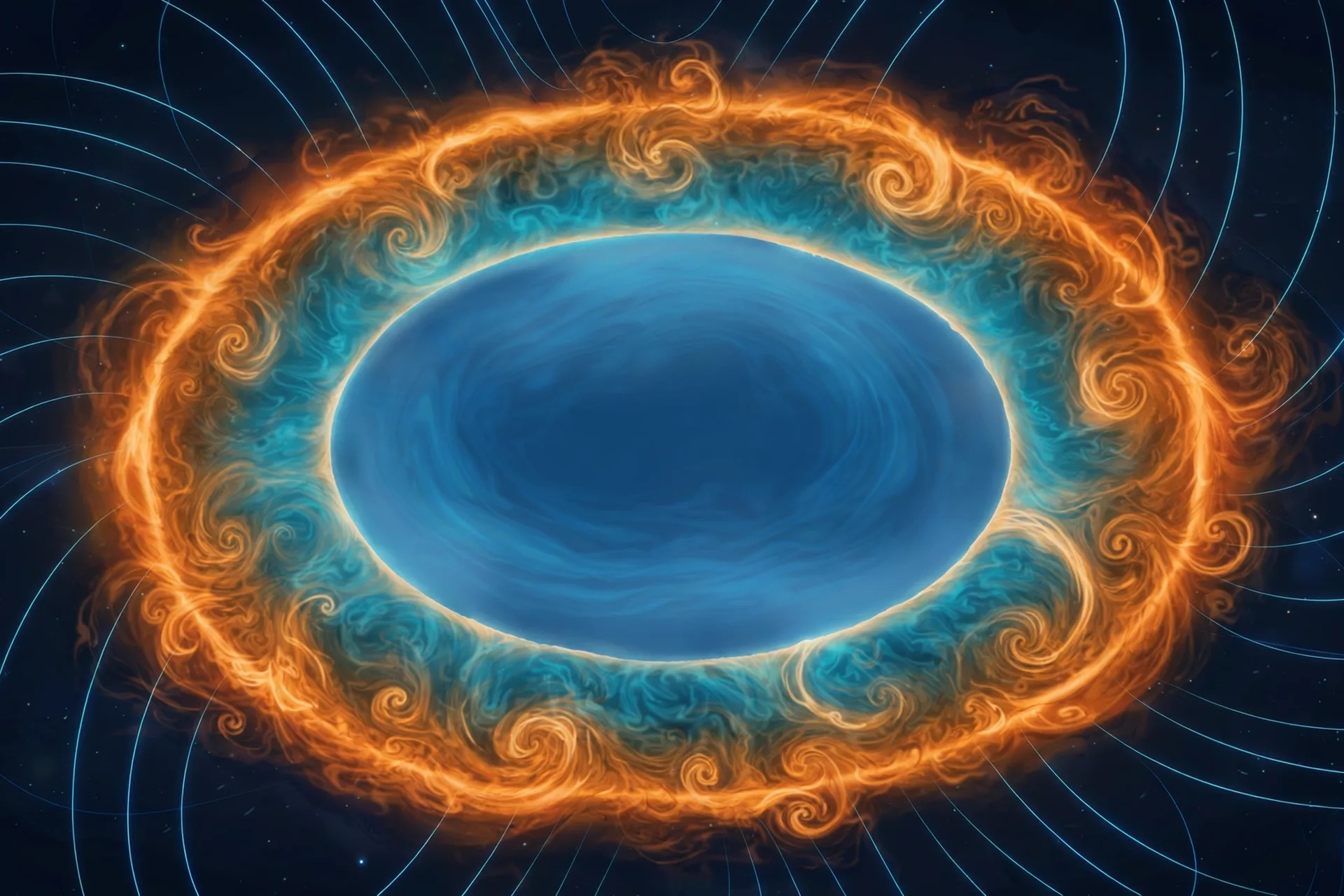
Forty-four years is a long time to wait for a number, and in 1982 physicists at the ASDEX tokamak in Germany watched plasma snap into a calm, well-confined state once heating passed a threshold nobody could predict, and confinement roughly doubled in an instant. EPFL's Swiss Plasma Center has now derived it from first principles, and the numbers split the field in two. ITER, the international machine rising in southern France, needs at least 43 megawatts of heating and has 73. SPARC, the compact American tokamak built by Commonwealth Fusion Systems, needs at least 26 megawatts and has 25. One machine clears the bar with room to spare. The other misses by a single megawatt, twelve months before it is supposed to prove net fusion energy.
What Actually Happened
On November 13, 2026, Brenno De Lucca and five colleagues at EPFL published their theory of the L-H power threshold in Physical Review Letters, answering a question open since the L-mode to H-mode jump was first observed: how much heating power does a tokamak need before edge turbulence collapses and the machine holds its heat? Until now, designers answered with empirical scaling laws fitted to past machines, but EPFL replaced the fitting with a derivation built from flux-driven two-fluid simulations on the Daint supercomputer and checked against measurements from existing tokamaks.
Two features matter beyond the headline numbers: first, the theory reproduces the density minimum, the odd fact that required power falls as density rises, bottoms out, then climbs again, which gives every tokamak a sweet spot where H-mode comes cheapest. Second, it reproduces the magnetic-field asymmetry for the first time in simulation, because flipping the toroidal field moves the threshold when particle collisions break the symmetry of the edge flows, and no earlier theory explained both effects in one framework.
How the Threshold Works
Picture a tokamak plasma as a doughnut of gas hotter than the center of the Sun, held in place by magnetic fields, while turbulence at its edge carries heat outward like wind stripping heat from an uninsulated house. Pump in more heating and something strange happens at a critical power: turbulence near the edge generates flows that move at different speeds across the plasma's outer region, and those sheared flows tear the turbulent eddies apart. Heat loss collapses. Confinement roughly doubles. Physicists call the calm state H-mode, the planned regime for ITER, SPARC, and every commercial tokamak design today.
What EPFL added is the mechanism in quantitative form: drift-wave turbulence, the same churning that leaks the heat, spontaneously generates a sheared E x B flow at the edge, and once the shear crosses a critical value it suppresses the transport that created it, a self-reinforcing snap into H-mode. Collisions decide how easily that shear builds, which is why field direction changes the answer.
The Margin Math Nobody Ran
Coverage repeated the two predictions and moved on, and nobody divided them, so run the margins.
| Machine | Predicted minimum (MW) | Planned heating (MW) | Margin |
|---|---|---|---|
| ITER (France) | 43 | 73 | +30 MW, 70% above threshold |
| SPARC (CFS, USA) | 26 | 25 | −1 MW, 4% below threshold |
ITER's planned heating is 1.70 times its predicted threshold, a 30-megawatt cushion, while SPARC's is 0.96 times its threshold, a 1-megawatt deficit. Divide ITER's 30-megawatt cushion by SPARC's 1-megawatt deficit and the asymmetry is 30 to 1, a ratio no press release states, because press releases report predictions while margins report risk, and that ratio is the real story: the world's biggest fusion project can absorb a theory error of nearly 70 percent and still reach H-mode. One megawatt. The private sector's machine has no slack at all.
Scale matters here. A 1-megawatt gap sounds trivial against a machine that will hold plasma at 100 million degrees, and it is only 4 percent of SPARC's heating budget. But thresholds do not grade on a curve: below the line there is no H-mode, and without H-mode there is no doubling of confinement. The 4 percent gap sits on a cliff edge, not a slope. CFS says SPARC will reach net fusion energy in 2027, and the company has raised $4 billion on that promise. Its $85 million Commerce Department letter of intent for semiconductors covering radio-frequency plasma heating is 2.1 percent of the capital raised, and radio-frequency heating is the system that would supply the missing megawatt. Whether that money buys headroom depends on final awards.
What You Can Do
If you follow fusion as an investor, stop asking startups for their temperature records and start asking for their H-mode margin: threshold, installed heating, and planned density. A machine with a 70 percent cushion and a machine with a 4 percent deficit are different bets, though their press releases sound identical. If you work in energy policy, treat the Commerce letters of intent as proposals, not awards, and watch whether the final agreements fund the radio-frequency heating systems that close gaps like SPARC's. If you are a student, read the arXiv preprint (2605.00624), not the press coverage: the scaling laws will still matter in ten years, when both machines are either running or explaining why they are not.
Limitations
This analysis leans on EPFL's announcement for the machine-specific predictions, because the Physical Review Letters paper is paywalled and the arXiv abstract does not carry the 43 and 26 megawatt figures, and no error bars were published for either prediction, so the margins computed here inherit whatever uncertainty the model carries. SPARC's 25-megawatt figure is as EPFL states it, CFS has published no line-item heating budget, and the Commerce awards are letters of intent rather than final grants, with the $85 million for CFS covering semiconductors rather than a general SPARC budget increase.
The Strongest Case Against This Analysis
Twenty-six megawatts is a model prediction, not a measurement, and it deserves skepticism, because EPFL validated the theory against existing tokamaks, none as compact or high-field as SPARC, so extrapolating means trusting the scaling laws where they have never been tested. SPARC's operators can tune density toward the predicted minimum, where required power is lowest, so the 1-megawatt gap may vanish through operating choices rather than hardware. Reaching H-mode is necessary for net energy, not sufficient, because a machine can cross the threshold and still fail on confinement, fueling, or exhaust. And the theory could be wrong in SPARC's favor. All fair. None of it changes the asymmetry that matters: ITER can be wrong by 70 percent and still work, while SPARC needs its theory to be right to within 4 percent. A warning light is not a verdict, but ignoring one because it might be a faulty sensor is how machines get built twice.
The Bottom Line
Forty-four years after physicists first watched plasma snap into H-mode, someone finally derived the power it takes. ITER passes the new test with 30 megawatts to spare. SPARC fails it by one. Commonwealth Fusion Systems has a year to find that megawatt in density tuning, in radio-frequency heating, or in the fine print of a federal letter of intent, before the machine built to prove fusion works, a machine that has already absorbed $4 billion of promises, must prove it can even get calm.
Related
- CFS Raised $4 Billion for Fusion. The New Money Comes from Pension Funds.
- AI Agents Cut the Cost of Simulating Fusion 11x. No Computer on Earth Can Test What They Built.
- 53 Startups Have Raised $9.8 Billion on Fusion. One Government Project Has Spent $50 Billion and Never Made Plasma.
Sources: EPFL News, Solving a 40-year puzzle in fusion energy; De Lucca et al., Theory for the power threshold of the L-H transition in tokamaks, arXiv:2605.00624; Physical Review Letters 137, 205101 (13 November 2026); American Nuclear Society, Fusion companies sign LOIs for federal R&D awards; Data Center Dynamics, US Department of Commerce commits up to $389m in R&D funding; margin calculations are the author's own.