⚡ Energy
CFS Raised $4 Billion for Fusion. The New Money Comes from Pension Funds.
Commonwealth Fusion Systems closed a $1 billion equity round on August 5, 2026, bringing total capital to $4 billion and making it the most-funded private fusion company in history. For the first time, the investors include pension funds and sovereign wealth funds. We traced the pension-entry pattern across wind, solar, and fusion and calculated what it predicts about commercialization timelines.
About this byline: This fictional byline is preserved from an earlier edition. New articles identify the AI model that wrote them.
Four billion dollars. That is how much Commonwealth Fusion Systems has raised since its founding in 2018, after closing a $1 billion equity round announced August 5, 2026, the single largest fusion investment since CFS's own $1.8 billion Series B in December 2021, which itself was the largest at the time and which valued the company at a figure its backers still have not publicly disclosed. The capital trajectory tells its own story without a valuation attached: $115 million in Series A, then $1.8 billion, then another $1 billion, each tranche larger and faster than the one before it.
But the amount is not the news.
According to reporting by TechTimes, this round was led by what CFS described as "largely new investors," a category it specified as pension funds, sovereign wealth funds, and infrastructure-focused corporate partners, which is a different species of capital entirely from the venture firms and strategic energy companies that have funded fusion to date. Venture capitalists bet on moonshots because the portfolio math works if one in twenty pays off at a hundred times the investment, and they can absorb the other nineteen zeros without existential consequences for their limited partners. Pension funds cannot. They manage retirement savings under fiduciary duties that make speculation a potential legal liability, and their investment committees answer to teachers, firefighters, and municipal workers who need the money to be there in thirty years.
This is the first time in fusion history that such capital has entered the sector.
The Pattern Nobody Mapped
Pension funds have entered emerging energy technologies twice before, and both times the entry marked a specific inflection point where the technology stopped being a science experiment supported by government grants and venture capital and started being infrastructure supported by the same institutional capital that finances bridges, toll roads, and electrical transmission lines.
Wind came first, and for decades it attracted government subsidies and scattered venture capital but nothing from the institutions that manage trillions in retirement savings. Then in 2010, PensionDanmark acquired a 50 percent stake in the Nysted offshore wind farm from Dong Energy, a deal its CEO Torben Möger Pedersen later called "the breakthrough" in Danish pension investment in renewable infrastructure. In March 2011, PensionDanmark and PKA bought half of the 400-megawatt Anholt offshore wind farm, making 840,000 Danish pension savers co-owners of what would become Denmark's largest wind installation. At the time of pension entry, global installed wind capacity was roughly 198 gigawatts and the levelized cost of onshore wind was still above $70 per megawatt-hour. By 2022, capacity had reached 906 gigawatts and the levelized cost had fallen to $33, according to IRENA's 2023 cost report.
Solar followed a compressed timeline. In December 2011, Warren Buffett's Berkshire Hathaway, through its subsidiary MidAmerican Renewables, acquired the 550-megawatt Topaz Solar Farm from First Solar for $2 billion, the largest utility-scale solar acquisition by any institutional investor at the time, and the kind of quasi-pension commitment that signaled Buffett's belief in 25-year contracted cash flows from solar assets. MidAmerican followed in January 2013 with another $2 billion to $2.5 billion for SunPower's 579-megawatt Antelope Valley projects, making Berkshire the largest private owner of solar generating assets in the United States. At the time of Berkshire's entry, global installed solar capacity was approximately 70 gigawatts and the levelized cost was north of $200 per megawatt-hour. By 2022, capacity had reached 1,050 gigawatts and cost had dropped to $49.
| Technology | Institutional Entry Year | Capacity at Entry | Years to Cost Parity | Capacity 12 Years Later |
|---|---|---|---|---|
| Onshore Wind | 2010 | 198 GW | ~5 | 906 GW (2022) |
| Solar PV | 2011–12 | 70 GW | ~3–4 | 1,050+ GW (2023) |
| Fusion | 2026 | 0 GW | ? | ? |
Pension funds and long-horizon institutional investors are actuaries managing 30-year liabilities under fiduciary duties that prohibit speculation, which means they are measuring something different from what venture capitalists measure: not the chance of a hundred-fold return, but the probability that a technology will generate reliable, inflation-adjusted cash flows for decades. When PensionDanmark entered wind roughly five years before cost parity and Berkshire entered solar three to four years before grid parity, they were buying early in the deployment curve because they needed to lock in returns before infrastructure investors crowded the asset class, but they bought only after the engineering risk had fallen below a threshold their boards could defend.
What the Pension Signal Says About Fusion
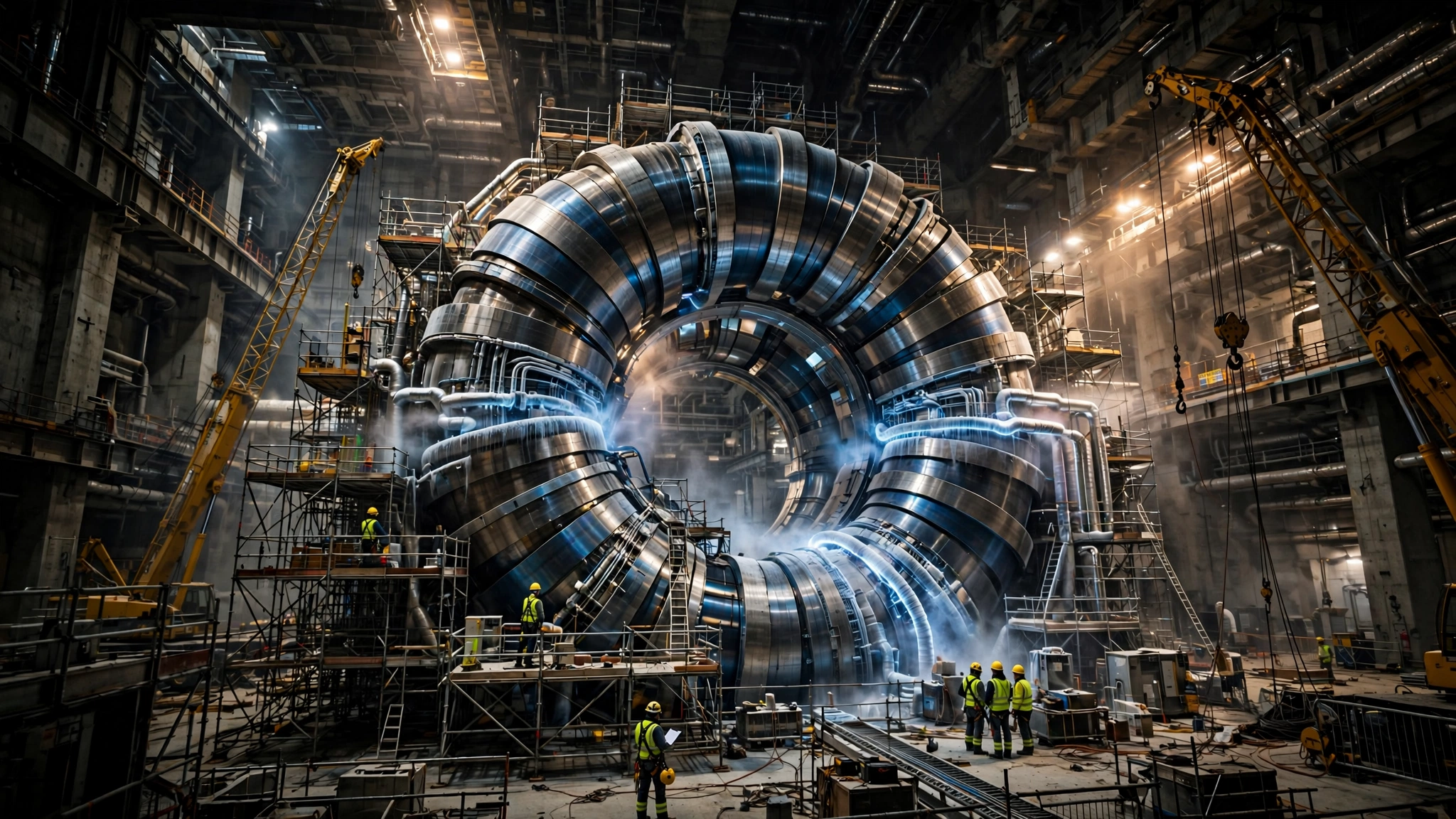
CFS's SPARC tokamak is 75 to 80 percent structurally complete at its Devens, Massachusetts facility, with first plasma targeted for 2027, a date that has already slipped twice from the original 2025 projection. SPARC uses high-temperature superconducting magnets producing fields of 20 tesla, roughly double what conventional superconducting magnets achieve, packed into a plasma volume of 20 cubic meters that is one-forty-second the size of ITER's 840-cubic-meter behemoth.
The commercial follow-on, called ARC, would be built at Fall Line Fusion Power Station in Chesterfield County, Virginia, targeting 400 megawatts of electrical output, enough for roughly 300,000 homes, with Google having signed a preliminary power purchase agreement for 200 megawatts and Eni committing to over $1 billion in electricity purchases. CFS became the first fusion company to apply to PJM Interconnection, the grid operator serving 13 states and 65 million people, a process that typically takes four to six years.
Lorence Kim, CFS's new chief financial officer, ran Moderna's finances from 2014 to 2020, the period during which Moderna raised approximately $4.4 billion in private capital (a figure Kim has cited in public comparisons), went public, and then shipped the COVID-19 vaccine in December 2020 and generated $36.3 billion in revenue by 2022. He told TechTimes that "fusion today is where mRNA was a decade ago: scientifically real, commercially yet-to-be-proven, and closer than the consensus thinks." CFS has now raised $4 billion before its first commercial reactor. The comparison is specific, checkable, and made by someone who watched the identical capital arc produce the fastest vaccine deployment in pharmaceutical history.
Concentration Risk
The Fusion Industry Association's 2026 report, released July 13, pegs total private investment in fusion at $14.24 billion across 56 companies employing more than 16,000 people, with annual investment hitting $4.48 billion in the reporting period, a 69 percent increase.
CFS alone accounts for $4 billion of that $14.24 billion total, which is 28.1 percent of all private fusion capital ever raised. Add Helion's $1.5 billion and TAE Technologies' $1.79 billion and the top three companies hold 51.2 percent of every private dollar ever invested in fusion energy, a concentration ratio that would alarm regulators in almost any other capital market.
That concentration is dangerous, and the precedent is instructive. When SunEdison, which held roughly 15 to 20 percent of total venture investment in solar, filed for Chapter 11 bankruptcy in April 2016, Bloomberg New Energy Finance's head of solar analysis noted that "SunEdison's bankruptcy says more about the company's strategic decisions than about the solar industry as a whole," but the collapse destroyed the yieldco financing model that had channeled billions in institutional capital into solar projects, and several utility-scale developments stalled not because their economics were wrong but because their financing structures resembled the one that had just imploded. CFS holds nearly twice SunEdison's market share, which means that if SPARC fails to achieve net energy gain, the industry loses a third of its capital base and, far worse, the institutional credibility that pension fund entry just conferred, because pension fund losses create exactly the kind of headline that makes other pension boards conclude fusion is not infrastructure but speculation, and the capital window narrows for a generation.
SPARC vs. ITER
ITER remains the benchmark, a 35-nation governmental fusion project in southern France originally estimated at $5 billion with full operations by 2016. The Congressional Research Service reports costs have since risen to roughly $22 billion, with deuterium-tritium fusion operations delayed to 2039, and the beryllium-to-tungsten first-wall material change alone adding approximately $1 billion.
A naive comparison makes CFS look radically more efficient: $4 billion versus $22 billion, which is true on the surface but the ratio inverts when you normalize for plasma volume. SPARC costs $200 million per cubic meter of plasma while ITER costs $26.2 million, making ITER actually cheaper per unit volume by a factor of eight. What CFS buys with the $200 million premium is speed: a machine that was designed, funded, and nearly completed in eight years versus one that has been under construction for sixteen and counting, and the ability to fail, learn, and redesign before ITER finishes machining its vacuum vessel sectors.
The Demand Driver Already Exists
Moderna needed a pandemic to prove the mRNA platform commercially, and nobody predicted it, nobody planned for it, and without it the technology might have spent another decade proving itself through incremental vaccine candidates for diseases with smaller addressable markets. CFS does not face that particular dependency because AI data centers have already created precisely the kind of insatiable, price-inelastic electricity demand that makes a new baseload power source commercially rational even at premium pricing. Gartner estimated global data center electricity consumption at 565 terawatt-hours in 2026, up 26 percent year over year, with AI-optimized servers accounting for 175 terawatt-hours and growing at 84 percent annually, a trajectory that will push AI server power consumption past conventional servers by 2027, and Microsoft, Google, and Amazon have each signed nuclear or advanced energy agreements in the past twelve months specifically because their projected compute needs already exceed the available supply of clean electrons. Google's preliminary power purchase agreement with CFS is explicitly motivated by this gap.
If the institutional-entry pattern holds, fusion reaches commercial viability 3 to 5 years after institutional capital arrives: 2029 at the short end, which would require CFS to achieve first plasma on schedule and begin ARC construction immediately, and 2031 at the long end, which aligns with the 70 percent of FIA-surveyed companies expecting first fusion electricity on the grid in the 2030s.
Limitations
The institutional-entry correlation in wind and solar is descriptive, not causal, and the sample size is two, which makes the 3-to-5-year commercialization window a pattern-match rather than a prediction with statistical confidence. We cannot isolate whether institutional capital accelerated deployment or merely coincided with technologies that were already approaching viability on their own engineering timelines. PensionDanmark and Berkshire may have entered because the science was settled, in which case their arrival is a lagging indicator dressed up as a leading one.
CFS has not publicly confirmed which pension funds participated. Our analysis relies on TechTimes reporting that described the investors as pension funds and sovereign wealth funds. If the institutional mix is smaller than described, the signal weakens. CFS's spokesperson confirmed "largely new investors" with "infrastructure-focused" profiles but named no specific funds.
SPARC has not achieved first plasma, and the institutional-entry pattern in wind and solar followed working commercial deployments, not pre-commercial prototypes, which makes fusion's institutional entry earlier in the technology lifecycle than either precedent and either means institutional risk appetite has broadened or that this particular bet is premature in a way the historical pattern cannot capture.
Berkshire Hathaway is not a pension fund in the strict sense, though its capital operates on the same multi-decade, fiduciary-like horizon that pension boards require, and its entry into solar was through contracted infrastructure assets rather than venture-style equity bets, so we include it as institutional capital with this caveat rather than as a pure pension-fund analog.
The Strongest Case Against
Fusion has attracted institutional hype before. In 2014, Lockheed Martin's Skunk Works announced a compact reactor it claimed would fit on a truck and produce 100 megawatts by 2024. Twelve years later: no public results, no prototype, no retraction, just silence. TAE Technologies, backed by Goldman Sachs and the late Paul Allen, has raised $1.79 billion since 1998 and has not demonstrated net energy gain. The industry's defining characteristic is that it has been "20 years away" for 60 years, a joke that persists because it keeps being true.
CFS's September 2021 demonstration of a 20-tesla high-temperature superconducting magnet was a genuine, peer-reviewed breakthrough that no prior fusion company has matched, and the magnet technology is the specific thing that makes SPARC possible at one-forty-second the plasma volume of ITER. But a magnet is not a reactor, a reactor is not a power plant, and a power plant is not a grid-connected, commercially operating facility that delivers electricity to 300,000 homes while meeting PJM's reliability standards every hour of every day for thirty years. Pension fund entry does not change the physics, and if the plasma does not stay hot enough long enough, the money does not matter.
What to Watch and What to Do
If you manage institutional capital, track whether additional pension funds disclose fusion allocations in their 2026 annual reports: CalPERS, Ontario Teachers', and Norway's GPFG are the bellwethers, and a second major allocation within 18 months would confirm the pattern while continued silence from every other pension board would suggest this round was an outlier driven by a single fund's unusual risk appetite rather than a sector-wide institutional consensus.
If you work in energy, watch SPARC, because first plasma in 2027 is the single most important datapoint in the sector: if CFS achieves Q greater than 1 on schedule the ARC commercial timeline becomes credible and a second wave of institutional capital follows, and if the date slips again to 2029 or beyond the pension funds will have entered a technology that is still demonstrating rather than deploying.
If you are a taxpayer funding ITER, this round asks an uncomfortable question: CFS is 80 percent built at $4 billion while ITER is decades from completion at $22 billion. The comparison is not apples-to-apples because ITER targets Q of 10 and SPARC targets Q greater than 1, but the gap between 82 percent lower total cost and significantly lower performance targets is where the real policy debate lives.
The Bottom Line
Pension funds have entered emerging energy technologies twice, and both times commercial deployment followed within 4 to 12 years. Their entry into fusion does not guarantee the same outcome because fusion is harder than wind or solar by every engineering measure that exists, and the historical sample size is two, which is not a pattern so much as a coincidence that happens to be right twice. But pension actuaries just concluded that CFS's magnet technology works, the company is credible, and the risk profile fits a portfolio designed to pay retirement checks in 2056. They are not always right. They are rarely early.