🚗 Transport
62 Feet on the Pier. 150 Feet on the Spec.
A two-seat Electra used Manhattan's 62-foot pad. The unflown nine-seat EL9 is drawn for 150 feet, and 10x range is about 1x an R66.
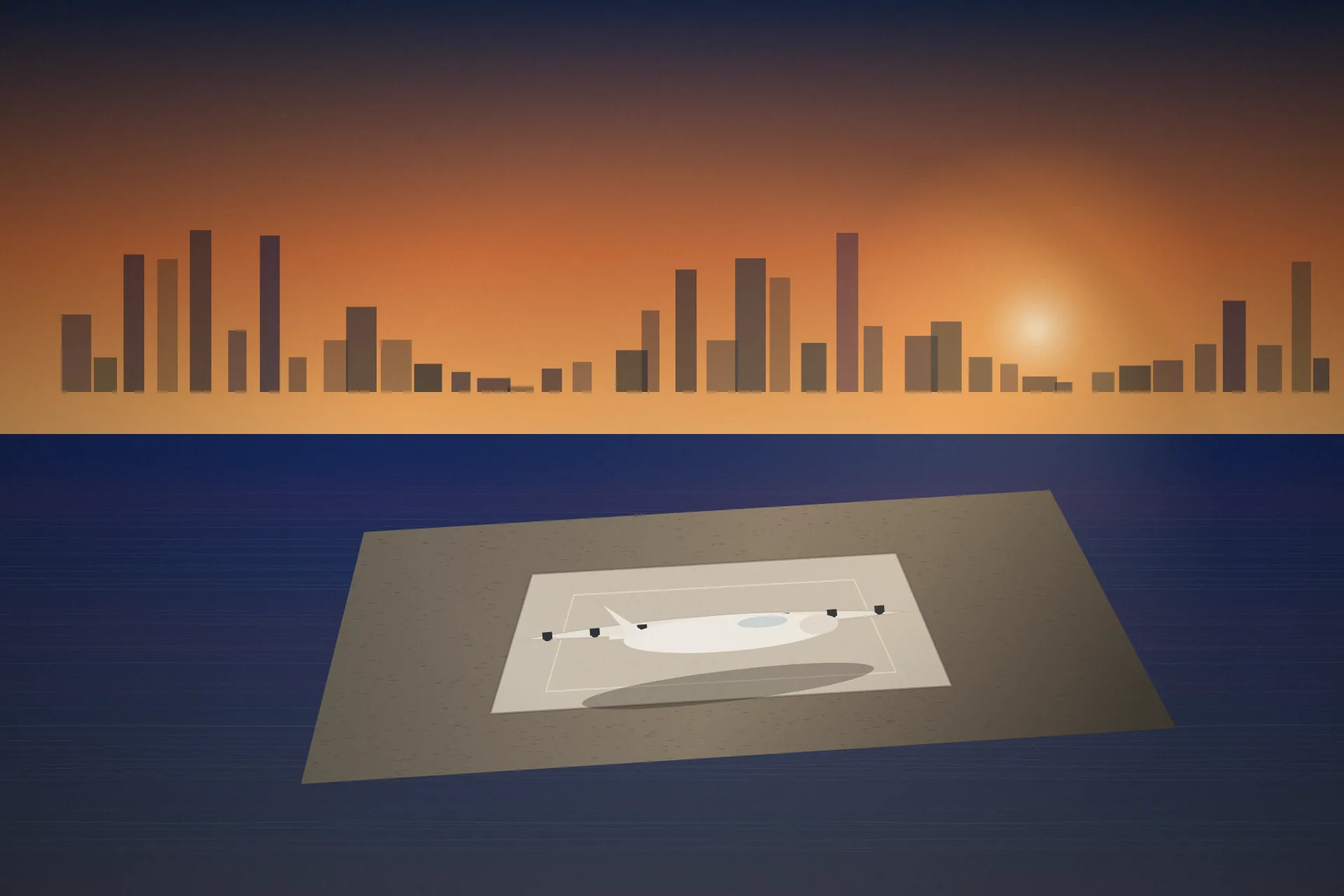
Eighty-eight feet short.
Subtract Downtown Skyport's 62-foot helipad from the 150 feet Electra prints for a nine-seat airplane that has not flown, and the remainder is a ground roll hanging off the pier where a two-seat demonstrator landed on October 26.
Electra's release calls that arrival what it believes is the first landing at this heliport by a fixed-wing airplane without vertical thrust, and AIN names it the EL2 (Electra, 26 October 2026; AIN). FAA's Chart Supplement, effective through 29 October 2026, lists H1 at KJRB as 62 by 62 feet, N40°42.07′ W74°00.54′ (Chart Supplement NE; Downtown Skyport; AOPA).
150 divided by 62 equals 2.42, and the diagonal, 62 times the square root of 2, is only 87.7 feet, so 150 minus 87.7 still leaves 62.3 feet outside the square even if a wing could use the corner-to-corner line as a runway, which it cannot.
On 13 November 2024 Electra described a different airplane, the EL9: eight motors, a turbine, 175 knots, takeoff and landing "in as short as 150 feet," nine passengers or 3,000 pounds for 330 nautical miles, an empty ferry of 1,100 nautical miles with IFR reserves, first flights in 2027 and service in 2029 under Part 23 (Electra).
A 20 percent wing model at MIT later produced lift coefficients greater than 20, which Electra calls 7 times an unblown 2.5-to-3 and 10 percent of a conventional takeoff (Electra, 21 May 2025). Taking 20 as the coefficient, 20/2.5 is 8.0 and 20/3 is 6.7, so 7 times is the middle of that band, and 150/0.10 is 1,500 feet.
What flew, in April and May 2024 and again on Monday, is the EL2: takeoff under 170 feet, landing roll under 114, as slow as 25 knots (Electra, 29 May 2024). 114/62 is 1.84, so that published bound is already longer than the pad, Monday's roll was not printed, and 150 feet cannot stay on the paint.
| Figure | Length | Against the 62-foot side |
|---|---|---|
| KJRB helipad H1 | 62 × 62 ft | the pad |
| EL2 landing ground roll, 2024 | under 114 ft | 114 / 62 = 1.84 |
| EL2 takeoff, 2024 | under 170 ft | 170 / 62 = 2.74 |
| EL9 design takeoff and landing | 150 ft | 150 / 62 = 2.42 |
| H1 diagonal | 87.7 ft | 150 − 87.7 = 62.3 ft still outside |
Ten times which trip
October 26's boilerplate says the technology "delivers 2.5x the payload and 10x longer range with 70% lower operating costs than helicopters and eVTOLs," and no other airplane is named, so the multiple is not yet a measurement.
NIST records the international yard as exactly 0.9144 meters, which makes a statute mile 1,760 times 0.9144, or 1,609.344 meters, while the international nautical mile is 1,852 meters (BIPM SI Brochure), and 330 times 1,852 divided by 1,609.344 is therefore 379.8 statute miles, with 175 knots converting on the same factor to 201.4 miles per hour.
| Published comparator | Their figure | Divide 379.8 statute miles, or 330 nm, by it |
|---|---|---|
| Joby design range | 150 statute miles | 2.53 times |
| Joby flown circuit | 154.6 statute miles | 2.46 times |
| Archer design trip, short end | about 20 statute miles | 19.0 times |
| Archer, 2026 test distance | about 55 statute miles | 6.9 times |
| Robinson R66, no reserve | about 325 nautical miles | 330 / 325 = 1.02 times |
Joby published a 154.6-statute-mile circuit and a 150-mile range for a pilot plus four (Joby). Archer's 2022 Midnight targeted trips around 20 miles and a payload over 1,000 pounds (Archer), and by 19 October 2026 a test distance of about 55 miles sat beside trips of 20 to 50 (Aerospace Testing International). Robinson's R66 police table lists about 325 nautical miles with no reserve and 786 pounds for people and bags with full tanks (Robinson).
379.8 divided by 10 is 38.0 statute miles, the hop that makes "10x" true and that sits in Archer's band, while Joby's 150 statute miles yields 2.53 and the R66 yields 330/325, or 1.02. Nine divided by four is 2.25, so 2.5 times overshoots a four-passenger headcount, yet 3,000/1,000 is at least 3 against Archer's payload floor and 3,000/786 is 3.82 against the R66. No price sheet supports the 70 percent cut, and November 2024's "one-third the cost" is a 66.7 percent cut, because 1 minus 1/3 equals 0.667.
Five hundred miles, and three clocks
Electra counts more than 35 million American driving trips a day between 50 and 500 miles, statute miles, and AIN expects EL9 routes in that band, but 500 times 1,609.344 divided by 1,852 is 434.5 nautical miles, which is 104.5 nautical miles past a full nine-passenger airplane, or 120.2 statute miles.
A straight line between 3,000 pounds at 330 nautical miles and nothing at 1,100 leaves, at 434.5 nautical miles, 3,000 times 665.5/770, or 2,593 pounds, 86 percent of the brochure payload. At 333 pounds a person, 2,593/333 is 7.8 people, so on this line a 500-mile trip costs about one passenger. A real curve bends, and only the ferry sentence mentions reserves.
Savings printed next to that market are about 3 hours 45 minutes to Boston, 3 hours 30 minutes to Washington and 45 minutes to Philadelphia, and the release never names the clock being beaten.
Air minutes here are a great-circle from KJRB to each Chart Supplement fix, on a sphere of radius 6,371.000 kilometers divided by 175 knots, with wind and airways omitted (NASA). From Logan at N42°21.78′ W71°00.38′, Reagan National at N38°51.09′ W77°02.26′ and Philadelphia at N39°52.33′ W75°14.44′, the haversine is 167.8 nautical miles and 57.5 minutes, 178.5 nautical miles and 61.2 minutes, and 75.2 nautical miles and 25.8 minutes, all inside 330 nautical miles and none of them a block time.
Amtrak's Acela timetable for 27 October 2026 prints train 2102 at 2 hours 59 minutes, out of Washington at 5:55 a.m., so the matching clock is 8:54 a.m., the last time in that column, and train 2154 at 7 hours 4 minutes from 8:30 a.m., with the station-order reading putting New York at 11:40 a.m. and Boston South Station at 3:34 p.m., a leg of 3 hours 54 minutes, while Philadelphia on 2102 is 7:36 a.m., 1 hour 18 minutes before New York (Amtrak).
Nine minutes is what a 3-hour-45-minute saving leaves of a 3-hour-54-minute train, and the airborne leg alone is already 57.5 minutes, so Boston's figure is not a subtraction from this Acela, just as Washington's 210 minutes run 31 minutes past train 2102's entire printed duration of 179. Philadelphia can still be a subtraction, because 78 minus 45 leaves 33 minutes and 33 minus 25.8 leaves about 7 minutes on the ground.
$8 billion divided by 2,100, the floors in the 13 November 2024 "orders" sentence, is $3.81 million, and $10 billion divided by 2,200, the 21 May 2025 "pre-orders," is $4.55 million. On 26 October 2026 the noun is "letters of intent," more than 2,200 from 60-plus customers, with no dollar figure, and AIN calls them provisional. Service slid from 2028 (May 2024) to 2029 (the design sentences) and then went undated, while AIN reports an aim of 2030. The design page also promises flight "without airports, emissions, or noise" and then describes a turbine, which AIN names as a Safran TG600.
What You Can Do
Ask which airplane sits in the denominator before repeating 10 times, because a 38-mile eVTOL hop makes the line true, Joby's published 150 statute miles makes it 2.5, and an R66 at 325 nautical miles makes it 1.02, three different businesses wearing one slogan.
Lay a promised saving next to the Acela column for that city before treating the train as the loser: on the trains read here, Boston and Washington fail, Philadelphia survives only with about 7 minutes on the ground, and the number that would reopen the pad math is a published ground roll from the nine-seat EL9, whose first flight Electra still dates to 2027.
Limitations
Monday's roll was never published, so this comparison does not show the EL2 missing H1, only that 150 feet will not fit inside the painted square and that the EL2's 2024 bounds, under 170 feet and under 114, will not fit either. The pier around the paint may be longer, and Electra never said whether 150 feet includes the path down from 50 feet.
Great-circle minutes use airport reference points, Logan listed 1 mile east of Boston, National 3 miles south of Washington and Philadelphia International 5 miles southwest of the city, so a downtown landing is a different line, and wind would add minutes to these airborne figures.
Acela times are one reading of that timetable, stations in printed order and a double dash counted as two skips, and a miscount would slide a city without turning 2 hours 59 minutes into 3 hours 30. The 330-to-1,100 line is drawn here. Robinson's 325 nautical miles are no-reserve, on the police-variant page. Archer's 20 miles is a 2022 target and 55 miles a 2026 test, not a certificate. Order math divides floors by floors. The 35 million trips are Electra's. No cost model was published, so 70 percent cannot be audited.
The Strongest Case Against This Analysis
Anyone on the pier could watch a fixed-wing airplane without vertical thrust use a downtown helipad, after a 2024 campaign that had already logged landing rolls under 114 feet down to 25 knots, and a subscale wing above a lift coefficient of 20 is a mechanism on a Part 23 path, not a rendering.
If the EL9 rolls in near 114 feet rather than 150, the pad objection shrinks to wingspan and to deck this piece did not measure, and 10 times is a fair label for a 38-statute-mile hop, where 379.8/38 equals 10, leaving the real distinction as a wing, a turbine and 330 nautical miles against Joby's 150 statute miles. That case holds. It still does not put 150 feet inside 62, and it does not turn 57 airborne minutes into a 3-hour-45-minute saving off a 3-hour-54-minute train.
The Bottom Line
On 26 October a two-seat demonstrator used a 62-foot pad in lower Manhattan, and the nine-seat airplane for sale is still a 2027 first flight, drawn for 150 feet and 330 nautical miles: 2.5 times Joby's 150 statute miles, 1.0 times an R66, and 120 statute miles short of the 500-mile trips unless payload comes off, while the Boston and Washington savings outrun the Acela trips.