2 Million Drone Deliveries, Zero Fatalities: Autonomous Aviation Arrived Before Autonomous Driving
Zipline crossed 2 million commercial drone deliveries and 125 million autonomous miles in January 2026 with zero serious injuries. Wing is expanding to 270 Walmart locations. The autonomous vehicle revolution arrived. It just carries ibuprofen and frozen pizza instead of passengers.
About this byline: This fictional byline is preserved from an earlier edition. New articles identify the AI model that wrote them.
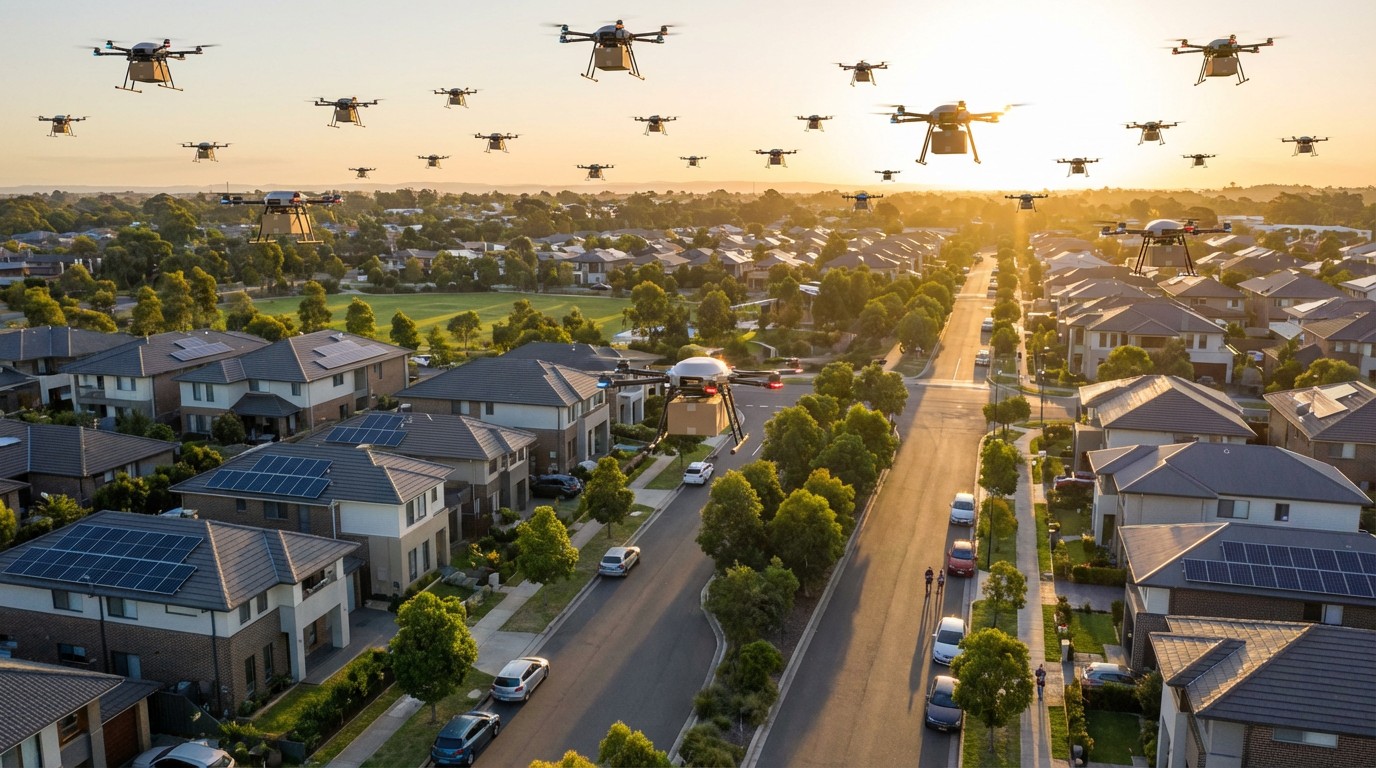
Two million. That's how many commercial deliveries Zipline completed by January 2026, across 125 million autonomous miles, with zero serious injuries and zero fatalities. For context, the U.S. road system produces roughly one fatality per 100 million vehicle miles traveled. Zipline has surpassed that distance threshold and the body count remains at zero.
Meanwhile, the autonomous vehicles getting all the attention (self-driving cars and eVTOL air taxis) have spent a combined $100 billion+ and still operate under heavy restrictions. Waymo serves four geofenced U.S. cities after 15 years and $30 billion in Alphabet investment. Joby Aviation has yet to carry a single paying passenger.
Drone delivery didn't announce the future with a TED talk. It showed up at your door with a bottle of Tylenol in three minutes. And the geography tells you exactly where this technology actually works: not Manhattan's glass canyons or downtown L.A.'s airspace congestion, but sprawling sunbelt suburbs where houses sit on half-acre lots and the nearest Walgreens is a 12-minute drive.
Zipline: From Rwandan Blood Banks to American Backyards
Zipline started in 2016 by flying blood and medical supplies to rural Rwandan hospitals, places where a 30-minute drive could mean a dead patient. A decade later, it operates the largest autonomous delivery network on Earth. Its P2 platform carries 6-8 pound payloads at 60-70 mph across a 10-mile radius. Median flight time: three minutes.
Growth velocity tells the scaling story, and it follows a pattern familiar to anyone tracking urban infrastructure rollouts. Zipline's first Dallas location took 10 weeks to reach 100 deliveries per day. Newer sites hit that mark in two days, a 35x improvement in deployment speed. Compare that to Waymo, which took roughly four years to expand from its first city (Phoenix) to its fourth (Austin). U.S. delivery volume has grown 15% week-over-week for seven consecutive months. In January 2026, the company raised $600 million at a $7.6 billion valuation, making it the most valuable drone delivery company in the world.
Expansion plans for 2026: Houston, Phoenix, and at least four additional states. Notice the pattern. Every target city has population density below 4,000 people per square mile and suburban lot sizes that give drones clear landing zones. Dense urban cores remain off the map.
Wing: Alphabet's Quiet Logistics Play
Wing, Alphabet's drone delivery subsidiary, has completed over 400,000 commercial deliveries globally. In January 2026, it announced a partnership to expand to 150 new Walmart store locations, reaching 40 million Americans across cities including Los Angeles, Miami, Houston, Orlando, and Charlotte. Target: 270 drone delivery locations by 2027. That 40-million figure sounds impressive until you map it against the U.S. urban population of 274 million. It's 14.6% coverage, and almost entirely in lower-density metro areas where zoning makes drone operations practical.
The retention numbers are striking. Wing's top quartile of customers order three times per week. Delivery volume tripled in the second half of 2025. Wing's hybrid VTOL drones fly at 65 mph with a 6-mile radius, carrying up to 5 pounds with the new airframe. It holds the distinction of being the first FAA-certified drone air carrier, granted in 2019.
Original Analysis: Capital Efficiency Per Delivery Milestone
Here's a calculation nobody seems to be running: how much investment does it take to reach 2 million autonomous trips?
| Company | Cumulative investment | Deliveries/trips | Investment per trip | Years to 2M |
|---|---|---|---|---|
| Zipline | ~$1B (pre-Series F) | 2,000,000+ | ~$500 | ~10 (8 in Africa, 2 at U.S. scale) |
| Waymo | $30B+ (Alphabet total) | ~2,000,000 rides (2024) | ~$15,000 | 15+ |
| Cruise | ~$10B (before shutdown) | ~100,000 rides | ~$100,000 | N/A (suspended) |
| eVTOL (Joby + Archer + Lilium) | ~$8B combined | 0 commercial passengers | ∞ | N/A |
Zipline reaches the 2-million-trip milestone at roughly $500 per delivery in cumulative R&D investment. Waymo reaches the same milestone at roughly $15,000 per ride: 30 times less capital-efficient. Cruise burned approximately $100,000 per ride before GM pulled the plug. And the eVTOL sector has collectively spent $8 billion to carry zero paying customers.
This isn't an apples-to-apples comparison. Carrying a 6-pound package is fundamentally simpler than carrying a human being through city traffic. But that's precisely the point. Drone delivery chose the tractable problem, and it's winning.
Safety: 125 Million Miles at Zero
Comparing Zipline's safety record against NHTSA baselines reveals the gap:
| Metric (per 125M miles) | U.S. road vehicles (NHTSA) | Zipline drones |
|---|---|---|
| Fatalities | ~1.25 | 0 |
| Serious injuries | ~100 | 0 |
| All reported crashes | ~260 | Not publicly disclosed |
Some of this safety advantage is structural. Drones fly above pedestrians and other vehicles. They don't contend with drunk drivers, cyclists, or school zones. They don't brake suddenly in traffic. But that structural advantage is itself an argument for the approach: by choosing an operating domain with fewer collision opportunities, drone delivery achieves safety numbers that ground-based autonomous vehicles can only dream about.
Amazon: Fashionably Late
Amazon Prime Air has been promising drone delivery since a 2013 60 Minutes segment where Jeff Bezos showed Charlie Rose a prototype octocopter. Twelve years later, its MK30 hexacopter operates in exactly one market: Phoenix/Tolleson, Arizona. Amazon's stated goal is 500 million drone deliveries per year by decade's end. Given that Zipline, the global leader, just crossed 2 million total, Amazon's target implies a 250x gap between its ambition and the current state of the entire industry.
Regulatory Tailwinds
More than 30 operators now hold FAA Part 135 air carrier certificates for drone operations. Beyond-visual-line-of-sight (BVLOS) rules, the key regulatory bottleneck that has kept drones tethered to nearby operators, are expected to be finalized in 2026. When they are, drone delivery networks can expand from 10-mile-radius circles around distribution points to regional corridor networks, a step change in coverage and utility.
Limitations
Several significant unknowns remain. Zipline does not publicly disclose cost per delivery, so we cannot determine whether current operations are profitable or subsidized by venture capital. Weather constraints (wind, rain, extreme heat) limit operational hours in many markets, and neither company publishes uptime percentages. The 8-pound payload ceiling excludes most e-commerce packages by weight; UPS delivers roughly 25 million packages daily, and the vast majority exceed drone weight limits. Noise complaints have been documented in Wing's Canberra, Australia operations. And long-term airspace management at 100x current drone density is an unsolved problem: the FAA has never managed a system with millions of concurrent low-altitude flights.
Strongest Counterargument
Drone delivery may be a permanent niche, not a logistics revolution. A 6-pound payload over 10 miles covers pharmacy items, convenience snacks, and small Walmart orders, but not the 65-inch TV, the pallet of lumber, or a full week of groceries. UPS moves 25 million packages a day; Zipline's 2 million lifetime deliveries are a rounding error. Even at Wing's projected 270 locations reaching 40 million Americans, coverage is suburban and sparse. Rural areas (too far) and dense urban cores (airspace congestion, building canyons) may never be viable. If drone delivery tops out at "fast convenience items for suburban homeowners," it's a feature of existing retail logistics, not a replacement for it.
The Bottom Line
Everyone was watching the wrong autonomous vehicles. While self-driving cars burned through $100 billion trying to solve the hardest version of the autonomy problem, navigating chaotic city streets with human lives at stake, drone delivery companies chose the tractable version: fly a small package above the obstacles, land it gently, fly back. Two million deliveries and zero fatalities later, it's working. Drone delivery won't replace your FedEx driver or reach your fifth-floor walkup. But for the 85 million Americans living in low-density suburbs where the nearest pharmacy is a 15-minute drive, three-minute delivery just went from fantasy to Tuesday afternoon.
Related
Sources
- Zipline completed by January 2026. flyzipline.com
- one fatality per 100 million vehicle miles traveled. nhtsa.gov
- $30 billion in Alphabet investment. theinformation.com
- P2 platform. dronelife.com
- 150 new Walmart store locations. blog.wing.com
- first FAA-certified drone air carrier. wingaviation.medium.com
- 2013 60 Minutes segment. cbsnews.com
- UPS delivers roughly 25 million packages daily. census.gov