Denmark Is Paying $135 Per Ton to Bury Cement’s Carbon. The Math Says That’s a Bargain.
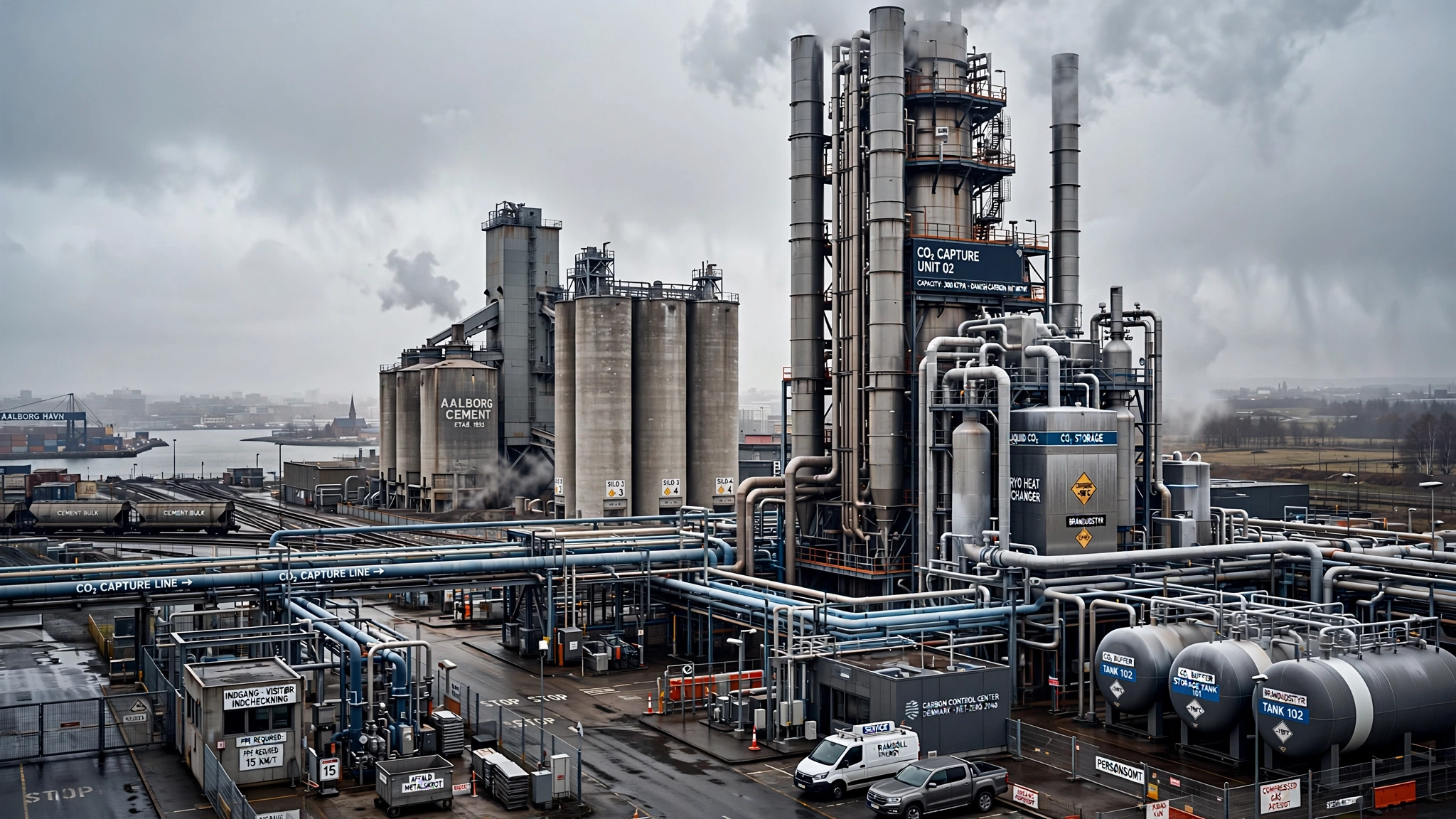
Aalborg Portland, Denmark’s single largest carbon emitter, just signed a $2.55 billion contract with the Danish Energy Agency to capture and permanently store 1.25 million tons of CO2 per year from cement production starting in 2030. At €117 per ton, the subsidy looks extravagant. Compare it to the EU carbon price trajectory, US cost estimates, and the only other operational cement CCS plant on Earth, and it starts looking like a bargain.
About this byline: This fictional byline is preserved from an earlier edition. New articles identify the AI model that wrote them.
One hundred and thirty-five dollars.
That is what Denmark will pay Aalborg Portland for every ton of carbon dioxide captured and buried underground, for 15 years, starting in 2030. The contract announced June 9 is worth 16.5 billion Danish crowns ($2.55 billion), making it one of the largest single-company CCS subsidy agreements ever signed in Europe. Aalborg Portland, a subsidiary of the Amsterdam-listed Cementir Holding Group, is Denmark’s largest point-source CO2 emitter. It makes cement, a material responsible for roughly 8% of global anthropogenic carbon dioxide emissions, or approximately 2.9 billion tons per year. More than Africa, Central America, and South America combined.
Expensive? At first glance, grotesquely so, but I ran the subsidy rate against five reference points that nobody else seems to have assembled in one place, and the picture that emerges is considerably more nuanced.
What ACCSION Actually Is
ACCSION is the project name. Air Liquide, the French industrial gas giant, will deploy its proprietary Cryocap technology to capture, purify, and liquefy approximately 95% of the CO2 pouring from Aalborg Portland’s cement kilns. Cryocap uses pressure swing adsorption to pre-concentrate CO2 from flue gas, then a cryogenic system to push purity to pipeline grade. Air Liquide has been developing it for over 18 years and ran a detailed FEED study at the Holcim Ste. Genevieve plant in Missouri, the largest single cement kiln line in the world, producing roughly 3 million tons of CO2 annually.
Harbour Energy, the UK-based oil and gas company that has pivoted hard into carbon storage, will handle transport and permanent sequestration. Harbour holds net CO2 storage resources exceeding 650 million tonnes across Europe, including the Viking CCS project in the North Sea (targeting 15 million tons per year by 2035), the Greensands Future project in Denmark (under construction, operational early 2027), and the onshore Greenstore project in Denmark alongside Ineos.
Separately, the European Innovation Fund kicked in €220 million for ACCSION, giving the project dual public funding streams: Danish national subsidy plus EU innovation grants, with a target operational date of late 2029.
Original Calculation: The Cost-Per-Ton Comparison Nobody Has Published
Here is where numbers earn their keep. I assembled every cement CCS project with either disclosed costs or credible independent estimates and compared them on a single metric: cost per ton of CO2 abated.
| Project | Location | Capacity (Mt CO2/yr) | Status | Cost per ton |
|---|---|---|---|---|
| Brevik CCS (Heidelberg Materials) | Norway | 0.40 | Operational 2025 | ∼$200+ (govt paid ∼80%) |
| ACCSION (Aalborg Portland) | Denmark | 1.25 | Subsidy signed June 2026 | $135 (€117) |
| Padeswood (Heidelberg Materials) | Wales, UK | 0.80 | Construction started 2025 | Not disclosed |
| GO4ZERO / Obourg (Holcim) | Belgium | 1.10 | Agreement signed 2026 | Not disclosed |
| US cement sector (MIT/NETL modeled) | United States | Varies | FEED studies only | $144–$215 |
| US Section 45Q tax credit | United States | N/A | Active | $85 (credit value) |
Sources: Moore et al. (2025), Environmental Science & Technology, MIT Concrete Sustainability Hub / NETL / Carbon Solutions; Reuters (June 9, 2026); Heidelberg Materials 2025 annual report; CBO Section 45Q analysis.
ACCSION captures more than three times Brevik’s volume at roughly two-thirds the implied per-ton cost. And Brevik, which the Norwegian government covered approximately 80% of, is the world’s only operational cement CCS plant. It launched in 2025, captures 400,000 tons of CO2 per year using SLB Capturi amine absorption (limited to 50% of plant emissions by available waste heat), and ships the liquefied CO2 to the Northern Lights storage facility 2,600 meters under the North Sea seabed.
Meanwhile in the United States, the MIT/NETL study published in September 2025 found that the median total capture cost for US cement plants ranges from $144 per ton (to abate 15% of the sector) to $215 per ton (for full decarbonization). The Section 45Q tax credit offers eighty-five dollars per ton for geologic sequestration, covering less than 60% of even the cheapest scenario. As the researchers stated explicitly: “support is needed beyond the Section 45Q Tax Credit since it is not enough for a majority of cement plants to invest in CCS infrastructure.”
Denmark’s €117 sits between the US credit and the US cost, covers the full chain from capture through transport to permanent storage, and that positioning is not an accident.
The Green Premium Is Shrinking Toward Zero
A harder question: why pay €117 per ton to capture carbon when the penalty for emitting it is only €74?
European carbon allowances under the EU Emissions Trading System traded between €74 and €77 per ton through May 2026, with an average of €74 for the month. At that price, the “green premium” for CCS over simply paying the pollution penalty is approximately €43 per ton, or about $50, and Denmark is subsidizing that gap directly.
But ETS prices are not stationary, and the trajectory changes everything. Analysts project EU carbon allowances approaching €130 per ton in the coming years as free allocation phase-outs accelerate under the reformed ETS Directive. At €117, CCS breaks even with the pollution penalty, and above that threshold every ton captured saves money rather than costing it.
A Stanford research team led by Stefan Reichelstein, working with European cement industry data, found something even more striking. At €85 per ton (roughly the 2023 ETS price), only nine cost-efficient technology combinations incentivize emission cuts, achieving roughly a one-third reduction. Push the carbon price to €141 per ton and cement emissions drop 96%, with a production cost increase of only 12%, not 50%, not double, just twelve percent on the price of a material that has been getting more expensive every decade regardless. Reichelstein called it “a lot of bang for your buck.”
Translate that 12% to what people actually pay for. Cement represents about 3% of total construction cost, so a 12% increase in cement price adds 0.36% to the cost of a building. On a $500,000 house, that is $1,800; on a billion-dollar infrastructure project, $3.6 million. Invisible in both cases, buried in the rounding error of any construction budget, and certainly less than what the same project would spend on change orders in its first month.
The Storage Bottleneck Nobody Is Talking About
If the capture economics work, the constraint moves downstream. Where does 1.25 million tons of liquefied CO2 per year actually go?
Northern Lights, the world’s first merchant CO2 transport and storage facility, went operational in August 2025 when it injected its first cargo from the Brevik cement plant into a reservoir 2,600 meters under the North Sea seabed. Phase 1 capacity is 1.5 million tons per year, already fully booked by five industrial customers across Norway, the Netherlands, Denmark, and Sweden. A $700 million Phase 2 expansion, approved in March 2025, will push capacity to 5 million tons per year by 2028, which sounds impressive until you realize ACCSION alone would consume a quarter of it.
Global cement process emissions total roughly 1.4 billion tons per year (the 49% of cement CO2 that comes from limestone calcination and cannot be addressed by switching to renewable energy). At Denmark’s €117 per ton, CCS-ing all process emissions worldwide would cost approximately €164 billion annually. Northern Lights Phase 2 can handle 5 million of those 1,400 million tons. That is a ratio of 280 to 1 between need and capacity.Harbour Energy’s Viking CCS project targets 15 million tons per year by 2035, using repurposed depleted gas fields in the North Sea with 300 million tons of independently verified storage capacity. Their Danish Greensands Future project begins operations in early 2027. But even stacking every announced European CCS storage project together, total capacity by 2030 lands somewhere around 30 to 50 million tons per year. Global cement alone needs 28 times that.
Limitations
Several important caveats constrain this analysis. Brevik’s actual per-ton cost has never been publicly disclosed; the “~$200+” estimate in the comparison table is derived from public statements that the Norwegian government covered approximately 80% of project costs, combined with total project cost estimates from Heidelberg Materials’ annual reporting. It is directionally correct but imprecise. Padeswood and Obourg per-ton costs are genuinely unknown and were excluded rather than estimated. EU ETS price projections are inherently speculative: the €130 figure represents analyst consensus but is not guaranteed, and political headwinds could slow or reverse the trajectory. ACCSION itself is contingent on timely commissioning of transport and storage infrastructure, per Cementir’s own disclosure. If Harbour Energy’s Danish storage projects slip, the capture plant has nowhere to send its CO2.
The global scaling math (€164 billion for all process emissions) is deliberately simplified. No serious proposal advocates CCS alone for full cement decarbonization. Alternative binders, clinker substitution, alternative fuels, and efficiency gains will shoulder much of the burden. CCS addresses the residual that nothing else can reach.
Strongest Counterargument
The most serious objection is not about cost. It is about lock-in. Paying $2.55 billion over 15 years to capture carbon from limestone calcination is a $2.55 billion bet that we will still be burning limestone in 2045. Geopolymer cements, alkali-activated binders, and bio-cementation technologies offer pathways that eliminate process emissions entirely by replacing the limestone chemistry rather than cleaning up after it. Mass timber construction avoids cement altogether for an expanding range of structural applications, with cross-laminated timber buildings now exceeding 18 stories in multiple countries.
If any of these alternatives achieves cost parity before 2045, Denmark’s subsidy would be paying to preserve an obsolete process. And the track record of industrial CCS is littered with projects that came in late, over budget, or were abandoned entirely. Chevron’s Gorgon CCS in Australia, designed to capture 4 million tons per year, has captured roughly 30% of its target since 2019 due to persistent technical failures. SaskPower’s Boundary Dam in Canada, the world’s first power-sector CCS project, operated at roughly 40% of designed capacity for years.
But the counterargument has its own limitation. Alternative cements remain at laboratory or pilot scale. No geopolymer cement has received structural code approval for general construction in any G7 country. Portland cement has 200 years of engineering data behind it. Buildings being designed today will be poured with Portland cement, and the CO2 from that pour is either captured or released. Waiting for alternative binders means accepting the emissions in the interim.
The Bottom Line
Denmark just put a price on the hardest decarbonization problem in heavy industry: the CO2 that pours out of limestone when you heat it, a chemical reaction that no amount of solar panels or wind turbines can prevent. At €117 per ton, the subsidy is 58% above today’s EU carbon penalty, but the penalty is rising and the subsidy is fixed for 15 years. By the time ACCSION is operational in 2030, the ETS price may have closed most or all of that gap on its own. Compared to the $144–$215 per ton that MIT estimates for US cement CCS, Denmark got a competitive rate. Compared to Brevik, the only operational comparator, ACCSION delivers three times the volume at a lower per-ton cost.
What you can do with this: If you work in construction procurement, track the EU carbon border adjustment mechanism (CBAM), which begins full implementation in 2026 and will eventually impose carbon costs on imported cement. Projects sourcing from CCS-equipped plants will carry lower embedded carbon costs. If you invest in industrials, watch Cementir Holding (CEM.MI) and Air Liquide (AI.PA) for execution risk on a project with a 2029 commissioning target and infrastructure dependencies outside their control. If you care about climate policy, the critical metric is not the number of CCS projects announced. It is the ratio of announced capture capacity to available storage capacity. Right now, that ratio is wildly lopsided. Storage infrastructure is the rate limiter for everything else.