A Startup Founded in 2023 Just Achieved the First Advanced Reactor Criticality in 40 Years. The Fuel Supply Math Doesn’t Work Yet.
Antares Nuclear’s Mark-0 microreactor hit zero-power criticality at Idaho National Laboratory on June 4, becoming the first privately developed non-light-water reactor to reach that milestone in the US in over four decades. Three years from founding to a self-sustaining fission chain reaction, in an industry where the average timeline is measured in decades. But the HALEU fuel these reactors need doesn’t exist at commercial scale, and won’t until 2031.
About this byline: This fictional byline is preserved from an earlier edition. New articles identify the AI model that wrote them.
Three years.
That is how long it took Antares Nuclear to go from incorporation to a self-sustaining nuclear chain reaction. On June 4, the Torrance, California-based startup’s Mark-0 microreactor achieved zero-power criticality at Idaho National Laboratory’s Materials and Fuels Complex, becoming the first advanced reactor to reach that milestone under the Department of Energy’s Reactor Pilot Program. The DOE confirmed it was the first privately developed non-light-water reactor to go critical in the United States in more than four decades. It is also the 53rd reactor built at INL since 1951 and the first novel design to achieve criticality at the lab in over 50 years.
For context on how abnormal that pace is: NuScale Power spent 23 years developing its small modular reactor, finally secured NRC design certification in 2023, and then watched its flagship project at Idaho collapse the same year when costs ballooned past $9.3 billion. TerraPower, founded by Bill Gates in 2008, broke ground on its Natrium reactor in 2024 after 16 years of development and doesn’t expect operations until approximately 2030. X-energy, founded in 2009, is still working through NRC design review for its Xe-100. Kairos Power, founded in 2016, has its Hermes reactor under construction but isn’t expecting operations until roughly 2027.
Antares was founded in 2023, raised $140 million in private capital including a $96 million Series B round led by Shine Capital in December 2025 with Alt Capital, FiftyThree Stations, Industrious, and Caffeinated participating, and went critical inside a DOE national laboratory 30 months later with a team and supply chain that most industry observers didn’t know existed two years ago. “We went from concept to a critical reactor, safely, in less than 12 months,” CEO Jordan Bramble said. “That doesn’t happen by accident.”
What Actually Happened (and What Didn’t)
Precision matters here, because the word “criticality” can carry more weight than the physics warrants. INL Laboratory Director John Wagner was careful to draw the line: “What Antares achieved is specifically zero-power criticality—the chain reaction was sustained at essentially no measurable energy output. This is not electricity generation. It is not full-power operation. It is proof that the system works: the scientific and engineering validation that every subsequent step depends on.”
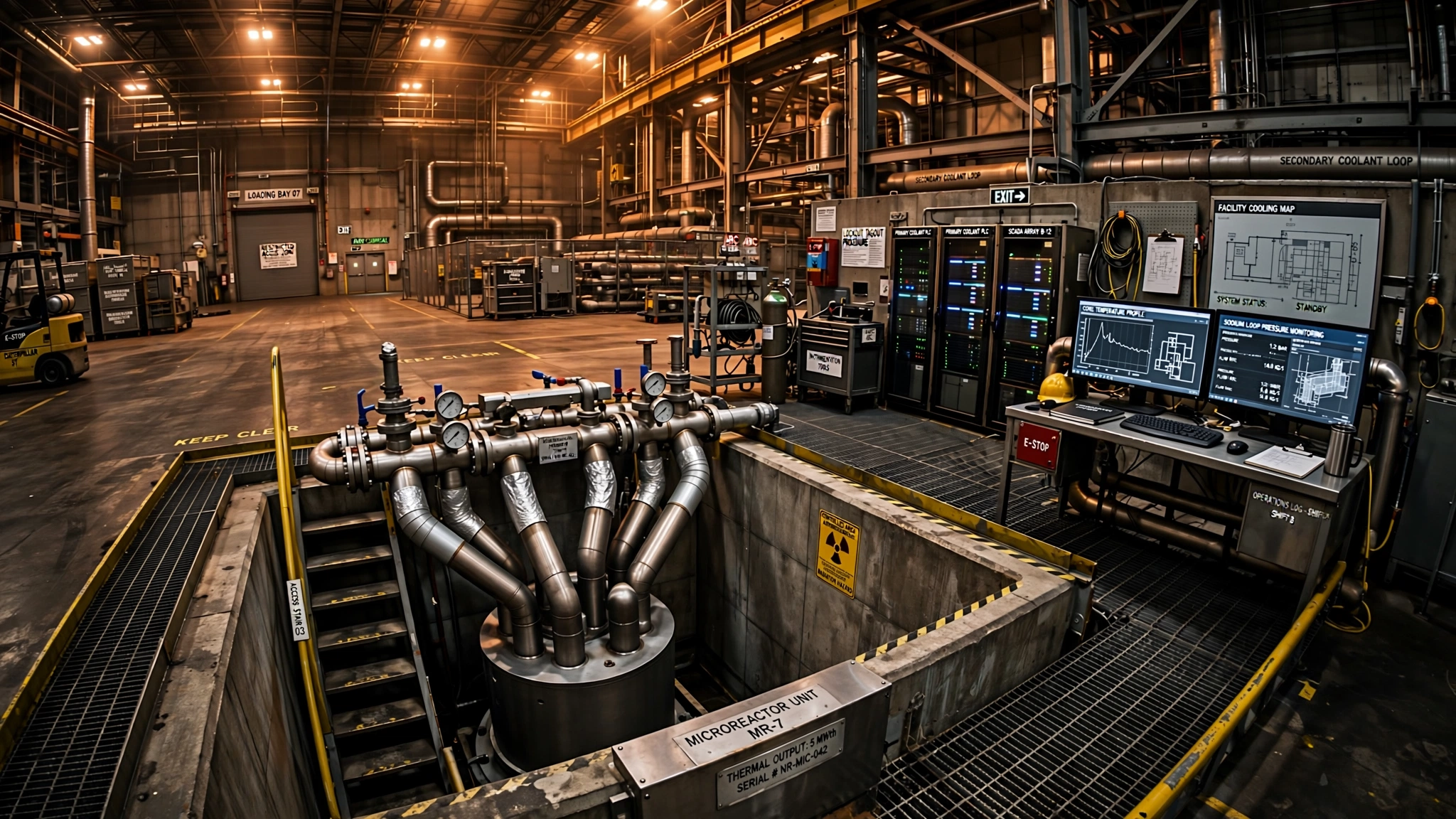
The Mark-0 is a sodium heat-pipe-cooled microreactor fueled by high-assay low-enriched uranium (HALEU) in TRISO fuel compacts, using less than 120 kilograms of fuel total. It has no power conversion system. No heat removal system. It was designed exclusively for zero-power criticality testing: validating reactor physics, confirming control system behavior, and producing neutronics data. The reactor sits in a below-grade pit inside Building MFC-793, with operations limited to less than one month before it begins cooling and defueling.
That makes it a physics experiment, not a power plant—a proof of concept in a below-grade pit with no heat removal and a one-month operational window. But it is a physics experiment that the American nuclear industry hasn’t been able to produce from the private sector since the Reagan administration, and Bramble’s team accomplished it faster than most nuclear companies complete their preliminary safety analyses, let alone pour any concrete or load any fuel.
Why So Fast: The DOE Bypass
The speed is explained almost entirely by a single policy lever. Executive Order 14301, signed by President Trump in May 2025, established the DOE Reactor Pilot Program, which authorizes advanced reactor demonstrations at national laboratories under DOE’s own safety framework rather than NRC commercial licensing. NRC design certification review alone takes an average of 42 months. The Vogtle combined license process consumed six years before construction even started, and Vogtle ultimately took 14 years from license application to commercial operation, coming in $17 billion over its original budget.
Under the DOE pathway, Antares secured preliminary safety approval in January 2026, final documented safety analysis approval in April, and criticality authorization by June. Five months from safety application to fission. The tradeoff is explicit: DOE authorization covers demonstrations at national labs for limited durations, not commercial power generation on private land for decades. The NRC still governs the commercial path, and the NRC process is the one that takes 42 months just for design certification review, before the applicant spends a single day building anything or pouring any concrete.
Four other groups are pressing toward the same July 4 deadline set by the executive order, which calls for at least three advanced-reactor criticalities. Valar Atomics received final DSA approval for its Ward 250 high-temperature gas reactor in April and is targeting power operations, not just criticality. Aalo Atomics completed its Critical Test Reactor at INL and entered operational readiness review in April. Radiant Nuclear received full-power test approval for its 1-MWe Kaleidos reactor and took possession of INL’s DOME facility in April. Oklo reported its Groves isotope test reactor in Lockhart, Texas, reached construction substantial completion in 229 days, with a stated July 4 criticality target.
Original Calculation: The Fuel That Doesn’t Exist
Here is where the story pivots from celebration to constraint. Every one of these advanced reactors runs on HALEU—uranium enriched to between 5% and 20% U-235, compared to the roughly 4% used in conventional light-water reactors. And the United States has essentially no commercial HALEU supply.
The numbers tell a blunt story. One enricher, one cascade, and an entire industry waiting in line behind it. Centrus Energy operates the only domestic HALEU enrichment capability: a single 16-machine demonstration cascade in Piketon, Ohio, that has produced approximately 920 kilograms total under a DOE contract. That is the entire US commercial HALEU stockpile. Antares’s Mark-0 alone consumed less than 120 kilograms. If each of the 10-plus Reactor Pilot Program companies needs 50 to 120 kilograms for their demonstrations, the math caps out at roughly 8 to 18 test reactors from existing supply—and that calculation generously assumes zero kilograms go to Project Pele, NASA, the Space Force, or any other government program competing for the same material.
For Antares’s Mark-0, the DOE sidestepped the problem by providing government-held surplus material that BWXT processed and fabricated into TRISO compacts at its Lynchburg, Virginia facility. But government scrap is finite and was never intended to power a commercial fleet of hundreds of transportable reactors scattered across military installations, remote mining operations, and disaster relief zones.
In May 2026, Antares signed what Urenco described as “the world’s first multi-year” commercial HALEU supply contract, a headline that reads better than the fine print warrants. Urenco’s Advanced Fuels Facility at Capenhurst in the UK isn’t planned to come online until 2031, with an initial capacity of up to 27 metric tons per year—enough to supply roughly 30 advanced reactors annually, assuming each unit needs approximately 500 kilograms for a multi-year fuel load, which is itself an estimate given how few of these designs have published their commercial fuel requirements. That leaves a five-year gap between the moment these reactors prove they work and the moment anyone can buy fuel to run them commercially.
What’s Actually Next
Antares plans to reuse the same HALEU fuel from Mark-0 in its Mark-1 reactor, a full-power electricity-producing prototype at INL in 2027 that will integrate sodium heat pipes with a nitrogen-closed Brayton power conversion cycle. In parallel, the company is running non-nuclear electrical prototype tests at its Torrance facility to qualify the heat pipe and heat exchanger designs without the regulatory burden of nuclear operations. If Mark-1 delivers electricity on schedule, the R1 commercial product—a modular, transportable microreactor rated at 100 kWe to 1 MWe, designed for 6-plus years without refueling—enters its final development phase.
The military customer base is already lined up and eager. The Air Force and Defense Innovation Unit selected Antares under the Advanced Nuclear Power for Installations initiative to deploy a prototype at Joint Base San Antonio by 2028. Agreements exist with the Space Force and NASA. The Army, which participated in the Mark-0 program as a future end user, is advancing plans to deploy microreactors at nine military installations—a commitment that implies demand for dozens of units before the decade is out, if Antares or anyone else can actually manufacture and fuel them at that scale.
Limitations
This analysis uses publicly available data, which constrains several important calculations. Antares does not disclose detailed R1 reactor costs, so the commercial economics of microreactor power versus diesel generation at forward operating bases—where the Army currently pays $30 to $50 per gallon for fuel delivered by convoy through contested territory in some operational theaters—remain estimated rather than precisely modeled. The HALEU demand figures for competing programs are approximate, since most companies do not publish their fuel requirements, and Centrus’s 920-kilogram production figure is cumulative through the most recent public disclosure and may have been supplemented by classified or undisclosed government allocations. The five-year fuel gap assumes Urenco’s 2031 timeline holds; both acceleration and delay are plausible, and a second commercial enricher entering the market before then would change the math significantly.
The strongest counterargument against reading this as a turning point is historical precedent. Zero-power criticality is necessary but nowhere near sufficient for a commercial product, and the nuclear industry’s graveyards are crowded with reactor concepts that achieved criticality and never generated a single dollar of revenue. Fort St. Vrain, the last commercial high-temperature gas reactor in the United States, went critical in 1974, suffered chronic helium leaks and bearing failures for 15 years, and shut down permanently in 1989 having operated at its rated capacity for a grand total of zero full years. The Experimental Breeder Reactor-II ran at INL from 1964 to 1994, producing foundational sodium-coolant science that everyone in advanced nuclear still cites, and its commercial descendants still haven’t materialized. The gap between “the physics works” and “the business works” is where nuclear dreams have died for half a century.
The Bottom Line
Antares proved that a startup can go from incorporation to criticality in three years under the DOE authorization pathway, shattering a timeline that has traditionally been measured in decades. That is a real policy achievement and a real engineering achievement. But criticality is a milestone, not a product. The reactor that went critical has no power conversion system, will operate for less than a month, and runs on fuel borrowed from government stockpiles that cannot scale. The commercial fuel supply doesn’t arrive until 2031 at the earliest. For the American nuclear renaissance to mean something beyond demonstration trophies, someone needs to solve the five-year HALEU gap between physics success and commercial fuel availability. If you work in energy policy, grid planning, or military installation management: the July 4 deadline will likely produce two or three more of these milestones in the next 24 days. Watch whether any of them announce firm fuel supply contracts with domestic enrichers, because that—not criticality—is the bottleneck that determines whether microreactors become infrastructure or remain experiments.