Cornell’s Battery Recycling Process Recovers 95% Capacity at Half the Cost. The Secret: Stop Shredding.
A new electrochemical regeneration method preserves spent lithium-ion electrodes intact and restores them to 95% capacity, cutting recycled-cell manufacturing costs 56% and sidestepping the Chinese processing infrastructure that conventional recycling depends on. An original multi-life calculation shows the real prize: 2.5× more battery service from every kilogram of mined lithium.
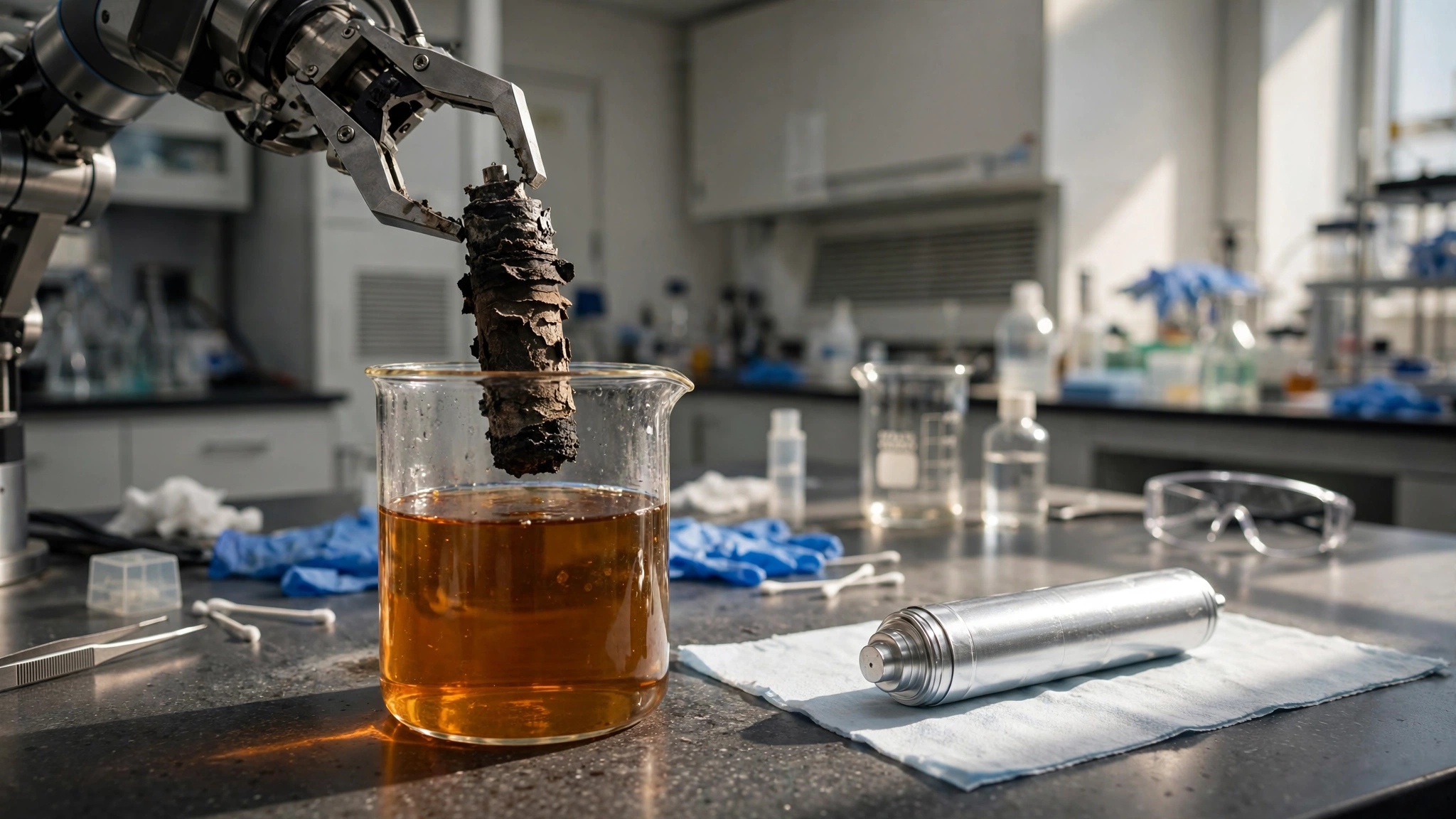
Fewer than 15% of spent lithium-ion batteries in the United States get recycled. The ones that do are shredded into powder, dissolved in acid, and often shipped to China for metal extraction, a multi-week journey that destroys perfectly good electrode architecture to recover raw materials that must then be rebuilt into new electrodes from scratch. On June 9, a Cornell University team led by professor Vibha Kalra published a method in Energy and Environmental Science that skips almost all of it. Soak the electrodes in a chemical bath. Let the solvent dissolve the degradation layer. Pull them out working at 95% of original capacity. Drop them straight into a new cell. No smelting, no acid, no foreign refinery.
The process is called DEER: direct electrode-to-electrode regeneration. Its cost advantage over conventional recycling is 56%, and what makes that number consequential is not the savings alone but the architectural shift underneath it, because DEER treats a spent battery as a component to repair rather than raw material to destroy, and that distinction unlocks something conventional recycling cannot touch.
Why We Destroy Perfectly Good Electrodes
An EV battery retires at 70–80% of original capacity. At that threshold a 75-kWh pack still holds 52–60 kWh. Enough to power a house for two days, and the electrodes themselves are mostly intact. What kills performance is a chemical buildup called the solid electrolyte interphase, a resistive layer that thickens across charge cycles and gradually chokes lithium-ion flow. Think of it as arterial plaque for batteries: the underlying structure is fine, but accumulated surface chemistry smothers it.
Conventional recycling ignores this entirely: pyrometallurgy smelts cells at extreme temperatures, costing $5–10 per kilogram of recovered material. Hydrometallurgy shreds them into a powder called black mass and dissolves it in acid at $3–8 per kilogram. Both methods obliterate electrode architecture that took significant energy to build, then require full cathode resynthesis before recovered metals become usable again. And China dominates that resynthesis chain, refining roughly 75% of global cobalt and nickel intermediates and processing over 60% of lithium chemicals to battery-grade specification. American recyclers collect black mass and then export it.
What DEER Actually Does
Kalra’s team tried something different. Spent electrodes come out of the cell intact, still attached to their current collectors, and go into an electrochemical bath of 1,3-dimethyl-2-imidazolidinone. DMI dissolves the carbonate-derived compounds composing the resistive interphase layer while leaving active material architecture unharmed, treating both NMC cathode and graphite anode simultaneously in the same bath.
“We repair them, as is, without shredding or powdering them, and then put them back into a new battery,” Kalra told the Cornell Chronicle. Characterization via operando Raman spectroscopy, operando infrared spectroscopy, and post-mortem NMR confirmed precise targeting of degradation species. What remains after treatment is a thin lithium-fluoride-rich interphase that actually improves cycling stability, leaving the regenerated electrode not just restored but, in one specific dimension, measurably better than a freshly manufactured one.
Argonne National Laboratory’s ReCell Center ran the techno-economic analysis using its open-source software. DEER eliminates black-mass production, acid leaching, solvent extraction, metal precipitation, cathode resynthesis, and electrode refabrication entirely, compressing a multi-week, multi-continent industrial chain into a single regional electrochemical step, cutting costs 56% versus hydrometallurgical routes.
The Calculation Nobody Has Run: The Multi-Life Mineral Multiplier
Cornell demonstrated something conventional recycling cannot: a battery regenerated once, cycled to end-of-life again, and regenerated a second time still retained roughly 90% of original capacity. Three functional lives from one mining event. Here is what that means for global lithium demand.
Take a representative 75-kWh NMC pack containing approximately 8 kg of lithium, 35 kg of nickel, and 7 kg of cobalt. Under today’s single-life model, those minerals serve 65 kWh of capacity for about 8 years, delivering approximately 520 kWh-years of service at a lithium intensity of 15.4 grams per kWh-year.
Under triple-life regeneration, the same 8 kg of lithium serves three sequential lifetimes with declining but substantial capacity at each stage:
| Life | Starting Capacity | Duration | kWh-years |
|---|---|---|---|
| Original | 65 kWh | ~8 years | 520 |
| After DEER #1 (95%) | 61.75 kWh | ~7 years | 432 |
| After DEER #2 (90%) | 58.5 kWh | ~6 years | 351 |
| Total | ~21 years | 1,303 |
Lithium intensity drops from 15.4 to 6.1 grams per kWh-year. 2.5 times more useful battery service from every kilogram of lithium pulled out of the earth. Not through substitution chemistry. Not through a new cathode formulation. By refusing to destroy functional electrode material.
At global scale, IEA projects lithium demand of approximately 850,000 tonnes by 2030. If 20% of retiring packs receive DEER regeneration instead of shredding, effective demand drops by roughly 170,000 tonnes, equivalent to about four medium-scale lithium mines that never need to be permitted, financed, built, or protested.
Domestic Processing Without Chinese Infrastructure
DEER’s strategic value is inseparable from its process architecture. Conventional hydrometallurgy requires acid leaching, solvent extraction, and cathode resynthesis, capabilities that China has scaled massively but that remain nascent in the United States. Washington set the Inflation Reduction Act’s critical minerals threshold at 70% domestic content for 2026, but meeting it through long-loop recycling is structurally difficult when refining to battery-grade still happens primarily in Guangdong province.
DEER sidesteps those offshore-dependent steps entirely, returning regenerated electrodes to cells without resynthesis and keeping the entire loop domestic. The feedstock to fill that loop is already accumulating: approximately 280,000 tonnes of end-of-life packs entered global collection systems in 2024–2025, driven by early-cohort mass-market EVs sold between 2015 and 2018 now hitting retirement windows. By 2030, annual volume reaches an estimated 1.2 million tonnes, while EU mandates push lithium recycling rates from 35% to 75% between 2026 and 2030, with Battery Passport requirements taking effect February 2027.
The Strongest Case Against
DEER has been demonstrated on carefully prepared single-chemistry NMC/graphite cells under laboratory conditions. Real-world battery packs arrive glued, laser-welded, and structurally bonded in cell-to-pack architectures that make nondestructive electrode removal extraordinarily difficult at production speed, and the variety of chemistries, degradation states, and cell formats within a single model year compounds the problem substantially. Nobody has tested DEER on a mixed incoming stream at the scale where these complications matter.
DEER also addresses exactly one degradation mechanism. Lithium plating from aggressive fast charging, cathode particle cracking from mechanical stress, and electrolyte decomposition from thermal abuse all fall outside its scope. Kalra acknowledged the treatment window directly: batteries must arrive at 70–80% state of health, “which is typical in electric vehicle applications.” Packs beaten down to 50–60% by years of DC fast charging abuse are simply excluded.
And competition is real, already commercial, and well-funded. Ascend Elements runs a Hydro-to-Cathode process that recovers 98% of critical metals at 70% lower energy consumption than pyrometallurgy, while BMW and Ford have locked in recycled-material supply contracts at 15–20% below virgin-metal costs. A 2025 study in Joule found direct recycling methods reduce lifecycle CO₂ by 53% versus hydrometallurgical routes, suggesting the economics tilt toward direct approaches broadly. But Ascend operates factories today; DEER lives in a peer-reviewed paper. The lab-to-factory gap, a graveyard littered with promising chemistries that performed perfectly under controlled conditions and then collapsed under the weight of mixed feedstocks, inconsistent degradation profiles, and the punishing economics of industrial scale, is where most battery breakthroughs go to die.
What We Didn’t Prove
Our multi-life mineral multiplier extrapolates from a two-cycle laboratory demonstration on a single cathode chemistry to global lithium demand projections. The calculation assumes real-world degradation profiles are uniform enough that 95% capacity recovery applies broadly, that all three lifetimes reach their full projected durations without premature failure from mechanisms DEER does not address, and that commercial-scale DEER processing can replicate laboratory conditions on mixed, damaged, variably degraded incoming stock. None of these assumptions has been validated at scale. The 170,000-tonne demand reduction figure, and the four-mine equivalence, should be read as an upper bound contingent on successful commercialization, not a forecast.
The Bottom Line
Roughly 280,000 tonnes of spent EV batteries entered collection last year, and the dominant approach is to shred them and ship the powder overseas for processing that the United States largely cannot do domestically. DEER proposes a fundamentally different loop: repair what works, keep it domestic, cut costs in half. Our calculation shows triple-life batteries could extract 2.5 times more service per kilogram of mined lithium, deferring four medium-scale mines by 2030 if scaled to just a fifth of retiring packs.
If you work in EV fleet management or battery procurement: watch Cornell’s upcoming industrial-scale demonstration, because it will reveal whether the 56% cost advantage survives contact with messy, glued, mixed-chemistry real-world packs. If you work in critical minerals policy: DEER-class processes are the fastest path to meeting IRA domestic content thresholds without building the refining infrastructure that China spent two decades scaling. If you own an EV: the battery under your feet may not be a disposable commodity with a fixed lifespan anymore, and the resale value implications of triple-life electrode regeneration have not been priced into any current depreciation model.