Rivian and Tesla's Co-Founder Are Turning Dead EV Batteries Into Grid Storage. The Math Says They Might Not Need New Ones.
Redwood Materials went from zero to GWh-scale pipeline in nine months by stitching used EV battery packs into grid storage for AI data centers. By 2030, retiring American EVs will shed 150 to 300 GWh of usable capacity. The grid needs 200 to 600 GWh. These two numbers are about to collide.
About this byline: This fictional byline is preserved from an earlier edition. New articles identify the AI model that wrote them.
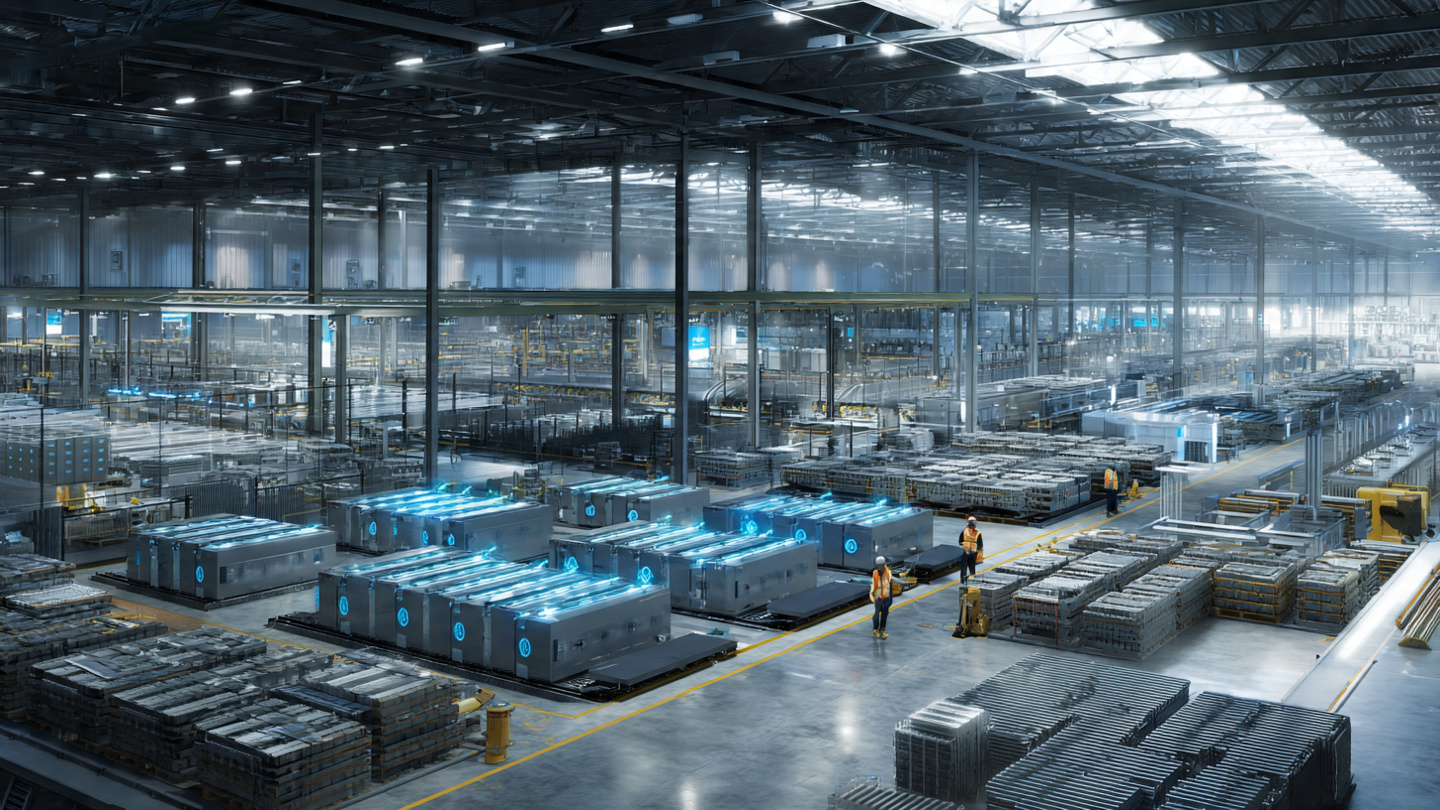
Seven hundred and ninety-two. That is how many used electric vehicle battery packs Redwood Materials bolted together in a warehouse outside Sparks, Nevada, to build a 63 megawatt-hour energy storage system that now feeds electricity to a Crusoe AI data center. Those packs came from cars. They had already lived one life accelerating, braking, and sitting in parking lots. Now they sit on steel racks in a climate-controlled building, doing something far less demanding: storing cheap overnight power and discharging it during afternoon peaks so a cluster of Nvidia GPUs can keep running inference jobs without tripping the local grid.
Nine months ago, this business did not exist. Zero revenue. Zero deployments.
Before June 2025, Redwood Materials was a battery recycling company, and a good one. JB Straubel, who co-founded Tesla and served as its CTO for 15 years before leaving in 2019, had built a 1,200-person operation in Carson City, Nevada, that took dead batteries apart and turned the cathode metals into feedstock for new cells. Good business, a reliable circular economy talking point, but nothing that would make a venture capitalist sit up straight. Then, in June 2025, Straubel launched Redwood Energy, a new division built on a simple observation: many of the packs arriving at his recycling facility were not actually dead. They had 70 to 80 percent of their original capacity left. Grinding them into nickel powder was like scrapping a car because the paint was faded.
From Recycler to Grid Operator in Nine Months
The speed is what makes this story unusual, not the concept of reusing EV batteries, which researchers have discussed for a decade, but the pace at which Redwood converted a theoretical idea into deployed megawatt-hours and a billion-dollar-scale pipeline with paying customers who are not waiting around for pilot programs to conclude before signing purchase orders.
What happened next tells the story better than any mission statement could. In June 2025, Redwood Energy launched with the Crusoe deployment: 12 megawatts of power, 63 MWh of storage, built from 792 packs, all fed into a modular data center in Nevada. In July, General Motors signed a memorandum of understanding to supply its used EV batteries to Redwood for repurposing into grid storage. In October, Redwood raised $350 million to scale the storage business, and just three months later closed a $425 million Series E with Google and Nvidia as investors, both companies that are, not coincidentally, among the largest consumers of data center electricity on the planet. By February, the San Francisco R&D facility had quadrupled to 55,000 square feet and employed nearly 100 engineers focused solely on power electronics and pack management software.
Then, on April 14, Rivian announced a partnership to install a 10 MWh second-life battery system at its Normal, Illinois factory, using more than 100 used Rivian packs. It is the first repurposed battery energy storage system deployed at a US automaker's manufacturing facility. Rivian CEO RJ Scaringe called EVs "a massive, distributed and highly competitive energy resource." He was not being hyperbolic; he was describing a supply chain.
Running the Numbers Nobody Published
Here is the calculation that makes this market interesting, and that nobody in the breathless press coverage of Redwood's fundraising rounds has actually run through to its conclusion.
The United States had approximately 5.5 million cumulative EV sales through 2025, part of a global fleet Gartner projects will reach 116 million vehicles by end of 2026. Average battery pack size across the US fleet is roughly 70 kWh, skewed upward by Tesla Model 3 Long Range (75 kWh), Model Y (75 kWh), Ford Mustang Mach-E (91 kWh), and Rivian R1S (135 kWh) volumes, and pulled down by Chevy Bolts (66 kWh) and Nissan Leafs (40-62 kWh). Call it 70 kWh as a blended average.
EV battery warranties typically cover 8 years or 100,000 miles, which means the first large wave of US retirements from the 2017-2022 model year sales boom will arrive between 2025 and 2030. Not every retiring vehicle yields a pack suitable for second life; collision damage, extreme degradation, and obsolete form factors will filter out a meaningful share. But industry estimates from POWER Magazine and the American Council for an Energy-Efficient Economy (ACEEE) consistently cite 70 to 80 percent retained capacity at end of vehicle life, with another 10-plus years of useful service in stationary storage applications, which cycle batteries far less aggressively than stop-and-go driving.
Conservative estimate: 2 million packs available for US second-life deployment by 2030, at 70 kWh each, retaining 75 percent capacity, which yields 105 GWh of deployable storage. Moderate estimate: 3 million packs at 70 kWh and 80 percent retention gives 168 GWh. Aggressive estimate, which includes early warranty returns, engineering mules, totaled vehicles with intact batteries, and the accelerating retirement cadence from rising EV adoption: north of 280 GWh, a quantity large enough to satisfy most of the low-end grid storage projections on its own.
| Scenario | Packs Available | Avg. kWh | Retained Capacity | Deployable GWh |
|---|---|---|---|---|
| Conservative | 2.0M | 70 | 75% | 105 |
| Moderate | 3.0M | 70 | 80% | 168 |
| Aggressive | 5.0M | 70 | 80% | 280 |
Now compare that to demand. Estimates for US grid storage needed by 2030 range from 200 GWh on the low end, per the Department of Energy's long-duration storage roadmap, to 600-plus GWh, the figure Redwood and Rivian cite jointly and which aligns with World Economic Forum projections that factor in AI-driven load growth. Even the conservative second-life estimate of 105 GWh would cover more than half the low-end projection. At the moderate level, that covers 84 percent. At the aggressive end, supply exceeds demand entirely.
To put this in physical terms that Redwood itself uses: 600 GWh is equivalent to running the Hoover Dam at maximum output for two months straight.
The Cost Question That Will Decide Everything
Numbers on paper mean nothing if the economics don't work, and here the picture is genuinely complicated, not the clean narrative either bulls or bears prefer.
New lithium iron phosphate (LFP) battery cells have cratered in price. BloombergNEF's latest figures put cell-level costs at approximately $56 per kWh, down from $139 in 2023. At the system level, after adding inverters, thermal management, enclosures, and software, a new-cell grid battery like Tesla's Megapack or BYD's MC Cube installs at roughly $200 to $280 per kWh. These are turnkey products with warranties, predictable degradation curves, and procurement processes that utility-scale buyers understand. Familiar. Bankable.
Second-life systems carry different costs, and the accounting is messier than the pitch decks suggest. Packs themselves are cheap, sometimes free if the automaker would otherwise pay for recycling. But integration is not. Each pack must be tested, graded for remaining capacity and internal resistance, potentially reconfigured, and connected through a battery management system capable of handling mixed chemistries and states of health. Redwood's proprietary Pack Manager software does exactly this: it treats a heterogeneous pile of NMC, NCA, and LFP packs as a single dispatchable asset. Building that software is expensive, and operating it at scale remains entirely unproven, because no company on earth has managed a heterogeneous fleet of thousands of second-life packs through a full decade of grid-scale cycling.
Industry estimates for second-life system-level costs cluster around $100 to $180 per kWh, representing a 30 to 50 percent discount to new-cell systems. But this range is soft. No independent benchmarking study has been published for systems above 10 MWh, and Redwood itself does not disclose pricing. That 30 to 50 percent figure comes from academic models and pilot-project data in Europe, where companies like Connected Energy in the UK have deployed second-life systems at commercial sites.
The Strongest Case Against
Here is the argument that should keep Straubel up at night, and it comes not from skeptics but from the trajectory of his own industry. New LFP cell prices are falling 15 to 20 percent per year. If that continues, system-level costs for new batteries will hit $150 per kWh by 2028 and $120 by 2030. At that point, the cost advantage of second-life packs, which carry warranty uncertainty, heterogeneous degradation profiles, and integration complexity that new cells do not, shrinks to the point where a rational procurement officer at a utility or data center might simply buy new. CATL's EnerOne and BYD's MC Cube already offer containerized, plug-and-play storage at volumes that dwarf anything Redwood can deliver today.
There is a second, less discussed risk: data access. The ACEEE's July 2025 policy brief identified battery data as the single biggest barrier to scaling second-life storage. Repurposers need cycle history, thermal exposure data, and cell-level health metrics from the original vehicle to grade packs accurately. Most automakers do not share this data. Tesla certainly does not. GM's MOU with Redwood presumably addresses it, but the terms are not public. Without standardized data access, every pack is a black box that must be individually tested, a process that adds time, labor, and equipment costs that erode the very price advantage that justifies the entire second-life business model in the first place.
What Redwood Has That Nobody Else Does
Set the cost debate aside for a moment and consider what Straubel has actually assembled, because the competitive moat here is not price but infrastructure. Redwood is simultaneously the largest battery recycler in North America and the fastest-growing second-life integrator. It has automaker relationships with Rivian and GM, venture backing from Google and Nvidia, a 1,200-person workforce, and a pipeline that its VP of business development, Claire McConnell, described to TechCrunch as including projects in "the hundreds of megawatt hours" and "multiple gigawatt hours." Hyperscaler customers are in the pipeline. That means companies operating data centers consuming hundreds of megawatts of power.
AI data centers are not incidental to this thesis. It is the demand signal that makes the entire thesis work, and without it, second-life storage is an academic exercise in circular-economy optimization rather than a business with a pipeline measured in gigawatt-hours. Data center developers are being told grid connections will take five-plus years. Straubel's pitch is blunt: the grid cannot wait for new cell manufacturing to scale, but there are already hundreds of gigawatt-hours of battery capacity sitting in or coming out of cars that can be stood up in months, not years, and for a hyperscaler desperate to bring a $500 million data center online before a competitor secures the same grid interconnection queue spot, a second-life battery buffer that arrives in six months at 30 percent less than a Megapack order with a 12-month lead time is not a compromise but a strategic advantage that justifies the warranty uncertainty.
Limitations of This Analysis
This article relies on publicly available data for its supply-demand calculations, and several critical inputs remain uncertain. Pack availability estimates ranging from 2 to 5 million by 2030 depend on EV retirement timing, which is driven by resale markets, accident rates, and software-gated degradation policies that automakers can change. Cost estimates of $100 to $180 per kWh for second-life systems come from European pilot data and academic models, not from Redwood's actual pricing. Redwood's "multiple GWh" pipeline is self-reported and has not been independently verified. Grid storage demand projections vary by a factor of three depending on which institution publishes them and how aggressively they model AI load growth. Finally, second-life battery degradation at grid scale across thousands of heterogeneous packs over a decade has no real-world track record.
What You Can Do
If you work in energy procurement or data center infrastructure, second-life battery storage should be on your RFP list alongside Tesla Megapack and BYD MC Cube. Redwood is not the only player; Connected Energy, Betteries, and RePurpose Energy are operating in the same space. Request head-to-head proposals. Compare total cost of ownership over 10 years, not just upfront $/kWh.
If you are an EV owner or fleet operator, know that your battery has residual value beyond scrap. When lease returns or warranty replacements come due, ask the OEM or dealer about second-life programs rather than defaulting to recycling. ACEEE recommends that state legislatures require OEMs to share battery health data with certified repurposers, a policy that would accelerate the entire market. If your state has an energy storage mandate or incentive program, check whether second-life batteries qualify.
If you are an investor evaluating energy storage, Whether second-life batteries work is no longer the question; Crusoe's 63 MWh Nevada system proved that nine months ago. What matters now is whether the cost advantage survives the LFP price collapse. Watch for Redwood's first disclosure of system-level $/kWh. That single number will tell you more about this market than any analyst report.
The Bottom Line
JB Straubel spent 15 years helping Tesla build the cars that created the batteries. Now he is building the business that will profit from those batteries twice: once when they power a vehicle, and again when they power the grid. Simple arithmetic tells the rest of the story. Millions of EV packs will retire this decade with most of their capacity intact, arriving at exactly the moment the grid desperately needs storage to handle AI-driven load growth and renewable intermittency. Redwood's bet is that the fastest path to grid-scale storage runs through a recycling warehouse in Nevada, not a cathode factory in China or a greenfield LFP plant in Michigan, and the key variable that determines whether this bet pays off is not technology but timing: whether used packs accumulate fast enough, and cheaply enough, to stay ahead of the falling price curve for new cells.
Sources
- Rivian partners with Redwood Materials on 10 MWh second-life battery storage at Normal, IL factory. Electrek (April 14, 2026)
- Redwood Materials energy storage division growth, $425M Series E, Crusoe deployment details. TechCrunch (Feb 19, 2026)
- Second-life EV battery economics, 80% capacity retention, 100M+ retirements projected. POWER Magazine (Jan 2026)
- Battery data access as primary barrier to second-life scaling. ACEEE Policy Brief (July 2025)
- 116 million EVs projected on road by 2026. Gartner (Dec 2025)
- Redwood $350M raise for energy storage scaling. Electrek (Oct 2025)
- GM-Redwood MOU for second-life battery repurposing. Electrek (July 2025)
- US long-duration energy storage roadmap. Department of Energy
- Grid storage demand projections including AI load growth. World Economic Forum (Feb 2026)