SK Hynix Hit 72% Operating Margin. Nvidia Hit 65%. Apple Hit 35%. Then SK Hynix Walked Away from AI's Hottest Chip.
The world's second-largest memory chipmaker just posted the highest operating margin in the semiconductor industry's history, beating every major tech company on profitability. Then it announced it was delaying its next-generation AI memory ramp to make more commodity DDR5, because boring desktop RAM now generates 2.8 times the profit per wafer. The golden cross nobody expected.
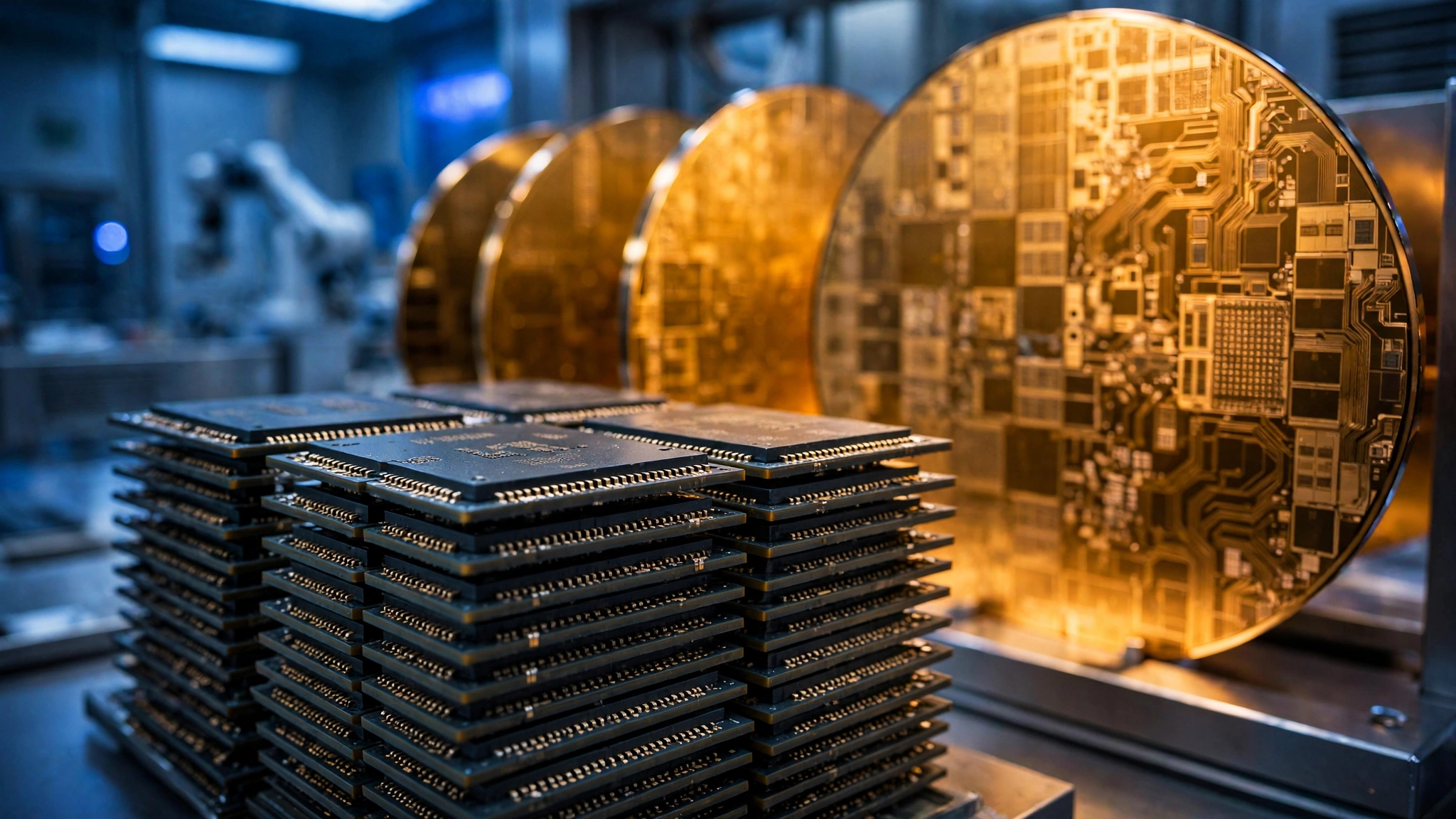
Seventy-two percent. That was SK Hynix's operating margin for the first quarter of 2026: 37.61 trillion won in operating profit on 52.58 trillion won in revenue. That figure is operating margin, not gross, calculated after research costs, manufacturing overhead, and depreciation are fully deducted, and it is the highest operating margin ever recorded by a semiconductor manufacturer, and it belongs to a company that makes memory chips, which until about 18 months ago traded as a cyclical commodity.
Here is what the rest of tech looked like during the same window:
| Company | Quarter | Revenue | Operating Margin |
|---|---|---|---|
| SK Hynix | Q1 2026 | $35.5B | 72% |
| Nvidia | Q1 FY2027 | $81.6B | ~65% |
| TSMC | Q1 2026 | $25.5B | ~48% |
| Microsoft | Q3 FY2026 | $82.9B | ~44% |
| Alphabet | Q1 2026 | $109.9B | 36% |
| Apple | Q1 FY2026 | $143.8B | 35% |
A company that stamps out memory dies is keeping 72 cents of every revenue dollar after operating costs, while Apple keeps 35 cents, Google keeps 36, and even Nvidia, the architect of the AI boom itself, retains only 65.
The Self-Reinforcing Shortage
SK Hynix's margin exists because of a supply dynamic it accidentally engineered. Critically, the company dominates high-bandwidth memory, holding 57 to 62 percent of the global HBM market, and HBM is architecturally different from conventional DRAM: each stack bonds eight to twelve vertically connected dies using through-silicon vias, and the entire assembly is packaged directly onto the GPU die. Critically, producing one gigabyte of HBM consumes roughly three times the silicon wafer area required for one gigabyte of conventional DDR5. Every wafer that SK Hynix, Samsung, and Micron redirected toward HBM through 2024 and 2025 pulled three equivalent wafers out of the DDR5 supply chain.
The resulting shortage was both violent and immediate: TrendForce reported that conventional DRAM contract prices surged 90 to 95 percent quarter-over-quarter in Q1 2026, with PC DRAM roughly doubling. A second wave hit in Q2: prices climbed another 58 to 63 percent on top of the Q1 surge. DDR5 memory kits that retailed for under $100 in early 2025 now regularly exceed $300, and enterprise server modules have tracked proportionally. IDC warns that the shortage is not expected to ease until early 2028, because meaningful new fab capacity from SK Hynix's M15X facility and Micron's Idaho plant will not come online before mid-2027.
The Golden Cross: DDR5 Per-Wafer Profit Surpasses HBM
On June 23, SK Hynix made a decision that looked irrational on the surface: it announced it was delaying the conversion of some HBM3E production lines that had been scheduled to transition to sixth-generation HBM4. Instead of upgrading those lines, SK Hynix is retooling them for DDR5 conventional DRAM. SK Hynix also locked in a three-year DDR5 supply agreement with Microsoft.
Cold arithmetic drove this apparently counterintuitive move: DDR5 operating margins are now projected by analysts to approach 90 percent, and while HBM commands a higher price per gigabyte, DDR5 yields three times the gigabytes per unit of wafer area. When you multiply volume by margin, DDR5 wins on every square millimeter of scarce silicon.
Here is the calculation nobody published, comparing profit per equivalent unit of wafer area:
| Metric | HBM3E | DDR5 |
|---|---|---|
| GB per wafer-area unit | 1× | 3× |
| Contract price per GB | ~$15 | ~$10 |
| Revenue per wafer-area unit | $15 | $30 |
| Operating margin | ~65% | ~90% |
| Profit per wafer-area unit | $9.75 | $27.00 |
DDR5 generates 2.77 times the operating profit per unit of fab capacity, and that is the golden cross: the moment commodity DRAM profit per wafer surpassed the exotic AI memory that created the shortage in the first place. SK Hynix did not retreat from AI; it recognized that its HBM dominance had accidentally created a more profitable product next door, and it walked through the door.
Samsung Sees the Opening
SK Hynix's measured HBM4 approach handed Samsung an opportunity it seized immediately. Samsung began mass production of sixth-generation HBM4 in February 2026 and crossed $1 billion in cumulative HBM4 revenue by June. Its customer list includes Nvidia, AMD, Google, Amazon, Microsoft, Meta, and Broadcom. Goldman Sachs still estimates SK Hynix will supply 60 to 70 percent of HBM4 volume for Nvidia's Rubin platform, but Samsung is chipping at the lead while SK Hynix harvests DDR5 profits. Morgan Stanley noted that the primary earnings driver this cycle is overall memory price appreciation across all categories, not HBM market share battles, which validates SK Hynix's DDR5 pivot as strategically coherent.
Strongest Counterargument
The best case against this framing: DDR5's 90% margin is a transient spike in a violently cyclical commodity market, not a structural equilibrium. SK Hynix's operating margin was negative 14% in Q1 2023, and the DRAM contract price surge of 90 to 95 percent in a single quarter is historically unprecedented, which means unprecedented moves revert. When M15X, Micron Idaho, and Samsung's Pyeongtaek P5 come online in 2027-2028, DDR5 supply will normalize, margins will compress, and SK Hynix's golden cross will collapse. HBM, by contrast, has structural pricing power because it is architecturally locked into each GPU design and cannot be substituted after manufacturing. The company that sacrificed HBM4 position for two years of DDR5 windfall may find it surrendered the franchise, and Samsung's $1 billion HBM4 head start is not a rounding error.
Limitations
This analysis has several gaps. SK Hynix does not disclose segment-level margins for HBM versus conventional DRAM, so the 65% HBM margin and 90% DDR5 margin used in the per-wafer calculation are analyst projections from TrendForce and industry sources cited by Chosun Biz, not confirmed company figures. The 3× wafer-area ratio is a widely cited industry approximation based on HBM3E's 8-high stack architecture; HBM4's 12-high or 16-high stacks could shift this ratio. Per-gigabyte contract pricing varies significantly by customer, volume, and module type; the $10/GB and $15/GB figures represent reported midpoints, not precise transaction prices. Finally, the comparison table uses the closest available quarter for each company, not perfectly overlapping calendar periods.
The Bottom Line
The narrative everyone tells about AI infrastructure goes: exotic chips are the bottleneck, and whoever controls the exotic supply controls the economics. SK Hynix's golden cross inverts that story, because the real bottleneck is not HBM availability but total silicon wafer capacity, and the most profitable use of that capacity right now is the boring product that goes in every server, laptop, and phone on earth. If you are building or budgeting AI server infrastructure through 2027, plan for DDR5 module costs 2 to 3 times higher than 2024 levels and lock in supply agreements now, before the second wave of Q2 pricing fully propagates. If you hold semiconductor equities, the signal is that memory pricing has decoupled from its historical cycle for at least 18 months, and the company that recognizes this fastest will capture the most value. SK Hynix recognized it in June, and the rest of the market is still catching up.