China Beamed 1,180 Watts Over 100 Meters. Orbit Is 358,000× Farther.
Xidian University's Zhuri project wirelessly transmitted 1,180 watts of microwave power at 20.8% DC-to-DC efficiency and powered a drone in flight — genuine progress on the hardest unsolved problem in clean energy. But an original beam-physics analysis reveals the chasm between a 100-meter ground demo and a geostationary power station 35,800 kilometers overhead.
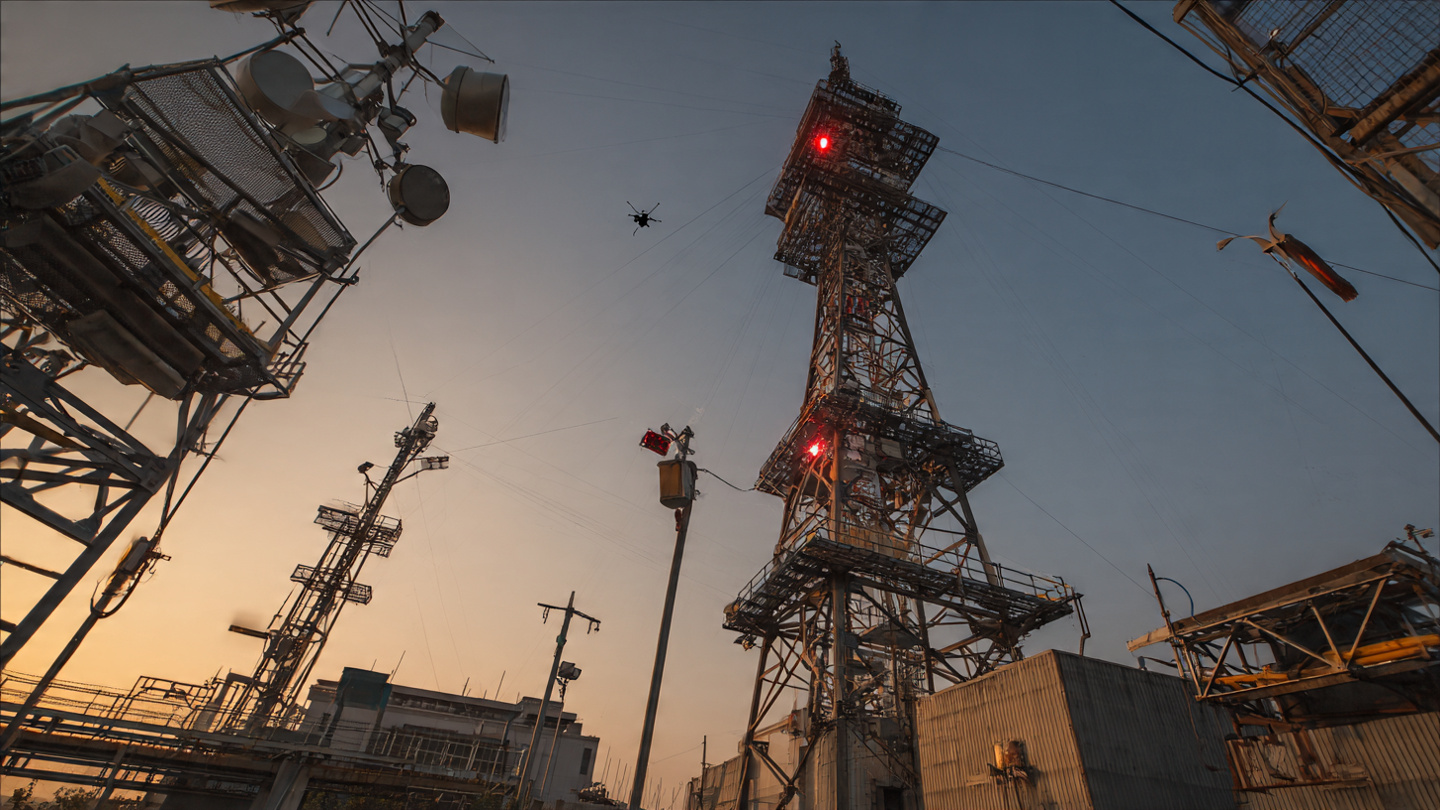
Three hundred fifty-eight thousand. That is the ratio between the distance China just beamed electricity through the air and the distance required from geostationary orbit to the ground — a number that captures both why the Zhuri project's latest results matter and why space-based solar power remains decades from delivering a single commercial kilowatt-hour.
The Xi'an numbers are real and they are impressive. Researchers at Xidian University, working atop a 75-meter steel tower as part of China's "Chasing the Sun" program led by Duan Baoyan of the Chinese Academy of Engineering, transmitted 1,180 watts of microwave power over distances exceeding 100 meters with 20.8% DC-to-DC efficiency and 88% beam collection efficiency. Separately, the system powered a drone flying at 30 kph with 143 watts from about 30 meters away — proving microwave energy transfer can track moving targets in real time.
No one else has done this. Not at this power level, not with this beam discipline, not to a moving object. It matters.
But here is what the headlines omit: the 20.8% efficiency figure measures one step in a six-step conversion chain, and the math of scaling from 100 meters to geostationary orbit doesn't break at one fixable bottleneck. It breaks everywhere.
The Efficiency Chain Nobody Publishes
Space solar requires converting sunlight to DC, DC to microwaves, microwaves to a beam surviving 35,800 kilometers of travel, then back to grid-ready AC. Each step hemorrhages energy. We calculated the full chain using Zhuri's figures alongside IEEE Spectrum's analysis and NASA's 2024 feasibility study:
| Conversion Step | Best Efficiency | Cumulative |
|---|---|---|
| Sunlight → DC (multi-junction cells) | 32% | 32.0% |
| DC → microwave | 80% | 25.6% |
| Atmospheric transmission | 90% | 23.0% |
| Beam collection at rectenna | 85% | 19.6% |
| Rectenna → DC | 85% | 16.6% |
| DC → grid AC | 95% | 15.8% |
Fifteen point eight percent under optimistic assumptions using best laboratory values at every step. Eighty-four out of every 100 watts collected in orbit never reach the grid. Henri Barde, former head of ESA's space power systems, puts the realistic figure at around 11% — meaning a satellite collecting 9 GW in space delivers roughly 1 GW below. Zhuri's 20.8% measures only the wireless hop itself, at a distance 358,000 times shorter than the target.
The Distance Problem Is Physics
Microwaves obey diffraction. At 5.8 GHz — the frequency Zhuri uses — a beam from GEO spreads relentlessly, and Thales Alenia Space estimated for ESA that the transmitter must be at least 750 meters wide to concentrate even the beam's bright center onto a feasible receiver field. That field still covers an ellipse exceeding 34 square kilometers. Zhuri's 88% beam collection at 100 meters, where diffraction is negligible, cannot survive the jump to 35,800 kilometers — it doesn't gradually degrade with distance, it collapses as energy density drops with the inverse square.
The team's answer is their Distributed OMEGA architecture: modular components assembled robotically in orbit to build that 750-meter transmitter, like snapping together a microwave antenna the size of nine football fields while traveling at 11,000 kph. Nobody has assembled anything remotely this large in space. The International Space Station, humanity's biggest orbital structure, spans 109 meters.
What $276 Billion Buys
NASA priced the first 2 GW orbital station at $276 billion, with 71% consumed by launch alone assuming Starship at $1,000/kg. For context: that sum purchases 276 GW of ground solar at current US utility-scale pricing of ~$1.00/watt, generating roughly 460 TWh annually at 19% capacity factor versus the orbital station's 17.5 TWh. Ground solar: 26 times more energy, same money, no cosmic radiation, no orbital debris.
China's roadmap tells a timeline story instead: a 10 kW LEO test in 2028, 1 MW from GEO in 2030 with on-orbit assembly, 10 MW by 2035, and the full 2 GW station by 2050 — 24 years from now.
Strongest Counterargument
Space solar doesn't have to beat Arizona ground solar. It delivers power at a 99.7% capacity factor — effectively baseload — while ground solar manages 19% in the American Southwest and 9% in northern Europe, dropping to zero at night. A London Economics study for ESA valued space solar's European energy security contribution at €180 billion by 2050 precisely because Britain has lousy sun and expensive storage. The military case may matter more: powering forward bases and surveillance drones without fuel convoys makes cost-per-watt irrelevant when the alternative is the Pentagon's fully burdened fuel cost of $400 per gallon in contested supply chains. China's dual-use framing — civilian clean energy wrapped around military power projection — is deliberate, and dismissing Zhuri as uneconomic may miss the point entirely.
Limitations
Our efficiency chain uses best laboratory values; real-world degradation from thermal stress, radiation damage to solar cells (1–2% per year in GEO), and pointing errors would reduce the 15.8% figure. The ground solar comparison uses US average costs; Chinese installations run 40% cheaper, widening the gap. We did not model baseload availability premiums or grid integration costs for intermittent renewables, which would improve space solar's relative economics — PyPSA-Eur modeling suggests space solar becomes competitive when battery storage exceeds $150/kWh and seasonal storage is needed. Zhuri's 20.8% figure comes from state media; independent peer review is pending.
What You Can Do
If you evaluate space solar startups — Space Solar, Solaren, Virtus Solis — demand end-to-end efficiency projections with every conversion step itemized, not just the wireless hop. A company quoting 20% without specifying which link is either confused or hoping you are. Ask for rectenna land-use in km² per GW and compare it to ground solar's 20–40 km²/GW, because the receiver field may negate the "no land use" argument.
If you make energy policy for northern latitudes, watch the 2028 LEO test. If China beams even partial power from 400 km, the technology moves from "physics demonstration" to "engineering program" — and the question shifts from "does it work" to "who controls it," because an orbital energy network operated by a single nation creates a dependency that makes gas pipelines look diversified.
The Bottom Line
China built the most capable wireless power transmission system ever demonstrated on Earth, and the honest assessment is that it proves the concept works at tower-height distances while exposing exactly how far the technology must travel — 358,000 times farther, through an efficiency chain that bleeds away 85% of collected sunlight, into receiver fields the size of cities, at a cost that buys 26 times more energy on the ground. Duan Baoyan's team has earned the credibility to attempt the 2028 LEO test, but the gap between 100 meters and 35,800 kilometers is not a scaling challenge. It is the challenge.