🤖 Robotics
China Deployed 87% of the World's New Autonomous Mining Trucks Last Year. Most of Them Dig Coal.
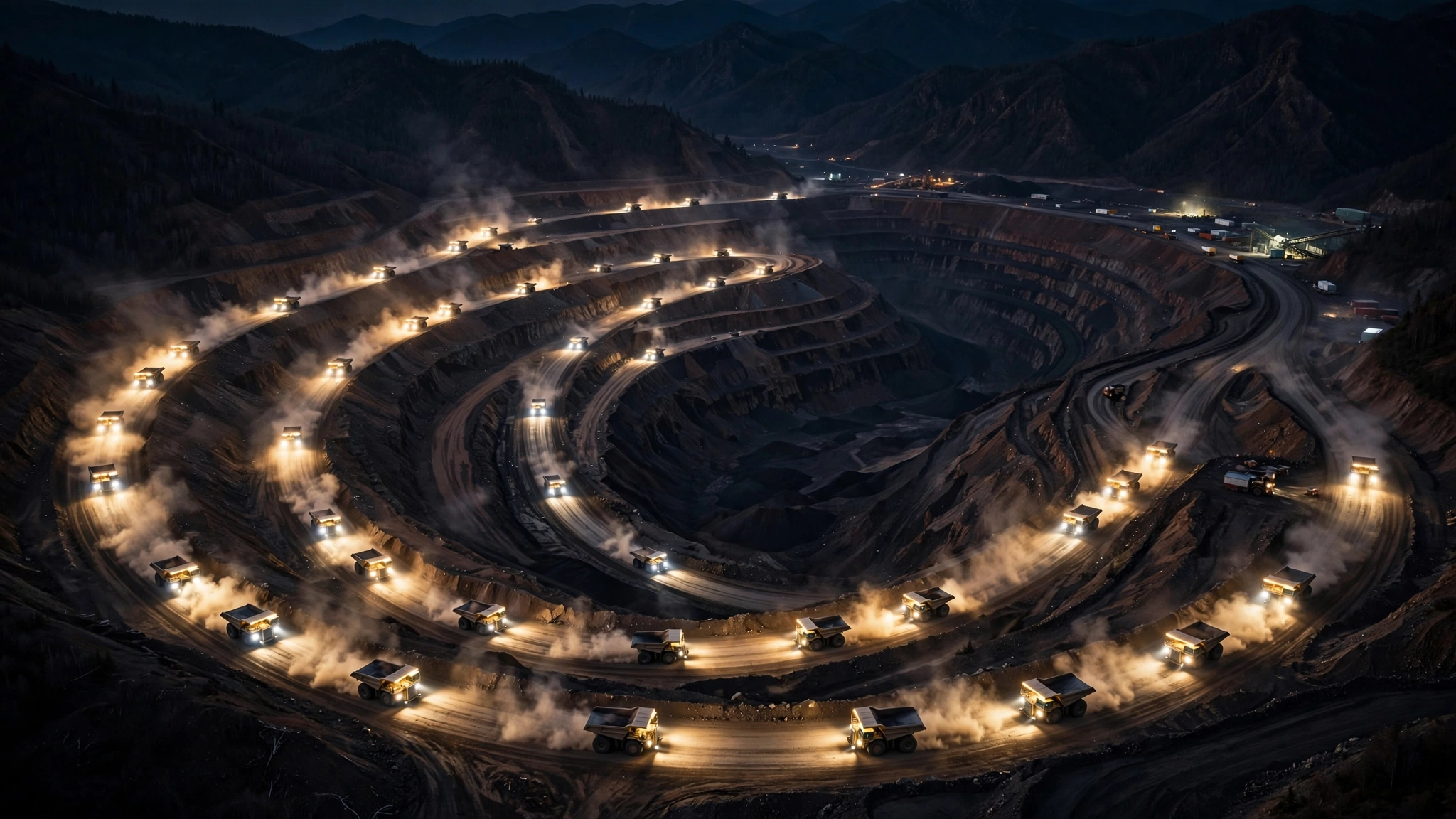
The global autonomous mining truck fleet jumped 84% to 3,832 in twelve months. China added 1,528 of the 1,752 new deployments, vaulting past Australia to run the world's largest robot mining operation. The machines are brilliant. What they're mining is the problem.
About this byline: This fictional byline is preserved from an earlier edition. New articles identify the AI model that wrote them.
Between July 2024 and July 2025, China added 1,528 autonomous haul trucks to its surface mines. Every other country on Earth, combined, managed 224.
That matters.
That single number, buried in a GlobalData Mining Intelligence Center report tracking fleet additions across dozens of mining jurisdictions worldwide, rewrites three narratives at once. It means China now operates 2,090 autonomous trucks, more than double Australia's 1,024. It means the global fleet of self-driving mining trucks hit 3,832, up 84% from 2,080 the year prior. And it means the most aggressive deployment of autonomous heavy equipment in history is digging up the one fossil fuel the planet is supposed to be phasing out.
The Numbers Nobody Combined
We pulled the country-level fleet data from GlobalData's July 2025 tracker and cross-referenced it with the prior year to calculate each nation's share of new deployments.
| Country | July 2024 | July 2025 | Added | Share of New |
|---|---|---|---|---|
| China | 562 | 2,090 | +1,528 | 87.2% |
| Australia | 927 | 1,024 | +97 | 5.5% |
| Canada | ~250 | 344 | ~+94 | 5.4% |
| Chile | ~185 | 208 | ~+23 | 1.3% |
| Rest of world | ~156 | 166 | ~+10 | 0.6% |
| Global | 2,080 | 3,832 | +1,752 | 100% |
China didn't just lead the growth; China, by every measure that matters to the global mining equipment market, was the growth.
Who's Driving the Trucks (Nobody Is)
Three Chinese operators now rank among the top four autonomous mining fleets on Earth. CHN ENERGY Investment Group runs 509 autonomous trucks, more than BHP (360) and Rio Tinto (305) combined, while Guanghui Energy operates 420 at sites including the Baishihu Coal Mine, which at 420 autonomous trucks constitutes the single largest autonomous mining site by fleet size anywhere on the planet.
Caterpillar and Komatsu still dominate the OEM landscape globally, but Chinese manufacturers Tonly and LGMG now hold third and fourth place, and together the four companies account for 88% of all tracked autonomous trucks. Komatsu crossed the 1,000-truck milestone with its FrontRunner deployment at Barrick's Nevada Gold Mines, where 300-tonne and 230-tonne trucks are being converted. Caterpillar, with roughly 690 autonomous trucks deployed, has publicly targeted 2,000 by 2030.
Those are serious numbers, and they are dwarfed by China's pace.
The Coal Paradox: Doing the Math
Here is where the story turns uncomfortable, because the owners of these fleets are not copper miners or lithium extractors or iron ore companies chasing the energy transition, but state-owned coal conglomerates scaling up production of the one fossil fuel that every major emissions treaty on Earth has agreed must be phased down. CHN ENERGY is a state-owned coal and power conglomerate that burns what it mines. Guanghui Energy is a coal and LNG company. Baishihu is a coal mine. The South open-pit coal mine, which operates more than 200 autonomous trucks, mines coal. The Yimin coal mine, planning to expand to 300 autonomous trucks within three years, also mines coal.
We estimated the coal extraction enabled by China's autonomous fleet using conservative throughput assumptions. Industry benchmarks from Pilbara iron ore operations show autonomous ultra-class trucks moving 4.2 to 4.8 million tonnes per truck per year. Chinese coal operations generally use smaller trucks at shallower depths, and we applied a conservative 2.5 million tonnes per truck per year.
At 2,090 trucks, predominantly in coal, that implies roughly 5.2 billion tonnes of material moved annually by autonomous trucks in Chinese coal mines alone. Even if only 40% of that material is saleable coal rather than overburden, the autonomous fleet is enabling the extraction of approximately 2.1 billion tonnes of coal per year. For reference, China's total coal production in 2025 was approximately 4.7 billion tonnes. The autonomous fleet, which barely existed two years ago, is already touching a significant fraction of national output.
This matters because the economics of autonomy make marginal deposits viable, and the cost differential between manual and autonomous fleets is not marginal at all.
| Cost Category | Manual Fleet ($/tonne) | Autonomous Fleet ($/tonne) | Change |
|---|---|---|---|
| Labor (drivers/ops) | $0.85 | $0.18 | -79% |
| Fuel / energy | $1.10 | $0.94 | -15% |
| Maintenance & tires | $0.65 | $0.52 | -20% |
| Tech/systems support | $0.05 | $0.15 | +200% |
| Total variable | $2.65 | $1.79 | -32% |
Source: Skillings Mining Intelligence, compiled from OEM aggregate data and 2026 benchmarks for ultra-class fleets. Chinese operations using smaller trucks likely see somewhat lower absolute costs but comparable percentage reductions.
A 32% reduction in variable haulage costs means coal seams that were unprofitable at $55 per tonne become viable at $37, which in turn means autonomous trucks do not just cut costs at existing mines but expand the geological boundary of what counts as a mine in the first place, turning marginal deposits into balance-sheet assets overnight.
The West's Different Bet
While China automates coal, the rest of the world is automating metals the energy transition requires and electrifying the trucks themselves.
Fortescue signed a $2.8 billion deal with Liebherr for 360 autonomous battery-electric haul trucks, 55 electric excavators, and 60 electric dozers for its Pilbara iron ore operations, all targeting deployment by 2030. In May 2026, the first production battery system was integrated into a Liebherr T 264, a 240-tonne truck that will charge from a 6-megawatt charger in 30 minutes, running with no diesel, no operator, and zero emissions at the point of extraction.
Vale in Brazil is scaling from 14 to approximately 90 autonomous trucks across its Carajás iron ore operations, using a novel interchangeable-kit approach where Caterpillar autonomous systems retrofit onto Komatsu truck bodies. That cross-brand compatibility, once unthinkable, reduces the capital expenditure barrier by eliminating the need to replace an existing fleet.
A Pronto-Whittle Consulting study added another dimension: autonomous 40-tonne trucks deliver 31% greater net present value than manually operated 100-tonne trucks, because autonomy reduces downtime to 5% of availability versus 20% for human-operated trucks. Smaller autonomous trucks mean narrower benches, steeper pit walls, less waste rock, and more ore per cubic meter of disturbed earth. The traditional mining logic that bigger equals cheaper inverts when the operator cost drops to near zero.
16,100 Operators Displaced, and Counting
Each autonomous haul truck eliminates roughly 4.2 operator positions: three shifts per day plus a coverage factor for leave, training, and absenteeism, which means the global fleet of 3,832 trucks has displaced approximately 16,100 mining truck operators whose jobs no longer exist in their traditional form, a figure that will climb to roughly 21,000 by 2030 when GlobalData projects the fleet approaching 5,000 trucks.
Even that understates the real displacement, because autonomous trucks also run 20.5 to 22.0 hours per day versus 16.5 to 18.5 for human-operated trucks, meaning each robot truck does the work of roughly 1.2 human-operated trucks, pushing the effective displacement closer to 19,300 operator-equivalent positions.
Mining companies counter that autonomy creates new roles: control room technicians, AHS engineers, data analysts, and this is true insofar as Barrick reported that its Nevada Gold Mines deployment transitioned operators into higher-skilled technical positions. But the replacement ratio is unfavorable: industry estimates suggest one control room technician oversees 8 to 12 autonomous trucks, meaning the 16,100 eliminated operator positions are replaced by roughly 1,600 to 2,000 technical roles. Net reduction across the industry is on the order of 14,000 positions globally.
By 2030, GlobalData projects the fleet approaching 5,000 trucks, implying roughly 21,000 operator positions eliminated and still accelerating.
Limitations
Several caveats apply to our calculations. The "autonomous" category tracked by GlobalData includes trucks that are "autonomous-ready" alongside those actually running autonomously, which inflates the active fleet count. We could not determine what fraction of China's 2,090 trucks are fully operational versus in commissioning. The cost-per-tonne benchmarks from Skillings are derived primarily from Pilbara and Nevada ultra-class operations and may not translate directly to Chinese coal mines using smaller, lower-cost equipment. Our coal extraction estimate uses a conservative 2.5 million tonnes per truck per year, but actual throughput varies enormously by haul distance, pit depth, and truck class. China's total coal production figure includes underground mines, which are not candidates for truck autonomy.
The Strongest Counterargument
The strongest case against alarm is that China's coal consumption is plateauing regardless of extraction costs, and cheaper extraction simply allows China to close less efficient mines faster rather than expanding total output. China's coal production has been essentially flat at 4.6 to 4.8 billion tonnes since 2023, and Beijing's stated goal is peak carbon emissions before 2030 with carbon neutrality by 2060. Under this interpretation, autonomous trucks are a productivity tool for an industry that is already sizing itself down, not a growth enabler. Marginal deposits made viable by autonomy may never be developed if demand is already saturating.
The counterpoint to the counterpoint: China's coal production has been "plateauing" at record highs. Every single year since 2021, production has set a new all-time record, with the annual increment growing rather than shrinking as the 2060 neutrality target approaches. "Plateau" is doing heroic rhetorical work in that sentence.
What You Can Do
If you're an investor: The autonomous mining truck market is no longer a Cat-vs-Komatsu duopoly. Chinese OEMs Tonly and LGMG are growing share rapidly and will likely offer autonomous kits at significantly lower price points for export markets within three years. Watch for Pronto AI's partnership with Heidelberg Materials, which is deploying autonomous haulage in quarries, a market segment ten times larger than surface mining by number of sites.
If you're in mining operations: The Pronto-Whittle study's finding that smaller autonomous trucks outperform larger manual ones has immediate implications for mine planning. Your next fleet order should model autonomous 40-tonne trucks against manual 100-tonne trucks before defaulting to the biggest truck the pit can handle.
If you follow climate policy: No emissions accounting framework currently distinguishes between coal extracted by manual trucks and coal extracted by autonomous trucks, which means the carbon intensity per unit of extraction labor is about to spike. Autonomous mining is a deflation technology for fossil fuels. Policy instruments need to price the carbon in the coal, not the labor in the truck, or autonomy will undercut every demand-reduction strategy.
The Bottom Line
China built the world's largest autonomous mining fleet in a single year, and it did it to dig coal faster and cheaper. Fortescue is building autonomous battery-electric trucks to mine iron ore with zero emissions. Both approaches work, and both are scaling, because the underlying technology is identical in every way that matters. The question is what it's pointed at. Right now, 87% of the world's new autonomous mining capacity is pointed at coal seams. The machines are brilliant, the math is brutal, and the irony writes itself.