🚀 Space
Stopping at Mercury Costs 17.15 km/s. Pluto Costs 15.50. BepiColombo Just Paid the Bill.
After eight years and 9.9 billion kilometres, ESA and JAXA's BepiColombo entered Mercury orbit on November 21. Our orbital-mechanics math puts the braking bill at 17.15 km/s, more than the 15.50 km/s a Pluto rendezvous demands.
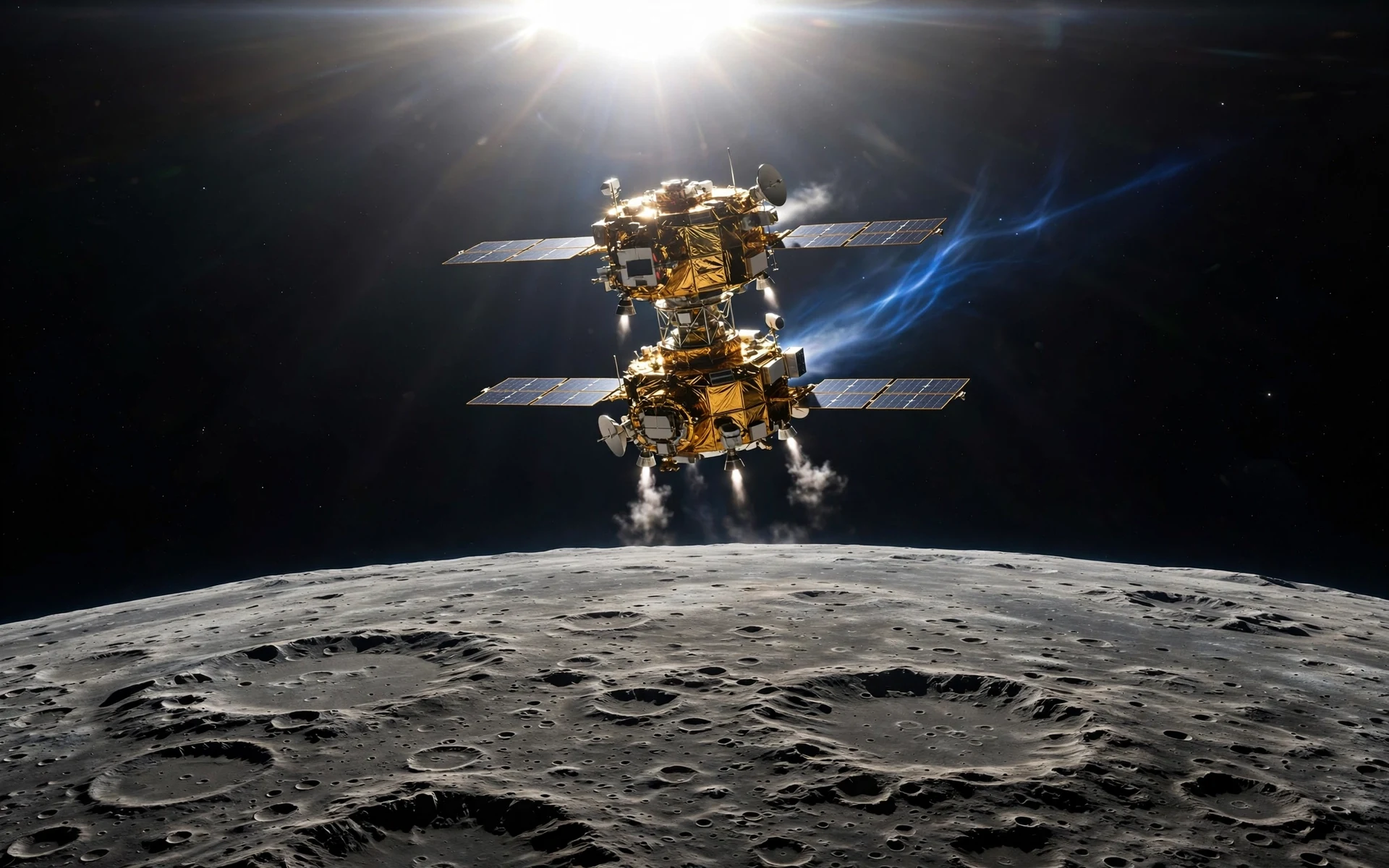
Seventeen point one five kilometres per second is the velocity change needed to travel from Earth orbit to Mercury orbit and stop there, by our calculation, more than the 15.50 km/s the same math gives for a rendezvous with Pluto, a world nearly forty times farther out. On November 21, 2026, the European Space Agency and the Japan Aerospace Exploration Agency paid that bill in full, when BepiColombo fired four chemical thrusters for a planned 37 minutes and slipped into orbit around Mercury, only the second mission in history to do so.
It almost went perfectly, until a day later ESA disclosed that the burn had ended earlier than planned "following a software issue," that the spacecraft is safe, and that engineers at its Darmstadt operations centre are working out what happened, with an update promised for Monday, November 23, and capture confirmed. What nobody in the coverage has done yet is run the numbers: what the trip cost in physics, what the short burn means in metres per second, and why a planet 58 million kilometres away is harder to stop at than one 5.9 billion kilometres away.
Falling Toward the Sun Speeds You Up
Intuition says distance is the difficulty: Pluto is 39.5 astronomical units out and Mercury only 0.387, so Pluto should be the expensive trip, but the expensive part of reaching Mercury is not getting there but stopping. A spacecraft falling toward the Sun trades gravitational potential for speed the whole way down, arriving at Mercury's orbit moving at 57.5 km/s while Mercury itself cruises at 47.9 km/s, and the 9.6 km/s difference has to be burned off or the spacecraft sails straight past. Pluto demands a huge departure burn to climb out of the Sun's gravity well, 11.81 km/s against Mercury's 7.53, but on arrival you are crawling at barely 1 km/s relative to a target moving at 4.7 km/s, so matching speeds costs only 3.69 km/s.
Here is the ledger, computed from first principles for idealized Hohmann transfers from Earth orbit. Real missions use flybys, so treat these as the physics bill, not any one spacecraft's propellant manifest.
| Destination | Departure burn | Arrival burn | Total |
|---|---|---|---|
| Venus (0.723 AU) | 2.50 km/s | 2.71 km/s | 5.21 km/s |
| Mars (1.524 AU) | 2.95 km/s | 2.65 km/s | 5.60 km/s |
| Mercury (0.387 AU) | 7.53 km/s | 9.61 km/s | 17.15 km/s |
| Pluto (39.5 AU) | 11.81 km/s | 3.69 km/s | 15.50 km/s |
Mercury beats Pluto by 1.65 km/s, about 11 percent, and costs just over three times a Mars rendezvous. ESA has said for years that reaching Mercury takes more energy than sending a mission to Pluto. Nobody had published the table behind the claim until now.
How BepiColombo Dodged Most of the Bill
No spacecraft carries 17 km/s of propellant, so BepiColombo dodged the bill the way every Mercury mission must, by letting planets do the braking. Launched October 20, 2018, aboard an Ariane 5, the 4,100-kilogram stack flew past Earth once, Venus twice, and Mercury six times across 2,954 days and 9.9 billion kilometres, while four British-built QinetiQ T6 ion thrusters pushed with a force roughly equal to the weight of a few sheets of paper, 145 millinewtons each, for months at a time, at an exhaust velocity near 42 kilometres per second.
That patience is the whole mission: the ion system delivered 23.7 meganewton-seconds of total impulse, according to ESA's mission documentation, and at the T6's specific impulse of 4,300 seconds that took about 562 kilograms of xenon. Run the same impulse through a chemical engine at a typical specific impulse of 320 seconds and it needs 7,552 kilograms of propellant, 84 percent more than the entire launch mass of the spacecraft. Chemical braking was not the expensive option; it was physically impossible inside an Ariane 5 fairing. Ion propulsion did not optimize this mission; it enabled it.
Even the ion engines nearly broke the plan. In April 2024 a power anomaly limited their thrust, and flight dynamics engineers re-solved the trajectory in flight, steering the fourth Mercury flyby 35 kilometres closer to the planet on September 4, 2024 to extract extra free braking, which moved arrival eleven months, from December 2025 to November 2026. On September 3, 2026, the transfer module separated and fell away, leaving the two science orbiters to make the final approach on chemical thrusters alone, and a September 24 test firing delivered an 11.4 m/s correction that put the stack precisely on course.
The Short Burn, in Metres per Second
The arithmetic ESA's Monday update must answer to is simple. Four 20-newton thrusters produce 80 newtons of thrust, and at arrival the stack weighed roughly 1,425 kilograms, the Mercury Planetary Orbiter at 1,150 plus JAXA's Mio at 275, not counting the sunshield structure, so acceleration was at most 0.056 metres per second squared. Over the planned 37 minutes that buys about 125 m/s of velocity change: every minute of burn was worth about 3.4 m/s.
That rate is the yardstick for judging Monday's update. Five minutes short means a shortfall of roughly 17 m/s; ten minutes short means roughly 34 m/s. At a typical bipropellant specific impulse near 320 seconds the full burn would have consumed about 57 kilograms of propellant, so a short burn also leaves propellant in the tanks, and propellant cannot be bought. ESA has sixteen burns planned between now and March 2027 to absorb this kind of error, with the first block of five due before Mercury's long eclipse season, when the spacecraft risks draining its batteries in shadow. Whether the December 9-10 separation still holds is the question Monday's update must answer.
What 1.65 Billion Euros Buys
Put the price in human scale: at 1.65 billion euros for 9.9 billion kilometres travelled, the journey cost about 17 euro cents per kilometre, and spread over a nominal one-year science mission from April 2027, that is 4.52 million euros per day of science, or 2.26 million per day if the extension through 2029 counts. For comparison, NASA's MESSENGER, the only previous Mercury orbiter, cost about $450 million, orbited from March 2011 to April 2015, and ended in a planned crash at roughly 14,000 km/h. BepiColombo carries two orbiters and sixteen instruments against MESSENGER's one orbiter and seven, at roughly four times the nominal cost.
What the money is for: Mercury is the Solar System's oddball. Its iron core takes up about 85 percent of its radius, it holds a global magnetic field despite being too small to have one, its polar craters hide water ice while the surface bakes at 450 degrees Celsius, and its "hollows" look young enough that the planet may still be changing. Two orbiters measuring field and surface together can settle whether Mercury is the stripped core of a larger planet or formed the way it is, and that answer feeds into how planets form close to their stars, where most known exoplanets live. MPO will descend to a 480 by 1,500 kilometre orbit with a 2.3-hour period, while Mio swings out to 11,640 kilometres on a 9.3-hour loop. One spacecraft could never separate Mercury's own field from the solar wind's noise, but two can.
Limitations
ESA has not disclosed how much shorter the insertion burn ran or the actual post-burn orbit, so the shortfall arithmetic above is a framework for interpreting Monday's update, not a measurement. The Hohmann ledger is idealized, with circular coplanar orbits, Mercury's eccentricity of 0.206 ignored, and no plane-change cost, so it measures the underlying physics rather than BepiColombo's propellant manifest. The chemical specific impulse of about 320 seconds is a typical bipropellant figure, stated as an assumption rather than an ESA-published value, and the 1.65 billion euro cost is a 2017 estimate, with the final cost higher and unpublished. The science case also rests on a mission that has taken no measurement in its working orbit yet.
The Strongest Case Against This Mission
Here is the best case against spending 1.65 billion euros and eight years to orbit a rock humanity already visited. MESSENGER mapped the surface, measured the field, and found the volatiles, while BepiColombo's answers, about core formation and dynamos, are the kind of knowledge that changes textbooks rather than lives. Against that, the honest reply is that textbook questions compound: Mercury is the only accessible example of a planet that formed and stayed close to its star, and most exoplanets we have found did exactly that, so understanding Mercury is the closest thing we have to a laboratory for the most common planetary arrangement in the galaxy. The glitch is real, but the mission was designed with sixteen burns of margin for exactly this kind of failure, and the capture burn's job was only to get caught. If the December separation holds, the glitch becomes a footnote. If it does not, the criticism stands.
What You Can Do
If you follow spaceflight, read ESA's Monday update with this article's yardstick: find the burn duration and resulting orbit, and divide the shortfall by 3.4 m/s per minute to see what it cost the plan. If you teach physics, the Hohmann table is a one-period classroom exercise: the vis-viva equation, four rows, and a result that surprises every student who assumes farther means harder. If you work in mission design, carry the ion-versus-chemical comparison into your next review, because 562 kilograms against 7,552 for the same impulse is not a trade study but a feasibility boundary. If you simply want to watch, BepiColombo's cameras start returning close-ups once the orbiters separate in December.
The Bottom Line
Stopping at Mercury costs 17.15 km/s, more than reaching Pluto at 15.50, because falling toward the Sun is the hard part and distance is not. BepiColombo paid that bill with nine planetary flybys, years of ion thrusting that a chemical rocket could never have afforded, and a 37-minute chemical burn that came up short for reasons ESA has yet to explain. The spacecraft is safe and captured, headed for separation in December and science in April 2027. Eight years, 9.9 billion kilometres, 17 euro cents per kilometre: the braking is done, and the science has not started yet.
Related
- Google's First AI Answer From Orbit Was a Haiku. Its 4 TPUs Average 14-19% of One H100.
- Voyager 1 Just Crossed One Light-Day. A Reply Now Takes 48 Hours.
- 10 Grams for $578 Million: The $58-Million-a-Gram Math of JAXA's Phobos Mission
Sources: ESA, "BepiColombo entering orbit around Mercury"; Orbinauts, "BepiColombo enters Mercury orbit, the second mission ever" (2026-11-22); eoPortal, BepiColombo mission page; Nature News, "BepiColombo finally reaches Mercury after eight-year odyssey" (2026-11-21); Eos, "BepiColombo Arrives at Mercury" (2026-11-21); Wikipedia, BepiColombo; SpaceNews, "ESA unveils BepiColombo Mercury orbiters" (2018). All delta-v figures, propellant masses, burn arithmetic, and cost-per-unit figures are the author's own calculations on the cited numbers; the Hohmann ledger assumes circular coplanar orbits.