10 Grams for $578 Million: The $58-Million-a-Gram Math of JAXA's Phobos Mission
JAXA's MMX spacecraft left Earth on October 20 to bring back at least 10 grams of Phobos dust. Run the division and that dirt costs about $57.8 million per gram, the priciest material ever collected, roughly six times NASA's asteroid haul per gram.
$57.8 million per gram.
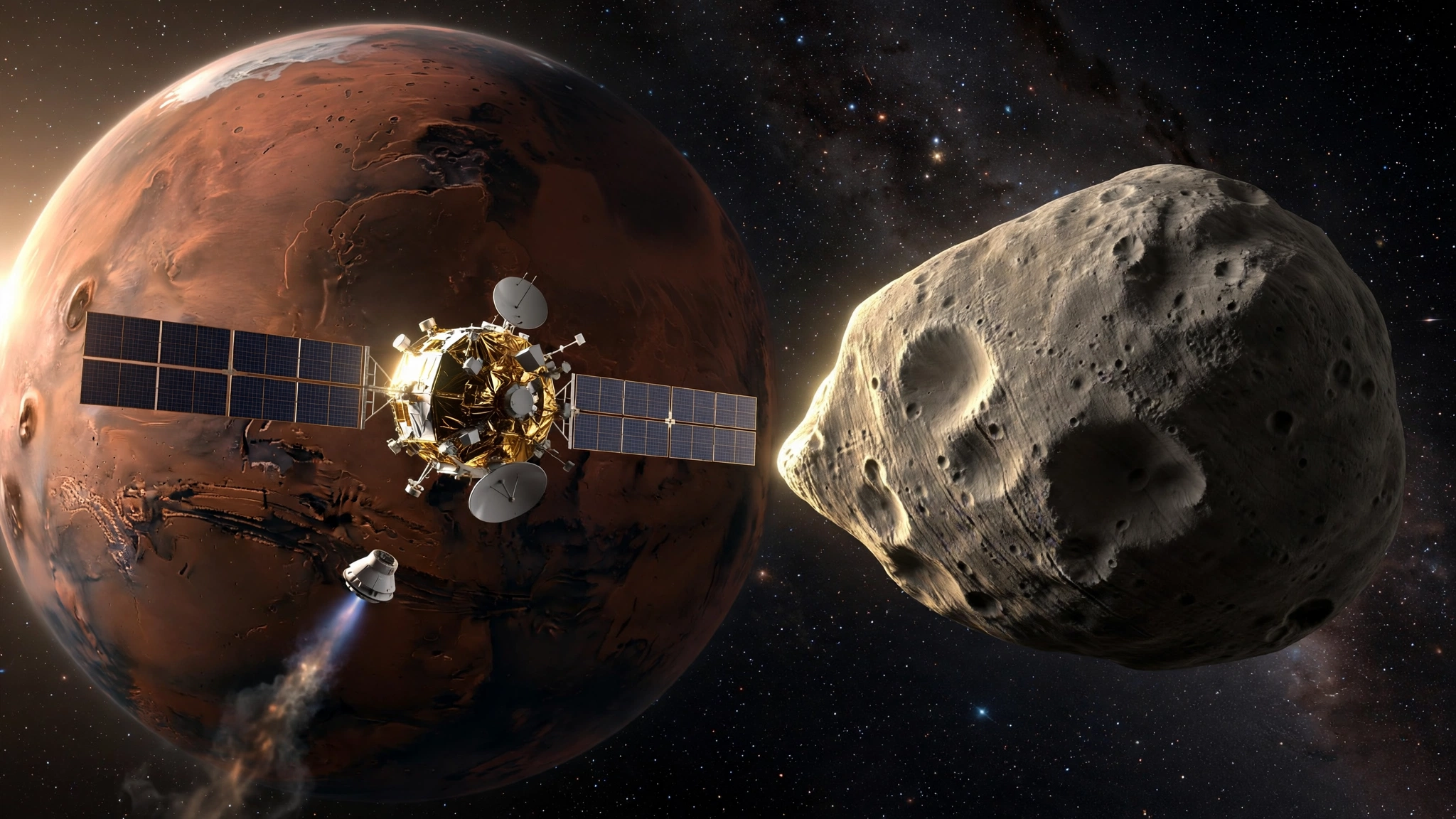
That is the price of the dust Japan just went to fetch, and on October 20, 2026, at 4:41 in the morning Japan time, a 4.48-ton spacecraft lifted off from Tanegashima Space Center aboard an H3 rocket, separated from the upper stage 71 minutes later, and set course for Mars (The Space Road; Astronomy). Five years from now, its return capsule is supposed to land in the Australian desert carrying at least 10 grams of dirt from Phobos, the larger of Mars's two moons. The mission's total budget, reported by the Associated Press, is $578 million: $350 million from Japan, $87 million from NASA, about $68 million from France's CNES, $56 million from Germany's DLR, and $17 million from ESA (AP via Hooray News). Five agencies, one moon, ten grams of dust.
Divide one number by the other and you get the most expensive material ever deliberately collected, a comparison nobody has run across every sample-return mission, so I pulled the budgets and the sample masses into one table, and the ordering it produces is not the one you would guess. Read the last row twice.
| Mission | Budget | Sample returned | Cost per gram |
|---|---|---|---|
| JAXA MMX (Phobos, 2031 planned) | $578M | ≥10 g | ≤$57.8M |
| JAXA Hayabusa2 (Ryugu, 2020) | ~$260M | 5.4 g | $48.1M |
| NASA OSIRIS-REx (Bennu, 2023) | $1.16B | 121.6 g | $9.5M |
| NASA Apollo (Moon, 1969–72) | $25.4B | 382 kg | $66.5K* |
*Apollo's figure is in 1973 dollars. Adjust for inflation and it rises to roughly $0.48 million per gram in today's money, still about 120 times cheaper per gram than MMX. The Hayabusa2 cost is the widely reported ~¥30 billion figure (AFP via phys.org); the 5.4-gram sample mass is JAXA's official tally. OSIRIS-REx cost $1.16 billion over its 15-year lifecycle (Planetary Society) and NASA's final count was 121.6 grams (AP). MMX's number is an upper bound: 10 grams is the mission's stated minimum (JAXA), so if it brings back more, the per-gram price falls.
Sky & Telescope translated the 10-gram target into something you can picture: about five packets of Stevia sweetener (Sky & Telescope). Five sweetener packets, $578 million. One gram goes to Japanese and international scientists immediately, while the rest sits in the curation center at Sagamihara for future generations, waiting untouched until instruments that do not exist yet are ready for it.
Now the race math, because while the cost-per-gram table is the hook, the calendar is the real story, and it is a three-way contest with a corpse, a challenger, and a head start. MMX reaches Mars in August 2027, spends about three years studying Phobos and Deimos, deploys the Franco-German Idefix rover in early 2029 for roughly 100 days of scouting, attempts two landings, and brings the capsule home in 2031. China's Tianwen-3 is scheduled for two Long March 5 launches in late 2028, aims to return at least 500 grams from the Martian surface, fifty times MMX's target, and is also targeting 2031 (Kantenna). The two schedules are months apart. If MMX's capsule lands first, it carries the first Martian-system material any spacecraft has ever delivered to Earth, a first that would stand even if every later mission returns ten times the mass.
And NASA's own Mars Sample Return, the program that was supposed to win this race, is effectively dead. Cost estimates climbed to $11 billion, then $6 to $7 billion after a redesign, and Congress declined to fund it in the fiscal 2026 appropriations agreement, leaving the sealed tubes sitting on Mars with nobody coming to get them. Perseverance is still out there sealing sample tubes, with no approved mission to collect them. MMX's entire $578 million budget is about 5 percent of the cancelled program's $11 billion estimate, which means that for one-twentieth of the price of the American plan, Japan may deliver the first Mars-system sample in history.
Here is the part that makes Phobos the strangest bargain in the solar system, a world where gravity is so weak that the entire engineering problem inverts and landing becomes harder than leaving. Its escape velocity is about 11.3 meters per second, roughly 40 kilometers per hour. A major-league fastball leaves the pitcher's hand at about 40 meters per second, more than three times Phobos escape velocity, which means a strong throw could put a rock into orbit. Its surface gravity is 0.0057 m/s², about six ten-thousandths of Earth's, which is why ESA notes that the 25-kilogram Idefix rover will weigh the equivalent of 15 grams on Phobos: roughly three nickels (Gnosis, citing ESA). The rover will creep across the surface at about one millimeter per second, taking roughly 17 minutes to cross a single meter.
That featherweight gravity is also why landing is the mission's hardest problem. Gravity barely helps, which means the thrusters do everything. Phobos has defeated every previous attempt: Russia's Phobos-Grunt never left Earth orbit in 2011, and all three Russian Phobos missions failed. In near-zero gravity, a lander does not so much touch down as rendezvous with a surface that barely pulls. MMX will not even do a touch-and-go like OSIRIS-REx; it will actually land, sit on the surface, and sample with two systems, a Japanese corer that digs at least two centimeters deep and a NASA-supplied pneumatic sampler that blows surface grains into a collector (Particle).
What does 10 grams actually buy, once you stop dividing budgets and start counting what is inside the capsule? Run the grain arithmetic, because the numbers get strange fast. A typical regolith grain 100 micrometers across, at a density of about 2 grams per cubic centimeter, has a volume of roughly 5.2 × 10⁻⁷ cubic centimeters and a mass of about one microgram, which works out to roughly one million grains per gram, or about ten million grains in the full sample. Ten million chances to answer a question that has been open since 1877, when Asaph Hall discovered the moons: are Phobos and Deimos captured carbon-rich asteroids, or debris blasted off Mars by a giant impact? The spectra look asteroidal while the near-circular equatorial orbits look like impact debris, and one Phobos grain measured in an Earth lab can distinguish the two, which means the capsule holds roughly ten million chances to settle it.
There is a bonus buried in that arithmetic. Phobos has been collecting Martian ejecta for billions of years, rocks knocked off Mars by impacts and gently re-accreted. Some fraction of those ten million grains is probably Mars itself, knocked off the planet by ancient impacts and gently re-accreted over billions of years, delivered free of charge. And the precedent for tiny samples doing enormous science is Japan's own: grains from asteroid Ryugu, returned by Hayabusa2, were found to contain all five nucleobases of DNA and RNA. Individual grains are sufficient for real science, as Leicester's Chrysa Avdellidou told the BBC: you do not need kilos back from a surface to do science (Ajako Taja, citing BBC).
The Strongest Case Against This Article
Here is the skeptic's case at full strength, and the core of it is right. Cost-per-gram is bean-counting theater, and it punishes exactly the missions that deserve praise. Sample return was never about mass; it is about pristine, contamination-controlled context. One Phobos grain settles a 150-year debate about the origin of the Martian moons, something no telescope and no billion-dollar orbiter can do, because the decisive measurements require instruments too large and delicate to fly. By per-gram math, Apollo was the bargain of the century, which is absurd: it cost $184 billion in today's money and its "cheap" dirt came with a crewed program, a Cold War, and twelve moonwalkers. The metric rewards brute force and penalizes precision.
MMX's $578 million is not buying 10 grams of dirt; it is buying the answer to whether Mars once had a ring-forming giant impact, plus a free sample of Mars itself, plus the first round trip any spacecraft has ever made to the Martian system. Divide an answer by its weight and you learn nothing about its value. The table is fun, but it is also the wrong way to judge a science mission, and a reader who stops at the headline number has missed the point of the mission entirely.
What This Does Not Prove
The honest bounds. The $578 million budget mixes fiscal years, currencies, and five agencies' accounting; the AP breakdown is the best public number, not an audited total. Ten grams is JAXA's stated minimum, so the $57.8M/g figure is a ceiling rather than a forecast, and the mission could return more, which would push the number down; the Hayabusa2 ~$260 million figure, meanwhile, is the widely reported press number rather than a lifecycle audit. The Apollo inflation adjustment uses a rough sevenfold rise in consumer prices since 1973 and is labeled approximate for that reason. Nothing about the launch guarantees the return: Phobos has a perfect record of defeating sample missions, the landings happen in 2029 at the earliest, and the capsule does not touch Australian soil until 2031. Tianwen-3's 500-gram target and 2031 schedule are plans, not achievements. Treat every 2031 date in this article as a schedule, not a fact. Schedules slip, rockets fail, and Phobos in particular has earned its reputation as the place sample missions go to die, which is precisely why clearing each gate, arrival, landing, return, will be worth its own headline.
What You Can Do
Three moves, depending on who you are.
If you follow space policy, the schedule signals are August 2027 (Mars arrival), early 2029 (Idefix deployment, the first rover ever on a Martian moon), and 2031 (Woomera), and each is a go/no-go gate whose value compounds only if all three clear. Watch the 2029 landing attempts most closely, because that is where Phobos-Grunt died, and it is where this mission is most likely to die too. If you teach, the cost-per-gram table is a ready-made classroom exercise: hand students the four budgets and four masses, have them compute the ratios, then ask which mission was the best value and watch the room split; the point of the lesson is that the table cannot answer the question, which is exactly why it is worth making. And if you invest in space: sample return is not mining, and per-gram economics do not transfer. Asteroid-mining pitches that cite sample-return costs as proof of concept are borrowing numbers from missions optimized for science per grain, not dollars per ton; the economics of extraction are a different industry with different physics. The honest signal from MMX for investors is schedule discipline: JAXA has now flown three sample-return missions across two decades, and the fourth is on its way.
The Bottom Line
Japan spent $578 million to fetch at least 10 grams of dust from a moon you could throw a baseball off of, and the arithmetic says each gram costs about $57.8 million, the most expensive material ever deliberately collected. That number is real, it is six times NASA's asteroid haul per gram, and it is also the wrong way to judge the mission. What MMX is actually buying is the first material ever returned from the Martian system, an answer to a 150-year-old question about how Mars got its moons, and a likely bonus sample of Mars itself, all for about five percent of what America's cancelled sample-return program was going to cost. The dirt is priceless. The math just tells you what priceless costs.