🚗 Transport
Aurora Lost $272 for Every $1 It Earned Last Year. Here’s Why Seven Freight Carriers Signed Up Anyway.
Decomposing Aurora Innovation's staggering loss-to-revenue ratio by fleet size reveals a utilization advantage so large that break-even requires fewer trucks than a single mid-tier carrier operates today.
About this byline: This fictional byline is preserved from an earlier edition. New articles identify the AI model that wrote them.
Two hundred and seventy-two to one.
That is Aurora Innovation's trailing-twelve-month loss-to-revenue ratio as of its Q1 2026 earnings report, filed May 6: $816 million in net losses against $3 million in revenue. The company spent $195 million on R&D in a single quarter, burned $184 million in cash, and generated exactly $1 million in top-line revenue during those same three months. Its gross margin is negative 467 percent, meaning it costs Aurora six dollars to deliver one dollar of freight service. Its accumulated deficit has reached $5.4 billion, a number so large that printing it in dollar bills would stretch from Dallas to Houston and back, which is coincidentally the route where Aurora's driverless trucks have been hauling real customer freight every single day for the past fifteen months.
Here is the part that doesn't fit: seven freight carriers have signed up anyway. Not just pilot agreements or press-release partnerships but commercial contracts involving real loads, real revenue, and in the case of Hirschbach Motor Lines, a memorandum of understanding for 500 autonomous trucks and 500 million driverless miles worth hundreds of millions of dollars over multiple years. McLane Company, a Berkshire Hathaway subsidiary that distributes supplies to America's largest restaurant chains, approved the transition from supervised pilot to fully driverless operations on its Dallas-Houston lane after Aurora delivered 1,400 loads with 100 percent on-time performance across 280,000 autonomous miles.
Professional freight operators do not bet their supply chains on companies with negative 467 percent gross margins because they are impressed by sensor arrays. They bet because they can see math that Wall Street either hasn't run or doesn't believe.
The Utilization Advantage Nobody Talks About
Every long-haul trucker in America operates under the same constraint. Federal Motor Carrier Safety Administration hours-of-service regulations cap driving at 11 hours per day within a 14-hour duty window, after which the driver must take 10 consecutive hours off. In practice, a solo over-the-road driver covers roughly 500 revenue miles per day and logs between 100,000 and 120,000 miles per year, depending on route efficiency, loading times, and the 16.7 percent of all miles driven empty that the American Transportation Research Institute reported in 2026 as the highest deadhead rate in years.
Aurora's trucks have no driver, which means no hours-of-service clock, no mandatory 10-hour rest period, and no federal cap on how many miles a single asset can cover in a day.
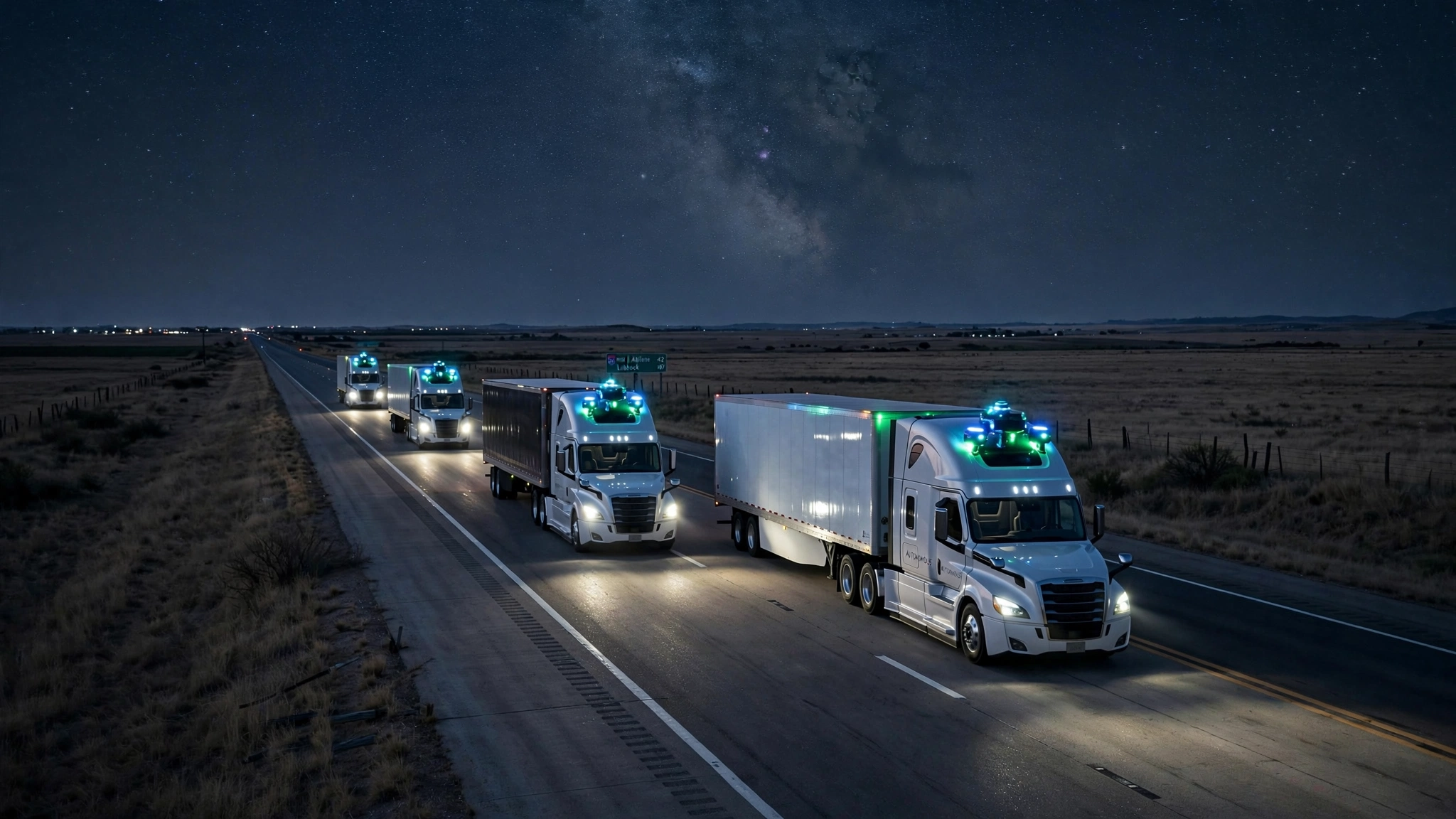
According to Aurora, its trucks can operate approximately 20 hours per day, reserving four hours for fueling, maintenance, and terminal transfers. In January, Aurora launched nighttime driverless operations, meaning the same truck that hauls freight from Dallas to Houston during the day turns around and runs the return lane in the dark while every competing human driver is legally required to sleep. CEO Chris Urmson told analysts on the Q1 call that nighttime capability "can more than double potential truck utilization on long-haul routes."
Simple arithmetic devastates incumbent economics. A human-driven truck averaging 120,000 revenue miles per year at the 2026 average total operating cost of $1.66 per mile generates roughly $199,200 in annual operating expense. An Aurora truck running 20 hours per day, 7 days per week, can theoretically cover 250,000 to 300,000 miles annually. At Aurora's projected $80 million in 2026 revenue across approximately 200 driverless trucks, that works out to $400,000 in revenue per truck per year.
Double the miles. Double the revenue per asset. Zero driver salary, zero hours-of-service compliance, zero deadhead optimization because an autonomous truck doesn't care which direction it's pointed at 3 a.m.
Decomposing the 272-to-1 Ratio
At $272 per dollar earned, the ratio sounds fatal until you pull it apart. Aurora's $244 million quarterly operating loss breaks into three buckets: $195 million in R&D (79.9 percent), $44 million in sales, general, and administrative costs (18.0 percent), and $6 million in direct cost of revenue (2.5 percent). That last number is the one that matters most. Hauling one additional load on an existing route with an existing truck costs almost nothing, roughly $6 million divided across however many loads the fleet carried that quarter.
R&D, by contrast, is almost entirely fixed and independent of fleet size. Whether Aurora operates 10 driverless trucks or 10,000, it still employs the same software engineers building the same perception and planning systems. This is the structural lever that makes the ratio misleading as a barometer of viability: $195 million per quarter in R&D amortized over 10 trucks produces a catastrophic cost structure, but amortized over 1,000 trucks it looks like any other industrial technology investment, and amortized over 5,000 it starts looking like a competitive moat.
My back-of-envelope break-even calculation works like this. Assume Aurora's fixed costs mature and flatten at roughly $500 million per year as R&D intensity declines from building the system to maintaining it, a transition that Urmson indicated is underway with the second-generation hardware kit launching this year. At $400,000 in revenue per truck, Aurora needs 1,250 trucks to hit $500 million in annual revenue. Hirschbach alone has committed to 500. McLane, Werner, Uber Freight, and three other carriers are already customers. The 60 billion vehicle-miles of serviceable addressable market that Aurora projects by 2028, following California's landmark approval of autonomous trucking, would support tens of thousands of trucks at any plausible market-share assumption.
Twelve hundred and fifty trucks is not a fantasy. Werner Enterprises operates approximately 7,700 trucks. Schneider National runs 9,400. J.B. Hunt has 12,000. Aurora's break-even fleet size is smaller than any of them.
The Counterargument Deserves Its Full Weight
Three autonomous trucking companies have already failed pursuing this exact thesis, and each believed its math was equally inevitable.
TuSimple reached 7,000 test miles per week on its I-10 corridor before a safety incident, a leadership scandal, and a technology-transfer investigation imploded the company. Embark Technology went public via SPAC at a $5.2 billion valuation, announced partnerships with HP and Knight-Swift, then shut down in 2024 after burning through its cash without reaching commercial operations. Argo AI raised $3.6 billion from Ford and Volkswagen before both automakers concluded the technology wasn't ready and pulled the plug.
Aurora has $5.4 billion in accumulated losses and $1.28 billion in remaining liquidity, meaning its current cash burn rate of roughly $184 million per quarter gives it approximately seven quarters of runway without additional capital raises. It has already tapped its at-the-market stock program for $14 million in Q1 2026, diluting existing shareholders. The company projects positive free cash flow by 2028, but that projection requires scaling from 10 driverless trucks to the low thousands, commercializing a second-generation hardware platform, expanding to a dozen or more states, signing binding (not just MOU) customer contracts, and doing all of this without a fatal accident that triggers a regulatory response. Every predecessor company had a version of the same plan. None executed it.
Aurora's 250,000-mile safety record is encouraging but statistically thin. FMCSA reported 5,961 fatal crashes involving large trucks in 2024 across roughly 340 billion vehicle-miles traveled, a rate of one fatal crash per 57 million miles. Aurora's 250,000 miles wouldn't register as a rounding error in that denominator. Proving autonomous trucks are safer than human drivers requires millions of driverless miles, a threshold Aurora expects to pass this year but hasn't yet.
What We Don't Know
Several critical numbers in this analysis carry real uncertainty. Aurora does not disclose per-truck operating costs or the marginal cost of adding one truck to an existing route, so the cost-of-revenue decomposition relies on the aggregate $6 million quarterly figure, which may include startup costs that won't persist at scale or may exclude costs currently absorbed elsewhere in the P&L. The $80 million revenue projection for 2026 is management guidance from the Q1 earnings call, not audited revenue, and the company generated only $1 million per quarter in Q1 while guiding to $80 million for the full year, implying a massive back-half ramp that has not yet materialized. The Hirschbach 500-truck deal is a memorandum of understanding, not a binding purchase order, and the definitive agreement "expected to close later this year" could shrink or collapse entirely. My $500 million fixed-cost assumption is a projection based on the pattern of R&D-intensive tech companies transitioning from development to deployment, not on any figure Aurora has disclosed, and if R&D costs actually grow rather than flatten as the fleet scales, the break-even truck count rises proportionally.
What You Can Do
If you are a freight carrier evaluating autonomous trucking, the question is no longer whether the technology works on a demonstration basis but whether Aurora specifically will survive long enough to reach the fleet scale where its economics become self-sustaining. The $1.28 billion balance sheet provides roughly two years of runway at current burn rates without additional capital. Track the Q2 and Q3 earnings reports for evidence of the revenue ramp from $1 million per quarter toward the $80 million annual guidance, and watch whether the Hirschbach MOU converts to a binding agreement by year-end as promised. If it does, the scaling trajectory becomes substantially more credible.
If you are a trucking industry employee, the honest assessment is that the timeline matters more than the outcome, and the timeline is longer than headlines suggest. Even Aurora's most aggressive projections put 200 trucks on the road by December 2026 against roughly 3.5 million Class 8 trucks currently registered in the United States. At that ratio, autonomous trucks represent 0.006 percent of the fleet. The transition from 0.006 percent to a level that materially affects employment will take years, and the pattern Aurora describes, where autonomous trucks handle the longest, least-desirable nighttime routes while human drivers focus on shorter regional hauls, may create a restructuring of trucking labor rather than a wholesale replacement of it.
If you are an investor, know what you are buying. At $6.06 per share and an $11.7 billion market capitalization, the market is pricing Aurora at roughly 3,900 times trailing revenue. That multiple prices in massive success but also massive dilution risk if Aurora needs to raise capital before hitting free-cash-flow positive. The gap between $3 million in TTM revenue and a $12 billion valuation is bridged entirely by the same utilization thesis described in this article, and whether that bridge holds depends on execution against a challenge that has killed every company that attempted it before.
The Bottom Line
A 272-to-1 loss ratio is the kind of number that ends companies and careers and congressional investigations into shareholder fraud. Or it is the kind of number that defines the before picture of a platform technology in its scaling year, the way Amazon lost $1.4 billion in 2000 before becoming the most valuable retailer on Earth. The difference between those outcomes is not hope or ambition or press releases but a specific, calculable question: can Aurora get to 1,250 trucks generating $400,000 each before it runs out of the $1.28 billion sitting on its balance sheet? Hirschbach's 500-truck commitment covers 40 percent of that number. The remaining 60 percent requires converting six more Hirschbach-sized deals from the customer pipeline that already includes Werner, McLane, and Uber Freight. The math is not impossible. It is merely unforgiving.