⚡ Energy
A UCLA Lab Turned Unsorted Plastic Trash Into 90%-Pure Hydrogen at Half the Temperature of Gasification. The Global Math Gets Interesting.
Alkaline thermal treatment converts mixed PET, PE, and PP waste into hydrogen without sorting, at 300-400°C below conventional gasification, while locking carbon away as solid mineral. An original yield analysis shows the unsorted plastic currently rotting in landfills could theoretically supply 11% of global hydrogen demand.
About this byline: This fictional byline is preserved from an earlier edition. New articles identify the AI model that wrote them.
84.5 kilograms. That is how much hydrogen a single metric tonne of mixed plastic waste can yield through a process published this month in the Proceedings of the National Academy of Sciences. Surprising? Not to the chemists. Commercially relevant? Potentially. What surprises them is the other half of the equation: nobody involved in the global hydrogen economy has seriously looked at the 205 million tonnes of plastic that goes unrecycled every year as a hydrogen feedstock, because until now, the chemistry simply would not cooperate with the heterogeneous mess that unsorted municipal plastic waste presents to a reactor.
Researchers co-led by UCLA Samueli School of Engineering and Ewha Womans University in South Korea demonstrated that alkaline thermal treatment, a reaction between sodium hydroxide and organic material under heat, can convert the three most common plastics in the waste stream into hydrogen gas exceeding 90% purity. In a single reactor, without sorting them first, at atmospheric pressure.
Eliminating the sorting step is the part that makes industrial chemists sit up, the part that makes the economics work on paper, and the part that might not survive contact with reality.
What Sorting Actually Costs
Only 9% of discarded plastic is recycled globally, not because recycling technology does not exist, but because 79% of the cost and complexity of the entire plastic waste management chain lives upstream of the recycler, in the sorting step that separates resin types, removes contaminants, and produces the clean single-polymer feedstock that downstream processors require. A materials recovery facility (MRF) in the United States spends $50 to $200 per tonne separating plastic by resin type, removing contaminants, and baling clean material for downstream processors, while sorted, clean PET bales sell for $100 to $300 per tonne. Do the subtraction: for many waste streams, the sorting cost alone erases or exceeds the commodity value of the output.
Conventional high-temperature gasification can handle mixed plastics, but it operates at 700 to 1,000°C and releases substantial CO2, defeating much of the environmental rationale for diverting plastic from landfill in the first place. Previous low-temperature alternatives, solar-driven photoreforming and electrochemical conversion, work only on oxygen-containing plastics like PET. Polyethylene and polypropylene, which together make up roughly 57% of plastic waste, are chemically inert under those conditions because their polymer backbones contain only carbon-hydrogen bonds, and no oxygen hooks means no reaction pathway.
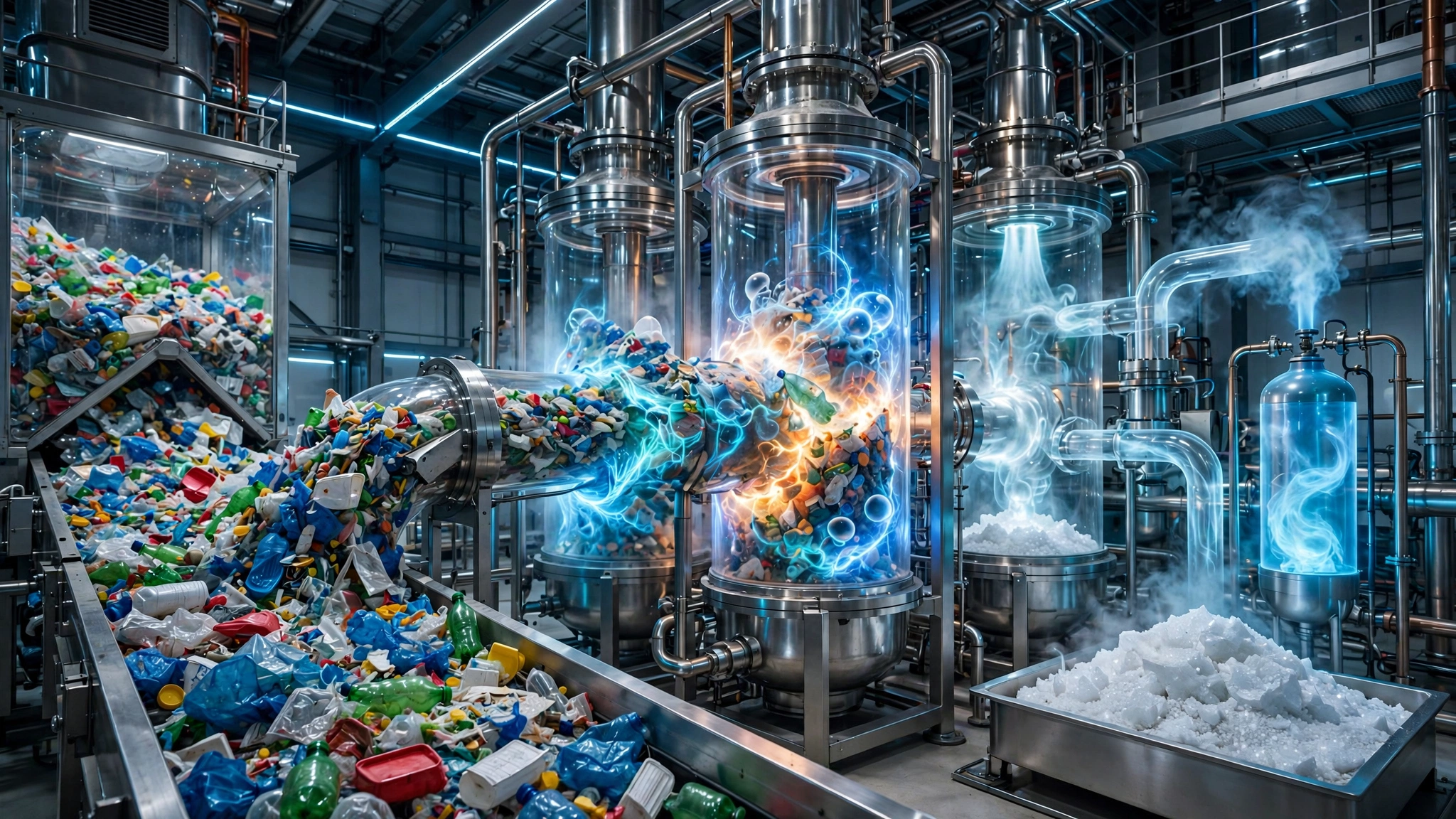
ATT cracks this problem with a two-step approach. First, a thermal oxidation pretreatment: the PE and PP are briefly exposed to mild heat in air. This grafts oxygen-containing functional groups onto the polymer chains, creating the reactive sites that alkaline conditions need. Second, sodium hydroxide reacts with the activated plastic at temperatures 300 to 400°C lower than steam gasification, breaking the polymer into hydrogen gas while the carbon bonds with NaOH to form solid sodium carbonate.
Running the Yield Numbers
Convert those to mass. At a molecular weight of 2.016 grams per mole, the simple average across the three plastic types is 41.9 mmol/g, or 84.5 grams of hydrogen per kilogram of plastic input.
That yield is higher than the hydrogen content of the plastic itself, a counterintuitive result that reveals something important about the chemistry. PE is roughly 14.3% hydrogen by mass, which translates to a theoretical maximum of about 71 mmol/g. The actual PE yield of 51.9 mmol/g represents 73% extraction efficiency from the polymer, but the PET yield of 43.7 mmol/g far exceeds PET's intrinsic hydrogen content of about 21 mmol/g. Where does the extra hydrogen come from? Water: NaOH is dissolved in an aqueous medium, and the alkaline thermal reaction incorporates water molecules as a hydrogen source, effectively using the plastic's carbon as an energy input to drive a thermochemical water-splitting reaction rather than simply extracting hydrogen atoms from the polymer. Carbon captured as mineral carbonate rather than released as CO2.
| Plastic Type | Share of Waste Stream | H2 Yield (mmol/g) | H2 per Tonne (kg) | Carbon Captured (%) |
|---|---|---|---|---|
| PET | ~12% | 43.7 | 88.1 | >75% |
| PE (HDPE + LDPE) | ~33% | 51.9 | 104.6 | >75% |
| PP | ~20% | 30.2 | 60.9 | >75% |
| Mixed (avg.) | ~65% combined | 41.9 | 84.5 | >75% |
Scaling to the Global Waste Stream
Global plastic waste generation hit 225 million tonnes in 2025, according to Earth Action's annual report. With 91% going unrecycled, roughly 205 million tonnes enters landfills, incinerators, or the environment annually. PET, PE, and PP together constitute approximately 65% of the plastic waste stream, yielding a theoretical feedstock pool of about 133 million tonnes per year.
At 84.5 kg of hydrogen per tonne of plastic, processing all available PET/PE/PP waste through ATT would produce Approximately 11.2 million tonnes of hydrogen annually. How much is that? Global hydrogen demand stands at roughly 100 million tonnes per year, according to the International Energy Agency. Unsorted plastic waste, processed through ATT, could theoretically supply about 11% of global hydrogen demand.
For comparison, the entire current global capacity of electrolysis-based green hydrogen production, after billions of dollars in government subsidies and private investment spanning more than a decade of concerted international effort, remains below 1 million tonnes per year. A scaled ATT industry processing even 10% of available plastic feedstock would produce more hydrogen than all the world's electrolyzers combined, though this comparison deliberately ignores the enormous gap between lab-bench chemistry and industrial-scale continuous processing that ATT has not yet crossed.
Carbon Math: ATT vs. Incineration
Post-reaction analysis from the PNAS paper showed that more than 75% of the original plastic carbon ends up as stable carbonate or liquid organic residues. Less than 13% appears in gaseous form. Compare that to incineration, the default endpoint for most collected plastic waste in Europe and increasingly in Asia, which releases approximately 2.7 tonnes of CO2 per tonne of mixed plastic burned.
Average plastic is roughly 60% carbon by weight. A tonne of plastic contains about 600 kg of carbon, with a CO2 potential of approximately 2,200 kg (multiplied by carbon's CO2 conversion factor of 3.67). ATT captures more than 75% of that carbon as solid sodium carbonate, which means the process avoids roughly 1,650 kg of CO2 emissions per tonne of plastic when compared to the incineration pathway that an increasing number of European and Asian waste management systems are adopting as their default endpoint for non-recyclable plastic.
At the full 133-million-tonne feedstock scale, ATT would avoid approximately 220 million tonnes of CO2 annually versus incineration. That is roughly equivalent to the annual carbon emissions of France. Not trivial. About 0.6% of global CO2 emissions, which sounds small until you consider it comes from a single chemical process applied to a single waste stream that most of the world currently pays to bury in the ground.
What It Would Be Worth
Gray hydrogen from steam methane reforming currently costs $1.11 to $2.35 per kilogram, according to BloombergNEF's 2026 estimates. Green hydrogen from electrolysis costs $3.74 to $11.70 per kilogram. At the gray hydrogen midpoint of $1.73/kg, each tonne of plastic processed through ATT would yield hydrogen worth about $146. At the green hydrogen midpoint of roughly $5/kg, that value rises to $423 per tonne.
Compare this to the current economics of plastic recycling. Sorted, clean PET bales sell for $100 to $300 per tonne. But ATT eliminates sorting costs ($50-200/tonne), accepts contaminated mixed waste, and produces a premium energy product instead of a commodity resin. On paper, ATT hydrogen at green-hydrogen prices ($423/tonne) competes favorably with mechanical recycling ($100-300/tonne) while simultaneously avoiding the sorting bottleneck that keeps 91% of plastic out of the recycling system entirely, though "on paper" is doing extraordinary heavy lifting in that sentence, and we will get to why.
What Could Kill It
Sodium hydroxide is expensive. Very expensive. Producing NaOH through the chlor-alkali process consumes approximately 2.5 megawatt-hours of electricity per tonne, and at current industrial NaOH prices, the reagent cost alone could dominate the economics of the entire process. The PNAS paper optimized the NaOH-to-plastic ratio but did not report the cost of the reagent at scale. If the process requires, say, 2 kg of NaOH per kg of plastic (a common range in alkaline conversion literature), the NaOH cost alone could reach $200-400 per tonne of plastic processed, significantly narrowing or eliminating the economic margin.
More problematically, the sodium carbonate byproduct must find a market, and the scale numbers here are sobering. Global soda ash (Na2CO3) production runs approximately 60 million tonnes per year. Processing 133 million tonnes of plastic through ATT would generate a comparable volume of sodium carbonate, potentially doubling global supply overnight. An industry-crashing oversupply of a low-value byproduct is not a path to commercial viability, and this single constraint may cap the practical scale of ATT at a small fraction of the theoretical feedstock pool that makes the 11% figure so attention-grabbing.
Real-world plastic waste also contains contaminants that lab-grade samples do not: adhesives, inks, food residue, flame retardants, and plasticizers that could poison or foul a reactor operating at ATT's moderate temperature range. PVC, which constitutes about 5% of the waste stream, releases hydrochloric acid when heated with NaOH, and the paper tested only PET, PE, and PP.
No pilot plant. No continuous-flow reactor. No technoeconomic analysis. Every chemical process that works beautifully in a lab faces a gauntlet of engineering challenges in scale-up: heat transfer, mixing uniformity, catalyst deactivation, equipment corrosion. Many do not survive, and the history of waste-to-energy startups is littered with companies that demonstrated impressive bench-scale chemistry only to discover that continuous industrial operation at the required throughput, temperature uniformity, and reagent efficiency was a fundamentally different engineering problem than the one their lab had solved.
Limitations of This Analysis
The 84.5 kg H2/tonne yield is derived from lab-scale experiments using clean, pre-processed plastic samples. Industrial waste streams would introduce efficiency losses from contamination, moisture content, and non-target plastics. The 11% global supply figure assumes all non-recycled PET/PE/PP is collected and processed, which is unrealistic given that much of the world's plastic waste is dispersed in landfills, oceans, and uncontrolled dumpsites where collection costs would be prohibitive.
The economic comparison excludes reactor capital costs, energy input for the thermal oxidation pretreatment, NaOH procurement, waste handling, and the cost of managing liquid organic residues. A full technoeconomic analysis could show ATT hydrogen is competitive with green hydrogen or could show it is more expensive than gray hydrogen. Without pilot-plant data, both outcomes remain plausible.
Carbon capture figures assume the sodium carbonate remains permanently sequestered. If the Na2CO3 is subsequently heated or acidified in downstream applications, some captured carbon could re-enter the atmosphere, reducing the net climate benefit.
The Bottom Line
ATT is not a recycling technology. It is destruction. It converts plastic into gas and mineral, irreversibly. That distinction matters, because the circular economy aspiration of turning a bottle back into a bottle is fundamentally different from turning a bottle into hydrogen gas and a pile of sodium carbonate, and policymakers who conflate the two risk misallocating waste management infrastructure investment toward a pathway that, however chemically elegant, is thermodynamically a one-way street.
If you manage a municipal waste system: Watch this space but do not restructure around it yet. ATT has no pilot-plant validation, no continuous-flow demonstration, and no published OPEX figures. What it does have is a peer-reviewed proof of concept in PNAS showing that the sorting bottleneck, the single largest barrier to plastic waste valorization, can be chemically bypassed. That is a meaningful advance worth tracking through 2027-2028 as scale-up data emerges.
If you are investing in hydrogen production: Run your own NaOH cost model before getting excited. At current caustic soda prices ($400-600/tonne), a 2:1 NaOH-to-plastic mass ratio would cost $800-1,200 per tonne of plastic processed, producing hydrogen worth $146-423 at market prices. The economics do not close without either dramatically reducing NaOH consumption, finding a high-value market for the Na2CO3 byproduct, or pricing in a substantial carbon credit for the avoided CO2.
If you are a chemist working on plastic waste conversion: The thermal oxidation pretreatment that activates PE and PP is the genuine innovation here. It cracks the polyolefin problem. That activation step could be adapted for electrochemical, photocatalytic, or enzymatic pathways that have historically been limited to oxygen-containing plastics.