India Skipped the Middleman. Its New Nuclear Reactor Makes Hydrogen Without Making Electricity First.
A 40-megawatt fast breeder reactor at Kalpakkam is now splitting water into hydrogen at 500°C, no electricity required. The thermodynamic math says this path extracts 57% more hydrogen per unit of nuclear heat than electrolysis.
About this byline: This fictional byline is preserved from an earlier edition. New articles identify the AI model that wrote them.
Five hundred degrees Celsius.
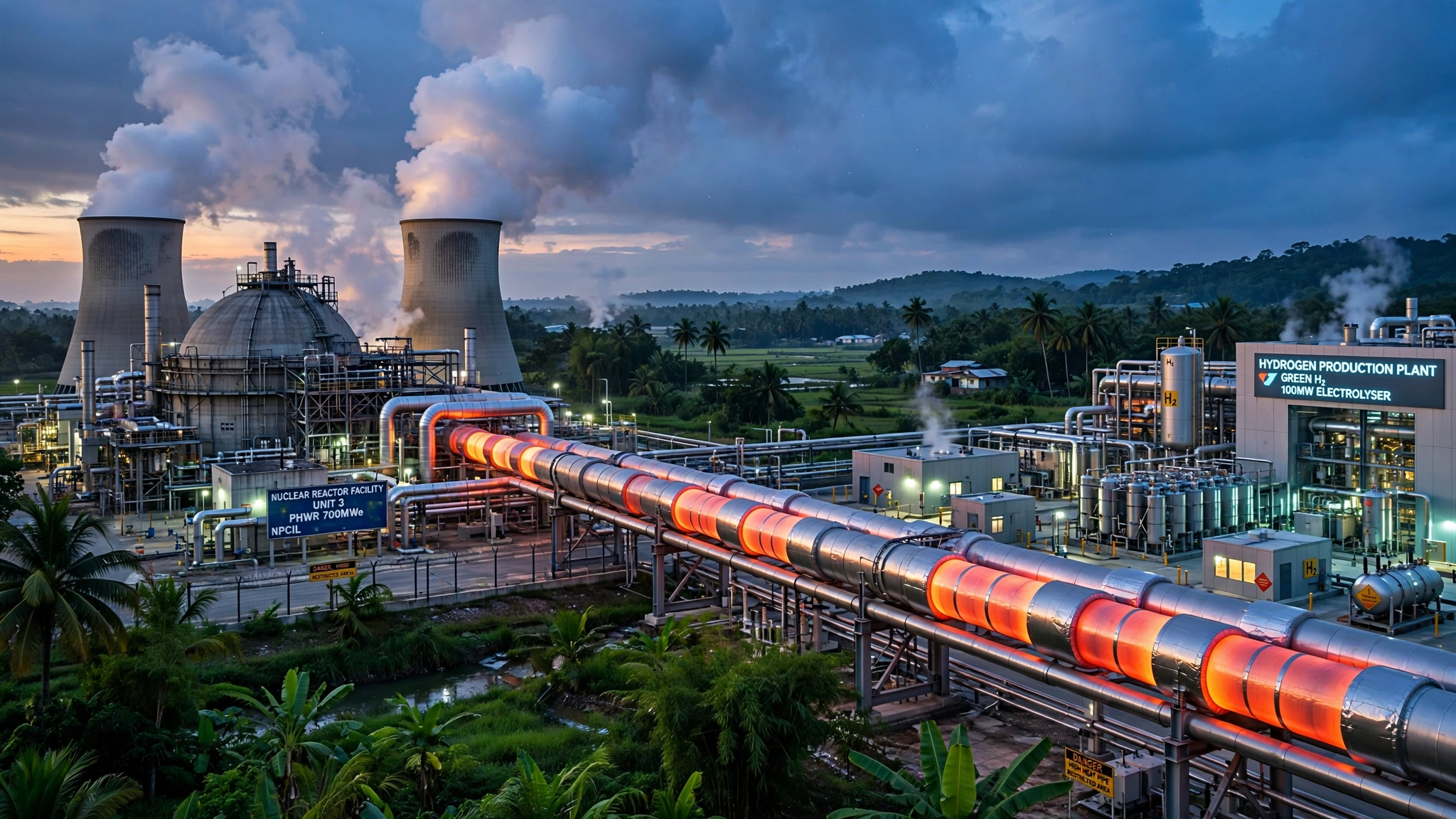
That is the temperature at which India's Bhabha Atomic Research Centre just proved you can split water into hydrogen and oxygen using nothing but nuclear heat. No turbine spinning, no generator humming, no electrolyzer stack drawing current from the grid. Just four chemical reactions cycling copper and chlorine compounds through a closed loop, powered entirely by thermal energy from a fast breeder reactor sitting thirty meters away.
On June 26, 2026, India's Department of Atomic Energy inaugurated the world's first hydrogen production facility driven by nuclear process heat at the Indira Gandhi Centre for Atomic Research (IGCAR) in Kalpakkam, Tamil Nadu. DAE Secretary Ajit Kumar Mohanty called it a "landmark achievement." That phrase gets thrown around loosely in press releases, but in this case the underlying chemistry earns it: no country has ever operated a nuclear-heat-to-hydrogen plant before.
Why Electricity Is the Wrong Middleman
Every major green hydrogen initiative on earth follows the same basic playbook, regardless of whether the project is backed by a European utility consortium, a Middle Eastern sovereign wealth fund, or a Silicon Valley venture capitalist chasing the energy transition. Build a nuclear reactor (or a solar farm, or a wind park). Convert heat into electricity, feed that electricity into an electrolyzer, split water, collect hydrogen.
Each step in that chain bleeds energy, and the losses compound faster than most people realize.
A light-water nuclear reactor converts roughly 33% of its thermal energy into electricity, a ratio that has barely improved in six decades because the Rankine cycle hits fundamental thermodynamic ceilings that no amount of engineering elegance can overcome. A high-temperature electrolyzer, running at current performance levels, operates at about 88% efficiency on a lower-heating-value basis, according to DOE technical targets published in 2024. A PEM electrolyzer at commercial scale sits closer to 70–80%. Multiply those together and the conventional pathway delivers between 23% and 29% of the reactor's original thermal energy as hydrogen chemical energy. The rest is wasted. Waste heat bleeding into cooling towers, mechanical friction in turbines and generators, electrical resistance across miles of copper wire and transformer coils.
India's Cu-Cl thermochemical cycle sidesteps the entire electrical conversion chain, which is the single largest source of energy loss in every nuclear-to-hydrogen pathway currently operating anywhere in the world. Heat from the reactor goes directly into chemical reactions, no Carnot cycle limiting the thermal-to-useful-work conversion, no power electronics losing a few percent at every junction. Published studies place the thermal-to-hydrogen efficiency of the Cu-Cl cycle between 39% and 45% for optimized systems (Razi et al., 2020, Energy Conversion and Management; VHTR-coupled analyses reach 41% thermal efficiency). Conservative numbers, peer-reviewed, with the caveats that real-world demonstration plants always underperform models.
Run the math anyway, because even the conservative numbers tell a striking story.
| Pathway | Step 1 | Step 2 | Overall Efficiency |
|---|---|---|---|
| LWR → Electricity → PEM Electrolysis | 33% (thermal→electric) | 75% (electric→H₂) | 24.8% |
| LWR → Electricity → HTE (high-temp) | 33% (thermal→electric) | 88% (electric→H₂) | 29.0% |
| Fast breeder → Electricity → PEM | 40% (thermal→electric) | 75% (electric→H₂) | 30.0% |
| Fast breeder → Cu-Cl (direct heat) | 39–45% (thermal→H₂, no electrical step) | 39–45% | |
At the conservative end, the Cu-Cl route extracts 57% more hydrogen per unit of nuclear heat than the standard light-water-reactor-plus-PEM pathway (39% ÷ 24.8% = 1.57×). At the optimistic end, the advantage widens to 81% (45% ÷ 24.8%). Against a fast breeder driving electrolysis, the gap narrows but still persists at 30–50% more hydrogen for the same reactor fuel, a margin large enough to reshape infrastructure planning for any country seriously considering a nuclear hydrogen program at national scale.
Fifty-seven percent more hydrogen from the same fuel. Same uranium rod, same fission reaction, same heat output, but 57% more hydrogen molecules collected at the end of the process because you skipped the turbine hall entirely. For an industry where a 3% efficiency gain justifies a billion-dollar R&D program, that number should be deafening.
The Chemistry: Four Reactions, One Closed Loop
The copper-chlorine thermochemical cycle decomposes water through four sequential reactions, each at a different temperature. Copper and chlorine compounds shuttle between oxidation states, transferring oxygen atoms from water molecules to molecular oxygen while releasing hydrogen gas. The net reaction is brutally simple: 2H₂O → 2H₂ + O₂. The intermediate compounds regenerate and recirculate; nothing is consumed except water and heat.
Step one runs at 430–475°C: solid copper reacts with hydrochloric acid gas to produce molten copper(I) chloride and hydrogen. Step two, at 400°C, hydrolyzes copper(II) chloride with steam to regenerate HCl and form copper oxychloride. Step three decomposes that oxychloride at 500°C, releasing oxygen and regenerating CuCl. Step four is an ambient-temperature electrolysis that oxidizes CuCl back to CuCl₂, completing the loop.
The peak temperature of 500°C matters enormously for compatibility with existing reactor designs. The competing sulfur-iodine cycle, which Japan has demonstrated at its High-Temperature Engineering Test Reactor in Oarai, demands temperatures above 800°C just to drive the decomposition of sulfuric acid in the oxygen-producing step. That restriction limits compatibility to a narrow set of reactor designs capable of reaching those temperatures, which effectively excludes the light-water reactors that constitute 85% of the world's installed nuclear fleet. By operating 300 degrees cooler, the Cu-Cl cycle can pair with most existing fast reactors, pressurized heavy-water reactors, and next-generation molten salt designs. Canada's Atomic Energy agency pioneered much of this research at the University of Ontario Institute of Technology, specifically targeting integration with CANDU reactors.
How Big Could This Get?
India's demonstration facility uses the Fast Breeder Test Reactor, a 40-megawatt-thermal research reactor that has been operating at Kalpakkam since 1985. It is a technology demonstrator, not a production plant. Not yet. IGCAR Director Sreekumar G. Pillai noted that FBTR's four decades of operating data informed the design, but 40 MWt is small.
Sitting adjacent at Kalpakkam is the 500-megawatt-electric Prototype Fast Breeder Reactor, which outputs roughly 1,250 MWt of thermal energy. Run the Cu-Cl conversion at 45% efficiency against that thermal output, and a single PFBR-class reactor dedicated entirely to hydrogen production could yield approximately 16,900 kilograms per hour. Over a year at 90% capacity factor, that totals around 133,000 tonnes of hydrogen. Global hydrogen consumption stands at roughly 95 million tonnes annually, so one reactor covers 0.14% of world demand.
To replace all grey hydrogen production worldwide with nuclear Cu-Cl, you would need approximately 714 PFBR-class reactors dedicated entirely to hydrogen. By comparison, the electrolysis route at 30% end-to-end efficiency would require roughly 950 reactors delivering the same annual output, because the lower conversion efficiency demands proportionally more thermal input at every step of the chain. That gap of 236 reactors, at an estimated $4–6 billion per unit, represents a capital savings of roughly $1–1.4 trillion. Scale economies have a way of making abstract efficiency advantages very concrete when multiplied across hundreds of reactor-years and trillions of dollars in infrastructure spending.
The Cost Question Nobody Can Answer Yet
Efficiency is necessary but not sufficient. What matters to the hydrogen economy is cost per kilogram at the plant gate, and on that metric, the Cu-Cl pathway has no commercial track record to cite.
Published literature places nuclear-sourced Cu-Cl hydrogen between $2.27 and $6.74 per kilogram, depending on plant capacity and reactor economics (2023 Energy Conversion and Management review). Grey hydrogen from unabated steam methane reforming costs $1–2/kg. Green hydrogen via renewable electrolysis exceeds $4/kg today, with the U.S. DOE targeting $2/kg by 2026 and $1/kg by 2031. The Cu-Cl range overlaps with green hydrogen but sits well above grey. Nuclear fuel and reactor capital are the dominant cost drivers, not the thermochemical plant itself.
| Method | Cost Range | CO₂ Emissions |
|---|---|---|
| Grey H₂ (SMR, no CCS) | $1.00–2.00 | ~9.3 kg CO₂/kg H₂ |
| Blue H₂ (SMR + CCS) | $2.50–4.50 | ~1.5–4.6 kg CO₂/kg H₂ |
| Green H₂ (renewable electrolysis) | $4.00–7.50 | ~0 (if fully renewable) |
| Nuclear Cu-Cl thermochemical | $2.27–6.74 | ~0 (nuclear heat) |
| Nuclear electrolysis (HTE) | $2.00–4.00 (DOE target) | ~0 (nuclear electricity) |
Cost competitiveness with grey hydrogen remains distant. But against green hydrogen, the Cu-Cl pathway starts looking interesting, particularly in regions where renewable electricity is expensive, intermittent, or constrained by grid infrastructure that was never designed to handle large-scale electrolysis loads. India, which generated 71% of its electricity from coal in fiscal year 2024, does not have abundant cheap renewables across most of its territory.
Coal dominates. It does, however, have a decades-long nuclear program specifically designed around fast breeder reactors and thorium utilization. Nuclear hydrogen may be cheaper than solar hydrogen for India, even if neither can beat methane today.
The Strongest Case Against
The most serious objection is scale readiness. India has operated one demonstration unit for two days. Japan's iodine-sulfur cycle at the HTTR has been tested for longer, at higher temperatures, and still hasn't moved to commercial-scale production. Canada's Cu-Cl research program published extensively for over a decade before AECL was restructured in 2015, and no commercial plant emerged. The gap between laboratory-validated chemistry and industrial hydrogen production is littered with promising thermochemical cycles that never survived contact with real engineering constraints: material corrosion from hot HCl gas, heat exchanger fouling, copper particle agglomeration, and the persistent difficulty of maintaining precise temperature control across four simultaneous reaction stages.
Electrolyzers, meanwhile, are boring. They work. PEM and alkaline systems have accumulated millions of operating hours across hundreds of installations worldwide. The learning curve is steep and well-documented. Betting on a 57% efficiency advantage from a process with essentially zero commercial operating history requires a certain faith in thermodynamics over experience.
What This Analysis Doesn't Cover
Three significant gaps. First, India's DAE has not published the actual hydrogen output rate or thermal efficiency of the Kalpakkam demonstration. Every efficiency figure in this article comes from peer-reviewed studies of the Cu-Cl cycle in general, not from measurements at IGCAR's specific facility. Real performance data may be higher or lower. Second, the capital cost estimates for Cu-Cl plants are modeled, not observed. No commercial-scale Cu-Cl plant exists anywhere. The $2.27–$6.74/kg range comes from engineering models with assumed equipment costs, and first-of-a-kind plants historically exceed modeled costs by 30–100%. Third, this analysis treats reactor thermal output as a fixed input and compares only the hydrogen conversion step. A full system comparison would need to account for reactor construction timelines, fuel cycle costs, decommissioning liabilities, and the regulatory environments in each country. Those factors could easily swamp the thermodynamic efficiency advantage.
What You Can Do With This
If you work in hydrogen infrastructure or energy policy, the Kalpakkam facility is worth watching for one specific data point: actual measured thermal-to-hydrogen efficiency under sustained operation. If IGCAR publishes numbers above 35%, the Cu-Cl pathway becomes a serious competitor to electrolysis for any country with an existing or planned nuclear fleet. If the numbers come in below 25%, the thermodynamic advantage evaporates and electrolyzers win on simplicity alone. Watch for peer-reviewed data from IGCAR in the next 12–18 months.
If you are evaluating nuclear-hydrogen investments, the cost driver to model is reactor utilization. A dedicated hydrogen reactor running at 90%+ capacity factor amortizes capital costs far more effectively than a dual-use reactor splitting output between electricity and hydrogen. India's three-stage nuclear program, designed around fast breeders feeding a future thorium cycle, provides a natural testbed because these reactors already exist and need a purpose beyond electricity in a coal-dominated grid.
If you simply want to understand what happened: India proved that nuclear heat can make hydrogen without electricity. The chemistry has been known for decades. The engineering had never been built. Now it has.
The Bottom Line
Green hydrogen's central problem is that it takes clean electricity and uses it to do chemistry. India just demonstrated a way to skip the electricity step entirely. At 500°C, the copper-chlorine cycle converts nuclear heat into hydrogen at roughly 39–45% efficiency, compared to 25–30% for the reactor-to-electrolyzer chain. That 57% advantage in hydrogen yield per unit of thermal energy won't matter if the engineering never scales. But the thermodynamics are real, the reactor already exists, and the first plant is now operating. Electrolyzers have a decade-long head start. India's question is whether a better thermodynamic pathway can close the gap before the learning curve makes the existing one cheap enough that nobody cares.
Sources & References
- The Business Standard, "India starts world's first hydrogen production facility using nuclear technology" (Jun 27, 2026)
- The Hindu Business Line, "DAE commissions world's first nuclear heat-based copper-chlorine hydrogen plant" (Jun 26, 2026)
- U.S. DOE, "Technical Targets for High Temperature Electrolysis" (updated 2024)
- Razi et al., "Exergoeconomic analysis of a new integrated copper-chlorine cycle for hydrogen production," Energy Conversion and Management (2020)
- Copper-chlorine cycle chemistry overview (Wikipedia, updated Jun 2026 with Kalpakkam commissioning)
- Orhan, Dincer & Rosen, "Energy and exergy assessments of the hydrogen production step of a copper-chlorine thermochemical water splitting cycle driven by nuclear-based heat," International Journal of Hydrogen Energy (2008)
- Interesting Engineering, "China neighbor advances reactor innovation with nuclear heat hydrogen plant" (Jun 27, 2026)
- ResearchAndMarkets, "The Global Green Hydrogen Market 2026-2036" (Dec 2025)