🚀 Space
A Robot Built the First Structure in Space. At That Pace, a 100-Meter Telescope Takes 474 Years.
Caltech's ASTRA assembled one truss bay in orbit with zero astronauts. The packing math scales beautifully. The calendar math does not.
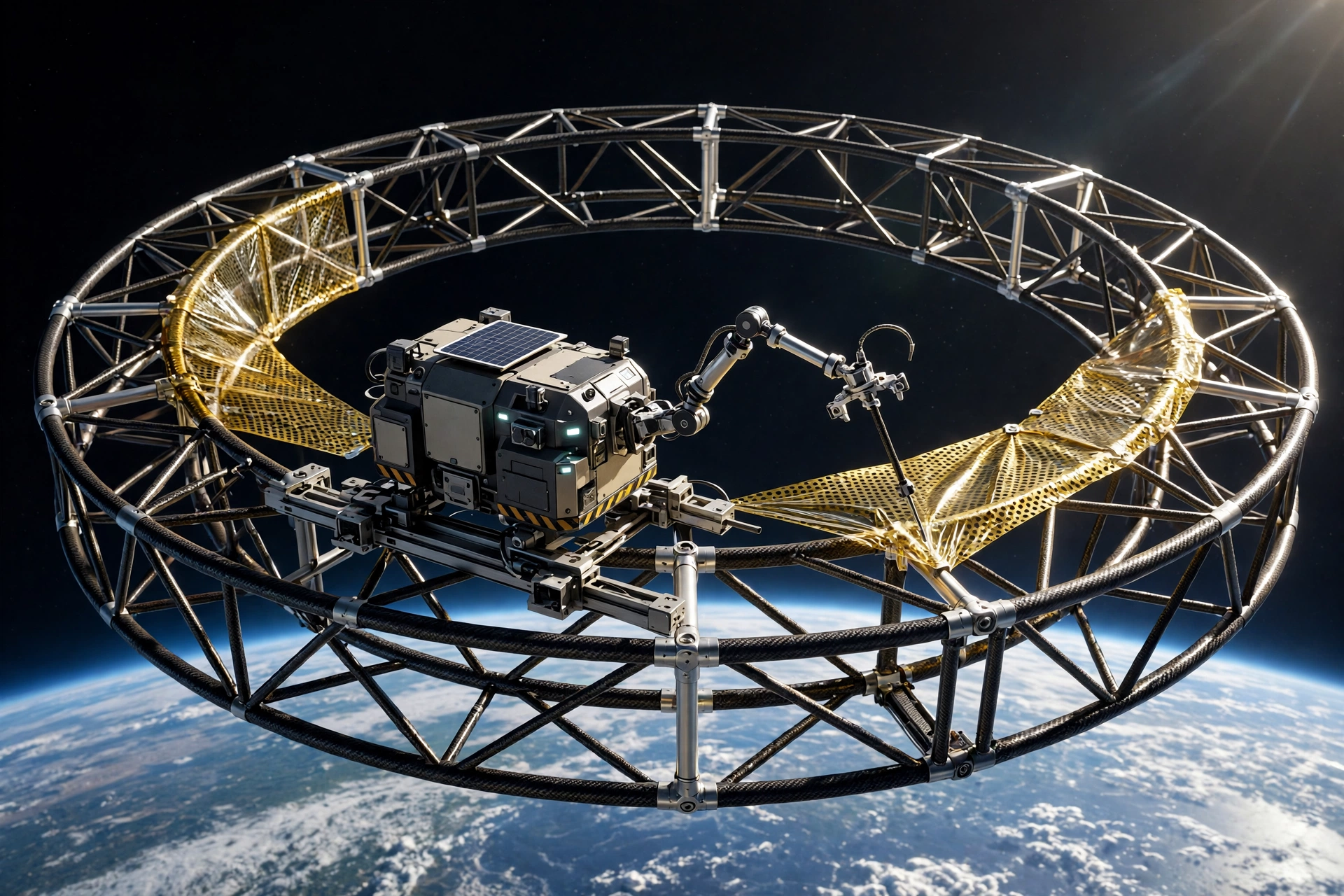
Seven months in orbit bought one bay. On November 5, 2026, Caltech and DARPA announced that ASTRA, a gantry robot in a box of roughly one cubic meter, had assembled a section of a reflector antenna in low Earth orbit with no astronaut help. It was the first structure ever built in space by a machine alone, and one bay took 220 days while eleven bays would make a 1.4-meter antenna. Run the division: at the pace ASTRA demonstrated, a 100-meter dish, the size its host company says comes next, takes 474 years. ASTRA proved the idea works and measured how far it has to go.
What Actually Happened
ASTRA, the Autonomous In-Space Tensioned Reflector Assembly, flew as part of DARPA's NOM4D program, Novel Orbital and Moon Manufacturing, Materials, and Mass-efficient Design, which DARPA started in 2022 to ferry raw materials to orbit for manufacturing. Caltech's payload was one of only two projects to reach phase three, the orbital demonstration, launching March 30, 2026, from Vandenberg as one of ten payloads aboard Momentus's Vigoride 7 on a SpaceX Transporter-16 rideshare.
Inside a box of one cubic meter, a simple gantry robot slides along three linear axes, pulling composite-fiber struts and aluminum joints from motorized dispensers, joining them into identical truss bays, attaching a perforated Kapton film held in tension by springs, and pushing each finished bay out. Two bays were prebuilt on Earth and deployed in orbit, and the robot built a third bay itself, with the film attached. No astronaut touched a strut, and no operator on the ground drove the arm in real time.
DARPA program manager Andrew Detor stressed there are "no complicated robotics or advanced algorithms" here, just solid engineering combined in a way that scales, and Caltech's small team designed, built, tested, and delivered the payload in under twelve months, fifteen months from the decision to attempt an orbital demo to launch.
The Packing Math Nobody Ran
Nobody asked what the numbers imply at scale, so here is the arithmetic, starting with the geometry: ASTRA's reflector is a ring truss, and a ring's bay count scales with its circumference, so doubling the diameter doubles the bays, tripling it triples them, and stowed volume follows bay count, which means it scales linearly with diameter rather than with area, the whole trick, because every folded structure in history has scaled with area.
| Structure | Diameter | Bays | Stowed volume |
|---|---|---|---|
| ASTRA demo | 1.4 m | 11 | ~1 m³ |
| Momentus next dish | 100 m | ~786 | ~71 m³ |
| Detor's kilometer scale | 1,000 m | ~7,860 | ~714 m³ |
| One Starship payload bay | 8 m wide | n/a | ~1,000 m³ |
Eleven bays per 1.4 meters works out to 7.86 bays per meter of diameter, so a 100-meter dish needs about 786 bays, stowed in roughly 71 cubic meters of parts. A kilometer-scale structure needs about 7,860 bays in roughly 714 cubic meters, which fits inside a single Starship payload bay, a cylinder about 8 meters across and 17 meters tall holding about 1,000 cubic meters. Put the same 100-meter dish through the folding route and the comparison collapses, because JWST's 6.5-meter mirror needed a 4.57-meter fairing and a sunshield folded twelve times, while a 100-meter folded mirror would need a fairing about 22 times wider than the one that carried Webb, and no such fairing exists, so folding hits a geometric wall while building does not.
Scale the other direction: ASTRA's reflector covers π × 0.7², about 1.54 square meters, 6.2 percent of JWST's 25, yet an ASTRA-style ring at JWST's 6.5-meter diameter takes about 51 bays and covers about 33.2 square meters, a third more aperture than Webb. One caveat: ASTRA's mesh reflects radio waves, while Webb's mirror reflects infrared light, so the two are not the same instrument.
The Calendar Math
Now the other side of the ledger: ASTRA spent 220 days in orbit, from March 30 to November 5, and built one bay, and treating that as the demonstrated calendar pace turns the numbers brutal.
| Target | Bays | Days | Years |
|---|---|---|---|
| Full ASTRA antenna | 11 | 2,420 | 6.6 |
| 100-meter dish | ~786 | ~172,920 | ~474 |
| 100-meter dish in one year | ~786 | 365 | 1 |
Finishing the 11-bay demo antenna at the demonstrated pace would take 6.6 years, and ASTRA's mission ends in December 2026, so Caltech says flatly it will not finish, while a 100-meter dish takes 474 years. Flip it around: to build a 100-meter dish in a single year, the system must complete about 2.15 bays per day, one bay every eleven hours, roughly 470 times faster than the calendar rate ASTRA just demonstrated. That factor of 470 is the number the program must close, a rate problem rather than a physics problem, because rates can be engineered while physics cannot be negotiated with.
The Bottleneck Was a Radio, Not an Arm
Before concluding that the robot is slow, look at what actually set the pace. Caltech says the team had seven or eight communication windows a day, about fifteen minutes each, roughly two hours of contact in every twenty-four, and over 220 days that is 410 hours of ground contact against 5,280 hours elapsed, under 8 percent of the mission. Whenever the robot hit a surprise, engineers reproduced the fault on a ground twin in a Caltech lab, worked out a fix, and waited for the next window to uplink it, so ASTRA spent more than 90 percent of its mission out of contact with the ground team.
That reframes the 470-times gap, since ASTRA's mechanical cycle, the time its arm needs to fetch a strut and join it, was never the constraint; human-in-the-loop debugging was, so give the next builder a continuous link, or better, enough onboard autonomy to solve its own surprises, and the calendar rate could jump by an order of magnitude with the same hardware.
What the Old Ways Cost
Space structures have always arrived by folding them on Earth and unfurling them in orbit, or by sending them up in pieces over many launches and bolting them together by hand, and both routes have now hit their limits in public, leaving ASTRA as the first attempt at a third.
| Approach | Largest structure | Flights | Spacewalk hours |
|---|---|---|---|
| Manual assembly (ISS) | 94-m truss | 42 assembly flights | 1,548 |
| Folding (JWST) | 6.5-m mirror, 21-m sunshield | 1 (Ariane 5) | 0 |
| Robotic assembly (ASTRA) | 1.4-m antenna, partial | 1 rideshare slot | 0 |
ISS assembly took 42 flights, and through December 2021 astronauts logged 245 spacewalks totaling 1,548 hours on assembly and maintenance. JWST avoided all of that by folding, at the price of a $10 billion spacecraft whose deployment carried hundreds of single-point failures and a hard ceiling, since nothing wider than the fairing can ever fly folded. ASTRA's bay cost zero spacewalk hours and one rideshare slot as one of ten payloads, and for scale, a 94-meter ASTRA-style ring would need about 739 bays stowed in roughly 67 cubic meters, one payload's worth of parts instead of 42 flights, though rings and linear trusses are different hardware, so treat it as a logistics comparison.
What You Can Do
If you run a space program, stop treating the fairing as the only constraint on structure size and start budgeting for on-orbit assembly now; the first organization to close the rate gap owns the kilometer-scale market. If you invest in space, watch the second data point: the University of Illinois team in the same program flies a resin-curing experiment to the space station later this year, and that test decides if ASTRA was a program or a demo. If you are a student choosing a specialty, note what mattered most here: no complicated robotics, no advanced algorithms, just solid mechanical engineering, careful testing, and operations under a two-hour-a-day radio link, built by a small Caltech team in under a year, a career path with a shorter runway than most people assume.
Limitations
No peer-reviewed paper supports this announcement; the figures come from releases by Caltech, DARPA, and Momentus, and any of them could be revised. ASTRA's payload mass and per-bay cycle time were never disclosed, so 220 days is calendar time in orbit, not mechanical build time, and the 474-year extrapolation is a bound on the demonstrated calendar pace. Stowed-volume scaling assumes identical bays and linear growth with diameter, while real structures need thicker members at larger scales, so 71 and 714 cubic meters are lower bounds. Starship's roughly 1,000 cubic meters is SpaceX's figure for a vehicle still in development. ISS spacewalk totals cover assembly plus maintenance through December 2021, not truss assembly alone, and are used only for the logistics contrast. ASTRA's reflector film was attached to a partial truss, and no signal has passed through the antenna, so "built a structure" means the frame, not a working instrument.
The Strongest Case Against This Analysis
One bay in seven months is not a construction industry. It is a lab demo that happened to be in orbit: ASTRA built a 1.4-meter frame that is not a working antenna, the mission ends with eight of eleven bays unbuilt, and the team itself says the design needs simplifying before it could support anything larger. Manual assembly, for all its cost, has built a 94-meter truss that holds a station together, and folding has flown a $10 billion telescope that works. ASTRA has proved a mechanism, not a method. Its 470-times rate gap is not a detail, and the kilometer-scale structures in Detor's quote remain a press-release future until a second, faster builder flies, and all of that is fair. None of it changes the two numbers that matter: packing scales linearly where folding scales with area, and the bottleneck was a radio link, which is fixable. A demo that proves the geometry and measures the gap beats one that only proves the geometry.
The Bottom Line
For sixty-nine years, getting a large structure into space meant folding it to fit a rocket or sending astronauts up to bolt it together. On November 5, a robot in a one-cubic-meter box built a piece of a structure in orbit by itself. It built one bay in 220 days, and at that pace the 100-meter dish takes 474 years. Both facts are true at once, and the gap between them is the story: the geometry says kilometer-scale structures fit in a single launch, while the calendar says the builders must get roughly 470 times faster. ASTRA proved the idea; now someone has to prove the rate.
Related
- Google's First AI Answer From Orbit Was a Haiku. Its 4 TPUs Average 14-19% of One H100.
- Stopping at Mercury Costs 17.15 km/s. Pluto Costs 15.50. BepiColombo Just Paid the Bill.
- Voyager 1 Just Crossed One Light-Day. A Reply Now Takes 48 Hours.
Sources: Caltech, Caltech Robotic Space Demo Successfully Builds in Space (Nov. 5, 2026); DARPA, NOM4D program demonstrates automated in-space assembly (Nov. 5, 2026); Momentus Inc., Momentus Reports Strong Progress of in-Space Robotic Assembly (Nov. 12, 2026); NASA, International Space Station Facts and Figures; NASA, James Webb Space Telescope Fact Sheet; List of International Space Station spacewalks; packing, rate, contact-time, and aperture calculations are the author's own.