California Put 1,211 AI Cameras in Its Mountains. They Detected 636 Wildfires Before Anyone Called 911.
ALERTCalifornia's network of rotating cameras, run by UC San Diego and CAL FIRE, now spots smoke in roughly 60 seconds and detects more than a third of fires before the first human report. At $37,736 per preemptive detection on a $24 million total investment, the economics are not subtle. Arizona, Colorado, and at least five other western states are deploying similar networks, turning a California pilot into a continental-scale early warning system.
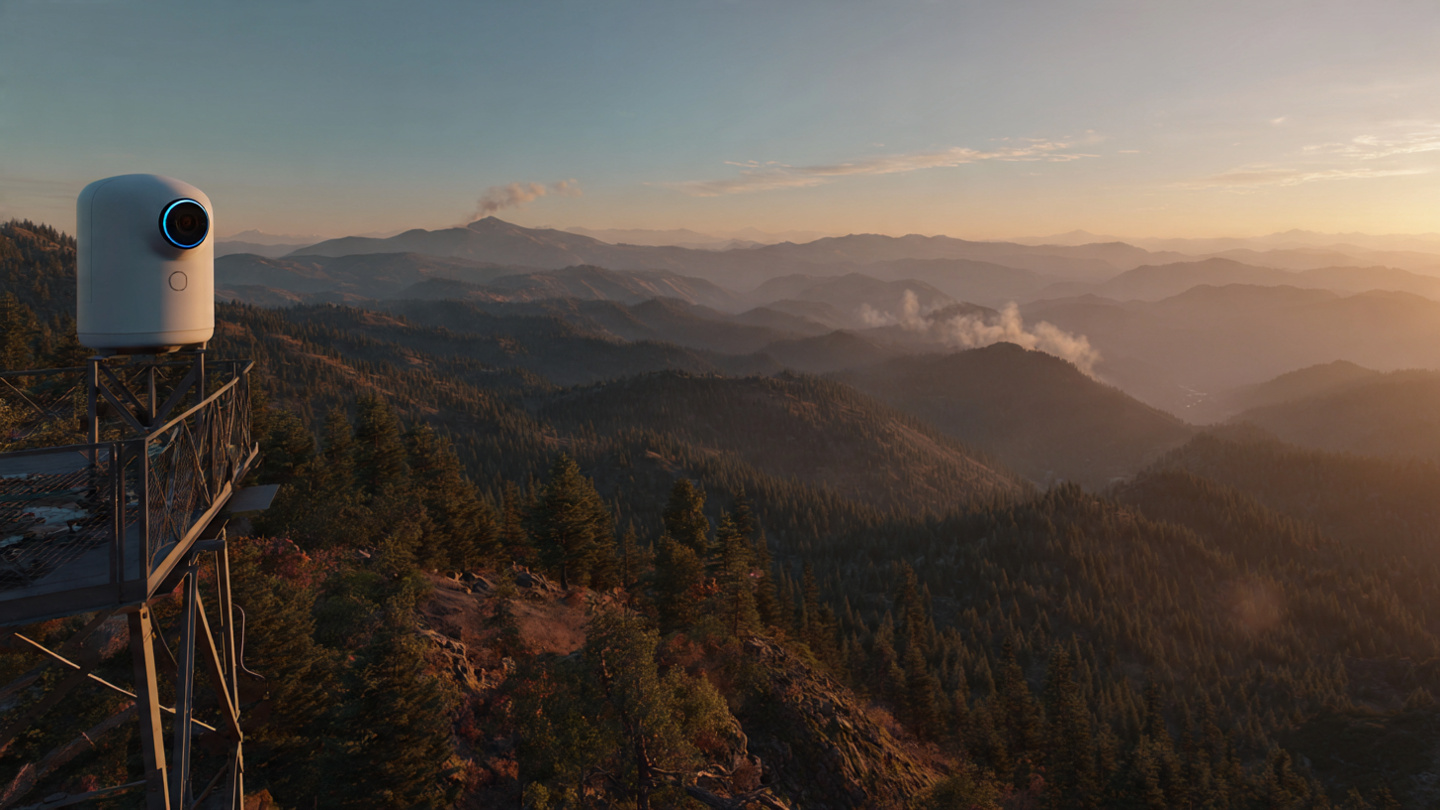
Thirty-eight percent. That is the share of California wildfires now detected by an AI camera before any person dials 911. Not by a pilot on approach. Not by a hiker. By a camera, rotating on a mountaintop, running inference on every frame. The number comes from CAL FIRE's operational data covering 1,668 fires aided since 2019, of which 636 were spotted by machine vision alone, with zero human input, often while the nearest person was asleep or miles away. Each camera rotates 360 degrees every two minutes, analyzes every frame against a smoke-detection model trained on thousands of confirmed fire events, and flags anomalies for human dispatchers within approximately 60 seconds of first smoke.
It is called ALERTCalifornia. In 2019, the Scripps Institution of Oceanography launched it as 35 cameras funded with $24 million from state emergency preparedness budgets. By late 2025, the network had grown to 1,211 cameras spread across every one of CAL FIRE's 21 dispatch centers, each unit covering 60 to 120 miles of terrain, operating around the clock, through darkness, through fog, through smoke that would blind a human lookout at half the distance. It never takes a lunch break. Never gets tired at 3 a.m. Never calls in sick during red flag warnings when it matters most.
The Cost Per Early Catch
Here is a calculation nobody seems to have run. Divide the total program cost by the number of fires caught before any 911 call: $24 million divided by 636 fires equals $37,736 per preemptive detection, a figure so small it barely registers against the cost of what it prevents. That number deserves context, because wildfire suppression costs scale exponentially with delay.
Under moderate conditions, a wildfire roughly doubles in size every 10 to 15 minutes, a rate of growth that means the difference between a 60-second detection and a 60-minute detection is not a matter of degree but a matter of whether the fire remains a manageable incident or becomes a disaster that consumes neighborhoods. A fire caught at sub-acre size, which is what a 60-second detection window makes possible, can be contained by one or two engine crews at a cost of $5,000 to $10,000. Let that same fire burn undetected for 45 additional minutes and it reaches 10 or more acres, requiring full incident response at $300,000 to $500,000 per event, based on USDA Forest Service suppression cost data averaging $3,000 to $4,000 per acre for contained wildfires.
Now apply that to the 636 fires ALERTCalifornia caught early. Assume conservatively that only 10% of those would have escalated to major incidents without early detection. That gives us 63 fires where the difference between a sub-acre catch and a 10-acre escape represents approximately $290,000 in avoided suppression cost per incident, yielding roughly $18.3 million in suppression cost avoidance from a $24 million total investment. Nearly broke even on suppression savings alone, before counting a single home saved, a single acre of forest preserved, or a single life protected.
For comparison: the Palisades and Eaton fires in January 2025 caused over $250 billion in estimated damage. One prevented conflagration of that scale would fund ALERTCalifornia's current network at the present budget for more than 10,000 years.
What the Cameras Replaced
California once maintained roughly 100 manned fire lookout stations, staffed by seasonal workers earning $15 to $20 per hour who watched the horizon for smoke during daylight hours from June through November. Many of those stations were decommissioned over the past two decades as state budgets contracted. Human lookouts had structural limits that no amount of funding could fix: a person cannot see at night, cannot maintain attention for more than a few hours without fatigue degradation, and cannot cover more than the visible horizon from a single fixed point, which in mountainous terrain means 15 to 30 miles in good conditions.
Those 1,211 AI cameras now cover more territory than the historical 100-station human network ever did, at any staffing level, during any era of California fire management. Each camera covers 60 to 120 miles versus a lookout's 15 to 30, operates 24 hours versus 10, and works 365 days per year versus roughly 150 during fire season. Per-camera lifetime cost: approximately $19,800, less than one year's fully loaded salary for a seasonal fire lookout.
| Metric | Human Lookout (Historical Peak) | ALERTCalifornia AI Network |
|---|---|---|
| Stations / Cameras | ~100 | 1,211 |
| Coverage per unit | 15-30 miles | 60-120 miles |
| Operating hours | ~10 hrs/day, daylight only | 24/7/365 |
| Season | June-November (~150 days) | Year-round (365 days) |
| Detection speed | Minutes to hours | ~60 seconds |
| Night capability | None | Full (IR-capable) |
| Total cost | ~$3-5M/year at full staffing | $24M total since 2019 |
The National Expansion
California is no longer alone, and the expansion is accelerating. An Associated Press investigation in May 2026 documented multi-state adoption of AI wildfire cameras across the western United States, with Arizona, Colorado, Oregon, Washington, Montana, Idaho, and Nevada either deploying or actively procuring systems.
Arizona Public Service, the state's largest electric utility, has installed over 40 Pano AI cameras and is expanding to 71 total. One of those cameras detected a 7-acre blaze 45 minutes before the first 911 call, confirming that ALERTCalifornia's early-detection advantage is replicable across different terrain and weather conditions. Xcel Energy in Colorado has deployed 126 cameras with plans to cover seven states. Federal funding backs the expansion: $5 billion over five years for wildfire preparedness, with AI detection systems eligible for a substantial share of that allocation.
Pano AI, the private company supplying cameras to multiple utilities, operates a distinct but complementary model to ALERTCalifornia's academic partnership with Scripps. Where ALERTCalifornia uses state-funded infrastructure and university-developed algorithms, Pano sells a commercial product to utilities that face wildfire liability exposure measured in billions. Pacific Gas & Electric's equipment sparked the 2018 Camp Fire that killed 85 people and cost the company $13.5 billion in settlements. At that scale of exposure, a camera network costing tens of millions is rounding error on the insurance actuarial table.
The 62% Gap
If 38% of fires are caught before 911, that means 62% are still reported by humans first. That gap is not a failure but a measure of how much room remains for improvement, and the trajectory suggests the ceiling is far higher than where the network sits today.
Several factors constrain the current detection rate. Camera placement follows existing infrastructure like communication towers and ridgelines, leaving valleys and canyons with coverage gaps. Smoke detection works best on clear days. Fog, low clouds, and dust can mimic smoke signatures, producing false positives that erode dispatcher trust if the algorithm is tuned too aggressively. Fires that start under dense canopy may not produce visible smoke until they have already spread beyond the initial ignition point, and no camera can see through a forest canopy no matter how frequently it rotates.
Reaching 50% or even 60% pre-911 detection likely involves three advances already underway: denser camera placement in high-risk corridors, satellite thermal imaging integration to catch fires that cameras miss because of terrain occlusion, and improved ML models trained on larger datasets that can distinguish smoke from fog with higher confidence in marginal conditions. ALERTCalifornia's expansion from 35 to 1,211 cameras moved the detection rate from essentially zero to 38%. Not linear. But not plateaued either.
The Strongest Case Against Optimism
A 2024 PLOS ONE study using machine learning to estimate the impact of detection times on wildfire suppression costs in Western Canada found that detection delays account for approximately 3% of total suppression costs, and that reducing delays by one hour saves roughly 0.25% of those costs. Take the number at face value and early detection sounds marginal.
But that research measured delays for fires that were already in the reporting pipeline, where someone had noticed smoke and the question was merely how quickly the report reached dispatchers. ALERTCalifornia's 636 pre-911 detections represent a categorically different situation: fires in remote locations where no human was present to report anything, where the detection delay without cameras would not have been minutes but potentially hours. Different phenomena entirely. Conflating them understates the value of camera networks deployed specifically in areas where human observation is sparse or nonexistent.
Limitations
This analysis relies on publicly reported program data that bundles infrastructure, installation, networking, and maintenance costs into a single $24 million figure. We cannot isolate the AI component cost from the physical camera and communications hardware. Nor does the 636-fire figure specify how many of those fires would have been reported by humans within minutes regardless, meaning some fraction of the "preemptive" detections may have offered only marginal time advantage rather than the 45-to-60-minute window that represents the highest-value scenario. Fire behavior doubling times vary enormously with terrain, fuel moisture, wind speed, and relative humidity, so the suppression cost avoidance estimate of $18.3 million assumes moderate conditions and should be treated as an order-of-magnitude approximation rather than a precise accounting. We also have no data on how many of the 636 early catches actually resulted in measurably smaller final fire perimeters, because CAL FIRE does not publish counterfactual analysis for individual incidents.
What You Can Do
If you live in a wildfire-prone area, check whether your county or utility has deployed AI detection cameras by searching your local CAL FIRE unit's website or contacting your electric utility's wildfire safety division. Know that camera detection is not a substitute for defensible space: maintaining 100 feet of cleared vegetation around your home remains the single most effective thing a homeowner can do, regardless of how fast a camera spots a fire three ridges away.
If you work in municipal or county government in a western state, the federal $5 billion wildfire preparedness allocation includes funding pathways for detection infrastructure. The grant application window for FEMA's Building Resilient Infrastructure and Communities program reopens annually in September. ALERTCalifornia's published operational data provides the cost-effectiveness case that federal grant reviewers look for.
If you work in insurance, the actuarial case for premium discounts in AI-monitored wildfire zones is sitting in CAL FIRE's data waiting for someone to model it. A 45-minute early detection advantage translates directly into reduced structure loss probability, and the first insurer to offer monitored-zone discounts will have a competitive advantage in a state where seven major carriers have already exited the market.
The Bottom Line
California spent $24 million over seven years and got a system that catches more than a third of wildfires before any human notices them, in a state that lost over $250 billion to fire in a single month of 2025. Cost per early detection: less than a mid-range pickup truck. Seven other states are buying in. It is not experimental, not promising, not on the horizon, but running right now on 1,211 mountaintops, rotating every two minutes, watching for smoke that human eyes would not see for another 45 minutes. Whether the network expands fast enough to matter for the next catastrophic fire season is the only remaining question, and it is a question about procurement speed, not technical capability.