🌍 Climate
A 330-Megawatt AI Data Center Beats the Industry's Water Efficiency 4-to-1. It's Still Being Sued for 287 Million Gallons.
Backing the water efficiency out of a June 2026 lawsuit gives 0.38 to 0.63 liters per kilowatt-hour, against an industry average of 1.9. Efficiency was never the dispute. The dispute is 786,000 gallons a day from a river that serves 40 million people.
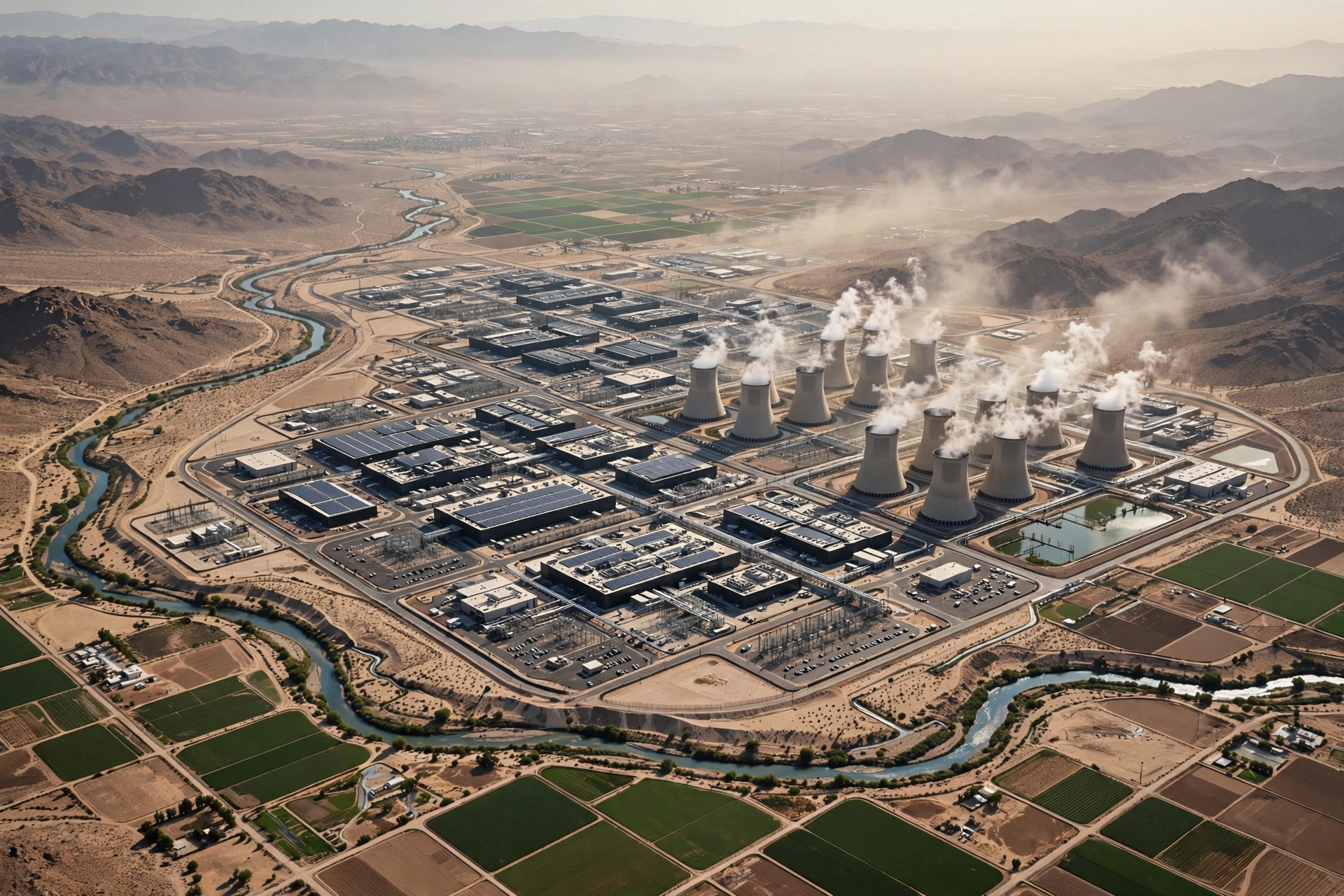
287 million gallons. That is the volume of water at the center of a lawsuit filed in June 2026 by Imperial Valley Computer Manufacturing, the developer behind a planned 330-megawatt AI data center in California's Imperial Valley. It had promised the project would not touch Colorado River water. Then the cities of El Centro and Imperial rejected its bids for recycled wastewater, the Imperial Irrigation District denied its request, and the developer sued for river access instead.
Run the number in the lawsuit backward and something odd appears. 287 million gallons a year converts to 1.086 billion liters, and a 330-megawatt facility running around the clock draws 2.89 billion kilowatt-hours a year, or about 2.02 billion at a realistic 70 percent utilization, which is the denominator the whole argument stands on. Divide water by energy and the implied water usage effectiveness lands between 0.38 and 0.63 liters per kilowatt-hour, depending on how hard the building actually runs.
Set that against the industry's own disclosures and the picture gets stranger:
| Operator | Water usage effectiveness (L/kWh) | Scope |
|---|---|---|
| Imperial Valley 330 MW (implied from lawsuit) | 0.38–0.63 | Consumption, estimated |
| Amazon (2025) | 0.12 | Withdrawal |
| Meta (2024) | 0.18 | Fleet |
| Microsoft (FY2025) | 0.27 | Fleet |
| Industry average | ~1.9 | Data Center Knowledge |
So the facility at the center of one of the ugliest water fights of the AI buildout is somewhere between three and five times more water-efficient than the average data center on earth. Not the best in its class, nowhere near the worst, and it lost anyway.
Because efficiency was never the metric that mattered in Imperial County. Researchers at the Next10 institute scored the project tract's water scarcity at 5.0 out of 5, the maximum possible. Colorado River water reaches 40 million people across seven states while farmers hold roughly 80 percent of California's allocation, which is why 786,000 gallons a day, the daily rate implied by the lawsuit, reads less like an engineering specification and more like a claim check on a river that is already overdrawn. Residents saw it that way too, and at a March meeting covered by KPBS the crowd turned unruly when the project came up and the board went into recess.
On September 21, 2026, the European Commission proposed the first disclosure regime that seems to understand this. Data centers above 500 kilowatts would have to publish energy and water efficiency under an EU-designed label and, crucially, disclose the relationship between their water use and local water stress, plus whether they can feed waste heat back to the local energy system. Efficiency and geography, printed on the same label. Brussels is not doing this out of curiosity: EU data center capacity is expected to more than double by 2030, from 12 to 28 gigawatts, and data centers already consume about 2.5 percent of EU electricity.
Run the EU's own numbers forward. 28 gigawatts at 70 percent utilization is 171.7 billion kilowatt-hours a year. At a respectable 0.5 liters per kilowatt-hour that is 22.7 billion gallons a year, and at the industry average of 1.9 it is 86.2 billion, a gap that shows what the efficiency number is actually worth once you multiply it by the buildout. For scale, Google's entire global fleet consumed 10.9 billion gallons in 2025, up 34 percent in a single year. Europe's 2030 fleet, built at average efficiency, would drink roughly eight Googles.
None of this makes the efficient operators villains. Google's infrastructure chief Bikash Koley notes that water cooling cuts a data center's energy use by roughly 10 percent compared with air cooling, which is a genuine climate tradeoff: every liter saved can mean more electricity burned. Closed-loop systems, which recirculate water instead of evaporating it, consume only 5 to 10 percent of what they withdraw. Edged Energy's new campuses claim a water usage effectiveness of 0.00 outright, using closed-loop cooling with no water consumed for heat rejection. The technology exists, but it simply costs more and most developers do not volunteer for it.
What kind of water? About 57 percent of the water data centers draw directly is potable, treated drinking water, according to research published in Nature. That single fact explains more community anger than any efficiency ratio ever will. Nobody riots over liters per kilowatt-hour. People riot over drinking water going to servers.
Limitations, stated plainly. Water reporting mixes two different measurements: withdrawal, meaning what a facility takes in, and consumption, meaning what evaporates and never comes back. Amazon publishes a withdrawal-based figure; evaporative cooling consumes 70 to 80 percent of withdrawal, while closed-loop systems consume 5 to 10 percent, so the company table above is not perfectly apples-to-apples. My Imperial Valley calculation assumes the 287-million-gallon lawsuit figure represents steady annual consumption inside a 60 to 100 percent utilization band. If the figure is a requested allocation cap rather than metered use, the true efficiency could be better. Google's 10.9 billion gallons includes offices, not data centers alone. And the EU rule is a proposal with a two-month objection window, not law.
The strongest case for the industry comes from Koley as well: American data centers use less than 1 percent of the water Americans spray on their lawns each year. He is right, and the number deserves respect rather than a sneer. Nationally, data center water is a rounding error; nationally, the AI buildout's water footprint is not the crisis. But nobody drinks nationally. Water is withdrawn from a specific river, in a specific basin, during a specific drought. His lawn comparison is true and beside the point in exactly the way a national average always is when the fight is local.
What you can do
If a data center is proposed near you, ignore the efficiency ratio at the hearing and ask three numbers in this order: absolute gallons per day, the source (potable or recycled), and the basin's water-stress score. Ask whether the cooling is evaporative or closed-loop, because the difference is roughly a factor of ten in consumption. Support recycled-water mandates for new builds; Imperial Valley's original plan was a dedicated recycled-water pipeline from the city treatment plant, and the fight started when that plan died. And watch the EU label process: whatever Brussels finalizes will become the template other jurisdictions copy.
The Bottom Line
Liters per kilowatt-hour tells you how clever the engineering is. Gallons per day, from which river, tells you whether the neighbors will fight it. Developers spent a decade optimizing the first number. Lawsuits are all about the second. The EU just proposed printing both on the same label, which is the first honest piece of paperwork the water fight has produced.