Small Clinics Pay $45 a Month for Medical Waste Pickup. The Market Leader Was Fined $295 Million for Overcharging Them
A dentist's red bag costs $45 a month to dispose of, and the company that picked it up set its billing software to raise prices 18 percent twice a year for its smallest customers. The market it dominated is worth $5.27 billion in the United States alone, and the small generators who pay the highest per-pound prices have never had a marketplace of their own.
The Problem
In 2018, a federal judge gave final approval to a $295 million settlement paid by the largest medical waste company in America to its own smallest customers. The suit alleged that Stericycle's billing software, a system called Tower, was set to raise prices on "small quantity" customers by 18 percent, up to twice a year, even when their contracts promised fixed prices. Those small customers, dentists, veterinarians, small clinics and labs, made up 97 percent of Stericycle's customer base. The settlement covered 254,400 of them, and the plaintiffs put total overcharges at $608 million.
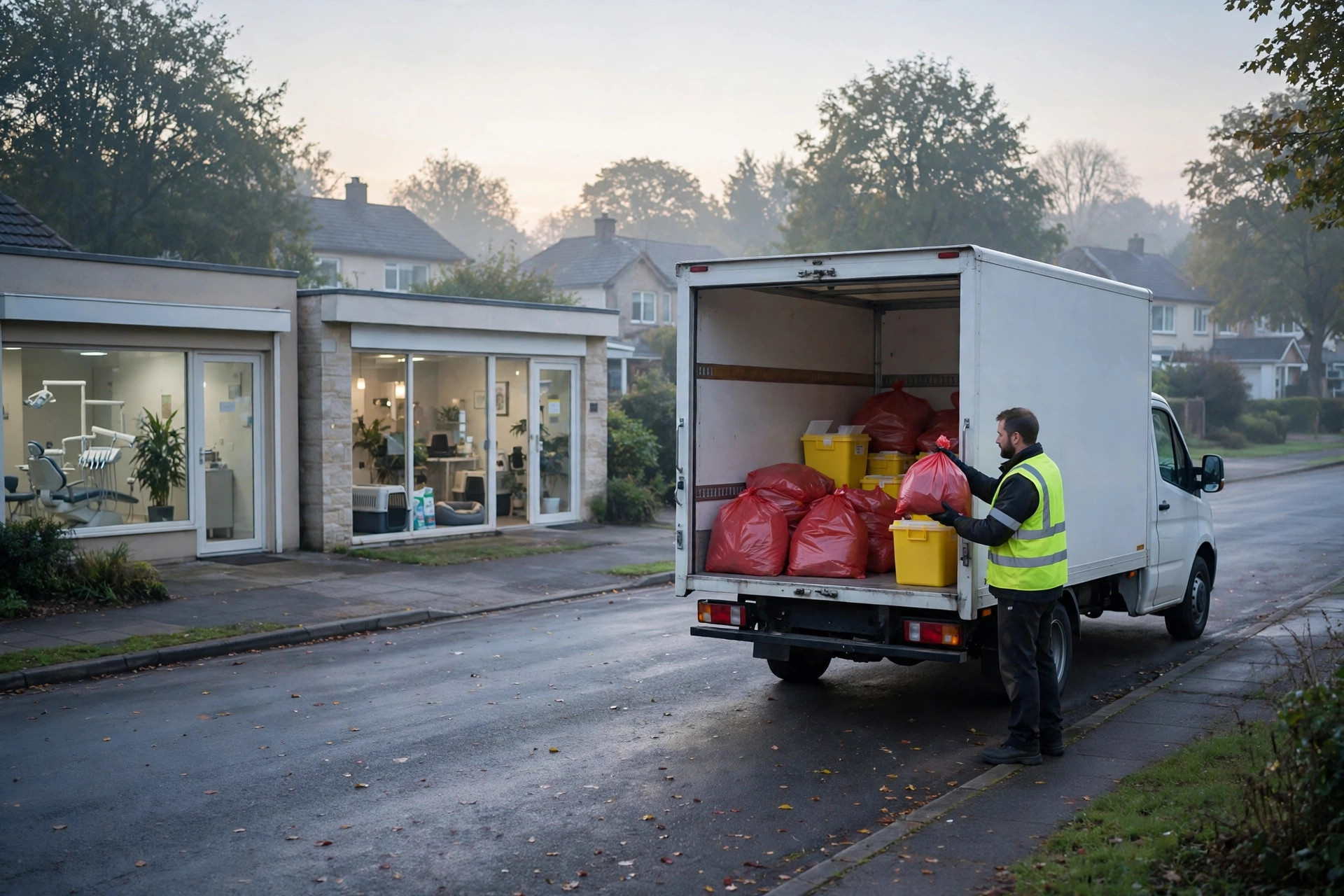
A small generator is any facility that produces regulated medical waste in small amounts: a dental office with one red bag a month, a veterinary clinic with a sharps container and a bag of pathological waste, an urgent care center, a dialysis clinic, a tattoo studio. The waste itself is not complicated. Sharps go in a puncture-proof container, blood-soaked material goes in a red bag, and a licensed hauler takes both to an autoclave or an incinerator. What is complicated is everything around it. There is no federal medical waste program. Regulation sits with the states, all fifty of them, layered over federal transport rules from the Department of Transportation and worker-safety rules from OSHA. A dental office in Texas and a dental office in California follow different manifest forms, different storage limits, and different registration requirements, and the office manager handling the paperwork is usually also the person answering the phones.
Small generators also pay the worst prices in the industry. A hospital pays $0.30 to $0.80 a pound because it ships by the ton. A small practice pays by the container, and the container price is whatever the hauler quotes. MedPro Disposal, one of the few brokers that publishes prices, charges about $45 a month for a dental office, $59 for a general practice, and $100 for an urgent care clinic, with a median of $108 for the first container on a pickup. Those are the transparent prices. The opaque ones are higher, and for years the market leader raised them automatically. The settlement required Stericycle to cap increases at 6 percent a year for existing customers and 8 percent for new ones, but a cap is not a market. Nobody publishes a price, nobody bids against the incumbent, and a clinic that wants a second quote has to call around and wait for a salesperson.
The largest medical waste company in America treated its smallest customers as a pricing machine.
The volume behind the problem is large. American hospitals generate about 5.9 million tons of waste a year, more than 29 pounds per bed per day, across more than 6,000 hospitals. The World Health Organization estimates that about 15 percent of healthcare waste is hazardous, infectious, toxic, or radioactive. The Centers for Disease Control and Prevention estimates that needlestick and other sharps injuries expose about 385,000 healthcare workers a year to bloodborne pathogens. Hospitals are the visible part of the stream. The invisible part is the hundreds of thousands of small facilities that generate a container or two a month each, pay the highest unit prices in the system, and have no say in the price at all.
Market Size
Original TAM calculation: the United States medical waste management market was $5.27 billion in 2024, projected to reach $9.87 billion by 2034 at a 6.5 percent compound annual growth rate. A second estimate puts the global market at $15.1 billion in 2024, with North America at $5.2 billion, which corroborates the US figure. Sharps disposal alone is a $2.15 billion global services market in 2025, projected to reach $3.29 billion by 2032. Those are the TAM anchors. The SAM is the small-generator slice, and it has to be built from the bottom up, because nobody reports it.
| Segment | Locations (US) | Typical monthly spend | Annual segment spend |
|---|---|---|---|
| Dental offices | 135,665 | $45 | $73.3M |
| Veterinary practices | 26,300 | $45 | $14.2M |
| Urgent care centers | 14,495 | $100 | $17.4M |
| Ambulatory surgery centers | 6,468 | $100 | $7.8M |
| Dialysis centers | 8,000 | $59 | $5.7M |
| Total SAM (five segments) | 200,928 | ~$118.3M |
Location counts come from the Census Bureau via the American Dental Association (135,665 dental office establishments in 2023), Vertical IQ (26,300 veterinary practices), the Journal of Urgent Care Medicine (14,495 urgent care centers as of July 1, 2026), and the Ambulatory Surgery Center Association via Becker's (6,468 Medicare-certified surgery centers as of March 2025). Monthly spend figures are MedPro Disposal's published November 2026 prices for 2027 budgeting. Veterinary practices are priced at the dental rate as a stated assumption, which is conservative, since vets also generate pathological waste that costs more to dispose of. Dialysis centers are priced at the general-practice rate, also an assumption. The SAM counts five segments only. It excludes physician offices, tattoo and body-art studios, independent laboratories, nursing homes, and home-health agencies, so the true small-generator SAM is larger, probably by half again. SOM in year three: 1,800 accounts across three metros at an average of $62 a month, or $1.34 million in annual billings, plus 5,000 mail-back sharps kits at $65, or $325,000, plus 500 compliance subscriptions at $29 a month, or $174,000. Total year-three revenue is about $1.84 million. That is a small business by venture standards, and this article says so plainly in the Limitations section. The case for building it is that the customers are concentrated enough to reach, the incumbent just spent $295 million admitting how it treated them, and nobody else is building the coordination layer.
The Product
A neutral route-density marketplace and compliance engine for small-quantity medical waste generators, built around the pickup route rather than around any single hauler. Five modules:
- Published price index: Per-container prices by ZIP code, pickup frequency, and waste type, published in the open. A generator sees the price before signing anything, and the index itself is the trust product. Contracts are month to month. No automatic price increases, no auto-renewal traps, no cancellation window measured in days.
- Shared-route marketplace: Regional haulers post route capacity, days, and service areas. The platform clusters nearby generators onto the same truck, so a hauler that used to drive to one dental office now serves eight on the same street. Generators join a route instead of buying a dedicated stop, and the price falls as the route fills.
- Compliance engine: A state-by-state rules database covering manifest forms, storage limits, registration deadlines, and training requirements, with digital chain of custody from pickup to treatment. OSHA bloodborne pathogens training is built in. The office manager gets a dashboard that shows what is due, what was picked up, and what the certificate says, instead of a drawer of paper forms.
- Mail-back sharps kits: DOT-approved mail-back kits from $45 for a one-quart container to $499 for a 28-gallon container, for the lowest-volume generators and for the millions of people who use sharps at home. Mail-back is the on-ramp: a generator that starts with a kit is a route customer later.
- Reusable container program: Reusable sharps containers on a swap model, following the Daniels Health SHARPSMART approach, which cuts container cost and plastic waste for mid-volume accounts. The container is a retention product. A generator with the platform's containers on the wall is not shopping for a hauler every quarter.
Unit Economics
| Metric | Value |
|---|---|
| Average monthly bill per account | $62 |
| Hauler wholesale cost per account | $40 |
| Gross profit per account per month | $22 |
| Gross margin on brokered billings | 35% |
| CAC per account | $180 |
| Average account life | 48 months |
| LTV (gross profit) | $1,056 |
| LTV:CAC ratio | 5.9:1 |
| CAC payback | 8.2 months |
| Startup cost | $1.21M |
| Break-even | Month 26 |
Methodology note: LTV uses gross profit only: $22 a month times 48 months equals $1,056. The 48-month life implies about 2 percent monthly churn, which is optimistic for small businesses and is the number most at risk in this table. CAC of $180 reflects inside sales plus association partnerships with dental and veterinary groups, where one presentation reaches hundreds of practices. The $62 average bill blends dental offices at $45, general practices at $59, and urgent care centers at $100, weighted toward the smaller accounts that dominate the count. Break-even means monthly operating break-even: gross profit across brokered billings, mail-back kits, and compliance subscriptions covering the $55,000 monthly burn, reached around month 26 on a linear ramp to 1,800 accounts. Startup cost of $1.21 million funds the build and exactly 12 months of burn, so cash is zero at month 12 and the plan needs about $200,000 of additional capital, earlier revenue, or a faster ramp to reach month 26 with cash. Cumulative cash break-even, counting the build, does not arrive until about month 40.
Startup Costs
| Category | Cost | Notes |
|---|---|---|
| Route-density engine + hauler marketplace | $180K | Route clustering, capacity posting, quote engine, hauler onboarding. 6 months. |
| Compliance module | $110K | State rules database, digital manifests, training, renewal alerts. 4 months. |
| Mail-back sharps kit program | $70K | Kit design, fulfillment partner, DOT approvals, e-commerce. |
| Hauler onboarding + pilot (2 metros) | $60K | Three regional haulers, route audits, design-partner clinics. |
| Sales + association partnerships, year 1 | $80K | Dental and veterinary association channels, direct outreach to independent practices. |
| Legal and regulatory | $50K | State transporter licensing, broker rules by state, DOT, OSHA. |
| Build subtotal | $550K | |
| Operating runway (12 months at $55,000/month) | $660K | Five-person team, cloud hosting, support. Covers the build period and the pilot phase. |
| Total startup cost | $1.21M |
Go-to-Market
Phase 1 (months 1-6): Build the price index and the compliance engine, and publish the index free. A public Small Generator Price Index, with per-container prices by state and practice type, is the cheapest possible inbound engine: every office manager who has ever wondered whether $108 a container is a fair price will search for it. Sign three regional haulers and 25 design-partner clinics in one metro, Dallas-Fort Worth, chosen for generator density and a single state rulebook.
Phase 2 (months 7-12): Run the routes and prove two numbers, not one. First, that the platform's per-stop cost beats the hauler's standalone route cost. Second, that the generator's bill falls against its prior contract. If either number fails, the product is a directory, not a marketplace, and the pricing has to change before scale. Publish the first quarterly Price Index report with real, anonymized transaction data.
Phase 3 (months 13-24): Open two more metros, add mail-back kits nationally, and sell the compliance subscription as a standalone product for generators who already have a hauler but need the paperwork handled. Publish the quarterly Small Generator Waste Index showing prices, route density, and compliance costs by state. A state with three competing haulers is not ranked against a state with one, and generators can see who is actually cheap rather than who happens to be local.
Competitive Landscape
| Company | What It Does | Gap |
|---|---|---|
| WM Healthcare Solutions (Stericycle) | The market leader: about $2.7 billion in 2023 revenue, 5,200 vehicles, 18 incinerators, 71 autoclaves, and 177 transfer stations; treated 1.5 billion pounds of medical waste globally in 2022 | Built for hospitals and large accounts. Small customers were 97 percent of its base and the source of the $295 million pricing case. No published prices, and the WM integration is still absorbing the business |
| Daniels Health | Reusable SHARPSMART containers and full medical waste service, with a systemwide University of California contract signed in March 2025 | Enterprise hospital focus. No small-generator marketplace, no price transparency, no route-pooling product for independents |
| MedPro Disposal | National broker model with published prices, about $30 to $135 a month for small practices, no long-term contracts, and built-in OSHA compliance training | A broker without route-density technology. Service quality depends on which local partner it routes to, and there is no shared-route pooling or live marketplace behind the published price |
| Clean Harbors | Incineration capacity and hazardous waste handling at industrial scale | Industrial focus. Not a small-generator service, and it sells treatment, not pickup or compliance |
| Sharps Compliance and mail-back specialists | DOT-approved mail-back kits for low-volume generators and home users | Mail-back only. No route service, no compliance engine, no path to a recurring pickup relationship |
| Regional haulers | Local trucks, local relationships, local permits | Single region, no technology layer, no compliance automation, no way to fill a truck beyond their own sales effort |
| This startup | Neutral price index, shared-route marketplace, compliance engine, and mail-back kits across all haulers | Must earn trust from both sides before either side will transact, and owns no trucks or treatment capacity |
Every existing player owns one piece: WM owns the trucks and the treatment plants, Daniels owns the reusable container, MedPro owns the published price list, and the mail-back specialists own the envelope. None of them owns the decision: which hauler a given clinic should use, what the fair price is, and whether the paperwork is in order. Clinics make that decision today by calling around, and the result is that most of them pay whatever the incumbent quotes. A neutral platform does not need to beat WM at hauling. It needs to be the place where the decision gets made, with the data to make it well.
Why Now
Five forces converge on this startup.
First, consolidation closed the door. WM completed its $7.2 billion acquisition of Stericycle on November 4, 2024, and the independent national challenger is gone. WM itself says the value is logistics and route density, projecting more than $125 million in annual run-rate synergies, later raised to about $250 million over three years. The acquirer validated the thesis and left the small-generator segment to a bigger, slower operator. A marketplace that plays the same route-density game, without owning the trucks, is the natural counter-move.
A medical waste truck loses money below 22 stops a day. Above it, the route prints.
Second, care is moving out of hospitals. Ambulatory surgery centers number 6,468 Medicare-certified facilities and are still growing, urgent care centers reached 14,495 in July 2026, and dialysis centers number about 8,000. Every one of those facilities is a small generator. The generator base is growing and fragmenting while hospital volumes consolidate into fewer, larger systems.
Third, trust is spent. The $295 million settlement covered 254,400 small customers who were charged more than their contracts allowed. The settlement capped future increases, but a cap is a one-time fix, not a market. Those 254,400 clinics have a documented reason to switch, and the company they are switching from is now a division of the largest waste company in America.
Fourth, sharps are going home. Millions of Americans self-inject insulin and other drugs at home, and mail-back is the only compliant disposal path for most of them. The sharps disposal services market is projected to grow from $2.15 billion in 2025 to $3.29 billion by 2032. Mail-back kits are the cheapest customer acquisition in the business: a kit sold online is a generator identified, priced, and onboarded without a sales call.
Fifth, the rules keep fragmenting. Medical waste is regulated state by state, with no federal program, and every new state rule raises the value of a rules engine. A platform that tracks fifty rulebooks is worth more every year the rulebooks diverge, and they are diverging.
Original Contribution: The Route-Density Arithmetic
Two calculations nobody has published in this form. Start with what the overcharge was worth per clinic. The plaintiffs put total overcharges at $608 million across 254,400 class members, which is about $2,390 per clinic over the class period from 2003 to 2017, or roughly $171 per clinic per year. That is the whole story in one number. The overcharge was small per clinic, which is exactly why it worked: no single dentist was going to hire a lawyer over $171 a year, and the billing software kept raising prices for fourteen years until a class action aggregated them.
Now the route math, which is the business. A medical waste route day has a planning cost of about $850: driver, fuel, truck, and the allocated cost of treatment and disposal. That figure is a planning assumption, not a measured cost, and the sensitivity analysis below shows what happens when it moves. At 20 stops a day, the fully loaded cost per stop is $42.50. At 40 stops a day, it is $21.25. The marginal cost of adding one more stop to a route that is already running is about $8: a few minutes at the curb and one container handled. At the platform's wholesale price of $40 per stop, a route breaks even at 21.25 stops a day, which rounds to 22. Below 22 stops the route loses money. Above it, every added stop is nearly pure margin for the hauler, and the platform's 35 percent take is funded by density, not by squeezing the generator.
Run the sensitivity. At a $700 route-day cost, break-even is 18 stops. At $1,000, it is 25 stops. At a $30 wholesale price, break-even is 29 stops, which is why the platform cannot compete on price alone: it has to deliver the stops. At $50 wholesale, break-even is 17 stops, but the generator's bill rises and the price advantage over the incumbent narrows. The $40 wholesale price and the $850 route-day cost are the middle of the band, and the conclusion survives across it: route density is the entire margin in this business, and the company that controls the stops controls the economics. A broker negotiates price. A marketplace changes the denominator.
Make it concrete per metro. A Dallas-Fort Worth launch with 600 accounts, each picked up monthly, is 600 stops a month, or about 30 stops a day across a five-day week. That is one truck running at 30 stops a day, above break-even, generating about $1,200 a day in wholesale revenue against $850 in route cost. The same 600 accounts served as 600 separate dedicated stops would need three trucks running thin routes at a loss. Density is not a feature of the product. Density is the product.
Limitations
This analysis has several weaknesses that should be stated plainly.
First, the $850 route-day cost is a planning assumption, not a measured figure. Fuel, driver wages, and disposal fees vary by metro, and a route in rural Texas costs something different from a route in Manhattan. The sensitivity analysis shows the break-even moves from 18 to 25 stops across a $700 to $1,000 range, but if the true cost in a launch metro is $1,200, break-even is 30 stops and the first year is harder than this article describes.
Second, the SAM uses MedPro's published prices, a single broker's price list. Stericycle and WM do not publish prices, so the comparison is against the most transparent competitor, not the market leader. If the incumbent's actual small-generator prices are lower than MedPro's published ones, the SAM is overstated. If they are higher, which the settlement suggests, it is understated. The dialysis count, about 8,000 centers, is the softest input in the SAM; it comes from an industry roundup rather than a government count, but the segment is $5.7 million of the $118.3 million total, so even a large error there moves the SAM by only a few million.
Third, the platform owns no trucks and no treatment capacity. WM owns 18 incinerators and 71 autoclaves. If treatment capacity tightens, or if WM decides the platform's haulers are a threat, the platform has nothing to bargain with. Its asset is the demand side, the generator relationships and the price data, and that asset is only as strong as the trust behind it.
Fourth, state transporter licensing is genuinely complicated. In some states a broker needs its own permits, in others it does not, and the $50,000 legal budget in the startup costs may be light. A wrong answer in one state can shut down a metro.
Fifth, the independent small-generator base is shrinking at the edges. Solo dental practice fell to 34 percent of dentists in 2024, and dental service organizations keep buying independent offices. A DSO with 500 locations negotiates its own national contract and does not need a marketplace. The platform's best customers are the independents who remain, and their share of the market falls a little every year.
Sixth, mail-back kits compete with the route business. A generator that switches to mail-back stops being a route stop, and the platform's own cheapest product cannibalizes its highest-margin one. The kit is still worth selling as an acquisition channel, but the tension is real and the mix has to be managed.
Finally, the costs land somewhere, and this article has not said where. Cheaper disposal for small generators means the savings come out of hauler margins, treatment plant fees, or both, and the workers handling the waste are the ones closest to the risk. Sharps injuries already expose about 385,000 healthcare workers a year to bloodborne pathogens, and a platform that pushes haulers to run denser routes faster has to answer for the pace it sets. Route density is a cost story, not a safety story, and the compliance engine has to be the part of the product that never gets cut for margin.
Strongest Counterargument
The most compelling case against this startup is that WM owns the trucks, the transfer stations, and the incinerators, and a broker adds a margin to the thinnest part of the market for no reason.
Start with the assets. WM paid $7.2 billion for Stericycle's 5,200 vehicles and 89 treatment facilities. It can internalize disposal volumes, run its own routes, and undercut any broker in any metro it chooses. MedPro already does the broker model with published prices and no long-term contracts, so the transparency play is taken. Small generators are the least profitable customers in waste for a reason: low volume, high service cost, and a tendency to close, merge, or get bought by a DSO. A marketplace that charges a take on top of that is a tax on the worst customers in the industry.
Then consider density. Route density requires owning routes, not listing them. A hauler with a thin route will not hand its stops to a platform that also lists its competitor two streets over. And if the platform succeeds, WM can simply buy the regional haulers, build the same price index, and publish its own prices, because it already has the data. The startup's answer is that the platform's asset is the demand side, the generator relationships and the price data, which WM spent twenty years burning, and that a neutral party can aggregate demand across haulers in a way no single hauler can. That answer is plausible but unproven, and it depends on small generators trusting a new brand more than the incumbent they already pay. If that trust does not transfer, this is a price-comparison website with a compliance checklist, not a marketplace. The honest statement is that the SAM is $118 million, not $5.27 billion, and the business wins by being the trusted party for the customers the incumbent overcharged, or it does not win at all.
The Bottom Line
America's largest medical waste company paid $295 million because its billing software raised prices 18 percent twice a year on the small customers who made up 97 percent of its base. Those customers, a dentist with one red bag a month, a vet clinic, an urgent care center, still have no marketplace, no published prices, and no bargaining power. The market around them is worth $5.27 billion in the United States alone and is growing toward $9.87 billion by 2034. The economics of the business are the economics of a truck route: below 22 stops a day the route loses money, above it the route prints, and the company that fills the truck wins. A neutral platform that publishes prices, pools small generators onto shared routes, and handles the fifty-state compliance paperwork is the whole business. Coordination, documentation, and density, sold to an industry that currently buys all three by phone, separately, and only when it has to. That is a $118 million market on the five segments counted here, growing as care moves outpatient. Too small for a unicorn. Exactly the right size for a focused vertical business that charges for coordination instead of for the hauling itself.
What You Can Do
If you run a dental office, veterinary clinic, or urgent care center: pull your last twelve months of waste invoices, add up what you paid per container, and compare it to the published prices in this article. If your contract auto-renews, find the cancellation window and mark it on the calendar now. Ask your hauler for a digital manifest trail and a certificate of destruction per pickup, and if it cannot provide one, that is information about the hauler. If you run a regional hauling company: publish your prices, your route days, and your service area, because the generators who need you cannot find you today. If you build this: start with the price index, not the marketplace. A free index that every office manager bookmarks is distribution no competitor has, and a marketplace without distribution is a database with a login page.
Related
📰 Renting a Dumpster Costs $294 to $800 a Week. The Price Depends on Who Answers the Phone — the same playbook, opaque prices and a marketplace fix, applied to roll-off dumpsters instead of red bags
📰 Commercial Waste Invoice Intelligence SaaS for Multi-Location Operators — the billing side of the same problem: waste invoices that nobody audits, applied to commercial haulers instead of medical waste
📰 No Match, No Pay: Ohio Denies Home Care Claims Without a Verified Visit — the compliance burden on small providers, applied to home care visits instead of waste manifests